Plato, Timaeus 55a-55e: pyramid, octahedron, icosahedron and cube
Introduction
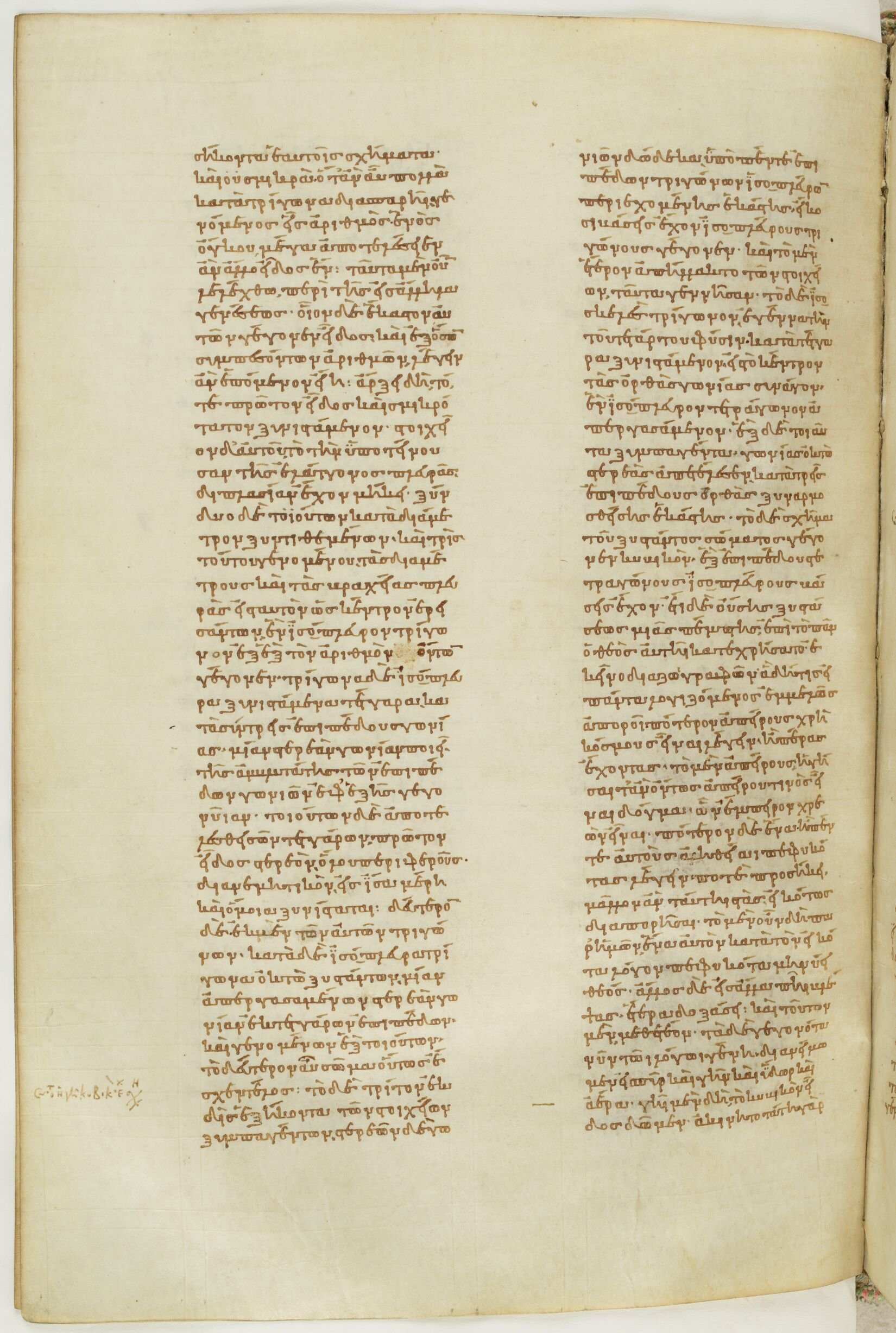
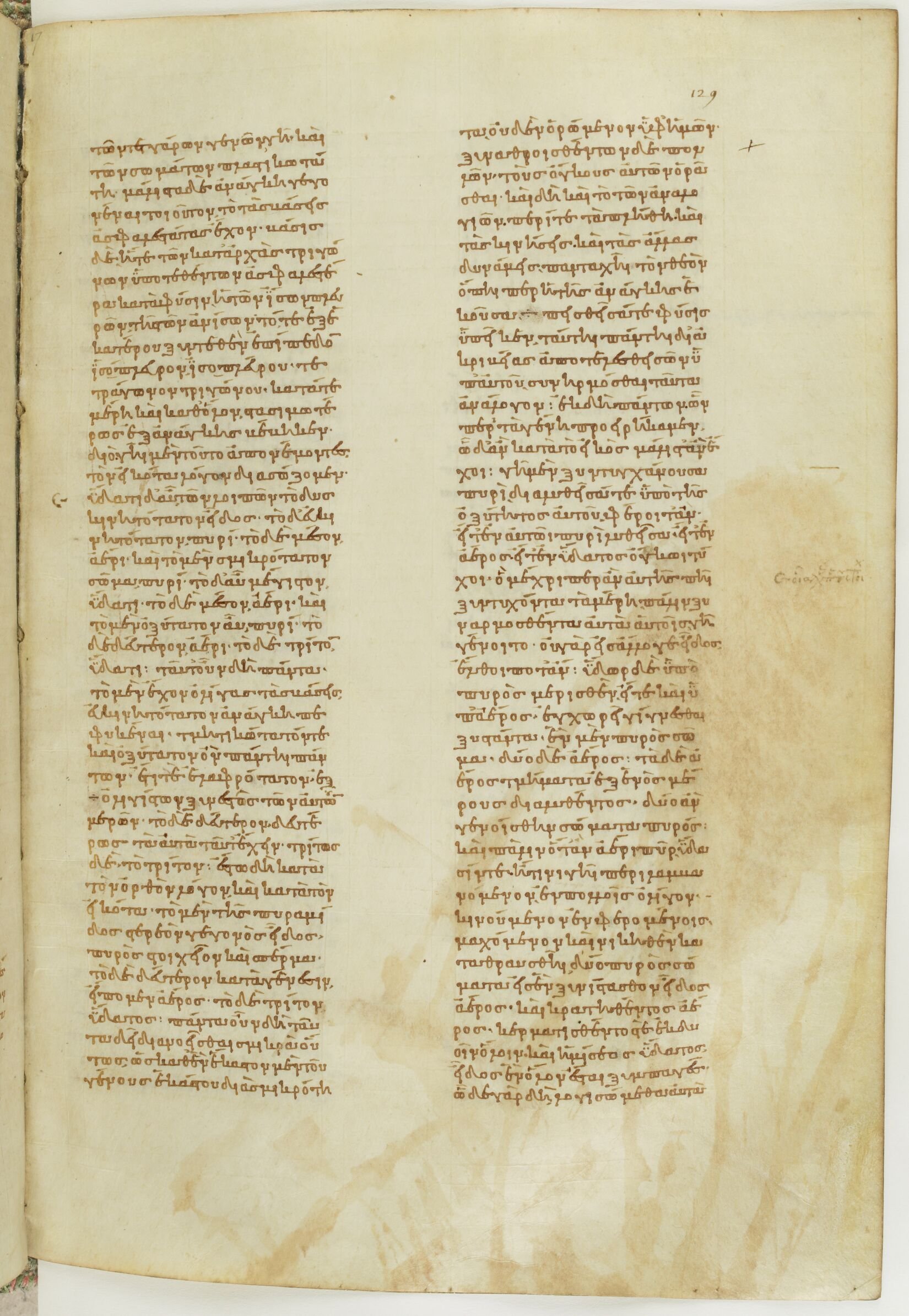
Stephanus page 55 of Plato's Timaeus (55a-55e): pyramid, octahedron, icosahedron and cube.
The manuscript is Paris, Bibliothèque nationale de France, grec 1807, known to editors as Plato A. It was copied in Constantinople around 850-875 by the scribe of the so-called philosophical collection, and is the oldest surviving medieval manuscript of the Timaeus and Critias (tetralogies VIII-IX: Clitophon, Republic, Timaeus, Critias, Minos, Laws, Epinomis, Letters). Each page has two columns of 44 lines. The Timaeus fills fol. 114r-144v and the Critias fol. 145r-151r.
On the manuscript this page of text runs over fol. 128v col. a to fol. 129r col. a. Each section below is linked to the folio side(s) that carry it. The mapping comes from reading the first words of every column on the images and finding them in Burnet's text: fol. 128v col. a begins ‹-σήκοντα ἑαυτοῖς σχήματα, καὶ σμικρὰ ὅταν› (Tim. 54c); fol. 128v col. b begins ‹-νιῶν δώδεκα, ὑπὸ πέντε ἐπιπέδων τριγώνων› (Tim. 55b); fol. 129r col. a begins ‹τῶν τεττάρων γενῶν γῆ καὶ τῶν› (Tim. 55e).
The Greek is John Burnet's critical text (Oxford, 1902), not a transcription of this manuscript; the scribe's spelling, accents and occasional readings differ from it. The English is R. G. Bury's Loeb translation (1929).
How was this verified? (Provenance)
Where on the image
Tim. 55a stands in Paris gr. 1807, fol. 128v col. a. Checked on the image (column openings read on the BnF photographs and found in Burnet's text, quoted in Burnet's spelling): fol. 128v col. a begins ‹-σήκοντα ἑαυτοῖς σχήματα, καὶ σμικρὰ ὅταν› (Tim. 54c).
γωνίαν ποιεῖ, τῆς ἀμβλυτάτης τῶν ἐπιπέδων γωνιῶν ἐφεξῆς γεγονυῖαν· τοιούτων δὲ ἀποτελεσθεισῶν τεττάρων πρῶτον εἶδος στερεόν, ὅλου περιφεροῦς διανεμητικὸν εἰς ἴσα μέρη καὶ ὅμοια, συνίσταται. δεύτερον δὲ ἐκ μὲν τῶν αὐτῶν τριγώνων, κατὰ δὲ ἰσόπλευρα τρίγωνα ὀκτὼ συστάντων, μίαν ἀπεργασαμένων στερεὰν γωνίαν ἐκ τεττάρων ἐπιπέδων· καὶ γενομένων ἓξ τοιούτων τὸ δεύτερον αὖ σῶμα οὕτως ἔσχεν τέλος. τὸ δὲ τρίτον ἐκ δὶς ἑξήκοντα τῶν στοιχείων συμπαγέντων,
meet in a point, they form one solid angle, which comes next in order to the most obtuse of the plane angles. And when four such angles are produced, the first solid figure is constructed, which divides the whole of the circumscribed sphere into equal and similar parts. And the second solid is formed from the same triangles, but constructed out of eight equilateral triangles, which produce one solid angle out of four planes; and when six such solid angles have been formed, the second body in turn is completed.
Where on the image
Tim. 55b stands in Paris gr. 1807, fol. 128v col. a to fol. 128v col. b. Checked on the image (column openings read on the BnF photographs and found in Burnet's text, quoted in Burnet's spelling): fol. 128v col. a begins ‹-σήκοντα ἑαυτοῖς σχήματα, καὶ σμικρὰ ὅταν› (Tim. 54c); fol. 128v col. b begins ‹-νιῶν δώδεκα, ὑπὸ πέντε ἐπιπέδων τριγώνων› (Tim. 55b).
στερεῶν δὲ γωνιῶν δώδεκα, ὑπὸ πέντε ἐπιπέδων τριγώνων ἰσοπλεύρων περιεχομένης ἑκάστης, εἴκοσι βάσεις ἔχον ἰσοπλεύρους τριγώνους γέγονεν. καὶ τὸ μὲν ἕτερον ἀπήλλακτο τῶν στοιχείων ταῦτα γεννῆσαν, τὸ δὲ ἰσοσκελὲς τρίγωνον ἐγέννα τὴν τοῦ τετάρτου φύσιν, κατὰ τέτταρα συνιστάμενον, εἰς τὸ κέντρον τὰς ὀρθὰς γωνίας συνάγον, ἓν ἰσόπλευρον τετράγωνον ἀπεργασάμενον· ἓξ δὲ τοιαῦτα
And the third solid is composed of twice sixty of the elemental triangles conjoined, and of twelve solid angles, each contained by five plane equilateral triangles, and it has, by its production, twenty equilateral triangular bases. Now the first of the elemental triangles ceased acting when it had generated these three solids, the substance of the fourth Kind being generated by the isosceles triangle. Four of these combined, with their right angles drawn together to the center, produced one equilateral quadrangle; and six such quadrangles,
Where on the image
Tim. 55c stands in Paris gr. 1807, fol. 128v col. b. Checked on the image (column openings read on the BnF photographs and found in Burnet's text, quoted in Burnet's spelling): fol. 128v col. b begins ‹-νιῶν δώδεκα, ὑπὸ πέντε ἐπιπέδων τριγώνων› (Tim. 55b).
συμπαγέντα γωνίας ὀκτὼ στερεὰς ἀπετέλεσεν, κατὰ τρεῖς ἐπιπέδους ὀρθὰς συναρμοσθείσης ἑκάστης· τὸ δὲ σχῆμα τοῦ συστάντος σώματος γέγονεν κυβικόν, ἓξ ἐπιπέδους τετραγώνους ἰσοπλεύρους βάσεις ἔχον. ἔτι δὲ οὔσης συστάσεως μιᾶς πέμπτης, ἐπὶ τὸ πᾶν ὁ θεὸς αὐτῇ κατεχρήσατο ἐκεῖνο διαζωγραφῶν. ἃ δή τις εἰ πάντα λογιζόμενος ἐμμελῶς ἀποροῖ πότερον ἀπείρους χρὴ κόσμους εἶναι λέγειν ἢ πέρας ἔχοντας, τὸ μὲν
when joined together, formed eight solid angles, each composed of three plane right angles; and the shape of the body thus constructed was cubic, having six plane equilateral quadrangular bases. And seeing that there still remained one other compound figure, the fifth, God used it up for the Universe in his decoration thereof. Now in reasoning about all these things, a man might question whether he ought to affirm the existence of an infinite diversity of Universes or a limited number; and if he questioned aright he would conclude that the doctrine of an infinite diversity is that of a man unversed
Where on the image
Tim. 55d stands in Paris gr. 1807, fol. 128v col. b. Checked on the image (column openings read on the BnF photographs and found in Burnet's text, quoted in Burnet's spelling): fol. 128v col. b begins ‹-νιῶν δώδεκα, ὑπὸ πέντε ἐπιπέδων τριγώνων› (Tim. 55b).
ἀπείρους ἡγήσαιτʼ ἂν ὄντως ἀπείρου τινὸς εἶναι δόγμα ὧν ἔμπειρον χρεὼν εἶναι, πότερον δὲ ἕνα ἢ πέντε αὐτοὺς ἀληθείᾳ πεφυκότας λέγειν ποτὲ προσήκει, μᾶλλον ἂν ταύτῃ στὰς εἰκότως διαπορήσαι. τὸ μὲν οὖν δὴ παρʼ ἡμῶν ἕνα αὐτὸν κατὰ τὸν εἰκότα λόγον πεφυκότα μηνύει θεόν, ἄλλος δὲ εἰς ἄλλα πῃ βλέψας ἕτερα δοξάσει. καὶ τοῦτον μὲν μεθετέον, τὰ δὲ γεγονότα νῦν τῷ λόγῳ γένη διανείμωμεν εἰς πῦρ καὶ γῆν καὶ ὕδωρ καὶ ἀέρα. γῇ μὲν δὴ τὸ κυβικὸν εἶδος δῶμεν·
in matters wherein he ought to be versed; but the question whether they ought really to be described as one Universe or five is one which might with more reason give us pause. Now our view declares the Universe to be essentially one, in accordance with the probable account; but another man, considering other facts, will hold a different opinion. Him, however, we must let pass. But as for the Kinds which have now been generated by our argument, let us assign them severally to fire and earth and water and air. To earth let us give the cubic form; for of the four Kinds earth is the most immobile
Where on the image
Tim. 55e stands in Paris gr. 1807, fol. 128v col. b to fol. 129r col. a. Checked on the image (column openings read on the BnF photographs and found in Burnet's text, quoted in Burnet's spelling): fol. 128v col. b begins ‹-νιῶν δώδεκα, ὑπὸ πέντε ἐπιπέδων τριγώνων› (Tim. 55b); fol. 129r col. a begins ‹τῶν τεττάρων γενῶν γῆ καὶ τῶν› (Tim. 55e).
ἀκινητοτάτη γὰρ τῶν τεττάρων γενῶν γῆ καὶ τῶν σωμάτων πλαστικωτάτη, μάλιστα δὲ ἀνάγκη γεγονέναι τοιοῦτον τὸ τὰς βάσεις ἀσφαλεστάτας ἔχον· βάσις δὲ ἥ τε τῶν κατʼ ἀρχὰς τριγώνων ὑποτεθέντων ἀσφαλεστέρα κατὰ φύσιν ἡ τῶν ἴσων πλευρῶν τῆς τῶν ἀνίσων, τό τε ἐξ ἑκατέρου συντεθὲν ἐπίπεδον ἰσόπλευρον ἰσοπλεύρου τετράγωνον τριγώνου κατά τε μέρη καὶ καθʼ ὅλον στασιμωτέρως ἐξ ἀνάγκης βέβηκεν.
διὸ
and the most plastic body, and of necessity the body which has the most stable bases must be pre-eminently of this character. Now of the triangles we originally assumed, the basis formed by equal sides is of its nature more stable than that formed by unequal sides; and of the plane surfaces which are compounded of these several triangles, the equilateral quadrangle, both in its parts and as a whole, has a more stable base than the equilateral triangle.
Notes
- Greek: John Burnet, Platonis Opera IV (Oxford, 1902), via Perseus canonical-greekLit; Burnet's text is a critical edition, so its wording can differ from the manuscript shown.
- English: R. G. Bury, Plato IX (Loeb Classical Library, 1929), via Perseus. Bury's footnotes are not reproduced. Quotation marks stand where Perseus marks quoted speech.
- Stephanus sections (a-e) are those of the 1578 Stephanus edition as given by Burnet and Bury; Bury's section breaks can fall a few words away from Burnet's because English word order differs.
Cite
Sources
- Source: Paris, BnF grec 1807 (Plato A, c. 850-875) fol. 128v-129r via BnF IIIF + Burnet's Greek (Perseus) + R. G. Bury's English (Loeb 1929, Perseus) (holding institution)
- Critical edition: Burnet, Platonis Opera IV (1902), via Perseus
← previous · → next · v cycle view · l back to library