Plato, Timaeus 56a-56e: earth the cube, water the icosahedron, air the octahedron, fire the pyramid
Introduction
Stephanus page 56 of Plato's Timaeus (56a-56e): earth the cube, water the icosahedron, air the octahedron, fire the pyramid.
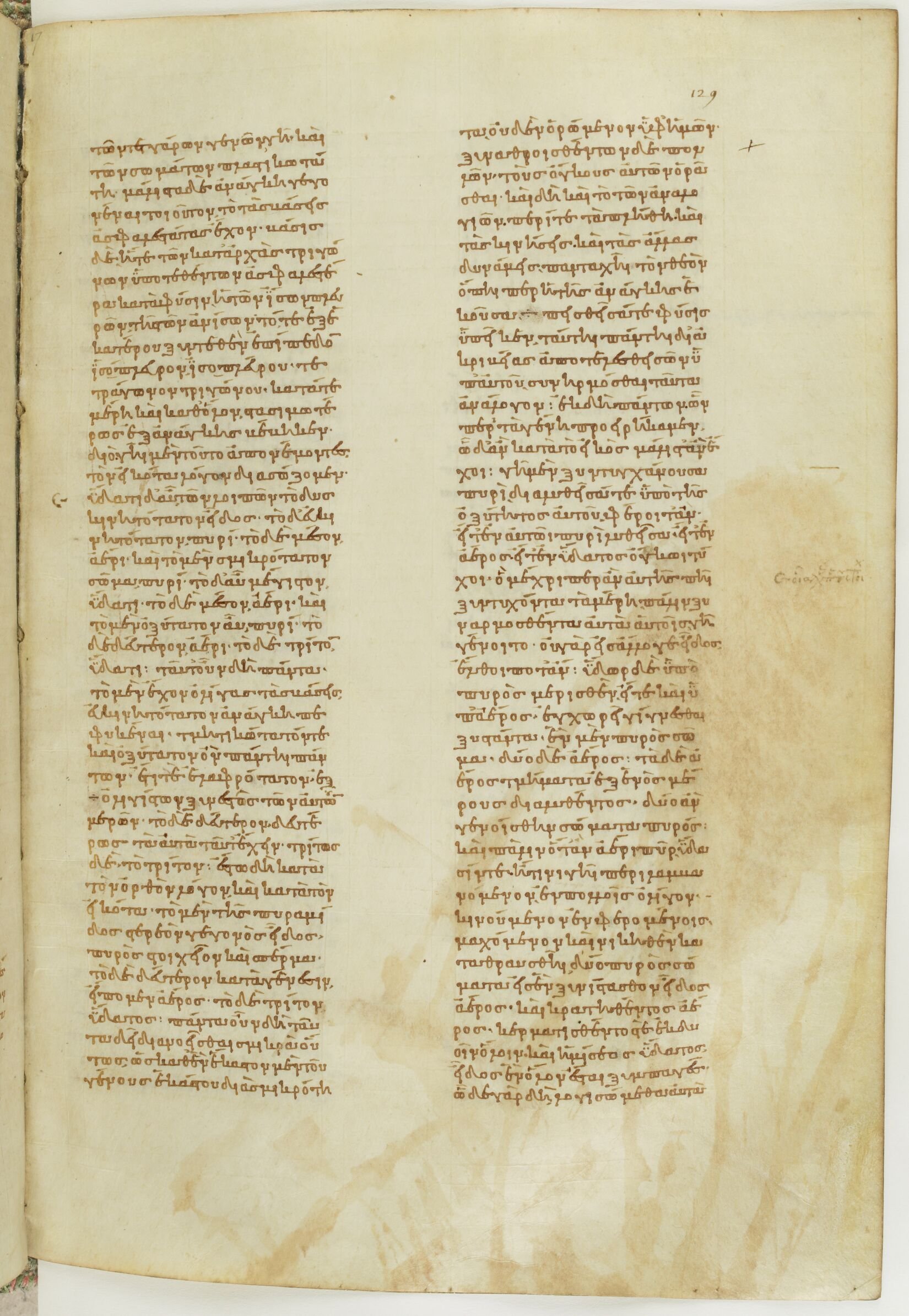
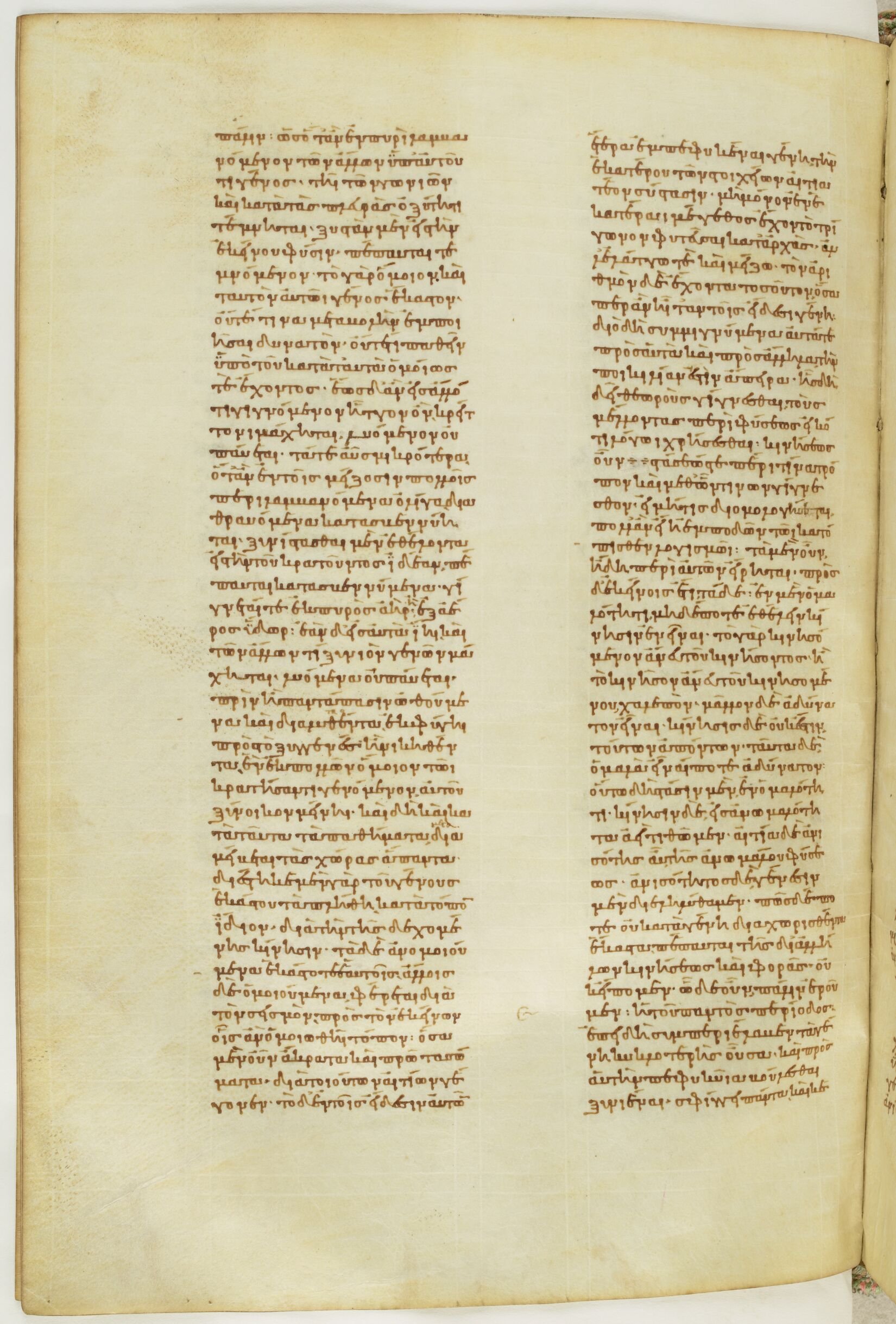
The manuscript is Paris, Bibliothèque nationale de France, grec 1807, known to editors as Plato A. It was copied in Constantinople around 850-875 by the scribe of the so-called philosophical collection, and is the oldest surviving medieval manuscript of the Timaeus and Critias (tetralogies VIII-IX: Clitophon, Republic, Timaeus, Critias, Minos, Laws, Epinomis, Letters). Each page has two columns of 44 lines. The Timaeus fills fol. 114r-144v and the Critias fol. 145r-151r.
On the manuscript this page of text runs over fol. 129r col. a to fol. 129v col. a. Each section below is linked to the folio side(s) that carry it. The mapping comes from reading the first words of every column on the images and finding them in Burnet's text: fol. 129r col. a begins ‹τῶν τεττάρων γενῶν γῆ καὶ τῶν› (Tim. 55e); fol. 129r col. b begins ‹-τα οὐδὲν ὁρώμενον ὑφʼ ἡμῶν, συναθροισθέντων› (Tim. 56c); fol. 129v col. a begins ‹πάλιν, ὡς ὅταν ἐν πυρὶ λαμβανόμενον› (Tim. 56e).
The Greek is John Burnet's critical text (Oxford, 1902), not a transcription of this manuscript; the scribe's spelling, accents and occasional readings differ from it. The English is R. G. Bury's Loeb translation (1929).
How was this verified? (Provenance)
Where on the image
Tim. 56a stands in Paris gr. 1807, fol. 129r col. a. Checked on the image (column openings read on the BnF photographs and found in Burnet's text, quoted in Burnet's spelling): fol. 129r col. a begins ‹τῶν τεττάρων γενῶν γῆ καὶ τῶν› (Tim. 55e).
γῇ μὲν τοῦτο ἀπονέμοντες τὸν εἰκότα λόγον διασῴζομεν, ὕδατι δʼ αὖ τῶν λοιπῶν τὸ δυσκινητότατον εἶδος, τὸ δʼ εὐκινητότατον πυρί, τὸ δὲ μέσον ἀέρι· καὶ τὸ μὲν σμικρότατον σῶμα πυρί, τὸ δʼ αὖ μέγιστον ὕδατι, τὸ δὲ μέσον ἀέρι· καὶ τὸ μὲν ὀξύτατον αὖ πυρί, τὸ δὲ δεύτερον ἀέρι, τὸ δὲ τρίτον ὕδατι. ταῦτʼ οὖν δὴ πάντα, τὸ μὲν ἔχον ὀλιγίστας βάσεις εὐκινητότατον ἀνάγκη πεφυκέναι, τμητικώτατόν τε
Wherefore, we are preserving the probable account when we assign this figure to earth, and of the remaining figures the least mobile to water, and the most mobile to fire, and the intermediate figure to air; and, further, when we assign the smallest body to fire, and the greatest to water, and the intermediate to air; and again, the first in point of sharpness to fire, the second to air, and the third to water. As regards all these forms, that which has the fewest bases must necessarily be the most mobile,
Where on the image
Tim. 56b stands in Paris gr. 1807, fol. 129r col. a. Checked on the image (column openings read on the BnF photographs and found in Burnet's text, quoted in Burnet's spelling): fol. 129r col. a begins ‹τῶν τεττάρων γενῶν γῆ καὶ τῶν› (Tim. 55e).
καὶ ὀξύτατον ὂν πάντῃ πάντων, ἔτι τε ἐλαφρότατον, ἐξ ὀλιγίστων συνεστὸς τῶν αὐτῶν μερῶν· τὸ δὲ δεύτερον δευτέρως τὰ αὐτὰ ταῦτʼ ἔχειν, τρίτως δὲ τὸ τρίτον. ἔστω δὴ κατὰ τὸν ὀρθὸν λόγον καὶ κατὰ τὸν εἰκότα τὸ μὲν τῆς πυραμίδος στερεὸν γεγονὸς εἶδος πυρὸς στοιχεῖον καὶ σπέρμα· τὸ δὲ δεύτερον κατὰ γένεσιν εἴπωμεν ἀέρος, τὸ δὲ τρίτον ὕδατος. πάντα οὖν δὴ ταῦτα δεῖ διανοεῖσθαι σμικρὰ οὕτως, ὡς καθʼ
since it is in all ways the sharpest and most acute of all; and it must also be the lightest, since it is composed of the fewest identical parts; and the second comes second in point of these same qualities, and the third third. Thus, in accordance with the right account and the probable, that solid which has taken the form of a pyramid shall be the element and seed of fire; the second in order of generation we shall affirm to be air, and the third water. Now one must conceive all these to be so small that none of them,
Where on the image
Tim. 56c stands in Paris gr. 1807, fol. 129r col. a to fol. 129r col. b. Checked on the image (column openings read on the BnF photographs and found in Burnet's text, quoted in Burnet's spelling): fol. 129r col. a begins ‹τῶν τεττάρων γενῶν γῆ καὶ τῶν› (Tim. 55e); fol. 129r col. b begins ‹-τα οὐδὲν ὁρώμενον ὑφʼ ἡμῶν, συναθροισθέντων› (Tim. 56c).
ἓν ἕκαστον μὲν τοῦ γένους ἑκάστου διὰ σμικρότητα οὐδὲν ὁρώμενον ὑφʼ ἡμῶν, συναθροισθέντων δὲ πολλῶν τοὺς ὄγκους αὐτῶν ὁρᾶσθαι· καὶ δὴ καὶ τὸ τῶν ἀναλογιῶν περί τε τὰ πλήθη καὶ τὰς κινήσεις καὶ τὰς ἄλλας δυνάμεις πανταχῇ τὸν θεόν, ὅπῃπερ ἡ τῆς ἀνάγκης ἑκοῦσα πεισθεῖσά τε φύσις ὑπεῖκεν, ταύτῃ πάντῃ διʼ ἀκριβείας ἀποτελεσθεισῶν ὑπʼ αὐτοῦ συνηρμόσθαι ταῦτα ἀνὰ λόγον. ἐκ δὴ πάντων ὧνπερ τὰ γένη προειρήκαμεν ὧδʼ ἂν κατὰ
when taken singly each in its several kind, is seen by us, but when many are collected together their masses are seen. And, moreover, as regards the numerical proportions which govern their masses and motions and their other qualities, we must conceive that God realized these everywhere with exactness, in so far as the nature of Necessity submitted voluntarily or under persuasion, and thus ordered all in harmonious proportion. From all that we have hitherto said about these Kinds,
Where on the image
Tim. 56d stands in Paris gr. 1807, fol. 129r col. b. Checked on the image (column openings read on the BnF photographs and found in Burnet's text, quoted in Burnet's spelling): fol. 129r col. b begins ‹-τα οὐδὲν ὁρώμενον ὑφʼ ἡμῶν, συναθροισθέντων› (Tim. 56c).
τὸ εἰκὸς μάλιστʼ ἂν ἔχοι. γῆ μὲν συντυγχάνουσα πυρὶ διαλυθεῖσά τε ὑπὸ τῆς ὀξύτητος αὐτοῦ φέροιτʼ ἄν, εἴτʼ ἐν αὐτῷ πυρὶ λυθεῖσα εἴτʼ ἐν ἀέρος εἴτʼ ἐν ὕδατος ὄγκῳ τύχοι, μέχριπερ ἂν αὐτῆς πῃ συντυχόντα τὰ μέρη, πάλιν συναρμοσθέντα αὐτὰ αὑτοῖς, γῆ γένοιτο—οὐ γὰρ εἰς ἄλλο γε εἶδος ἔλθοι ποτʼ ἄν—ὕδωρ δὲ ὑπὸ πυρὸς μερισθέν, εἴτε καὶ ὑπʼ ἀέρος, ἐγχωρεῖ γίγνεσθαι συστάντα ἓν μὲν πυρὸς σῶμα, δύο
they will, in all likelihood, behave themselves as follows. Earth will keep moving when it happens to meet with fire and has been dissolved by its acuteness, whether this dissolution takes place in pure fire or in a mass of air or of water; and this motion will continue until the particles of earth happen to meet together somewhere and reunite one with another, when they become earth again; for assuredly earth will never change into another form. But water, when broken up by fire or even by air, is capable of becoming a compound of one corpuscle of fire with two of air;
Where on the image
Tim. 56e stands in Paris gr. 1807, fol. 129r col. b to fol. 129v col. a. Checked on the image (column openings read on the BnF photographs and found in Burnet's text, quoted in Burnet's spelling): fol. 129r col. b begins ‹-τα οὐδὲν ὁρώμενον ὑφʼ ἡμῶν, συναθροισθέντων› (Tim. 56c); fol. 129v col. a begins ‹πάλιν, ὡς ὅταν ἐν πυρὶ λαμβανόμενον› (Tim. 56e).
δὲ ἀέρος· τὰ δὲ ἀέρος τμήματα ἐξ ἑνὸς μέρους διαλυθέντος δύʼ ἂν γενοίσθην σώματα πυρός. καὶ πάλιν, ὅταν ἀέρι πῦρ ὕδασίν τε ἤ τινι γῇ περιλαμβανόμενον ἐν πολλοῖς ὀλίγον, κινούμενον ἐν φερομένοις, μαχόμενον καὶ νικηθὲν καταθραυσθῇ, δύο πυρὸς σώματα εἰς ἓν συνίστασθον εἶδος ἀέρος· καὶ κρατηθέντος ἀέρος κερματισθέντος τε ἐκ δυοῖν ὅλοιν καὶ ἡμίσεος ὕδατος εἶδος ἓν ὅλον ἔσται συμπαγές.
ὧδε γὰρ δὴ λογισώμεθα αὐτὰ πάλιν, ὡς ὅταν ἐν πυρὶ λαμβανόμενον τῶν
and the fractions of air which come from the dissolving of one particle will form two corpuscles of fire. And again, when a small quantity of fire is enclosed by a large quantity of air and water, or of earth, and moves within them as they rush along, and is defeated in its struggle and broken up, then two corpuscles of fire unite to make one form of air. And when air is defeated and disintegrated, from two whole forms of air and a half, one whole form of water will be compounded.
Notes
- Greek: John Burnet, Platonis Opera IV (Oxford, 1902), via Perseus canonical-greekLit; Burnet's text is a critical edition, so its wording can differ from the manuscript shown.
- English: R. G. Bury, Plato IX (Loeb Classical Library, 1929), via Perseus. Bury's footnotes are not reproduced. Quotation marks stand where Perseus marks quoted speech.
- Stephanus sections (a-e) are those of the 1578 Stephanus edition as given by Burnet and Bury; Bury's section breaks can fall a few words away from Burnet's because English word order differs.
Cite
Sources
- Source: Paris, BnF grec 1807 (Plato A, c. 850-875) fol. 129r-129v via BnF IIIF + Burnet's Greek (Perseus) + R. G. Bury's English (Loeb 1929, Perseus) (holding institution)
- Critical edition: Burnet, Platonis Opera IV (1902), via Perseus
← previous · → next · v cycle view · l back to library