Plato, Timaeus 57a-57e: the transformation of the elements; motion and rest
Introduction
Stephanus page 57 of Plato's Timaeus (57a-57e): the transformation of the elements; motion and rest.
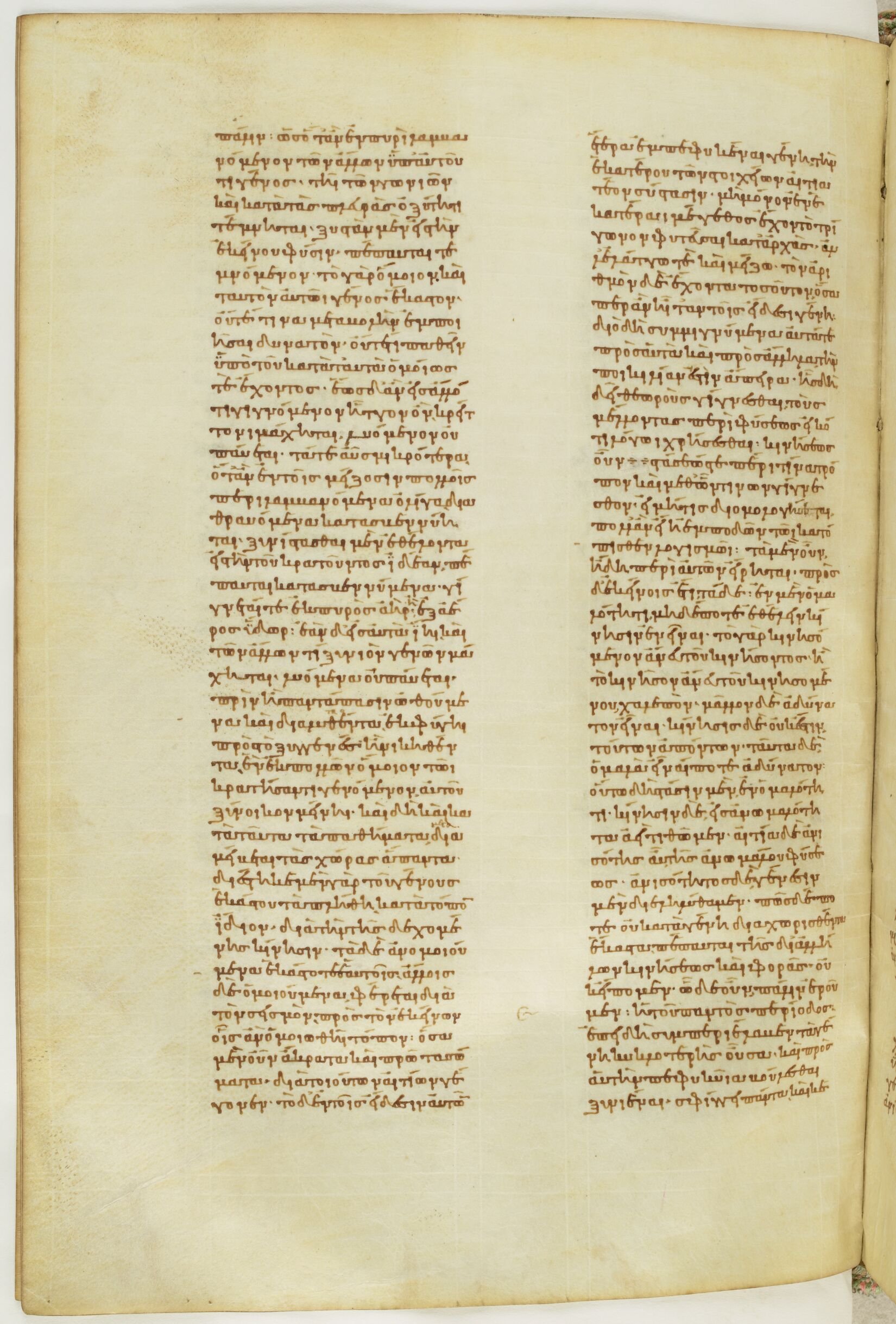
The manuscript is Paris, Bibliothèque nationale de France, grec 1807, known to editors as Plato A. It was copied in Constantinople around 850-875 by the scribe of the so-called philosophical collection, and is the oldest surviving medieval manuscript of the Timaeus and Critias (tetralogies VIII-IX: Clitophon, Republic, Timaeus, Critias, Minos, Laws, Epinomis, Letters). Each page has two columns of 44 lines. The Timaeus fills fol. 114r-144v and the Critias fol. 145r-151r.
On the manuscript this page of text runs over fol. 129v col. a to fol. 129v col. b. Each section below is linked to the folio side(s) that carry it. The mapping comes from reading the first words of every column on the images and finding them in Burnet's text: fol. 129v col. a begins ‹πάλιν, ὡς ὅταν ἐν πυρὶ λαμβανόμενον› (Tim. 56e); fol. 129v col. b begins ‹ἕτερα ἐμπεφυκέναι γένη τὴν ἑκατέρου τῶν› (Tim. 57c).
The Greek is John Burnet's critical text (Oxford, 1902), not a transcription of this manuscript; the scribe's spelling, accents and occasional readings differ from it. The English is R. G. Bury's Loeb translation (1929).
How was this verified? (Provenance)
Where on the image
Tim. 57a stands in Paris gr. 1807, fol. 129v col. a. Checked on the image (column openings read on the BnF photographs and found in Burnet's text, quoted in Burnet's spelling): fol. 129v col. a begins ‹πάλιν, ὡς ὅταν ἐν πυρὶ λαμβανόμενον› (Tim. 56e).
ἄλλων ὑπʼ αὐτοῦ τι γένος τῇ τῶν γωνιῶν καὶ κατὰ τὰς πλευρὰς ὀξύτητι τέμνηται, συστὰν μὲν εἰς τὴν ἐκείνου φύσιν πέπαυται τεμνόμενον—τὸ γὰρ ὅμοιον καὶ ταὐτὸν αὑτῷ γένος ἕκαστον οὔτε τινὰ μεταβολὴν ἐμποιῆσαι δυνατὸν οὔτε τι παθεῖν ὑπὸ τοῦ κατὰ ταὐτὰ ὁμοίως τε ἔχοντος—ἕως δʼ ἂν εἰς ἄλλο τι γιγνόμενον ἧττον ὂν κρείττονι μάχηται, λυόμενον οὐ παύεται. τά τε αὖ σμικρότερα ὅταν ἐν τοῖς μείζοσιν πολλοῖς περιλαμβανόμενα
Once again let us reason out their character in this way. Whenever any of the other Kinds is caught within fire it is cut up thereby, owing to the acuteness of its angles and of the line of its sides, but when it has been re-composed into the substance of fire it ceases to be cut; for the Kind that is similar and uniform is in no case able either to cause any change in, or to suffer any affection from, a Kind which is in a uniform and similar state; but so long as, in the course of its passage into another form, it is a weaker body fighting against a stronger, it is continually being dissolved. And again,
Where on the image
Tim. 57b stands in Paris gr. 1807, fol. 129v col. a. Checked on the image (column openings read on the BnF photographs and found in Burnet's text, quoted in Burnet's spelling): fol. 129v col. a begins ‹πάλιν, ὡς ὅταν ἐν πυρὶ λαμβανόμενον› (Tim. 56e).
ὀλίγα διαθραυόμενα κατασβεννύηται, συνίστασθαι μὲν ἐθέλοντα εἰς τὴν τοῦ κρατοῦντος ἰδέαν πέπαυται κατασβεννύμενα γίγνεταί τε ἐκ πυρὸς ἀήρ, ἐξ ἀέρος ὕδωρ· ἐὰν δʼ εἰς ταὐτὰ ἴῃ καὶ τῶν ἄλλων τι συνιὸν γενῶν μάχηται, λυόμενα οὐ παύεται, πρὶν ἢ παντάπασιν ὠθούμενα καὶ διαλυθέντα ἐκφύγῃ πρὸς τὸ συγγενές, ἢ νικηθέντα, ἓν ἐκ πολλῶν ὅμοιον τῷ κρατήσαντι γενόμενον, αὐτοῦ σύνοικον μείνῃ. καὶ
whenever a few of the smaller corpuscles, being caught within a great number of larger corpuscles, are broken up and quenched, then, if they consent to be re-compounded into the shape of the victorious Kind, they cease to be quenched, and air is produced out of fire, and out of air water; but if they fight against combining with these or with any of the other Kinds, they do not cease from dissolution until either they are driven out to their own kindred, by means of this impact and dissolution, or else they are defeated and, instead of many forms, assume one form similar to the victorious Kind, and continue dwelling therewith as a united family. Moreover, it is owing to these affections
Where on the image
Tim. 57c stands in Paris gr. 1807, fol. 129v col. a to fol. 129v col. b. Checked on the image (column openings read on the BnF photographs and found in Burnet's text, quoted in Burnet's spelling): fol. 129v col. a begins ‹πάλιν, ὡς ὅταν ἐν πυρὶ λαμβανόμενον› (Tim. 56e); fol. 129v col. b begins ‹ἕτερα ἐμπεφυκέναι γένη τὴν ἑκατέρου τῶν› (Tim. 57c).
δὴ καὶ κατὰ ταῦτα τὰ παθήματα διαμείβεται τὰς χώρας ἅπαντα· διέστηκεν μὲν γὰρ τοῦ γένους ἑκάστου τὰ πλήθη κατὰ τόπον ἴδιον διὰ τὴν τῆς δεχομένης κίνησιν, τὰ δὲ ἀνομοιούμενα ἑκάστοτε ἑαυτοῖς, ἄλλοις δὲ ὁμοιούμενα, φέρεται διὰ τὸν σεισμὸν πρὸς τὸν ἐκείνων οἷς ἂν ὁμοιωθῇ τόπον. ὅσα μὲν οὖν ἄκρατα καὶ πρῶτα σώματα διὰ τοιούτων αἰτιῶν γέγονεν· τὸ δʼ ἐν τοῖς εἴδεσιν αὐτῶν ἕτερα ἐμπεφυκέναι γένη τὴν ἑκατέρου τῶν στοιχείων αἰτιατέον σύστασιν,
that they all interchange their places; for while the bulk of each Kind keeps apart in a region of its own because of the motion of the Recipient, yet those corpuscles which from time to time become dissimilar to themselves and similar to others are carried, because of the shaking, towards the region which belongs to those corpuscles whereto they have been assimilated. Such are the causes which account for the generation of all the unmixed and primary bodies. But within these four Kinds other classes exist, whereof the cause must be sought in the construction of each of the two elemental triangles, each such construction having originally produced
Where on the image
Tim. 57d stands in Paris gr. 1807, fol. 129v col. b. Checked on the image (column openings read on the BnF photographs and found in Burnet's text, quoted in Burnet's spelling): fol. 129v col. b begins ‹ἕτερα ἐμπεφυκέναι γένη τὴν ἑκατέρου τῶν› (Tim. 57c).
μὴ μόνον ἓν ἑκατέραν μέγεθος ἔχον τὸ τρίγωνον φυτεῦσαι κατʼ ἀρχάς, ἀλλʼ ἐλάττω τε καὶ μείζω, τὸν ἀριθμὸν δὲ ἔχοντα τοσοῦτον ὅσαπερ ἂν ᾖ τἀν τοῖς εἴδεσι γένη. διὸ δὴ συμμειγνύμενα αὐτά τε πρὸς αὑτὰ καὶ πρὸς ἄλληλα τὴν ποικιλίαν ἐστὶν ἄπειρα· ἧς δὴ δεῖ θεωροὺς γίγνεσθαι τοὺς μέλλοντας περὶ φύσεως εἰκότι λόγῳ χρήσεσθαι. κινήσεως οὖν στάσεώς τε πέρι, τίνα τρόπον καὶ μεθʼ ὧντινων γίγνεσθον, εἰ μή τις διομολογήσεται, πόλλʼ ἂν εἴη
not merely a triangle of one definite size, but larger and smaller triangles of sizes as numerous as are the classes within the Kinds. Consequently, when these are combined amongst themselves and with one another they are infinite in their variety; and this variety must be kept in view by those who purpose to employ probable reasoning concerning Nature. Now, unless we can arrive at some agreed conclusion concerning Motion and Rest, as to how and under what conditions they come about,
Where on the image
Tim. 57e stands in Paris gr. 1807, fol. 129v col. b. Checked on the image (column openings read on the BnF photographs and found in Burnet's text, quoted in Burnet's spelling): fol. 129v col. b begins ‹ἕτερα ἐμπεφυκέναι γένη τὴν ἑκατέρου τῶν› (Tim. 57c).
ἐμποδὼν τῷ κατόπισθεν λογισμῷ. τὰ μὲν οὖν ἤδη περὶ αὐτῶν εἴρηται, πρὸς δʼ ἐκείνοις ἔτι τάδε, ἐν μὲν ὁμαλότητι μηδέποτε ἐθέλειν κίνησιν ἐνεῖναι. τὸ γὰρ κινησόμενον ἄνευ τοῦ κινήσοντος ἢ τὸ κινῆσον ἄνευ τοῦ κινησομένου χαλεπόν, μᾶλλον δὲ ἀδύνατον, εἶναι· κίνησις δὲ οὐκ ἔστιν τούτων ἀπόντων, ταῦτα δὲ ὁμαλὰ εἶναί ποτε ἀδύνατον.
οὕτω δὴ στάσιν μὲν ἐν ὁμαλότητι, κίνησιν δὲ εἰς ἀνωμαλότητα ἀεὶ
our subsequent argument will be greatly hampered. The facts about them have already been stated in part; but in addition thereto we must state further that motion never consents to exist within uniformity. For it is difficult, or rather impossible, for that which is to be moved to exist without that which is to move, or that which is to move without that which is to be moved; but in the absence of these there is no motion, and that these should ever be uniform is a thing impossible.
Accordingly, we must always place rest in uniformity,
Notes
- Greek: John Burnet, Platonis Opera IV (Oxford, 1902), via Perseus canonical-greekLit; Burnet's text is a critical edition, so its wording can differ from the manuscript shown.
- English: R. G. Bury, Plato IX (Loeb Classical Library, 1929), via Perseus. Bury's footnotes are not reproduced. Quotation marks stand where Perseus marks quoted speech.
- Stephanus sections (a-e) are those of the 1578 Stephanus edition as given by Burnet and Bury; Bury's section breaks can fall a few words away from Burnet's because English word order differs.
Cite
Sources
- Source: Paris, BnF grec 1807 (Plato A, c. 850-875) fol. 129v via BnF IIIF + Burnet's Greek (Perseus) + R. G. Bury's English (Loeb 1929, Perseus) (holding institution)
- Critical edition: Burnet, Platonis Opera IV (1902), via Perseus
← previous · → next · v cycle view · l back to library