Plato, Timaeus 58a-58e: why motion never stops; the kinds of fire and air
Introduction
Stephanus page 58 of Plato's Timaeus (58a-58e): why motion never stops; the kinds of fire and air.
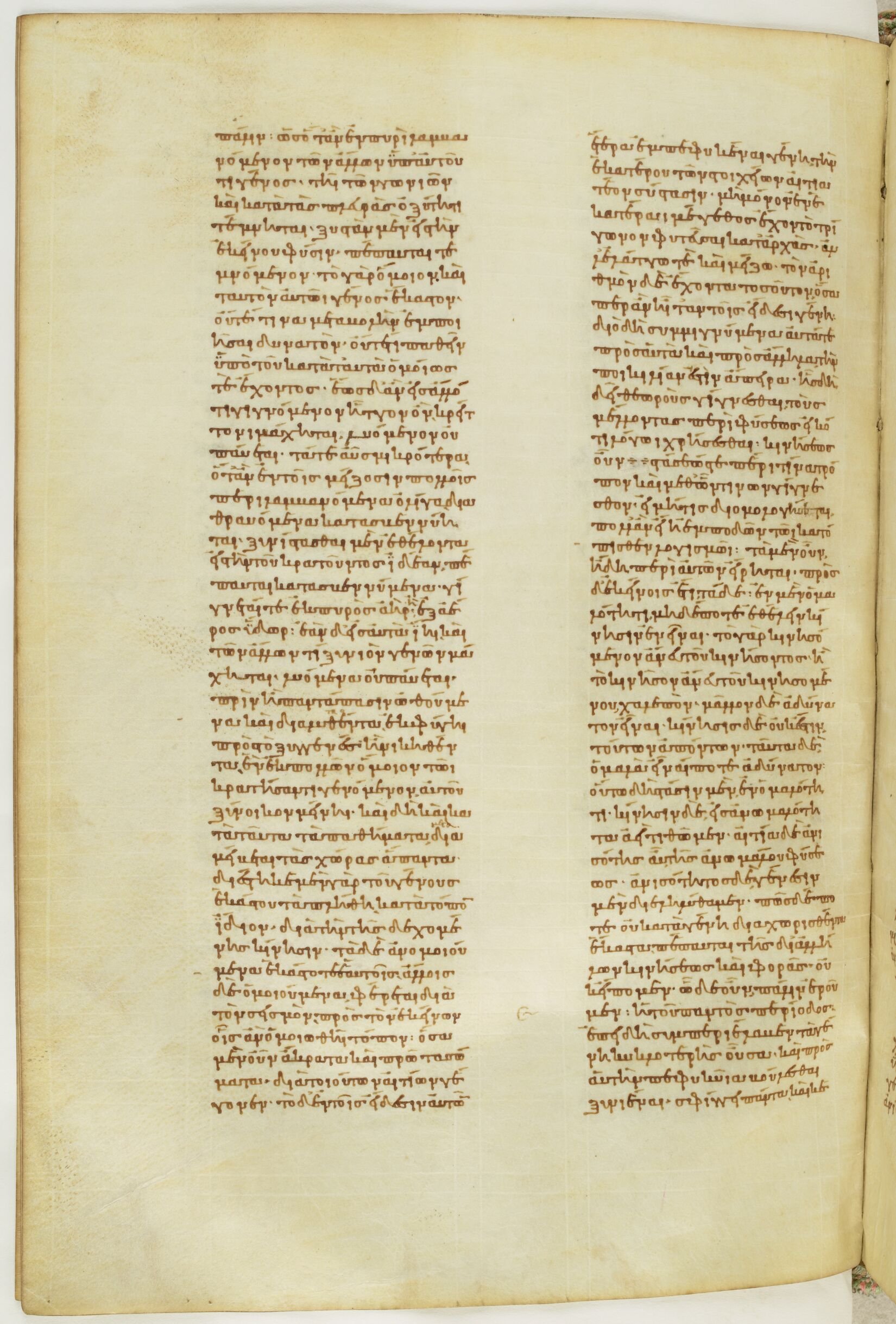
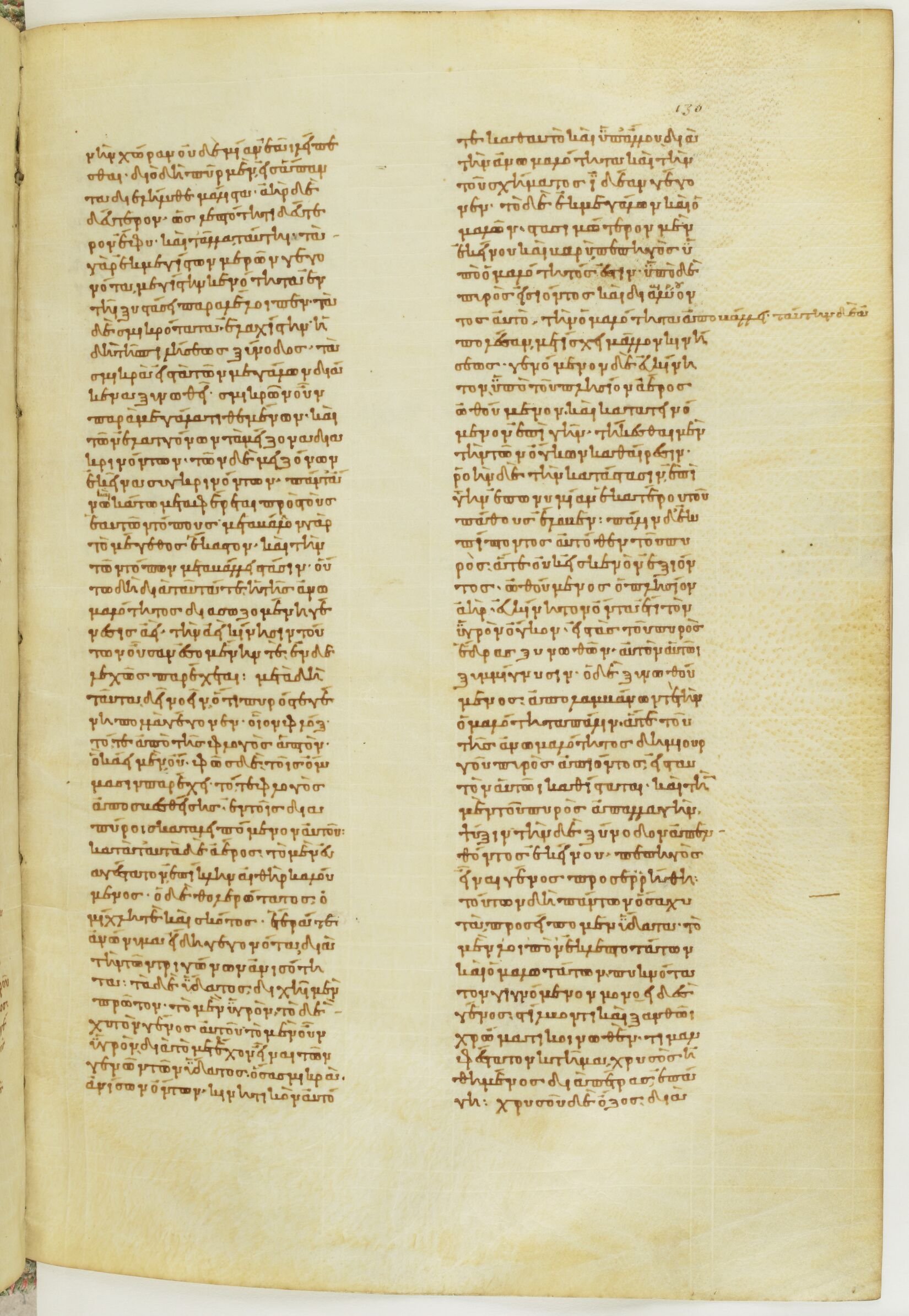
The manuscript is Paris, Bibliothèque nationale de France, grec 1807, known to editors as Plato A. It was copied in Constantinople around 850-875 by the scribe of the so-called philosophical collection, and is the oldest surviving medieval manuscript of the Timaeus and Critias (tetralogies VIII-IX: Clitophon, Republic, Timaeus, Critias, Minos, Laws, Epinomis, Letters). Each page has two columns of 44 lines. The Timaeus fills fol. 114r-144v and the Critias fol. 145r-151r.
On the manuscript this page of text runs over fol. 129v col. b to fol. 130r col. b. Each section below is linked to the folio side(s) that carry it. The mapping comes from reading the first words of every column on the images and finding them in Burnet's text: fol. 129v col. b begins ‹ἕτερα ἐμπεφυκέναι γένη τὴν ἑκατέρου τῶν› (Tim. 57c); fol. 130r col. a begins ‹-νὴν χώραν οὐδεμίαν ἐᾷ λείπεσθαι. διὸ› (Tim. 58a); fol. 130r col. b begins ‹τε καθʼ αὑτὸ καὶ ὑπʼ ἄλλου› (Tim. 58d).
The Greek is John Burnet's critical text (Oxford, 1902), not a transcription of this manuscript; the scribe's spelling, accents and occasional readings differ from it. The English is R. G. Bury's Loeb translation (1929).
How was this verified? (Provenance)
Where on the image
Tim. 58a stands in Paris gr. 1807, fol. 129v col. b to fol. 130r col. a. Checked on the image (column openings read on the BnF photographs and found in Burnet's text, quoted in Burnet's spelling): fol. 129v col. b begins ‹ἕτερα ἐμπεφυκέναι γένη τὴν ἑκατέρου τῶν› (Tim. 57c); fol. 130r col. a begins ‹-νὴν χώραν οὐδεμίαν ἐᾷ λείπεσθαι. διὸ› (Tim. 58a).
τιθῶμεν· αἰτία δὲ ἀνισότης αὖ τῆς ἀνωμάλου φύσεως. ἀνισότητος δὲ γένεσιν μὲν διεληλύθαμεν· πῶς δέ ποτε οὐ κατὰ γένη διαχωρισθέντα ἕκαστα πέπαυται τῆς διʼ ἀλλήλων κινήσεως καὶ φορᾶς, οὐκ εἴπομεν. ὧδε οὖν πάλιν ἐροῦμεν. ἡ τοῦ παντὸς περίοδος, ἐπειδὴ συμπεριέλαβεν τὰ γένη, κυκλοτερὴς οὖσα καὶ πρὸς αὑτὴν πεφυκυῖα βούλεσθαι συνιέναι, σφίγγει πάντα καὶ κενὴν χώραν οὐδεμίαν ἐᾷ λείπεσθαι. διὸ
and motion in non-uniformity; and the cause of the non-uniform nature lies in inequality. Now we have explained the origin of inequality; but we have not declared how it is that these bodies are not separated according to their several Kinds, and cease not from their motion and passage one through another. Wherefore, we shall once more expound the matter as follows. The revolution of the All, since it comprehends the Kinds, compresses them all, seeing that it is circular and tends naturally to come together to itself; and thus it suffers no void place to be left.
Where on the image
Tim. 58b stands in Paris gr. 1807, fol. 130r col. a. Checked on the image (column openings read on the BnF photographs and found in Burnet's text, quoted in Burnet's spelling): fol. 130r col. a begins ‹-νὴν χώραν οὐδεμίαν ἐᾷ λείπεσθαι. διὸ› (Tim. 58a).
δὴ πῦρ μὲν εἰς ἅπαντα διελήλυθε μάλιστα, ἀὴρ δὲ δεύτερον, ὡς λεπτότητι δεύτερον ἔφυ, καὶ τἆλλα ταύτῃ· τὰ γὰρ ἐκ μεγίστων μερῶν γεγονότα μεγίστην κενότητα ἐν τῇ συστάσει παραλέλοιπεν, τὰ δὲ σμικρότατα ἐλαχίστην. ἡ δὴ τῆς πιλήσεως σύνοδος τὰ σμικρὰ εἰς τὰ τῶν μεγάλων διάκενα συνωθεῖ. σμικρῶν οὖν παρὰ μεγάλα τιθεμένων καὶ τῶν ἐλαττόνων τὰ μείζονα διακρινόντων, τῶν δὲ μειζόνων ἐκεῖνα συγκρινόντων, πάντʼ ἄνω κάτω μεταφέρεται πρὸς τοὺς ἑαυτῶν τόπους·
Wherefore, fire most of all has permeated all things, and in a second degree air, as it is by nature second in fineness; and so with the rest; for those that have the largest constituent parts have the largest void left in their construction, and those that have the smallest the least. Thus the tightening of the compression forces together the small bodies into the void intervals of the large. Therefore, when small bodies are placed beside large, and the smaller disintegrate the larger while the larger unite the smaller, they all shift up and down
Where on the image
Tim. 58c stands in Paris gr. 1807, fol. 130r col. a. Checked on the image (column openings read on the BnF photographs and found in Burnet's text, quoted in Burnet's spelling): fol. 130r col. a begins ‹-νὴν χώραν οὐδεμίαν ἐᾷ λείπεσθαι. διὸ› (Tim. 58a).
μεταβάλλον γὰρ τὸ μέγεθος ἕκαστον καὶ τὴν τόπων μεταβάλλει στάσιν. οὕτω δὴ διὰ ταῦτά τε ἡ τῆς ἀνωμαλότητος διασῳζομένη γένεσις ἀεὶ τὴν ἀεὶ κίνησιν τούτων οὖσαν ἐσομένην τε ἐνδελεχῶς παρέχεται. μετὰ δὴ ταῦτα δεῖ νοεῖν ὅτι πυρός τε γένη πολλὰ γέγονεν, οἷον φλὸξ τό τε ἀπὸ τῆς φλογὸς ἀπιόν, ὃ κάει μὲν οὔ, φῶς δὲ τοῖς ὄμμασιν παρέχει, τό τε φλογὸς ἀποσβεσθείσης ἐν
towards their own proper regions; for the change in their several sizes causes their position in space also to change. And since in this way and for these reasons the production of non-uniformity is perpetually maintained, it brings about unceasingly, both now and for the future, the perpetual motion of these bodies. In the next place, we must observe that there are many kinds of fire: for example, there is flame; and the kind issuing from flame, which does not burn but supplies light to the eyes; and the kind which, when the flame is quenched, is left behind among the embers.
Where on the image
Tim. 58d stands in Paris gr. 1807, fol. 130r col. a to fol. 130r col. b. Checked on the image (column openings read on the BnF photographs and found in Burnet's text, quoted in Burnet's spelling): fol. 130r col. a begins ‹-νὴν χώραν οὐδεμίαν ἐᾷ λείπεσθαι. διὸ› (Tim. 58a); fol. 130r col. b begins ‹τε καθʼ αὑτὸ καὶ ὑπʼ ἄλλου› (Tim. 58d).
τοῖς διαπύροις καταλειπόμενον αὐτοῦ· κατὰ ταὐτὰ δὲ ἀέρος, τὸ μὲν εὐαγέστατον ἐπίκλην αἰθὴρ καλούμενος, ὁ δὲ θολερώτατος ὁμίχλη τε καὶ σκότος, ἕτερά τε ἀνώνυμα εἴδη, γεγονότα διὰ τὴν τῶν τριγώνων ἀνισότητα. τὰ δὲ ὕδατος διχῇ μὲν πρῶτον, τὸ μὲν ὑγρόν, τὸ δὲ χυτὸν γένος αὐτοῦ. τὸ μὲν οὖν ὑγρὸν διὰ τὸ μετέχον εἶναι τῶν γενῶν τῶν ὕδατος ὅσα σμικρά, ἀνίσων ὄντων, κινητικὸν αὐτό τε καθʼ αὑτὸ καὶ ὑπʼ ἄλλου διὰ τὴν ἀνωμαλότητα καὶ τὴν τοῦ σχήματος ἰδέαν γέγονεν· τὸ
So likewise of air, there is the most translucent kind which is called by the name of aether, and the most opaque which is mist and darkness, and other species without a name, which are produced by reason of the inequality of the triangles. The kinds of water are, primarily, two, the one being the liquid, the other the fusible kind. Now the liquid kind, inasmuch as it partakes of those small particles of water which are unequal, is mobile both in itself and by external force owing to its non-uniformity and the shape of its figure. But the other kind, which is composed of large
Where on the image
Tim. 58e stands in Paris gr. 1807, fol. 130r col. b. Checked on the image (column openings read on the BnF photographs and found in Burnet's text, quoted in Burnet's spelling): fol. 130r col. b begins ‹τε καθʼ αὑτὸ καὶ ὑπʼ ἄλλου› (Tim. 58d).
δὲ ἐκ μεγάλων καὶ ὁμαλῶν στασιμώτερον μὲν ἐκείνου καὶ βαρὺ πεπηγὸς ὑπὸ ὁμαλότητός ἐστιν, ὑπὸ δὲ πυρὸς εἰσιόντος καὶ διαλύοντος αὐτὸ τὴν ὁμαλότητα ἀποβάλλει, ταύτην δὲ ἀπολέσαν μετίσχει μᾶλλον κινήσεως, γενόμενον δὲ εὐκίνητον, ὑπὸ τοῦ πλησίον ἀέρος ὠθούμενον καὶ κατατεινόμενον ἐπὶ γῆν, τήκεσθαι μὲν τὴν τῶν ὄγκων καθαίρεσιν, ῥοὴν δὲ τὴν κατάτασιν ἐπὶ γῆν ἐπωνυμίαν ἑκατέρου τοῦ πάθους ἔλαβεν.
and uniform particles, is more stable than the first and is heavy, being solidified by its uniformity; but when fire enters and dissolves it, this causes it to abandon its uniformity, and this being lost it partakes more largely in motion; and when it has become mobile it is pushed by the adjacent air and extended upon the earth; and for each of these modifications it has received a descriptive name—melting for the disintegration of its masses, and for its extension over the earth fluidity.
Again, since the fire on issuing from the water
Notes
- Greek: John Burnet, Platonis Opera IV (Oxford, 1902), via Perseus canonical-greekLit; Burnet's text is a critical edition, so its wording can differ from the manuscript shown.
- English: R. G. Bury, Plato IX (Loeb Classical Library, 1929), via Perseus. Bury's footnotes are not reproduced. Quotation marks stand where Perseus marks quoted speech.
- Stephanus sections (a-e) are those of the 1578 Stephanus edition as given by Burnet and Bury; Bury's section breaks can fall a few words away from Burnet's because English word order differs.
Cite
Sources
- Source: Paris, BnF grec 1807 (Plato A, c. 850-875) fol. 129v-130r via BnF IIIF + Burnet's Greek (Perseus) + R. G. Bury's English (Loeb 1929, Perseus) (holding institution)
- Critical edition: Burnet, Platonis Opera IV (1902), via Perseus
← previous · → next · v cycle view · l back to library