Plato, Timaeus 59a-59e: the kinds of water: gold, bronze, ice, snow
Introduction
Stephanus page 59 of Plato's Timaeus (59a-59e): the kinds of water: gold, bronze, ice, snow.
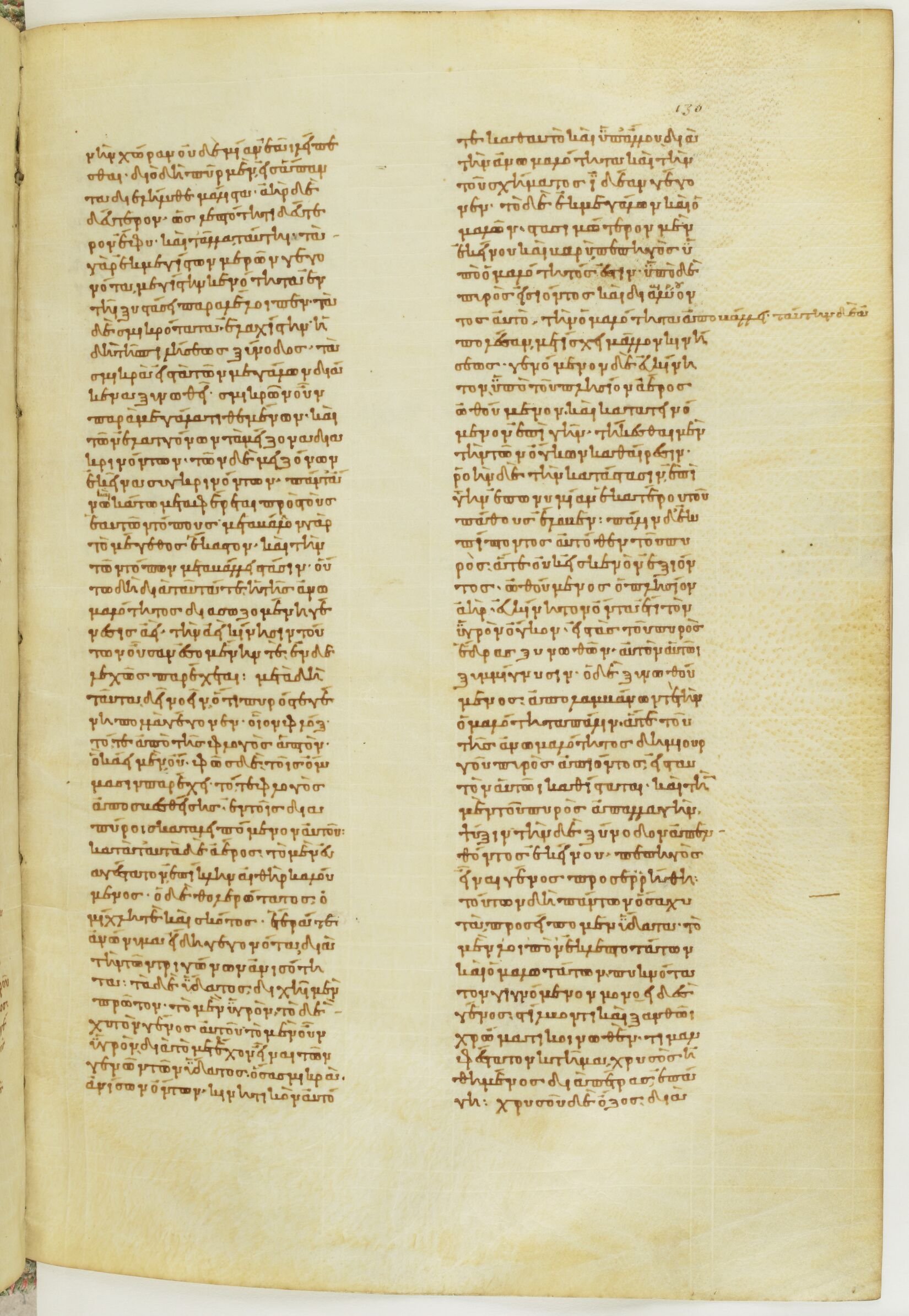
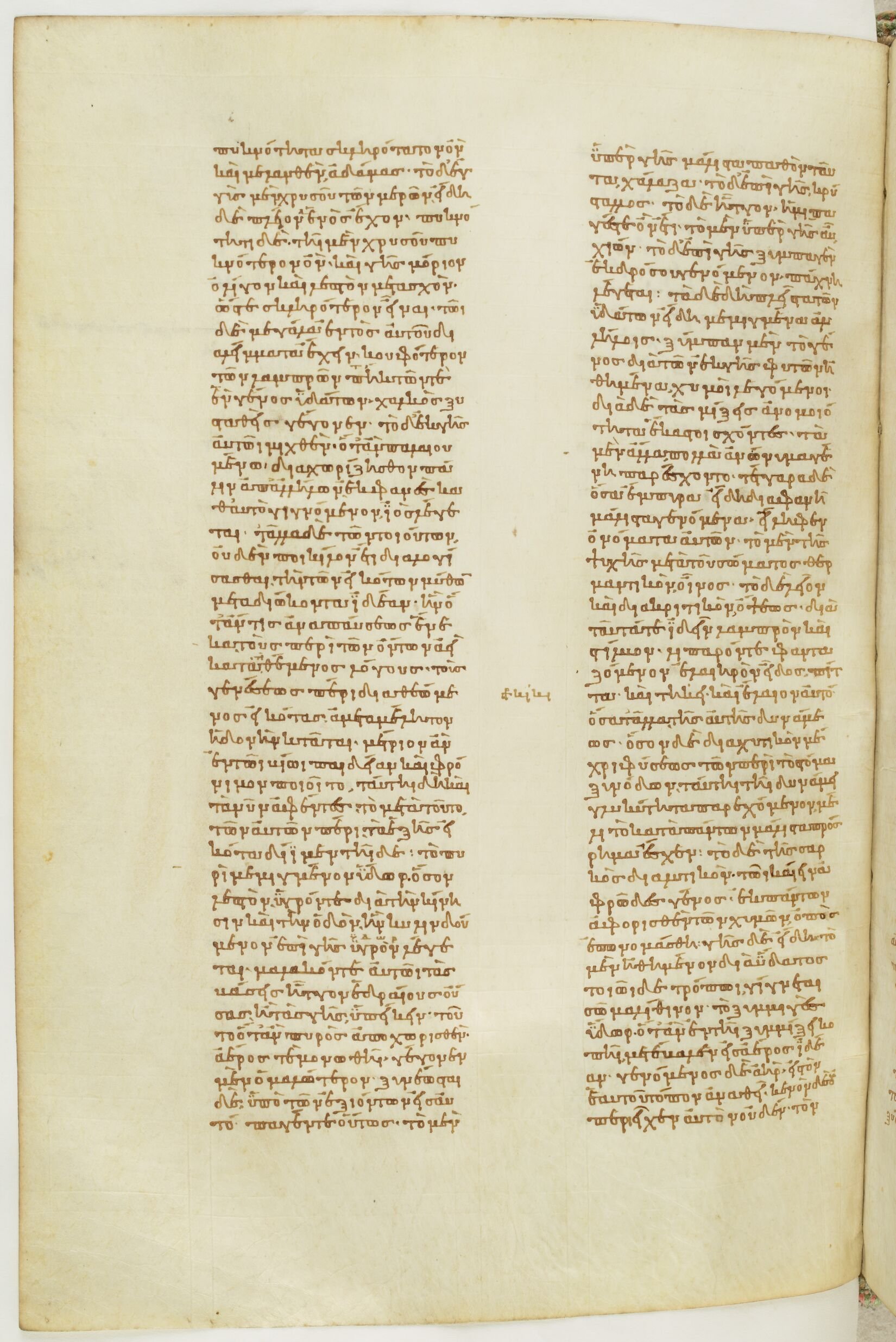
The manuscript is Paris, Bibliothèque nationale de France, grec 1807, known to editors as Plato A. It was copied in Constantinople around 850-875 by the scribe of the so-called philosophical collection, and is the oldest surviving medieval manuscript of the Timaeus and Critias (tetralogies VIII-IX: Clitophon, Republic, Timaeus, Critias, Minos, Laws, Epinomis, Letters). Each page has two columns of 44 lines. The Timaeus fills fol. 114r-144v and the Critias fol. 145r-151r.
On the manuscript this page of text runs over fol. 130r col. b to fol. 130v col. b. Each section below is linked to the folio side(s) that carry it. The mapping comes from reading the first words of every column on the images and finding them in Burnet's text: fol. 130r col. b begins ‹τε καθʼ αὑτὸ καὶ ὑπʼ ἄλλου› (Tim. 58d); fol. 130v col. a begins ‹πυκνότητα σκληρότατον ὂν καὶ μελανθέν, ἀδάμας› (Tim. 59b); fol. 130v col. b begins ‹ὑπὲρ γῆς μάλιστα παθὸν ταῦτα χάλαζα› (Tim. 59e).
The Greek is John Burnet's critical text (Oxford, 1902), not a transcription of this manuscript; the scribe's spelling, accents and occasional readings differ from it. The English is R. G. Bury's Loeb translation (1929).
How was this verified? (Provenance)
Where on the image
Tim. 59a stands in Paris gr. 1807, fol. 130r col. b. Checked on the image (column openings read on the BnF photographs and found in Burnet's text, quoted in Burnet's spelling): fol. 130r col. b begins ‹τε καθʼ αὑτὸ καὶ ὑπʼ ἄλλου› (Tim. 58d).
πάλιν δʼ ἐκπίπτοντος αὐτόθεν τοῦ πυρός, ἅτε οὐκ εἰς κενὸν ἐξιόντος, ὠθούμενος ὁ πλησίον ἀὴρ εὐκίνητον ὄντα ἔτι τὸν ὑγρὸν ὄγκον εἰς τὰς τοῦ πυρὸς ἕδρας συνωθῶν αὐτὸν αὑτῷ συμμείγνυσιν· ὁ δὲ συνωθούμενος ἀπολαμβάνων τε τὴν ὁμαλότητα πάλιν, ἅτε τοῦ τῆς ἀνωμαλότητος δημιουργοῦ πυρὸς ἀπιόντος, εἰς ταὐτὸν αὑτῷ καθίσταται. καὶ τὴν μὲν τοῦ πυρὸς ἀπαλλαγὴν ψῦξιν, τὴν δὲ σύνοδον ἀπελθόντος ἐκείνου πεπηγὸς εἶναι γένος προσερρήθη. τούτων δὴ πάντων
does not pass into a void but presses on the adjacent air, this in turn compresses the liquid mass which is still mobile into the abodes of the fire and combines it with itself; and the mass, being this, is compressed and recovering again its uniformity, because of the departure of the fire, the author of its non-uniformity, returns to its state of self-identity. And this cessation of the fire is termed cooling, and the combination which follows on its departure solidification.
Where on the image
Tim. 59b stands in Paris gr. 1807, fol. 130r col. b to fol. 130v col. a. Checked on the image (column openings read on the BnF photographs and found in Burnet's text, quoted in Burnet's spelling): fol. 130r col. b begins ‹τε καθʼ αὑτὸ καὶ ὑπʼ ἄλλου› (Tim. 58d); fol. 130v col. a begins ‹πυκνότητα σκληρότατον ὂν καὶ μελανθέν, ἀδάμας› (Tim. 59b).
ὅσα χυτὰ προσείπομεν ὕδατα, τὸ μὲν ἐκ λεπτοτάτων καὶ ὁμαλωτάτων πυκνότατον γιγνόμενον, μονοειδὲς γένος, στίλβοντι καὶ ξανθῷ χρώματι κοινωθέν, τιμαλφέστατον κτῆμα χρυσὸς ἠθημένος διὰ πέτρας ἐπάγη· χρυσοῦ δὲ ὄζος, διὰ πυκνότητα σκληρότατον ὂν καὶ μελανθέν, ἀδάμας ἐκλήθη. τὸ δʼ ἐγγὺς μὲν χρυσοῦ τῶν μερῶν, εἴδη δὲ πλείονα ἑνὸς ἔχον, πυκνότητι δέ, τῇ μὲν χρυσοῦ πυκνότερον ὄν, καὶ γῆς μόριον ὀλίγον καὶ λεπτὸν μετασχόν, ὥστε σκληρότερον εἶναι, τῷ
Of all the kinds of water which we have termed fusible, the densest is produced from the finest and most uniform particles: this is a kind of unique form, tinged with a glittering and yellow hue, even that most precious of possessions, gold, which has been strained through stones and solidified. And the off-shoot of gold, which is very hard because of its density and black in color, is called adamant. And the kind which closely resembles gold in its particles but has more forms than one, and in density is more dense than gold, and partakes of small and fine portions of earth so that it is harder, while it is also lighter
Where on the image
Tim. 59c stands in Paris gr. 1807, fol. 130v col. a. Checked on the image (column openings read on the BnF photographs and found in Burnet's text, quoted in Burnet's spelling): fol. 130v col. a begins ‹πυκνότητα σκληρότατον ὂν καὶ μελανθέν, ἀδάμας› (Tim. 59b).
δὲ μεγάλα ἐντὸς αὑτοῦ διαλείμματα ἔχειν κουφότερον, τῶν λαμπρῶν πηκτῶν τε ἓν γένος ὑδάτων χαλκὸς συσταθεὶς γέγονεν· τὸ δʼ ἐκ γῆς αὐτῷ μειχθέν, ὅταν παλαιουμένω διαχωρίζησθον πάλιν ἀπʼ ἀλλήλων, ἐκφανὲς καθʼ αὑτὸ γιγνόμενον ἰὸς λέγεται. τἆλλα δὲ τῶν τοιούτων οὐδὲν ποικίλον ἔτι διαλογίσασθαι τὴν τῶν εἰκότων μύθων μεταδιώκοντα ἰδέαν· ἣν ὅταν τις ἀναπαύσεως ἕνεκα τοὺς περὶ τῶν ὄντων ἀεὶ καταθέμενος λόγους, τοὺς γενέσεως πέρι διαθεώμενος
owing to its having large interstices within it,—this particular kind of the bright and solid waters, being compounded thus, is termed bronze. And the portion of earth that is mixed therewith becomes distinct by itself, when both grow old and separate again-each from the other; and then it is named rust. And the rest of such phenomena it is no longer difficult to explain in full, if one aims at framing a description that is probable. For as regards this, whenever for the sake of recreation a man lays aside arguments concerning eternal Realities and considers probable accounts of Becoming,
Where on the image
Tim. 59d stands in Paris gr. 1807, fol. 130v col. a. Checked on the image (column openings read on the BnF photographs and found in Burnet's text, quoted in Burnet's spelling): fol. 130v col. a begins ‹πυκνότητα σκληρότατον ὂν καὶ μελανθέν, ἀδάμας› (Tim. 59b).
εἰκότας ἀμεταμέλητον ἡδονὴν κτᾶται, μέτριον ἂν ἐν τῷ βίῳ παιδιὰν καὶ φρόνιμον ποιοῖτο. ταύτῃ δὴ καὶ τὰ νῦν ἐφέντες τὸ μετὰ τοῦτο τῶν αὐτῶν πέρι τὰ ἑξῆς εἰκότα δίιμεν τῇδε. τὸ πυρὶ μεμειγμένον ὕδωρ, ὅσον λεπτὸν ὑγρόν τε διὰ τὴν κίνησιν καὶ τὴν ὁδὸν ἣν κυλινδούμενον ἐπὶ γῆς ὑγρὸν λέγεται, μαλακόν τε αὖ τῷ τὰς βάσεις ἧττον ἑδραίους οὔσας ἢ τὰς γῆς ὑπείκειν, τοῦτο ὅταν πυρὸς ἀποχωρισθὲν ἀέρος τε μονωθῇ,
gaining thereby a pleasure not to be repented of, he provides for his life a pastime that is both moderate and sensible. To this pastime let us now give free play, and proceed to expound in order the subsequent probabilities concerning these same phenomena in the following way. The water that is mixed with fire, which is fine and fluid, is termed fluid, owing to its motion and the way it rolls over the earth. Also it is soft owing to the fact that its bases, being less stable than those of earth, give way. When this kind is separated off from fire and air and isolated it becomes more uniform,
Where on the image
Tim. 59e stands in Paris gr. 1807, fol. 130v col. a to fol. 130v col. b. Checked on the image (column openings read on the BnF photographs and found in Burnet's text, quoted in Burnet's spelling): fol. 130v col. a begins ‹πυκνότητα σκληρότατον ὂν καὶ μελανθέν, ἀδάμας› (Tim. 59b); fol. 130v col. b begins ‹ὑπὲρ γῆς μάλιστα παθὸν ταῦτα χάλαζα› (Tim. 59e).
γέγονεν μὲν ὁμαλώτερον, συνέωσται δὲ ὑπὸ τῶν ἐξιόντων εἰς αὑτό, παγέν τε οὕτως τὸ μὲν ὑπὲρ γῆς μάλιστα παθὸν ταῦτα χάλαζα, τὸ δʼ ἐπὶ γῆς κρύσταλλος, τὸ δὲ ἧττον, ἡμιπαγές τε ὂν ἔτι, τὸ μὲν ὑπὲρ γῆς αὖ χιών, τὸ δʼ ἐπὶ γῆς συμπαγὲν ἐκ δρόσου γενόμενον πάχνη λέγεται.
τὰ δὲ δὴ πλεῖστα ὑδάτων εἴδη μεμειγμένα ἀλλήλοις—σύμπαν μὲν τὸ γένος,
but because of their outflow it is compressed upon itself; and when it is thus solidified, the part of it above the earth which is most affected by this process is termed hail, and the part upon the earth ice and the part which is less affected and is still only half-solid is called snow when it is above the earth, but when it is upon the earth and solidified out of dew it is called hoar-frost.
Now as regards most forms of water that are intermingled one with another, the kind as a whole, consisting of water that has been strained through earth-grown plants,
Notes
- Greek: John Burnet, Platonis Opera IV (Oxford, 1902), via Perseus canonical-greekLit; Burnet's text is a critical edition, so its wording can differ from the manuscript shown.
- English: R. G. Bury, Plato IX (Loeb Classical Library, 1929), via Perseus. Bury's footnotes are not reproduced. Quotation marks stand where Perseus marks quoted speech.
- Stephanus sections (a-e) are those of the 1578 Stephanus edition as given by Burnet and Bury; Bury's section breaks can fall a few words away from Burnet's because English word order differs.
Cite
Sources
- Source: Paris, BnF grec 1807 (Plato A, c. 850-875) fol. 130r-130v via BnF IIIF + Burnet's Greek (Perseus) + R. G. Bury's English (Loeb 1929, Perseus) (holding institution)
- Critical edition: Burnet, Platonis Opera IV (1902), via Perseus
← previous · → next · v cycle view · l back to library