Plato, Timaeus 60a-60e: juices, oil and honey; the kinds of earth
Introduction
Stephanus page 60 of Plato's Timaeus (60a-60e): juices, oil and honey; the kinds of earth.
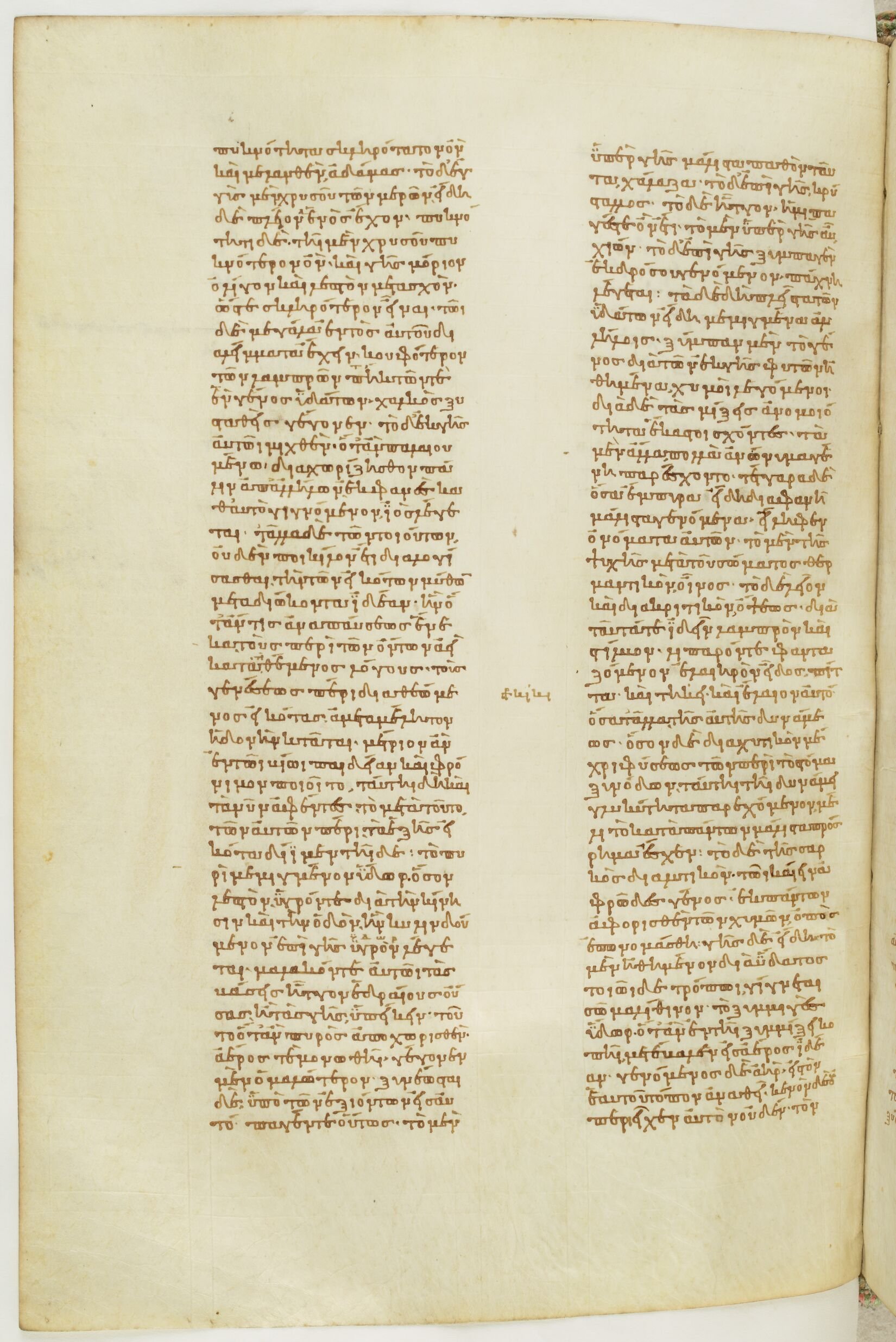
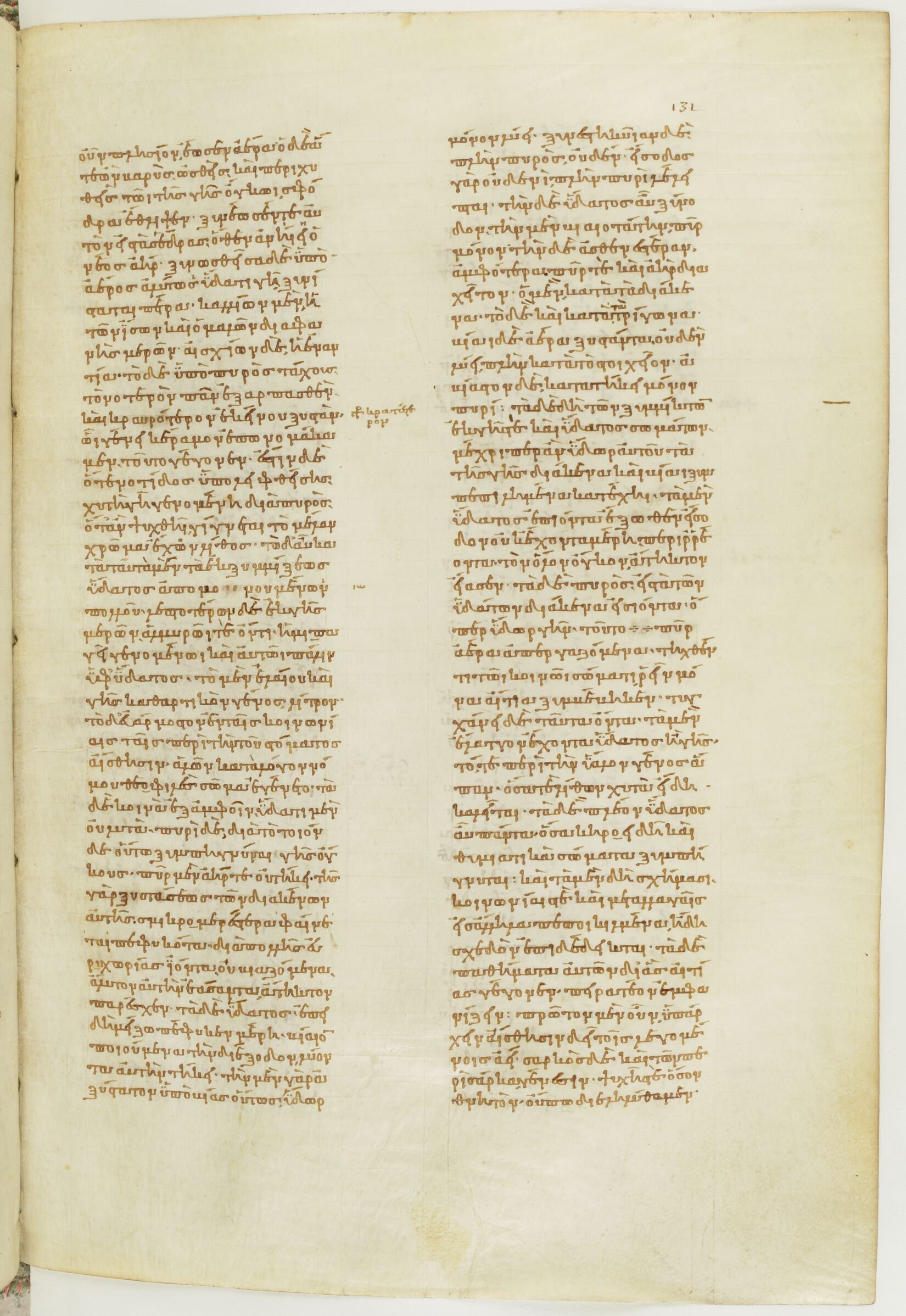
The manuscript is Paris, Bibliothèque nationale de France, grec 1807, known to editors as Plato A. It was copied in Constantinople around 850-875 by the scribe of the so-called philosophical collection, and is the oldest surviving medieval manuscript of the Timaeus and Critias (tetralogies VIII-IX: Clitophon, Republic, Timaeus, Critias, Minos, Laws, Epinomis, Letters). Each page has two columns of 44 lines. The Timaeus fills fol. 114r-144v and the Critias fol. 145r-151r.
On the manuscript this page of text runs over fol. 130v col. b to fol. 131r col. a. Each section below is linked to the folio side(s) that carry it. The mapping comes from reading the first words of every column on the images and finding them in Burnet's text: fol. 130v col. b begins ‹ὑπὲρ γῆς μάλιστα παθὸν ταῦτα χάλαζα› (Tim. 59e); fol. 131r col. a begins ‹οὖν πλησίον ἔωσεν ἀέρα. ὁ δὲ› (Tim. 60c).
The Greek is John Burnet's critical text (Oxford, 1902), not a transcription of this manuscript; the scribe's spelling, accents and occasional readings differ from it. The English is R. G. Bury's Loeb translation (1929).
How was this verified? (Provenance)
Where on the image
Tim. 60a stands in Paris gr. 1807, fol. 130v col. b. Checked on the image (column openings read on the BnF photographs and found in Burnet's text, quoted in Burnet's spelling): fol. 130v col. b begins ‹ὑπὲρ γῆς μάλιστα παθὸν ταῦτα χάλαζα› (Tim. 59e).
διὰ τῶν ἐκ γῆς φυτῶν ἠθημένα, χυμοὶ λεγόμενοι—διὰ δὲ τὰς μείξεις ἀνομοιότητα ἕκαστοι σχόντες τὰ μὲν ἄλλα πολλὰ ἀνώνυμα γένη παρέσχοντο, τέτταρα δὲ ὅσα ἔμπυρα εἴδη, διαφανῆ μάλιστα γενόμενα, εἴληφεν ὀνόματα αὐτῶν, τὸ μὲν τῆς ψυχῆς μετὰ τοῦ σώματος θερμαντικὸν οἶνος, τὸ δὲ λεῖον καὶ διακριτικὸν ὄψεως διὰ ταῦτά τε ἰδεῖν λαμπρὸν καὶ στίλβον λιπαρόν τε φανταζόμενον ἐλαιηρὸν εἶδος, πίττα καὶ κίκι καὶ ἔλαιον αὐτὸ ὅσα τʼ ἄλλα τῆς αὐτῆς δυνάμεως· ὅσον δὲ διαχυτικὸν
is called sap; but inasmuch as the several sorts have become dissimilar owing to intermixture, most of the kinds thus produced are unnamed. Four of these kinds, however, being fiery and specially conspicuous, have received names. Of these, that which is heating to the soul as well as the body is called wine; that which is smooth and divisive of the vision, and therefore bright to look upon and gleaming and glistening in appearance, is the species oil, including pitch and castor oil and olive oil itself and all the others that are of the same character;
Where on the image
Tim. 60b stands in Paris gr. 1807, fol. 130v col. b. Checked on the image (column openings read on the BnF photographs and found in Burnet's text, quoted in Burnet's spelling): fol. 130v col. b begins ‹ὑπὲρ γῆς μάλιστα παθὸν ταῦτα χάλαζα› (Tim. 59e).
μέχρι φύσεως τῶν περὶ τὸ στόμα συνόδων, ταύτῃ τῇ δυνάμει γλυκύτητα παρεχόμενον, μέλι τὸ κατὰ πάντων μάλιστα πρόσρημα ἔσχεν, τὸ δὲ τῆς σαρκὸς διαλυτικὸν τῷ κάειν, ἀφρῶδες γένος, ἐκ πάντων ἀφορισθὲν τῶν χυμῶν, ὀπὸς ἐπωνομάσθη. γῆς δὲ εἴδη, τὸ μὲν ἠθημένον διὰ ὕδατος τοιῷδε τρόπῳ γίγνεται σῶμα λίθινον. τὸ συμμιγὲς ὕδωρ ὅταν ἐν τῇ συμμείξει κοπῇ, μετέβαλεν εἰς ἀέρος ἰδέαν· γενόμενος δὲ
and all that kind which tends to expand the contracted parts of the mouth, so far as their nature allows, and by this property produces sweetness, has received as a general designation the name of honey; and the foamy kind, which tends to dissolve the flesh by burning, and is secreted from all the saps, is named verjuice. Of the species of earth, that which is strained through water becomes a stony substance in the following way. When the water commingled therewith is divided in the process of mingling, it changes into the form of air; and when it has become air it rushes up to its own region;
Where on the image
Tim. 60c stands in Paris gr. 1807, fol. 130v col. b to fol. 131r col. a. Checked on the image (column openings read on the BnF photographs and found in Burnet's text, quoted in Burnet's spelling): fol. 130v col. b begins ‹ὑπὲρ γῆς μάλιστα παθὸν ταῦτα χάλαζα› (Tim. 59e); fol. 131r col. a begins ‹οὖν πλησίον ἔωσεν ἀέρα. ὁ δὲ› (Tim. 60c).
ἀὴρ εἰς τὸν ἑαυτοῦ τόπον ἀναθεῖ. κενὸν δʼ ὑπερεῖχεν αὐτῶν οὐδέν· τὸν οὖν πλησίον ἔωσεν ἀέρα. ὁ δὲ ἅτε ὢν βαρύς, ὠσθεὶς καὶ περιχυθεὶς τῷ τῆς γῆς ὄγκῳ, σφόδρα ἔθλιψεν συνέωσέν τε αὐτὸν εἰς τὰς ἕδρας ὅθεν ἀνῄει ὁ νέος ἀήρ· συνωσθεῖσα δὲ ὑπὸ ἀέρος ἀλύτως ὕδατι γῆ συνίσταται πέτρα, καλλίων μὲν ἡ τῶν ἴσων καὶ ὁμαλῶν διαφανὴς μερῶν, αἰσχίων δὲ ἡ ἐναντία. τὸ δὲ ὑπὸ πυρὸς τάχους τὸ νοτερὸν
but because there was no void space above them, therefore it pressed against the adjacent air; and it, being heavy, when pressed and poured round the mass of earth, crushed it forcibly and compressed it into the spaces from which the new air was ascending. But when earth is thus compressed by the air so as to be indissoluble by water it forms stone; of which the fairer sort is that composed of equal and uniform parts and transparent, and the coarser sort the opposite. That kind from which all the moisture has been carried off by the rapidity of fire, and which is more brittle
Where on the image
Tim. 60d stands in Paris gr. 1807, fol. 131r col. a. Checked on the image (column openings read on the BnF photographs and found in Burnet's text, quoted in Burnet's spelling): fol. 131r col. a begins ‹οὖν πλησίον ἔωσεν ἀέρα. ὁ δὲ› (Tim. 60c).
πᾶν ἐξαρπασθὲν καὶ κραυρότερον ἐκείνου συστάν, ᾧ γένει κέραμον ἐπωνομάκαμεν, τοῦτο γέγονεν· ἔστιν δὲ ὅτε νοτίδος ὑπολειφθείσης χυτὴ γῆ γενομένη διὰ πυρὸς ὅταν ψυχθῇ, γίγνεται τὸ μέλαν χρῶμα ἔχον λίθος. τὼ δʼ αὖ κατὰ ταὐτὰ μὲν ταῦτα ἐκ συμμείξεως ὕδατος ἀπομονουμένω πολλοῦ, λεπτοτέρων δὲ ἐκ γῆς μερῶν ἁλμυρώ τε ὄντε, ἡμιπαγῆ γενομένω καὶ λυτὼ πάλιν ὑφʼ ὕδατος, τὸ μὲν ἐλαίου καὶ γῆς καθαρτικὸν γένος λίτρον, τὸ δʼ εὐάρμοστον ἐν ταῖς κοινωνίαις
in its composition than the first kind, is the kind to which we have given the name of earthenware. But sometimes, when moisture is still left in the earth and it has been fused by fire and has cooled again, it forms the species which is black in hue. On the other hand there are two kinds, which, in exactly the same manner, are isolated after the mixture from much of their water, but are composed of finer parts of earth, and are saline: when these have become semi-solid and soluble again by water, one of them is purgative of oil and earth and forms the species called lye; and the other, which blends well with the combinations which affect the sensation of the mouth,
Where on the image
Tim. 60e stands in Paris gr. 1807, fol. 131r col. a. Checked on the image (column openings read on the BnF photographs and found in Burnet's text, quoted in Burnet's spelling): fol. 131r col. a begins ‹οὖν πλησίον ἔωσεν ἀέρα. ὁ δὲ› (Tim. 60c).
ταῖς περὶ τὴν τοῦ στόματος αἴσθησιν ἁλῶν κατὰ λόγον νόμου θεοφιλὲς σῶμα ἐγένετο. τὰ δὲ κοινὰ ἐξ ἀμφοῖν ὕδατι μὲν οὐ λυτά, πυρὶ δέ, διὰ τὸ τοιόνδε οὕτω συμπήγνυται. γῆς ὄγκους πῦρ μὲν ἀήρ τε οὐ τήκει· τῆς γὰρ συστάσεως τῶν διακένων αὐτῆς σμικρομερέστερα πεφυκότα, διὰ πολλῆς εὐρυχωρίας ἰόντα, οὐ βιαζόμενα, ἄλυτον αὐτὴν ἐάσαντα ἄτηκτον παρέσχεν· τὰ δὲ ὕδατος ἐπειδὴ μείζω πέφυκεν μέρη, βίαιον ποιούμενα τὴν διέξοδον, λύοντα αὐτὴν τήκει.
γῆν
is that substance which is customarily termed beloved of the gods, namely salt. As regards the kinds which are a blend of these two, and are dissoluble by fire and not by water, their composition is due to the following cause. Fire and air do not melt masses of earth; for, inasmuch as their particles are smaller then the interstices of its structure, they have room to pass through without forcible effort and leave the earth undissolved, with the result that it remains unmelted; whereas the particles of water, being larger, must use force to make their way out, and consequently dissolve and melt the earth.
Notes
- Greek: John Burnet, Platonis Opera IV (Oxford, 1902), via Perseus canonical-greekLit; Burnet's text is a critical edition, so its wording can differ from the manuscript shown.
- English: R. G. Bury, Plato IX (Loeb Classical Library, 1929), via Perseus. Bury's footnotes are not reproduced. Quotation marks stand where Perseus marks quoted speech.
- Stephanus sections (a-e) are those of the 1578 Stephanus edition as given by Burnet and Bury; Bury's section breaks can fall a few words away from Burnet's because English word order differs.
Cite
Sources
- Source: Paris, BnF grec 1807 (Plato A, c. 850-875) fol. 130v-131r via BnF IIIF + Burnet's Greek (Perseus) + R. G. Bury's English (Loeb 1929, Perseus) (holding institution)
- Critical edition: Burnet, Platonis Opera IV (1902), via Perseus
← previous · → next · v cycle view · l back to library