Plato, Timaeus 61a-61e: solution of earth; the sensible qualities begin with heat
Introduction
Stephanus page 61 of Plato's Timaeus (61a-61e): solution of earth; the sensible qualities begin with heat.
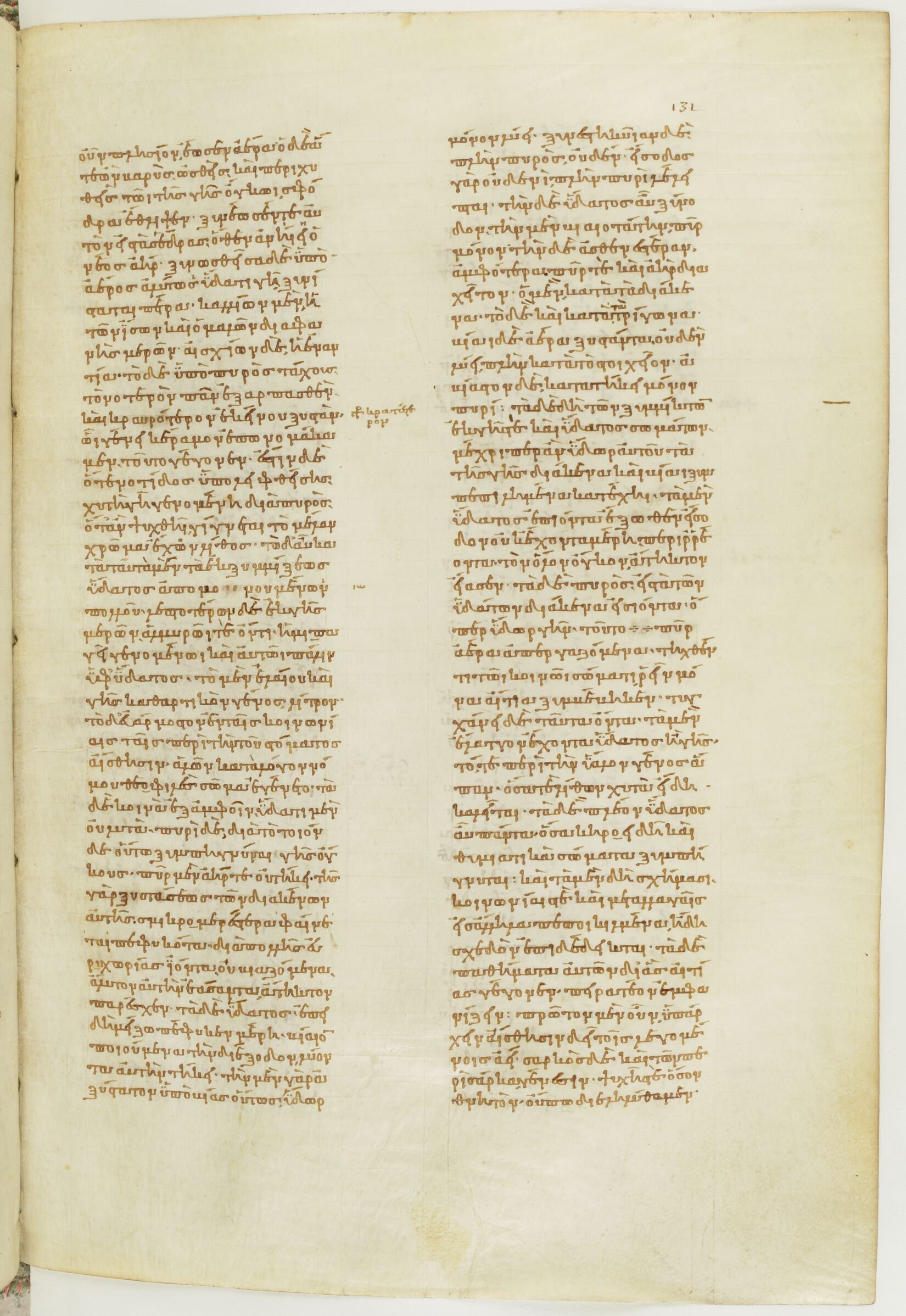
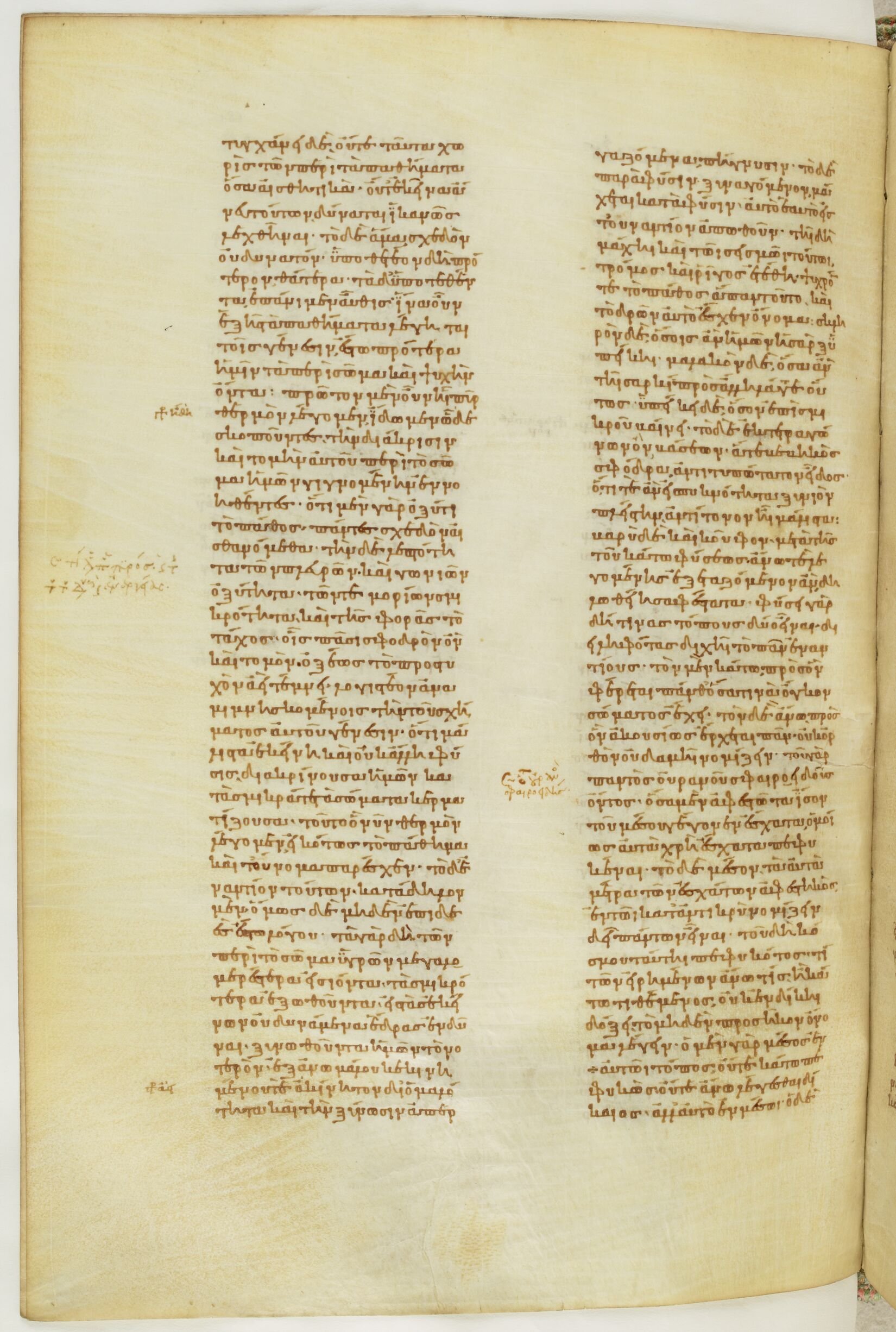
The manuscript is Paris, Bibliothèque nationale de France, grec 1807, known to editors as Plato A. It was copied in Constantinople around 850-875 by the scribe of the so-called philosophical collection, and is the oldest surviving medieval manuscript of the Timaeus and Critias (tetralogies VIII-IX: Clitophon, Republic, Timaeus, Critias, Minos, Laws, Epinomis, Letters). Each page has two columns of 44 lines. The Timaeus fills fol. 114r-144v and the Critias fol. 145r-151r.
On the manuscript this page of text runs over fol. 131r col. a to fol. 131v col. a. Each section below is linked to the folio side(s) that carry it. The mapping comes from reading the first words of every column on the images and finding them in Burnet's text: fol. 131r col. a begins ‹οὖν πλησίον ἔωσεν ἀέρα. ὁ δὲ› (Tim. 60c); fol. 131r col. b begins ‹μόνον λύει, συνεστηκυῖαν δὲ πλὴν πυρὸς› (Tim. 61a); fol. 131v col. a begins ‹τυγχάνει δὲ οὔτε ταῦτα χωρὶς τῶν› (Tim. 61c).
The Greek is John Burnet's critical text (Oxford, 1902), not a transcription of this manuscript; the scribe's spelling, accents and occasional readings differ from it. The English is R. G. Bury's Loeb translation (1929).
How was this verified? (Provenance)
Where on the image
Tim. 61a stands in Paris gr. 1807, fol. 131r col. a to fol. 131r col. b. Checked on the image (column openings read on the BnF photographs and found in Burnet's text, quoted in Burnet's spelling): fol. 131r col. a begins ‹οὖν πλησίον ἔωσεν ἀέρα. ὁ δὲ› (Tim. 60c); fol. 131r col. b begins ‹μόνον λύει, συνεστηκυῖαν δὲ πλὴν πυρὸς› (Tim. 61a).
μὲν γὰρ ἀσύστατον ὑπὸ βίας οὕτως ὕδωρ μόνον λύει, συνεστηκυῖαν δὲ πλὴν πυρὸς οὐδέν· εἴσοδος γὰρ οὐδενὶ πλὴν πυρὶ λέλειπται. τὴν δὲ ὕδατος αὖ σύνοδον τὴν μὲν βιαιοτάτην πῦρ μόνον, τὴν δὲ ἀσθενεστέραν ἀμφότερα, πῦρ τε καὶ ἀήρ, διαχεῖτον, ὁ μὲν κατὰ τὰ διάκενα, τὸ δὲ καὶ κατὰ τὰ τρίγωνα· βίᾳ δὲ ἀέρα συστάντα οὐδὲν λύει πλὴν κατὰ τὸ στοιχεῖον, ἀβίαστον δὲ κατατήκει μόνον πῦρ. τὰ δὴ τῶν συμμείκτων ἐκ γῆς τε καὶ ὕδατος σωμάτων, μέχριπερ ἂν
Thus earth when it is not forcibly condensed is dissolved only by water; and when it is condensed it is dissolved by fire only, since no entrance is left for anything save fire. Water, again, when most forcibly massed together is dissolved by fire only, but when massed less forcibly both by fire and air, the latter acting by way of the interstices, and the former by way of the triangles; but air when forcibly condensed is dissolved by nothing save by way of its elemental triangles, and when unforced it is melted down by fire only. As regards the classes of bodies which are compounds of earth and water,
Where on the image
Tim. 61b stands in Paris gr. 1807, fol. 131r col. b. Checked on the image (column openings read on the BnF photographs and found in Burnet's text, quoted in Burnet's spelling): fol. 131r col. b begins ‹μόνον λύει, συνεστηκυῖαν δὲ πλὴν πυρὸς› (Tim. 61a).
ὕδωρ αὐτοῦ τὰ τῆς γῆς διάκενα καὶ βίᾳ συμπεπιλημένα κατέχῃ, τὰ μὲν ὕδατος ἐπιόντα ἔξωθεν εἴσοδον οὐκ ἔχοντα μέρη περιρρέοντα τὸν ὅλον ὄγκον ἄτηκτον εἴασεν, τὰ δὲ πυρὸς εἰς τὰ τῶν ὑδάτων διάκενα εἰσιόντα, ὅπερ ὕδωρ γῆν, τοῦτο πῦρ ἀέρα ἀπεργαζόμενα, τηχθέντι τῷ κοινῷ σώματι ῥεῖν μόνα αἴτια συμβέβηκεν· τυγχάνει δὲ ταῦτα ὄντα, τὰ μὲν ἔλαττον ἔχοντα ὕδατος ἢ γῆς, τό τε περὶ τὴν ὕαλον γένος
so long as the water occupies the interspaces of earth which are forcibly contracted, the portions of water which approach from without find no entrance, but flow round the whole mass and leave it undissolved. But when portions of fire enter into the interspaces of the water they produce the same effects on water as water does on earth; consequently, they are the sole causes why the compound substance is dissolved and flows. And of these substances those which contain less water than earth form the whole kind known as glass,
Where on the image
Tim. 61c stands in Paris gr. 1807, fol. 131r col. b to fol. 131v col. a. Checked on the image (column openings read on the BnF photographs and found in Burnet's text, quoted in Burnet's spelling): fol. 131r col. b begins ‹μόνον λύει, συνεστηκυῖαν δὲ πλὴν πυρὸς› (Tim. 61a); fol. 131v col. a begins ‹τυγχάνει δὲ οὔτε ταῦτα χωρὶς τῶν› (Tim. 61c).
ἅπαν ὅσα τε λίθων χυτὰ εἴδη καλεῖται, τὰ δὲ πλέον ὕδατος αὖ, πάντα ὅσα κηροειδῆ καὶ θυμιατικὰ σώματα συμπήγνυται. καὶ τὰ μὲν δὴ σχήμασι κοινωνίαις τε καὶ μεταλλαγαῖς εἰς ἄλληλα πεποικιλμένα εἴδη σχεδὸν ἐπιδέδεικται· τὰ δὲ παθήματα αὐτῶν διʼ ἃς αἰτίας γέγονεν πειρατέον ἐμφανίζειν. πρῶτον μὲν οὖν ὑπάρχειν αἴσθησιν δεῖ τοῖς λεγομένοις ἀεί, σαρκὸς δὲ καὶ τῶν περὶ σάρκα γένεσιν, ψυχῆς τε ὅσον θνητόν, οὔπω διεληλύθαμεν· τυγχάνει δὲ οὔτε ταῦτα χωρὶς
and all the species of stone called fusible; while those which contain more water include all the solidified substances of the type of wax and frankincense. And now we have explained with some fullness the Four Kinds, which are thus variegated in their shapes and combinations and permutations; but we have still to try to elucidate the Causes which account for their affective qualities. Now, first of all, the quality of sense-perceptibility must always belong to the objects under discussion; but we have not as yet described the generation of flesh and the appurtenances of flesh, nor of that portion of Soul which is mortal. But, in truth, these last cannot be adequately explained
Where on the image
Tim. 61d stands in Paris gr. 1807, fol. 131v col. a. Checked on the image (column openings read on the BnF photographs and found in Burnet's text, quoted in Burnet's spelling): fol. 131v col. a begins ‹τυγχάνει δὲ οὔτε ταῦτα χωρὶς τῶν› (Tim. 61c).
τῶν περὶ τὰ παθήματα ὅσα αἰσθητικὰ οὔτʼ ἐκεῖνα ἄνευ τούτων δυνατὰ ἱκανῶς λεχθῆναι, τὸ δὲ ἅμα σχεδὸν οὐ δυνατόν. ὑποθετέον δὴ πρότερον θάτερα, τὰ δʼ ὑποτεθέντα ἐπάνιμεν αὖθις. ἵνα οὖν ἑξῆς τὰ παθήματα λέγηται τοῖς γένεσιν, ἔστω πρότερα ἡμῖν τὰ περὶ σῶμα καὶ ψυχὴν ὄντα. πρῶτον μὲν οὖν ᾗ πῦρ θερμὸν λέγομεν, ἴδωμεν ὧδε σκοποῦντες, τὴν διάκρισιν καὶ τομὴν αὐτοῦ περὶ τὸ σῶμα ἡμῶν γιγνομένην
apart from the subject of the sensible affections, nor the latter without the former; while to explain both simultaneously is hardly possible. Therefore, we must assume one of the two, to begin with, and return later to discuss our assumptions. In order, then, that the affective properties may be treated next after the kinds, let us presuppose the facts about body and soul. Firstly, then, let us consider how it is that we call fire hot by noticing the way it acts
Where on the image
Tim. 61e stands in Paris gr. 1807, fol. 131v col. a. Checked on the image (column openings read on the BnF photographs and found in Burnet's text, quoted in Burnet's spelling): fol. 131v col. a begins ‹τυγχάνει δὲ οὔτε ταῦτα χωρὶς τῶν› (Tim. 61c).
ἐννοηθέντες. ὅτι μὲν γὰρ ὀξύ τι τὸ πάθος, πάντες σχεδὸν αἰσθανόμεθα·
τὴν δὲ λεπτότητα τῶν πλευρῶν καὶ γωνιῶν ὀξύτητα τῶν τε μορίων σμικρότητα καὶ τῆς φορᾶς τὸ τάχος, οἷς πᾶσι σφοδρὸν ὂν καὶ τομὸν ὀξέως τὸ προστυχὸν ἀεὶ
upon our bodies by dividing and cutting. That its property is one of sharpness we all, I suppose, perceive;
but as regards the thinness of its sides and the acuteness of its angles and the smallness of its particles and the rapidity of its motion—owing to all which properties fire is intense and keen and sharply cuts whatever it encounters,—these properties we must explain by recalling
Notes
- Greek: John Burnet, Platonis Opera IV (Oxford, 1902), via Perseus canonical-greekLit; Burnet's text is a critical edition, so its wording can differ from the manuscript shown.
- English: R. G. Bury, Plato IX (Loeb Classical Library, 1929), via Perseus. Bury's footnotes are not reproduced. Quotation marks stand where Perseus marks quoted speech.
- Stephanus sections (a-e) are those of the 1578 Stephanus edition as given by Burnet and Bury; Bury's section breaks can fall a few words away from Burnet's because English word order differs.
Cite
Sources
- Source: Paris, BnF grec 1807 (Plato A, c. 850-875) fol. 131r-131v via BnF IIIF + Burnet's Greek (Perseus) + R. G. Bury's English (Loeb 1929, Perseus) (holding institution)
- Critical edition: Burnet, Platonis Opera IV (1902), via Perseus
← previous · → next · v cycle view · l back to library