Plato, Timaeus 62a-62d: hot and cold, hard and soft, heavy and light
Introduction
Stephanus page 62 of Plato's Timaeus (62a-62d): hot and cold, hard and soft, heavy and light.
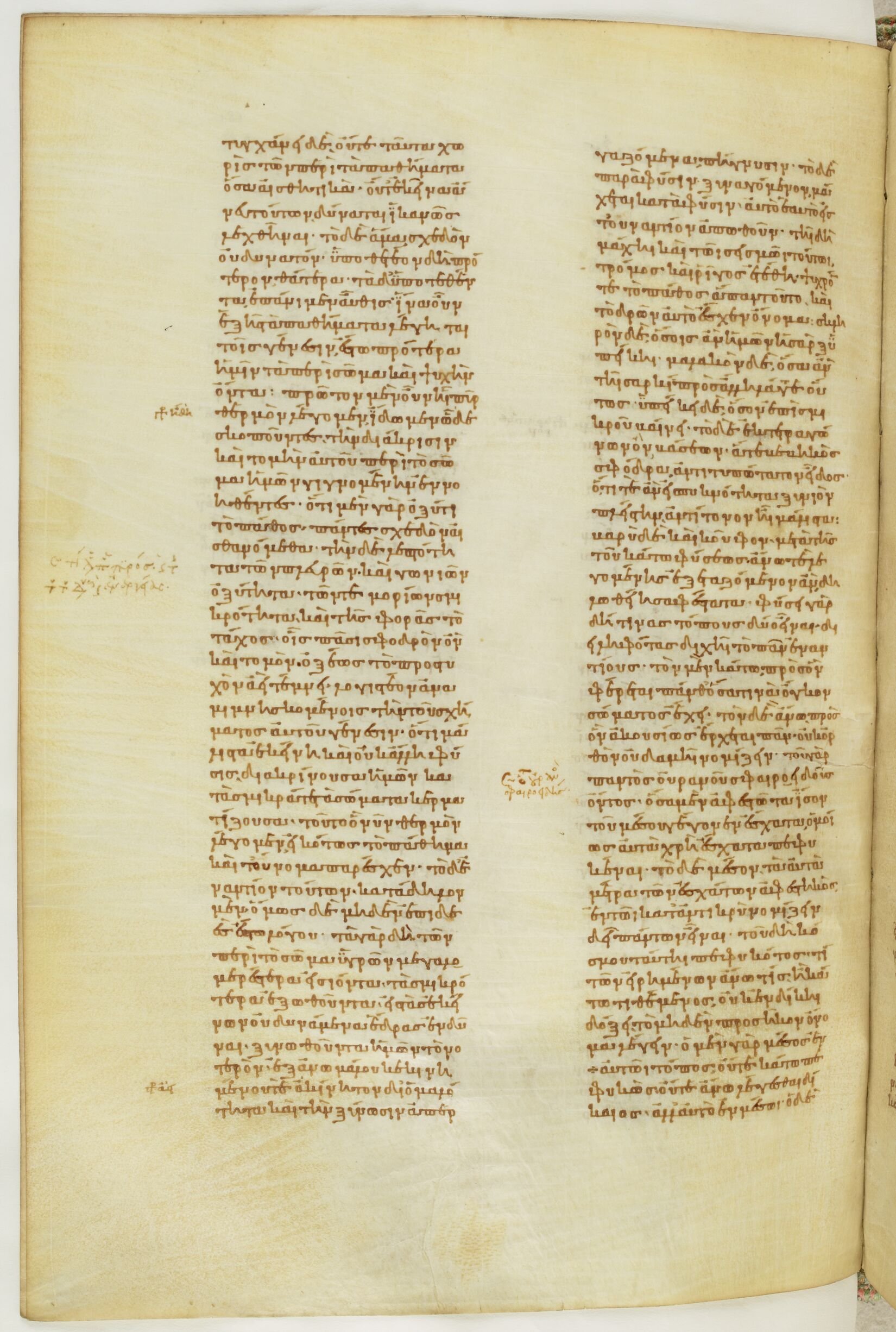
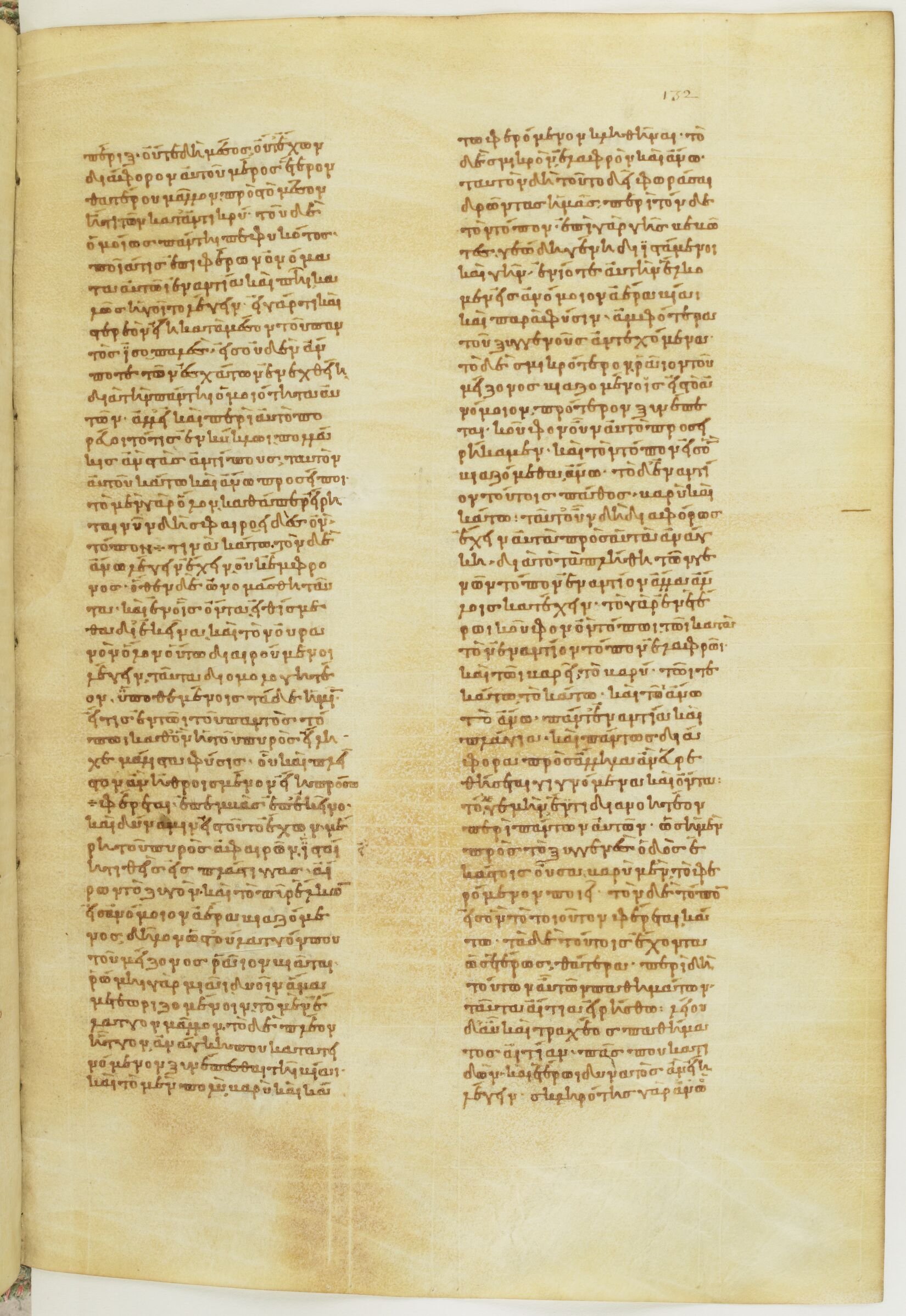
The manuscript is Paris, Bibliothèque nationale de France, grec 1807, known to editors as Plato A. It was copied in Constantinople around 850-875 by the scribe of the so-called philosophical collection, and is the oldest surviving medieval manuscript of the Timaeus and Critias (tetralogies VIII-IX: Clitophon, Republic, Timaeus, Critias, Minos, Laws, Epinomis, Letters). Each page has two columns of 44 lines. The Timaeus fills fol. 114r-144v and the Critias fol. 145r-151r.
On the manuscript this page of text runs over fol. 131v col. a to fol. 132r col. a. Each section below is linked to the folio side(s) that carry it. The mapping comes from reading the first words of every column on the images and finding them in Burnet's text: fol. 131v col. a begins ‹τυγχάνει δὲ οὔτε ταῦτα χωρὶς τῶν› (Tim. 61c); fol. 131v col. b begins ‹-γαζόμενα πήγνυσιν· τὸ δὲ παρὰ φύσιν› (Tim. 62b); fol. 132r col. a begins ‹πέριξ οὔτε δὴ μέσος οὔτʼ ἔχων› (Tim. 62d).
The Greek is John Burnet's critical text (Oxford, 1902), not a transcription of this manuscript; the scribe's spelling, accents and occasional readings differ from it. The English is R. G. Bury's Loeb translation (1929).
How was this verified? (Provenance)
Where on the image
Tim. 62a stands in Paris gr. 1807, fol. 131v col. a. Checked on the image (column openings read on the BnF photographs and found in Burnet's text, quoted in Burnet's spelling): fol. 131v col. a begins ‹τυγχάνει δὲ οὔτε ταῦτα χωρὶς τῶν› (Tim. 61c).
τέμνει, λογιστέον ἀναμιμνῃσκομένοις τὴν τοῦ σχήματος αὐτοῦ γένεσιν, ὅτι μάλιστα ἐκείνη καὶ οὐκ ἄλλη φύσις διακρίνουσα ἡμῶν κατὰ σμικρά τε τὰ σώματα κερματίζουσα τοῦτο ὃ νῦν θερμὸν λέγομεν εἰκότως τὸ πάθημα καὶ τοὔνομα παρέσχεν. τὸ δʼ ἐναντίον τούτων κατάδηλον μέν, ὅμως δὲ μηδὲν ἐπιδεὲς ἔστω λόγου. τὰ γὰρ δὴ τῶν περὶ τὸ σῶμα ὑγρῶν μεγαλομερέστερα εἰσιόντα, τὰ σμικρότερα ἐξωθοῦντα, εἰς τὰς ἐκείνων οὐ δυνάμενα ἕδρας ἐνδῦναι, συνωθοῦντα ἡμῶν
the origin of its form, how that it above all others is the one substance which so divides our bodies and minces them up as to produce naturally both that affection which we call heat and its very name. The opposite affection is evident, but none the less it must not lack description. When liquids with larger particles, which surround the body, enter into it they drive out the smaller particles; but as they cannot pass into their room they compress the moisture within us, so that in place of non-uniformity and motion they produce immobility and density,
Where on the image
Tim. 62b stands in Paris gr. 1807, fol. 131v col. a to fol. 131v col. b. Checked on the image (column openings read on the BnF photographs and found in Burnet's text, quoted in Burnet's spelling): fol. 131v col. a begins ‹τυγχάνει δὲ οὔτε ταῦτα χωρὶς τῶν› (Tim. 61c); fol. 131v col. b begins ‹-γαζόμενα πήγνυσιν· τὸ δὲ παρὰ φύσιν› (Tim. 62b).
τὸ νοτερόν, ἐξ ἀνωμάλου κεκινημένου τε ἀκίνητον διʼ ὁμαλότητα καὶ τὴν σύνωσιν ἀπεργαζόμενα πήγνυσιν· τὸ δὲ παρὰ φύσιν συναγόμενον μάχεται κατὰ φύσιν αὐτὸ ἑαυτὸ εἰς τοὐναντίον ἀπωθοῦν. τῇ δὴ μάχῃ καὶ τῷ σεισμῷ τούτῳ τρόμος καὶ ῥῖγος ἐτέθη, ψυχρόν τε τὸ πάθος ἅπαν τοῦτο καὶ τὸ δρῶν αὐτὸ ἔσχεν ὄνομα. σκληρὸν δέ, ὅσοις ἂν ἡμῶν ἡ σὰρξ ὑπείκῃ, μαλακὸν δέ, ὅσα ἂν τῇ σαρκί· πρὸς ἄλληλά τε οὕτως. ὑπείκει δὲ ὅσον ἐπὶ σμικροῦ βαίνει· τὸ δὲ ἐκ
as a result of the uniformity and compression. But that which is being contracted contrary to nature fights, and, in accordance with its nature, thrusts itself away in the contrary direction. And to this fighting and shaking we give the names of trembling and shivering; while this affection as a whole, as well as the cause thereof, is termed cold. By the term hard we indicate all the things to which our flesh gives way; and by the term soft all those which give way to our flesh; and these terms are similarly used relatively to each other. Now a substance gives way when it has its base small; but when it is constructed
Where on the image
Tim. 62c stands in Paris gr. 1807, fol. 131v col. b. Checked on the image (column openings read on the BnF photographs and found in Burnet's text, quoted in Burnet's spelling): fol. 131v col. b begins ‹-γαζόμενα πήγνυσιν· τὸ δὲ παρὰ φύσιν› (Tim. 62b).
τετραγώνων ὂν βάσεων, ἅτε βεβηκὸς σφόδρα, ἀντιτυπώτατον εἶδος, ὅτι τε ἂν εἰς πυκνότητα συνιὸν πλείστην ἀντίτονον ᾖ μάλιστα. βαρὺ δὲ καὶ κοῦφον μετὰ τῆς τοῦ κάτω φύσεως ἄνω τε λεγομένης ἐξεταζόμενον ἂν δηλωθείη σαφέστατα. φύσει γὰρ δή τινας τόπους δύο εἶναι διειληφότας διχῇ τὸ πᾶν ἐναντίους, τὸν μὲν κάτω, πρὸς ὃν φέρεται πάνθʼ ὅσα τινὰ ὄγκον σώματος ἔχει, τὸν δὲ ἄνω, πρὸς ὃν ἀκουσίως ἔρχεται πᾶν, οὐκ ὀρθὸν οὐδαμῇ νομίζειν· τοῦ γὰρ παντὸς
of quadrangular bases, being very firmly based, it is a most inelastic form; and so too is everything which is of very dense composition and most rigid. The nature of heavy and light would be shown most clearly if, along with them, we examined also the nature of above and below, as they are called. That there really exist two distinct and totally opposite regions, each of which occupies one-half of the Universe—the one termed below, towards which move all things possessing any bodily mass, and the other above, towards which everything goes against its will,—
Where on the image
Tim. 62d stands in Paris gr. 1807, fol. 131v col. b to fol. 132r col. a. Checked on the image (column openings read on the BnF photographs and found in Burnet's text, quoted in Burnet's spelling): fol. 131v col. b begins ‹-γαζόμενα πήγνυσιν· τὸ δὲ παρὰ φύσιν› (Tim. 62b); fol. 132r col. a begins ‹πέριξ οὔτε δὴ μέσος οὔτʼ ἔχων› (Tim. 62d).
οὐρανοῦ σφαιροειδοῦς ὄντος, ὅσα μὲν ἀφεστῶτα ἴσον τοῦ μέσου γέγονεν ἔσχατα, ὁμοίως αὐτὰ χρὴ ἔσχατα πεφυκέναι, τὸ δὲ μέσον τὰ αὐτὰ μέτρα τῶν ἐσχάτων ἀφεστηκὸς ἐν τῷ καταντικρὺ νομίζειν δεῖ πάντων εἶναι. τοῦ δὴ κόσμου ταύτῃ πεφυκότος, τί τῶν εἰρημένων ἄνω τις ἢ κάτω τιθέμενος οὐκ ἐν δίκῃ δόξει τὸ μηδὲν προσῆκον ὄνομα λέγειν; ὁ μὲν γὰρ μέσος ἐν αὐτῷ τόπος οὔτε κάτω πεφυκὼς οὔτε ἄνω λέγεσθαι δίκαιος, ἀλλʼ αὐτὸ ἐν μέσῳ· ὁ δὲ πέριξ οὔτε δὴ μέσος οὔτʼ ἔχων διάφορον αὑτοῦ μέρος ἕτερον θατέρου μᾶλλον πρὸς τὸ μέσον ἤ τι τῶν καταντικρύ. τοῦ δὲ ὁμοίως πάντῃ πεφυκότος ποῖά τις ἐπιφέρων ὀνόματα αὐτῷ ἐναντία καὶ πῇ καλῶς ἂν ἡγοῖτο λέγειν;
εἰ γάρ τι καὶ στερεὸν εἴη κατὰ μέσον τοῦ
this is a wholly erroneous supposition For inasmuch as the whole Heaven is spherical, all its outermost parts, being equally distant from the center, must really be outermost in a similar degree; and one must conceive of the center, which is distant from all the outermost parts by the same measures, as being opposite to them all. Seeing, then, that the Cosmos is actually of this nature, which of the bodies mentioned can one set above or below without incurring justly the charge of applying a wholly unsuitable name? For its central region cannot rightly be termed either above or below, but just central; while its circumference neither is central nor has it any one part more divergent than another from the center or any of its opposite parts. But to that which is in all ways uniform, what opposite names can we suppose are rightly applicable, or in what sense?
For suppose there were a solid body evenly-balanced at the center of the universe,
Notes
- Greek: John Burnet, Platonis Opera IV (Oxford, 1902), via Perseus canonical-greekLit; Burnet's text is a critical edition, so its wording can differ from the manuscript shown.
- English: R. G. Bury, Plato IX (Loeb Classical Library, 1929), via Perseus. Bury's footnotes are not reproduced. Quotation marks stand where Perseus marks quoted speech.
- Stephanus sections (a-e) are those of the 1578 Stephanus edition as given by Burnet and Bury; Bury's section breaks can fall a few words away from Burnet's because English word order differs.
Cite
Sources
- Source: Paris, BnF grec 1807 (Plato A, c. 850-875) fol. 131v-132r via BnF IIIF + Burnet's Greek (Perseus) + R. G. Bury's English (Loeb 1929, Perseus) (holding institution)
- Critical edition: Burnet, Platonis Opera IV (1902), via Perseus
← previous · → next · v cycle view · l back to library