Plato, Timaeus 63a-63e: up and down; heavy and light defined
Introduction
Stephanus page 63 of Plato's Timaeus (63a-63e): up and down; heavy and light defined.
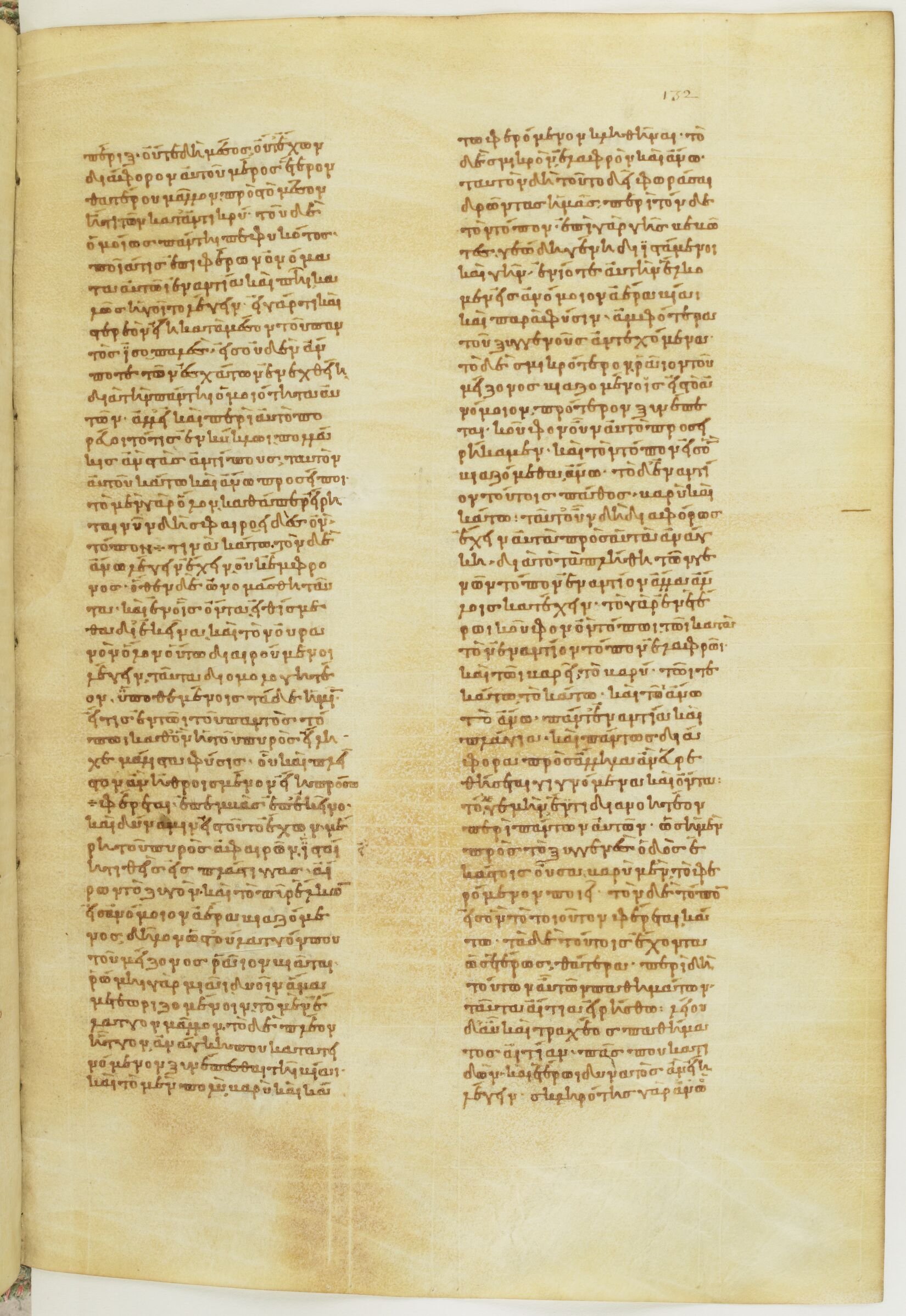
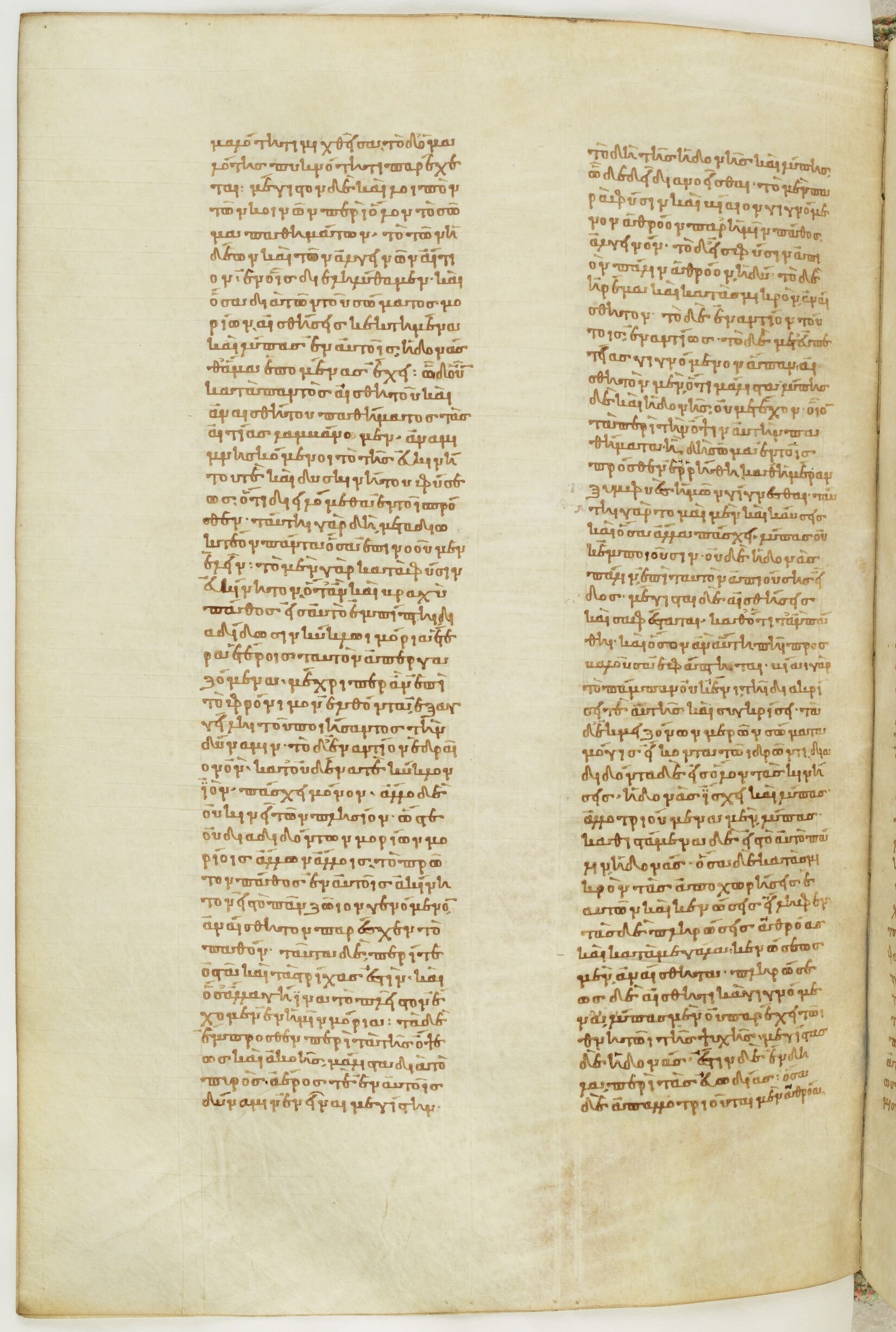
The manuscript is Paris, Bibliothèque nationale de France, grec 1807, known to editors as Plato A. It was copied in Constantinople around 850-875 by the scribe of the so-called philosophical collection, and is the oldest surviving medieval manuscript of the Timaeus and Critias (tetralogies VIII-IX: Clitophon, Republic, Timaeus, Critias, Minos, Laws, Epinomis, Letters). Each page has two columns of 44 lines. The Timaeus fills fol. 114r-144v and the Critias fol. 145r-151r.
On the manuscript this page of text runs over fol. 132r col. a to fol. 132v col. a. Each section below is linked to the folio side(s) that carry it. The mapping comes from reading the first words of every column on the images and finding them in Burnet's text: fol. 132r col. a begins ‹πέριξ οὔτε δὴ μέσος οὔτʼ ἔχων› (Tim. 62d); fol. 132r col. b begins ‹φερόμενον κληθῆναι, τὸ δὲ σμικρὸν ἐλαφρὸν› (Tim. 63c); fol. 132v col. a begins ‹-μαλότητι μειχθεῖσα, τὸ δʼ ὁμαλότης πυκνότητι› (Tim. 63e).
The Greek is John Burnet's critical text (Oxford, 1902), not a transcription of this manuscript; the scribe's spelling, accents and occasional readings differ from it. The English is R. G. Bury's Loeb translation (1929).
How was this verified? (Provenance)
Where on the image
Tim. 63a stands in Paris gr. 1807, fol. 132r col. a. Checked on the image (column openings read on the BnF photographs and found in Burnet's text, quoted in Burnet's spelling): fol. 132r col. a begins ‹πέριξ οὔτε δὴ μέσος οὔτʼ ἔχων› (Tim. 62d).
παντὸς ἰσοπαλές, εἰς οὐδὲν ἄν ποτε τῶν ἐσχάτων ἐνεχθείη διὰ τὴν πάντῃ ὁμοιότητα αὐτῶν· ἀλλʼ εἰ καὶ περὶ αὐτὸ πορεύοιτό τις ἐν κύκλῳ, πολλάκις ἂν στὰς ἀντίπους ταὐτὸν αὐτοῦ κάτω καὶ ἄνω προσείποι. τὸ μὲν γὰρ ὅλον, καθάπερ εἴρηται νυνδή, σφαιροειδὲς ὄν, τόπον τινὰ κάτω, τὸν δὲ ἄνω λέγειν ἔχειν οὐκ ἔμφρονος· ὅθεν δὲ ὠνομάσθη ταῦτα καὶ ἐν οἷς ὄντα εἰθίσμεθα διʼ ἐκεῖνα καὶ τὸν οὐρανὸν ὅλον οὕτω διαιρούμενοι
it would never be carried away to the extremities because of their uniformity in all respects; nay, even were a man to travel round it in a circle he would often call the same part of it both above and below, according as he stood now at one pole, now at the opposite. For seeing that the Whole is, as we said just now, spherical, the assertion that it has one region above and one below does not become a man of sense. Now the origin of these names and their true meaning which accounts for our habit of making these verbal distinctions even about the whole Heaven,
Where on the image
Tim. 63b stands in Paris gr. 1807, fol. 132r col. a. Checked on the image (column openings read on the BnF photographs and found in Burnet's text, quoted in Burnet's spelling): fol. 132r col. a begins ‹πέριξ οὔτε δὴ μέσος οὔτʼ ἔχων› (Tim. 62d).
λέγειν, ταῦτα διομολογητέον ὑποθεμένοις τάδε ἡμῖν. εἴ τις ἐν τῷ τοῦ παντὸς τόπῳ καθʼ ὃν ἡ τοῦ πυρὸς εἴληχε μάλιστα φύσις, οὗ καὶ πλεῖστον ἂν ἠθροισμένον εἴη πρὸς ὃ φέρεται, ἐπεμβὰς ἐπʼ ἐκεῖνο καὶ δύναμιν εἰς τοῦτο ἔχων, μέρη τοῦ πυρὸς ἀφαιρῶν ἱσταίη τιθεὶς εἰς πλάστιγγας, αἴρων τὸν ζυγὸν καὶ τὸ πῦρ ἕλκων εἰς ἀνόμοιον ἀέρα βιαζόμενος
we must determine on the basis of the following principles. Suppose that a man were to take his stand in that region of the Universe in which the substance of fire has its special abode, and where also that substance to which it flies is collected in largest bulk; and suppose that, having the power to do so, he were to separate portions of the fire and weigh them, putting them on scales and lifting the balance and pulling the fire by force into the dissimilar air, it is obvious that he will force the smaller mass more easily than the larger.
Where on the image
Tim. 63c stands in Paris gr. 1807, fol. 132r col. a to fol. 132r col. b. Checked on the image (column openings read on the BnF photographs and found in Burnet's text, quoted in Burnet's spelling): fol. 132r col. a begins ‹πέριξ οὔτε δὴ μέσος οὔτʼ ἔχων› (Tim. 62d); fol. 132r col. b begins ‹φερόμενον κληθῆναι, τὸ δὲ σμικρὸν ἐλαφρὸν› (Tim. 63c).
δῆλον ὡς τοὔλαττόν που τοῦ μείζονος ῥᾷον βιᾶται· ῥώμῃ γὰρ μιᾷ δυοῖν ἅμα μετεωριζομένοιν τὸ μὲν ἔλαττον μᾶλλον, τὸ δὲ πλέον ἧττον ἀνάγκη που κατατεινόμενον συνέπεσθαι τῇ βίᾳ, καὶ τὸ μὲν πολὺ βαρὺ καὶ κάτω φερόμενον κληθῆναι, τὸ δὲ σμικρὸν ἐλαφρὸν καὶ ἄνω. ταὐτὸν δὴ τοῦτο δεῖ φωρᾶσαι δρῶντας ἡμᾶς περὶ τόνδε τὸν τόπον. ἐπὶ γὰρ γῆς βεβῶτες γεώδη γένη διιστάμενοι, καὶ γῆν ἐνίοτε αὐτήν, ἕλκομεν εἰς ἀνόμοιον ἀέρα βίᾳ καὶ παρὰ φύσιν, ἀμφότερα τοῦ
For if two masses are lifted up simultaneously by a single effort, the smaller will necessarily yield more and the larger less, owing to its resistance, to the force exerted; and the large mass will be said to be heavy and moving down, the small light and moving up. Now this is just what we ought to detect ourselves doing in our region here. Standing on the earth and detaching various earthy substances, and sometimes pure earth, we pull them into the dissimilar air by force and against nature, since both these kinds cleave to their own kindred;
Where on the image
Tim. 63d stands in Paris gr. 1807, fol. 132r col. b. Checked on the image (column openings read on the BnF photographs and found in Burnet's text, quoted in Burnet's spelling): fol. 132r col. b begins ‹φερόμενον κληθῆναι, τὸ δὲ σμικρὸν ἐλαφρὸν› (Tim. 63c).
συγγενοῦς ἀντεχόμενα, τὸ δὲ σμικρότερον ῥᾷον τοῦ μείζονος βιαζομένοις εἰς τὸ ἀνόμοιον πρότερον συνέπεται· κοῦφον οὖν αὐτὸ προσειρήκαμεν, καὶ τὸν τόπον εἰς ὃν βιαζόμεθα, ἄνω, τὸ δʼ ἐναντίον τούτοις πάθος βαρὺ καὶ κάτω. ταῦτʼ οὖν δὴ διαφόρως ἔχειν αὐτὰ πρὸς αὑτὰ ἀνάγκη διὰ τὸ τὰ πλήθη τῶν γενῶν τόπον ἐναντίον ἄλλα ἄλλοις κατέχειν—τὸ γὰρ ἐν ἑτέρῳ κοῦφον ὂν τόπῳ τῷ κατὰ τὸν ἐναντίον τόπον ἐλαφρῷ
and the smaller mass yields more easily, and follows first, as we force it into the dissimilar kind; wherefore we name it light, and the region to which we force it above; and the conditions opposite thereto we name heavy and below. Thus, these must necessarily differ in their mutual relations, because the main masses of the Kinds occupy regions opposite to one another; for when we compare what is light in one region with what is light in the opposite region, and the heavy with the heavy, the below with the below,
Where on the image
Tim. 63e stands in Paris gr. 1807, fol. 132r col. b to fol. 132v col. a. Checked on the image (column openings read on the BnF photographs and found in Burnet's text, quoted in Burnet's spelling): fol. 132r col. b begins ‹φερόμενον κληθῆναι, τὸ δὲ σμικρὸν ἐλαφρὸν› (Tim. 63c); fol. 132v col. a begins ‹-μαλότητι μειχθεῖσα, τὸ δʼ ὁμαλότης πυκνότητι› (Tim. 63e).
καὶ τῷ βαρεῖ τὸ βαρὺ τῷ τε κάτω τὸ κάτω καὶ τὸ ἄνω τῷ ἄνω πάντʼ ἐναντία καὶ πλάγια καὶ πάντως διάφορα πρὸς ἄλληλα ἀνευρεθήσεται γιγνόμενα καὶ ὄντα—τόδε γε μὴν ἕν τι διανοητέον περὶ πάντων αὐτῶν, ὡς ἡ μὲν πρὸς τὸ συγγενὲς ὁδὸς ἑκάστοις οὖσα βαρὺ μὲν τὸ φερόμενον ποιεῖ, τὸν δὲ τόπον εἰς ὃν τὸ τοιοῦτον φέρεται, κάτω, τὰ δὲ τούτοις ἔχοντα ὡς ἑτέρως θάτερα. περὶ δὴ τούτων αὖ τῶν παθημάτων ταῦτα αἴτια εἰρήσθω.
λείου δʼ αὖ καὶ τραχέος παθήματος αἰτίαν πᾶς που κατιδὼν καὶ ἑτέρῳ δυνατὸς ἂν εἴη λέγειν· σκληρότης γὰρ ἀνωμαλότητι μειχθεῖσα, τὸ δʼ
and the” above with the above, we shall discover that these all become and are opposite and oblique and in every way different in their mutual relations. There is, however, this one fact to be noticed about them all, that it is the passage of each kind to its kindred mass which makes the moving body heavy, and the region to which such a body moves below; while the opposite conditions produce the contrary results. Let this, then, stand as our account of the causes of these conditions.
Of smoothness and roughness anyone might be able to discern the causes and explain them also to others. For the cause of the latter is hardness combined with irregularity, and of the former
Notes
- Greek: John Burnet, Platonis Opera IV (Oxford, 1902), via Perseus canonical-greekLit; Burnet's text is a critical edition, so its wording can differ from the manuscript shown.
- English: R. G. Bury, Plato IX (Loeb Classical Library, 1929), via Perseus. Bury's footnotes are not reproduced. Quotation marks stand where Perseus marks quoted speech.
- Stephanus sections (a-e) are those of the 1578 Stephanus edition as given by Burnet and Bury; Bury's section breaks can fall a few words away from Burnet's because English word order differs.
Cite
Sources
- Source: Paris, BnF grec 1807 (Plato A, c. 850-875) fol. 132r-132v via BnF IIIF + Burnet's Greek (Perseus) + R. G. Bury's English (Loeb 1929, Perseus) (holding institution)
- Critical edition: Burnet, Platonis Opera IV (1902), via Perseus
← previous · → next · v cycle view · l back to library