Plato, Timaeus 64a-64e: rough and smooth; pleasure and pain
Introduction
Stephanus page 64 of Plato's Timaeus (64a-64e): rough and smooth; pleasure and pain.
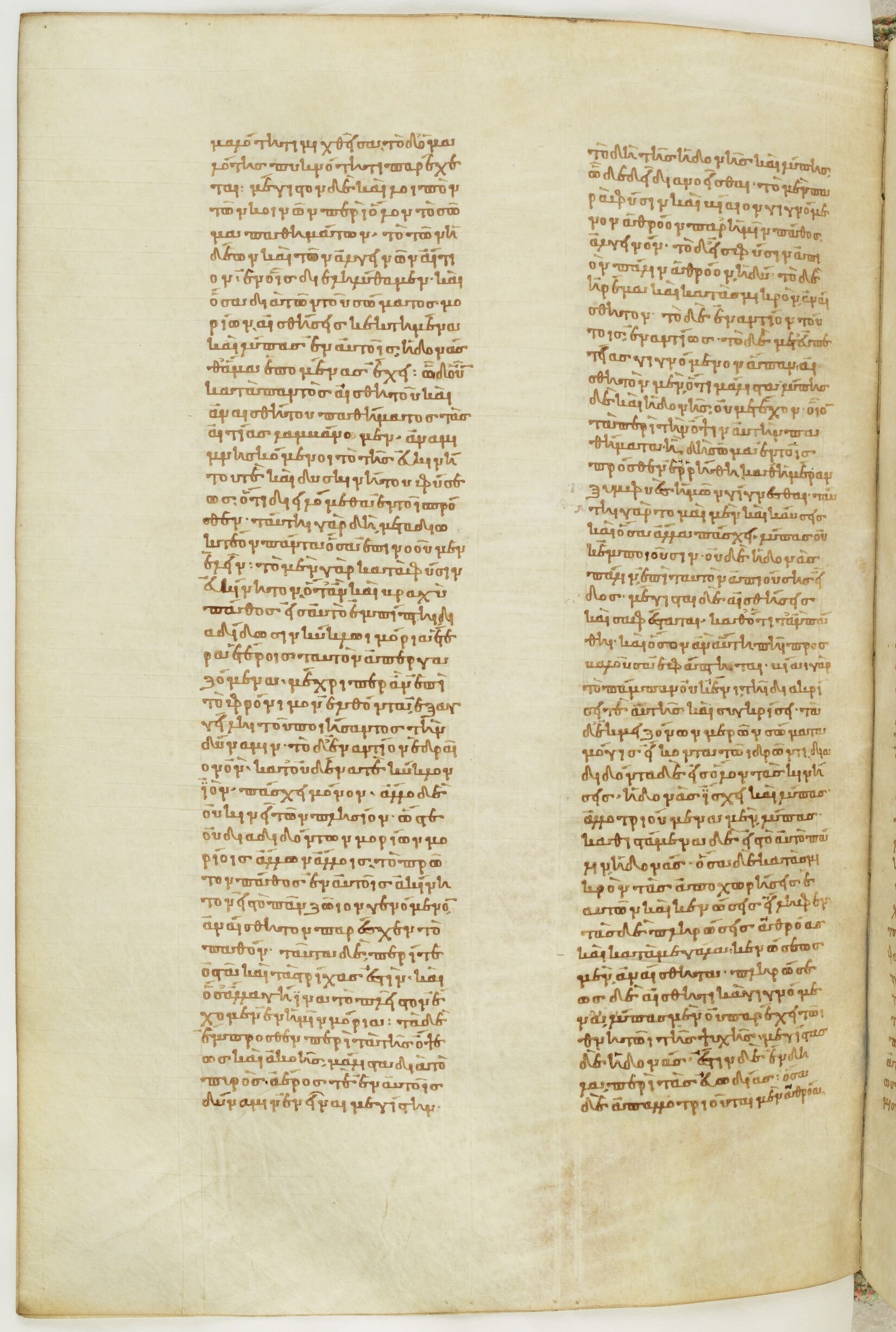
The manuscript is Paris, Bibliothèque nationale de France, grec 1807, known to editors as Plato A. It was copied in Constantinople around 850-875 by the scribe of the so-called philosophical collection, and is the oldest surviving medieval manuscript of the Timaeus and Critias (tetralogies VIII-IX: Clitophon, Republic, Timaeus, Critias, Minos, Laws, Epinomis, Letters). Each page has two columns of 44 lines. The Timaeus fills fol. 114r-144v and the Critias fol. 145r-151r.
On the manuscript this page of text runs over fol. 132v col. a to fol. 132v col. b. Each section below is linked to the folio side(s) that carry it. The mapping comes from reading the first words of every column on the images and finding them in Burnet's text: fol. 132v col. a begins ‹-μαλότητι μειχθεῖσα, τὸ δʼ ὁμαλότης πυκνότητι› (Tim. 63e); fol. 132v col. b begins ‹τὸ δὴ τῆς ἡδονῆς καὶ λύπης› (Tim. 64c).
The Greek is John Burnet's critical text (Oxford, 1902), not a transcription of this manuscript; the scribe's spelling, accents and occasional readings differ from it. The English is R. G. Bury's Loeb translation (1929).
How was this verified? (Provenance)
Where on the image
Tim. 64a stands in Paris gr. 1807, fol. 132v col. a. Checked on the image (column openings read on the BnF photographs and found in Burnet's text, quoted in Burnet's spelling): fol. 132v col. a begins ‹-μαλότητι μειχθεῖσα, τὸ δʼ ὁμαλότης πυκνότητι› (Tim. 63e).
ὁμαλότης πυκνότητι παρέχεται. μέγιστον δὲ καὶ λοιπὸν τῶν κοινῶν περὶ ὅλον τὸ σῶμα παθημάτων τὸ τῶν ἡδέων καὶ τῶν ἀλγεινῶν αἴτιον ἐν οἷς διεληλύθαμεν, καὶ ὅσα διὰ τῶν τοῦ σώματος μορίων αἰσθήσεις κεκτημένα καὶ λύπας ἐν αὑτοῖς ἡδονάς θʼ ἅμα ἑπομένας ἔχει. ὧδʼ οὖν κατὰ παντὸς αἰσθητοῦ καὶ ἀναισθήτου παθήματος τὰς αἰτίας λαμβάνωμεν, ἀναμιμνῃσκόμενοι τὸ τῆς
regularity combined with density. In respect of the affections common to the whole body a very important point, which still remains, is the cause of the pleasures and pains attaching to the sense-affections we have been discussing; and the cause also of those affections which have become perceptible by means of the bodily parts and involve in themselves concomitant pains and pleasures. Let us, then, try to grasp the causes in connection with every perceptible and imperceptible affection in the following way,
Where on the image
Tim. 64b stands in Paris gr. 1807, fol. 132v col. a. Checked on the image (column openings read on the BnF photographs and found in Burnet's text, quoted in Burnet's spelling): fol. 132v col. a begins ‹-μαλότητι μειχθεῖσα, τὸ δʼ ὁμαλότης πυκνότητι› (Tim. 63e).
εὐκινήτου τε καὶ δυσκινήτου φύσεως ὅτι διειλόμεθα ἐν τοῖς πρόσθεν· ταύτῃ γὰρ δὴ μεταδιωκτέον πάντα ὅσα ἐπινοοῦμεν ἑλεῖν. τὸ μὲν γὰρ κατὰ φύσιν εὐκίνητον, ὅταν καὶ βραχὺ πάθος εἰς αὐτὸ ἐμπίπτῃ, διαδίδωσιν κύκλῳ μόρια ἕτερα ἑτέροις ταὐτὸν ἀπεργαζόμενα, μέχριπερ ἂν ἐπὶ τὸ φρόνιμον ἐλθόντα ἐξαγγείλῃ τοῦ ποιήσαντος τὴν δύναμιν· τὸ δʼ ἐναντίον ἑδραῖον ὂν κατʼ οὐδένα τε κύκλον ἰὸν πάσχει μόνον,
bearing in mind the distinction we previously drew between mobile and immobile substances; for it is in this way that we must track down all those facts that we intend to grasp. Whenever what is naturally mobile is impressed by even a small affection, it transmits it in a circle, the particles passing on to one another this identical impression until they reach the organ of intelligence and announce the quality of the agent. But a substance of the opposite kind, being stable and having no circular movement, is only affected in itself and does not move any other adjacent particle; consequently,
Where on the image
Tim. 64c stands in Paris gr. 1807, fol. 132v col. a to fol. 132v col. b. Checked on the image (column openings read on the BnF photographs and found in Burnet's text, quoted in Burnet's spelling): fol. 132v col. a begins ‹-μαλότητι μειχθεῖσα, τὸ δʼ ὁμαλότης πυκνότητι› (Tim. 63e); fol. 132v col. b begins ‹τὸ δὴ τῆς ἡδονῆς καὶ λύπης› (Tim. 64c).
ἄλλο δὲ οὐ κινεῖ τῶν πλησίον, ὥστε οὐ διαδιδόντων μορίων μορίοις ἄλλων ἄλλοις τὸ πρῶτον πάθος ἐν αὐτοῖς ἀκίνητον εἰς τὸ πᾶν ζῷον γενόμενον ἀναίσθητον παρέσχεν τὸ παθόν. ταῦτα δὲ περί τε ὀστᾶ καὶ τὰς τρίχας ἐστὶν καὶ ὅσʼ ἄλλα γήϊνα τὸ πλεῖστον ἔχομεν ἐν ἡμῖν μόρια· τὰ δὲ ἔμπροσθεν περὶ τὰ τῆς ὄψεως καὶ ἀκοῆς μάλιστα, διὰ τὸ πυρὸς ἀέρος τε ἐν αὐτοῖς δύναμιν ἐνεῖναι μεγίστην. τὸ δὴ τῆς ἡδονῆς καὶ λύπης ὧδε δεῖ διανοεῖσθαι· τὸ μὲν παρὰ φύσιν καὶ
since the particles do not transmit to one another the original affection, it fails to act upon the living creature as a whole, and the result is that the affected body is non-percipient. This is the case with the bones and the hair and all our other parts that are mainly earthy whereas the former character belongs especially to the organs of sight and of hearing, owing to the fact that they contain a very large quantity of fire and air. Now the nature of pleasure and pain we must conceive of in this way.
Where on the image
Tim. 64d stands in Paris gr. 1807, fol. 132v col. b. Checked on the image (column openings read on the BnF photographs and found in Burnet's text, quoted in Burnet's spelling): fol. 132v col. b begins ‹τὸ δὴ τῆς ἡδονῆς καὶ λύπης› (Tim. 64c).
βίαιον γιγνόμενον ἁθρόον παρʼ ἡμῖν πάθος ἀλγεινόν, τὸ δʼ εἰς φύσιν ἀπιὸν πάλιν ἁθρόον ἡδύ, τὸ δὲ ἡρέμα καὶ κατὰ σμικρὸν ἀναίσθητον, τὸ δʼ ἐναντίον τούτοις ἐναντίως. τὸ δὲ μετʼ εὐπετείας γιγνόμενον ἅπαν αἰσθητὸν μὲν ὅτι μάλιστα, λύπης δὲ καὶ ἡδονῆς οὐ μετέχον, οἷον τὰ περὶ τὴν ὄψιν αὐτὴν παθήματα, ἣ δὴ σῶμα ἐν τοῖς πρόσθεν ἐρρήθη καθʼ ἡμέραν συμφυὲς ἡμῶν γίγνεσθαι. ταύτῃ γὰρ τομαὶ μὲν καὶ καύσεις καὶ ὅσα ἄλλα πάσχει λύπας οὐκ ἐμποιοῦσιν, οὐδὲ
When an affection which is against nature and violent occurs within us with intensity it is painful, whereas the return back to the natural condition, when intense, is pleasant; and an affection which is mild and gradual is imperceptible, while the converse is of a contrary character. And the affection which, in its entirety, takes place with ease is eminently perceptible, but it does not involve pain or pleasure; such, for example, are the affections of the visual stream itself, which, as we said before, becomes in the daylight a body substantially one with our own. For no pains are produced therein by cuttings or burnings
Where on the image
Tim. 64e stands in Paris gr. 1807, fol. 132v col. b. Checked on the image (column openings read on the BnF photographs and found in Burnet's text, quoted in Burnet's spelling): fol. 132v col. b begins ‹τὸ δὴ τῆς ἡδονῆς καὶ λύπης› (Tim. 64c).
ἡδονὰς πάλιν ἐπὶ ταὐτὸν ἀπιούσης εἶδος, μέγισται δὲ αἰσθήσεις καὶ σαφέσταται καθʼ ὅτι τʼ ἂν πάθῃ καὶ ὅσων ἂν αὐτή πῃ προσβαλοῦσα ἐφάπτηται· βία γὰρ τὸ πάμπαν οὐκ ἔνι τῇ διακρίσει τε αὐτῆς καὶ συγκρίσει.
τὰ δʼ ἐκ μειζόνων μερῶν σώματα μόγις εἴκοντα τῷ δρῶντι, διαδιδόντα δὲ εἰς ὅλον τὰς κινήσεις, ἡδονὰς ἴσχει καὶ λύπας, ἀλλοτριούμενα
or any other affections, nor does its reversion to its original form produce pleasures; but it has most intense and clear perceptions concerning every object that affects it, and every object also which it strikes against or touches; for force is wholly absent both from its dilation and from its contraction.
But those bodies which are composed of larger particles, since they yield with difficulty to the agent and transmit their motions to the whole, feel pleasures and pains—
Notes
- Greek: John Burnet, Platonis Opera IV (Oxford, 1902), via Perseus canonical-greekLit; Burnet's text is a critical edition, so its wording can differ from the manuscript shown.
- English: R. G. Bury, Plato IX (Loeb Classical Library, 1929), via Perseus. Bury's footnotes are not reproduced. Quotation marks stand where Perseus marks quoted speech.
- Stephanus sections (a-e) are those of the 1578 Stephanus edition as given by Burnet and Bury; Bury's section breaks can fall a few words away from Burnet's because English word order differs.
Cite
Sources
- Source: Paris, BnF grec 1807 (Plato A, c. 850-875) fol. 132v via BnF IIIF + Burnet's Greek (Perseus) + R. G. Bury's English (Loeb 1929, Perseus) (holding institution)
- Critical edition: Burnet, Platonis Opera IV (1902), via Perseus
← previous · → next · v cycle view · l back to library