Plato, Timaeus 65a-65e: pleasure and pain continued; tastes
Introduction
Stephanus page 65 of Plato's Timaeus (65a-65e): pleasure and pain continued; tastes.
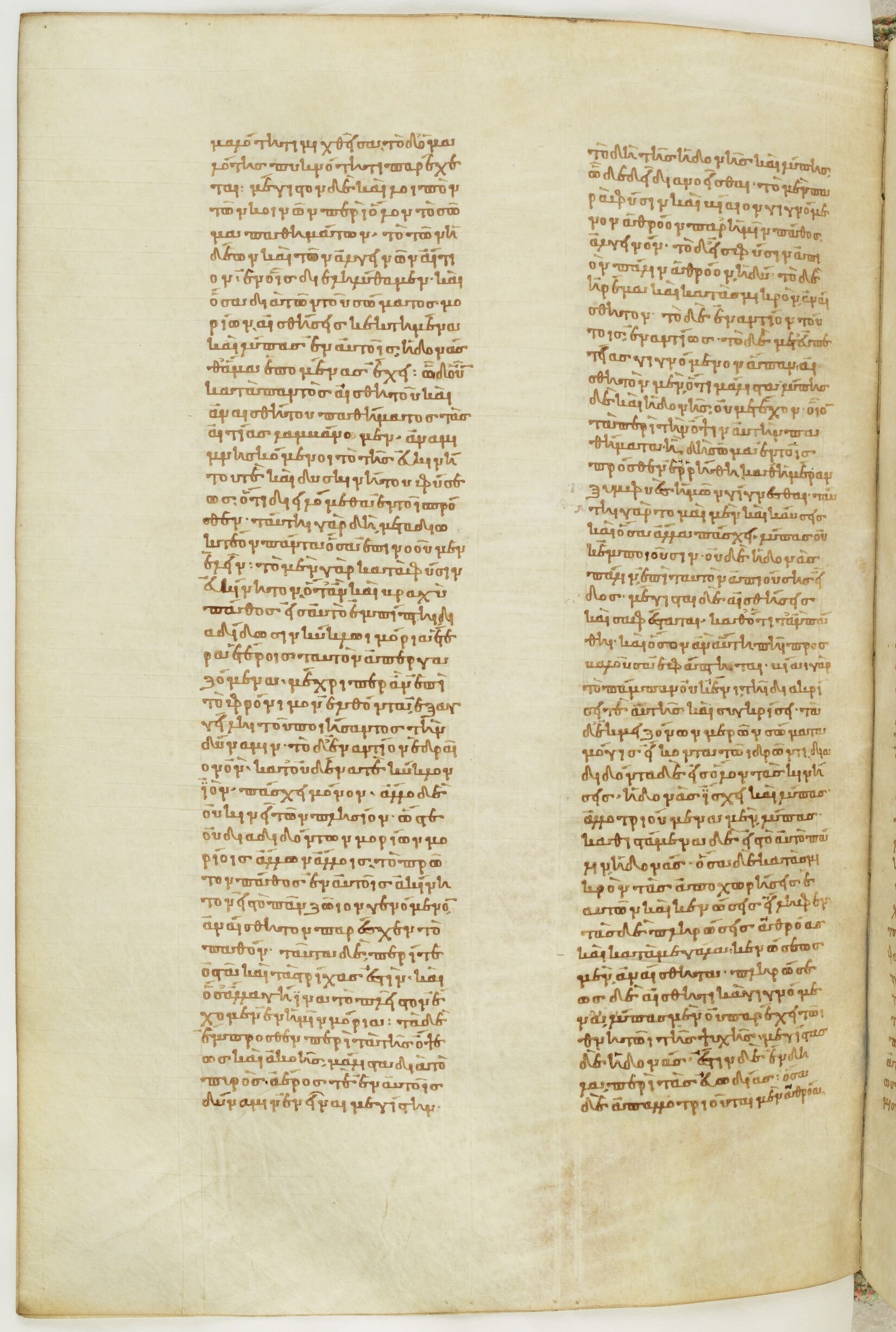
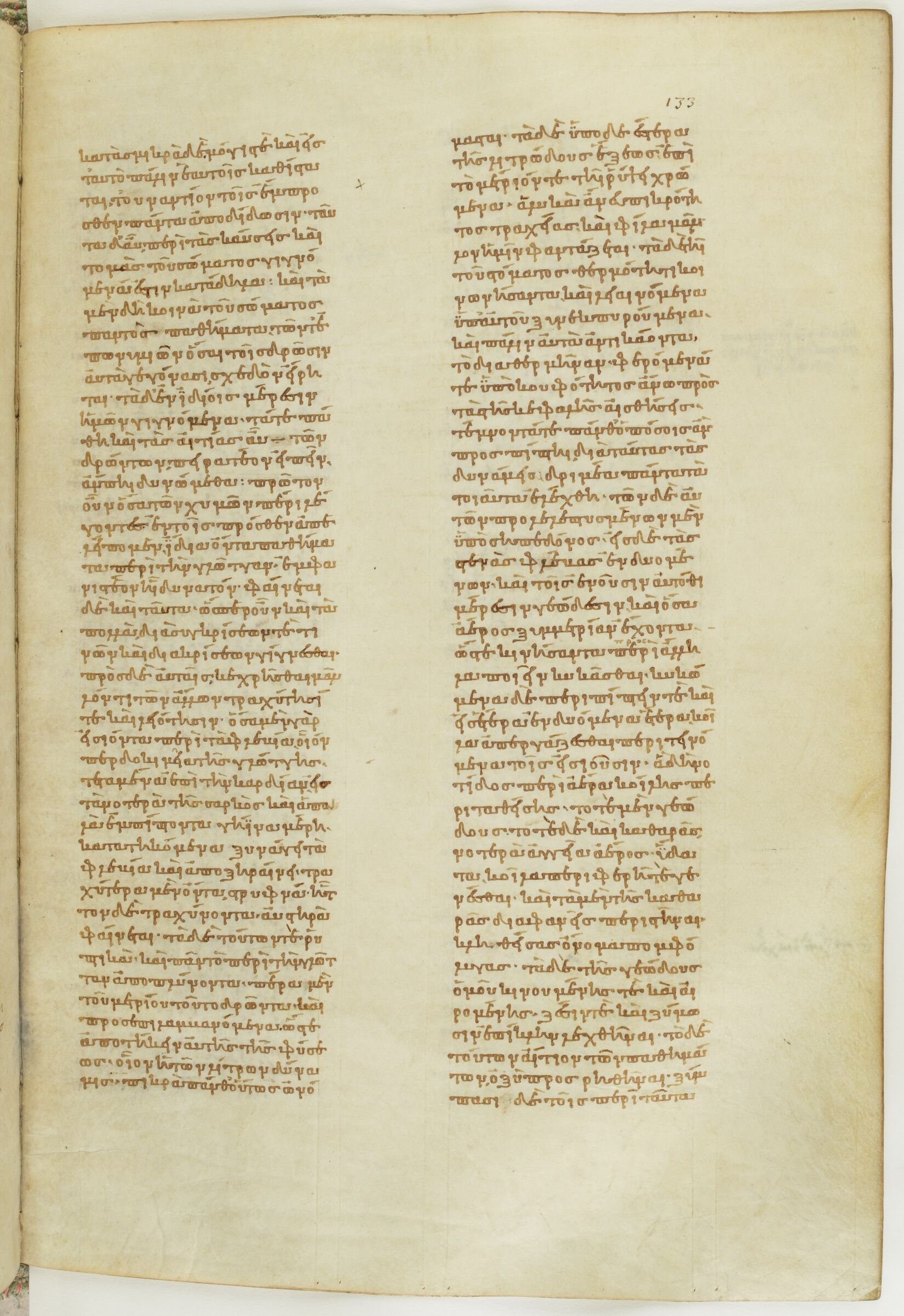
The manuscript is Paris, Bibliothèque nationale de France, grec 1807, known to editors as Plato A. It was copied in Constantinople around 850-875 by the scribe of the so-called philosophical collection, and is the oldest surviving medieval manuscript of the Timaeus and Critias (tetralogies VIII-IX: Clitophon, Republic, Timaeus, Critias, Minos, Laws, Epinomis, Letters). Each page has two columns of 44 lines. The Timaeus fills fol. 114r-144v and the Critias fol. 145r-151r.
On the manuscript this page of text runs over fol. 132v col. b to fol. 133r col. b. Each section below is linked to the folio side(s) that carry it. The mapping comes from reading the first words of every column on the images and finding them in Burnet's text: fol. 132v col. b begins ‹τὸ δὴ τῆς ἡδονῆς καὶ λύπης› (Tim. 64c); fol. 133r col. a begins ‹κατὰ σμικρὰ δὲ μόγις τε εἰς› (Tim. 65a); fol. 133r col. b begins ‹-μασται, τὰ δὲ ὑποδεέστερα τῆς λιτρώδους› (Tim. 65e).
The Greek is John Burnet's critical text (Oxford, 1902), not a transcription of this manuscript; the scribe's spelling, accents and occasional readings differ from it. The English is R. G. Bury's Loeb translation (1929).
How was this verified? (Provenance)
Where on the image
Tim. 65a stands in Paris gr. 1807, fol. 132v col. b to fol. 133r col. a. Checked on the image (column openings read on the BnF photographs and found in Burnet's text, quoted in Burnet's spelling): fol. 132v col. b begins ‹τὸ δὴ τῆς ἡδονῆς καὶ λύπης› (Tim. 64c); fol. 133r col. a begins ‹κατὰ σμικρὰ δὲ μόγις τε εἰς› (Tim. 65a).
μὲν λύπας, καθιστάμενα δὲ εἰς τὸ αὐτὸ πάλιν ἡδονάς. ὅσα δὲ κατὰ σμικρὸν τὰς ἀποχωρήσεις ἑαυτῶν καὶ κενώσεις εἴληφεν, τὰς δὲ πληρώσεις ἁθρόας καὶ κατὰ μεγάλα, κενώσεως μὲν ἀναίσθητα, πληρώσεως δὲ αἰσθητικὰ γιγνόμενα, λύπας μὲν οὐ παρέχει τῷ θνητῷ τῆς ψυχῆς, μεγίστας δὲ ἡδονάς· ἔστιν δὲ ἔνδηλα περὶ τὰς εὐωδίας. ὅσα δὲ ἀπαλλοτριοῦται μὲν ἁθρόα, κατὰ σμικρὰ δὲ μόγις τε εἰς ταὐτὸν
pains when they suffer alteration, and pleasures when they are restored to their original state. And all those bodies which undergo losses of substance and emptyings that are gradual, but replenishings that are intense and abundant, become insensitive to the emptyings but sensitive to the replenishings; consequently, they furnish no pains to the mortal part of the soul, but the greatest pleasures—a result which is obvious in the case of perfumes. But all those parts which undergo violent alterations, and are restored gradually and with difficulty
Where on the image
Tim. 65b stands in Paris gr. 1807, fol. 133r col. a. Checked on the image (column openings read on the BnF photographs and found in Burnet's text, quoted in Burnet's spelling): fol. 133r col. a begins ‹κατὰ σμικρὰ δὲ μόγις τε εἰς› (Tim. 65a).
πάλιν ἑαυτοῖς καθίσταται, τοὐναντίον τοῖς ἔμπροσθεν πάντα ἀποδίδωσιν· ταῦτα δʼ αὖ περὶ τὰς καύσεις καὶ τομὰς τοῦ σώματος γιγνόμενά ἐστιν κατάδηλα. καὶ τὰ μὲν δὴ κοινὰ τοῦ σώματος παντὸς παθήματα, τῶν τʼ ἐπωνυμιῶν ὅσαι τοῖς δρῶσιν αὐτὰ γεγόνασι, σχεδὸν εἴρηται· τὰ δʼ ἐν ἰδίοις μέρεσιν ἡμῶν γιγνόμενα, τά τε πάθη καὶ τὰς αἰτίας αὖ τῶν δρώντων, πειρατέον εἰπεῖν, ἄν πῃ
to their original condition, produce results the opposite of those last mentioned; and it is evident that this is what occurs in the case of burnings and cuttings of the body. And now we have given a fairly complete statement of the affections which are common to the body as a whole, and of all the names which belong to the agents which produce them. Next we must try, if haply we are able, to describe what takes place in the several parts of our bodies, both the affections themselves and the agents to which they are ascribed.
Where on the image
Tim. 65c stands in Paris gr. 1807, fol. 133r col. a. Checked on the image (column openings read on the BnF photographs and found in Burnet's text, quoted in Burnet's spelling): fol. 133r col. a begins ‹κατὰ σμικρὰ δὲ μόγις τε εἰς› (Tim. 65a).
δυνώμεθα. πρῶτον οὖν ὅσα τῶν χυμῶν πέρι λέγοντες ἐν τοῖς πρόσθεν ἀπελίπομεν, ἴδια ὄντα παθήματα περὶ τὴν γλῶτταν, ἐμφανιστέον ᾗ δυνατόν. φαίνεται δὲ καὶ ταῦτα, ὥσπερ οὖν καὶ τὰ πολλά, διὰ συγκρίσεών τέ τινων καὶ διακρίσεων γίγνεσθαι, πρὸς δὲ αὐταῖς κεχρῆσθαι μᾶλλόν τι τῶν ἄλλων τραχύτησί τε καὶ λειότησιν. ὅσα μὲν γὰρ εἰσιόντα περὶ τὰ φλέβια, οἷόνπερ δοκίμια τῆς γλώττης
Firstly, then, we must endeavor to elucidate so far as possible those affections which we omitted in our previous account of the flavors, they being affections peculiar to the tongue. It is evident that these also, like most others, are brought about by means of certain contractions and dilations; and, more than other affections, they involve also conditions of roughness and smoothness. For all the earthy particles which enter in by the small veins—which, extending as far as to the heart, serve as it were
Where on the image
Tim. 65d stands in Paris gr. 1807, fol. 133r col. a. Checked on the image (column openings read on the BnF photographs and found in Burnet's text, quoted in Burnet's spelling): fol. 133r col. a begins ‹κατὰ σμικρὰ δὲ μόγις τε εἰς› (Tim. 65a).
τεταμένα ἐπὶ τὴν καρδίαν, εἰς τὰ νοτερὰ τῆς σαρκὸς καὶ ἁπαλὰ ἐμπίπτοντα γήϊνα μέρη κατατηκόμενα συνάγει τὰ φλέβια καὶ ἀποξηραίνει, τραχύτερα μὲν ὄντα στρυφνά, ἧττον δὲ τραχύνοντα αὐστηρὰ φαίνεται· τὰ δὲ τούτων τε ῥυπτικὰ καὶ πᾶν τὸ περὶ τὴν γλῶτταν ἀποπλύνοντα, πέρα μὲν τοῦ μετρίου τοῦτο δρῶντα καὶ προσεπιλαμβανόμενα ὥστε ἀποτήκειν αὐτῆς τῆς φύσεως, οἷον ἡ τῶν λίτρων
for testing-instruments of the tongue,—when they strike upon the moist and soft parts of the flesh and are melted down, contract the small veins and dry them up; and these particles when more rough appear to be astringent, when less rough harsh. And such as act on these veins as detergents and wash out all the surface of the tongue, when they do this excessively and lay such hold on the tongue as to dissolve part of its substance—and such, for example, is the property of alkalies,—
Where on the image
Tim. 65e stands in Paris gr. 1807, fol. 133r col. a to fol. 133r col. b. Checked on the image (column openings read on the BnF photographs and found in Burnet's text, quoted in Burnet's spelling): fol. 133r col. a begins ‹κατὰ σμικρὰ δὲ μόγις τε εἰς› (Tim. 65a); fol. 133r col. b begins ‹-μασται, τὰ δὲ ὑποδεέστερα τῆς λιτρώδους› (Tim. 65e).
δύναμις, πικρὰ πάνθʼ οὕτως ὠνόμασται, τὰ δὲ ὑποδεέστερα τῆς λιτρώδους ἕξεως ἐπὶ τὸ μέτριόν τε τῇ ῥύψει χρώμενα ἁλυκὰ ἄνευ πικρότητος τραχείας καὶ φίλα μᾶλλον ἡμῖν φαντάζεται.
τὰ δὲ τῇ τοῦ στόματος θερμότητι κοινωνήσαντα καὶ λεαινόμενα ὑπʼ αὐτοῦ, συνεκπυρούμενα καὶ πάλιν αὐτὰ ἀντικάοντα τὸ διαθερμῆναν, φερόμενά τε ὑπὸ κουφότητος ἄνω πρὸς τὰς τῆς κεφαλῆς αἰσθήσεις, τέμνοντά τε
are all termed bitter; while those which have a property less strong than the alkaline, being detergent in a moderate degree, seem to us to be saline, and more agreeable, as being devoid of the rough bitterness.
And those which share in the heat of the mouth and are made smooth thereby, when they are fully inflamed and are themselves in turn burning the part which heated them, fly upwards because of their lightness towards the senses of the head and cut all the parts on which they impinge;
Notes
- Greek: John Burnet, Platonis Opera IV (Oxford, 1902), via Perseus canonical-greekLit; Burnet's text is a critical edition, so its wording can differ from the manuscript shown.
- English: R. G. Bury, Plato IX (Loeb Classical Library, 1929), via Perseus. Bury's footnotes are not reproduced. Quotation marks stand where Perseus marks quoted speech.
- Stephanus sections (a-e) are those of the 1578 Stephanus edition as given by Burnet and Bury; Bury's section breaks can fall a few words away from Burnet's because English word order differs.
Cite
Sources
- Source: Paris, BnF grec 1807 (Plato A, c. 850-875) fol. 132v-133r via BnF IIIF + Burnet's Greek (Perseus) + R. G. Bury's English (Loeb 1929, Perseus) (holding institution)
- Critical edition: Burnet, Platonis Opera IV (1902), via Perseus
← previous · → next · v cycle view · l back to library