Plato, Timaeus 66a-66e: tastes continued; smells
Introduction
Stephanus page 66 of Plato's Timaeus (66a-66e): tastes continued; smells.
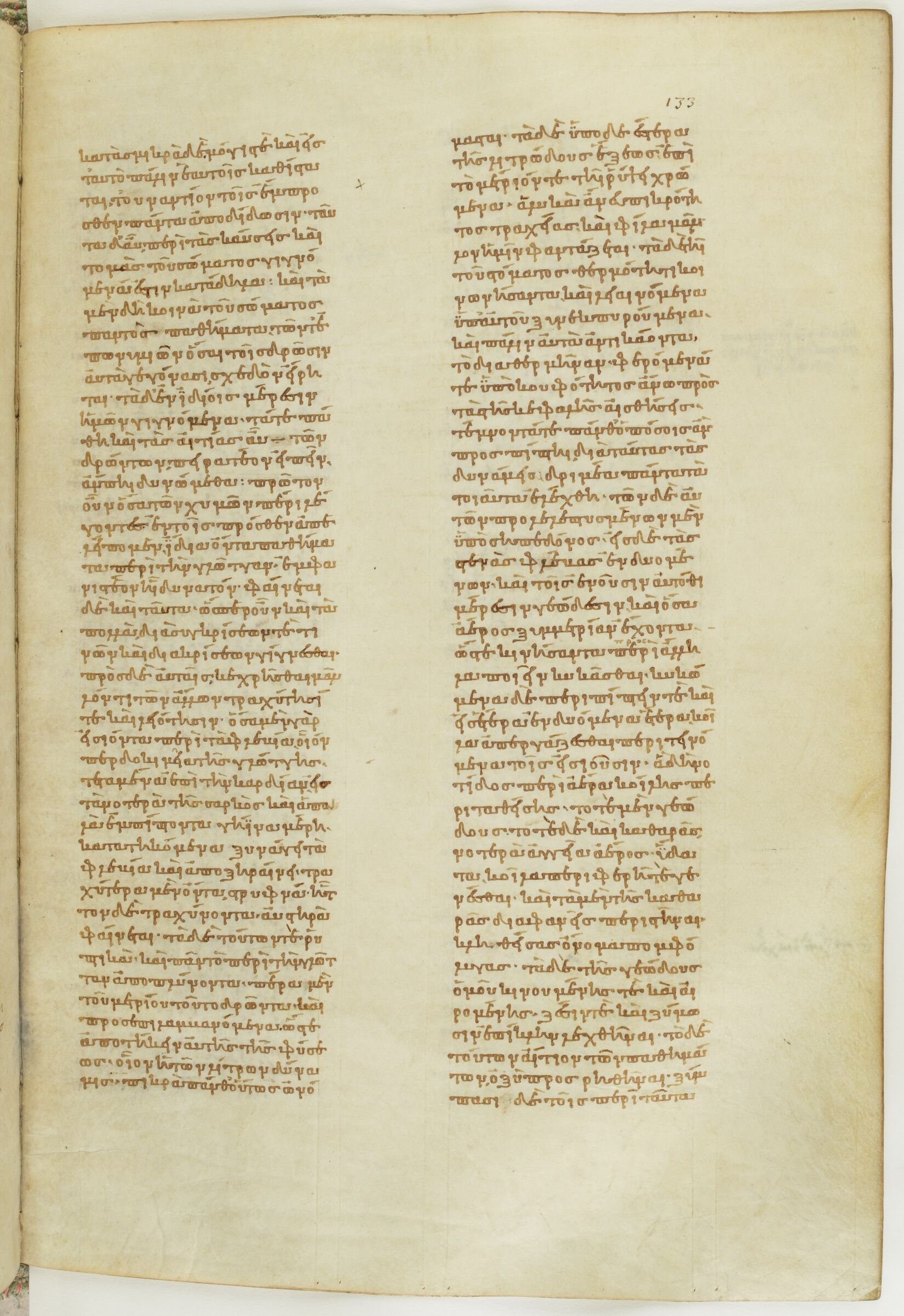
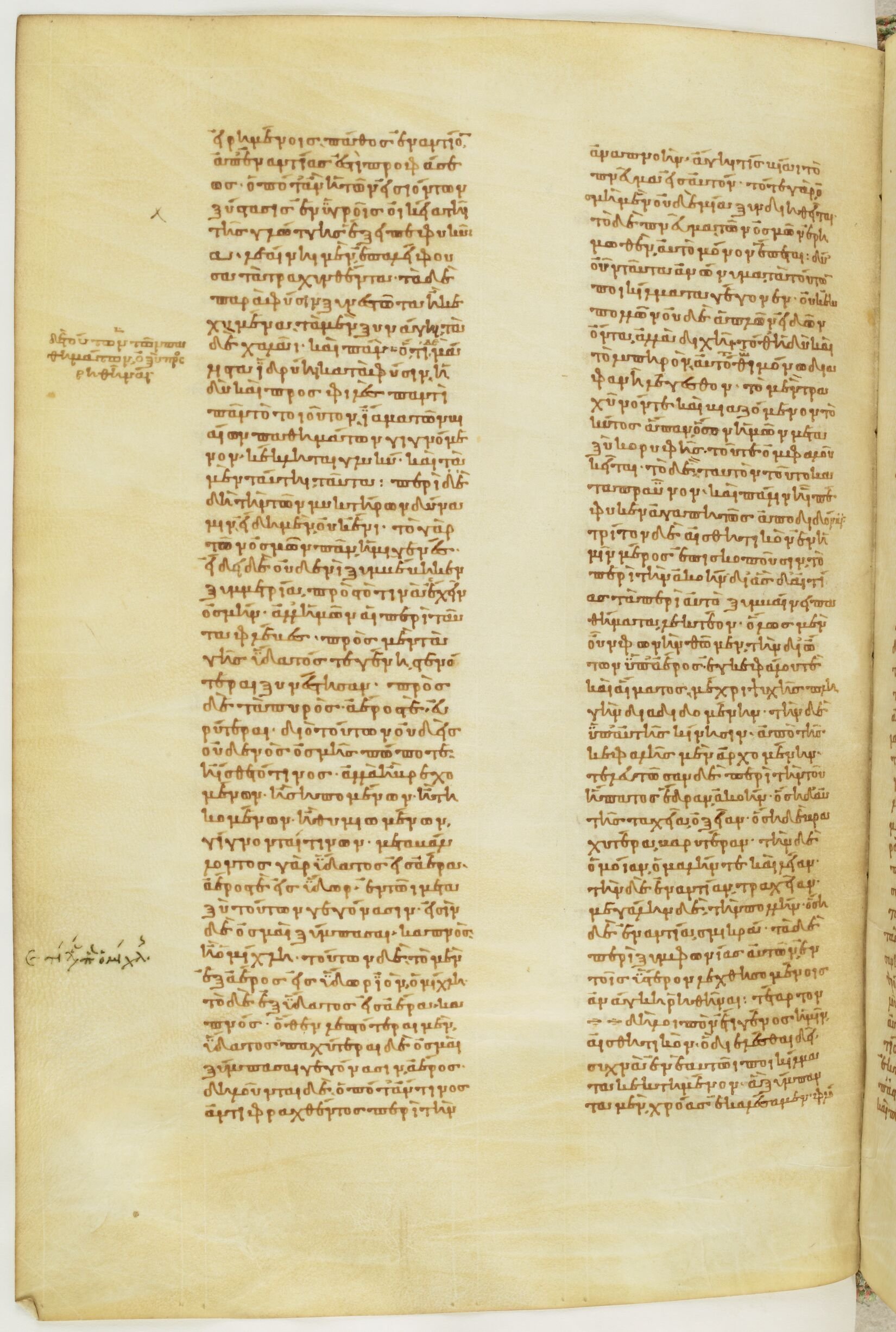
The manuscript is Paris, Bibliothèque nationale de France, grec 1807, known to editors as Plato A. It was copied in Constantinople around 850-875 by the scribe of the so-called philosophical collection, and is the oldest surviving medieval manuscript of the Timaeus and Critias (tetralogies VIII-IX: Clitophon, Republic, Timaeus, Critias, Minos, Laws, Epinomis, Letters). Each page has two columns of 44 lines. The Timaeus fills fol. 114r-144v and the Critias fol. 145r-151r.
On the manuscript this page of text runs over fol. 133r col. b to fol. 133v col. b. Each section below is linked to the folio side(s) that carry it. The mapping comes from reading the first words of every column on the images and finding them in Burnet's text: fol. 133r col. b begins ‹-μασται, τὰ δὲ ὑποδεέστερα τῆς λιτρώδους› (Tim. 65e); fol. 133v col. a begins ‹εἰρημένοις πάθος ἐναντίον ἀπʼ ἐναντίας ἐστὶ› (Tim. 66b); fol. 133v col. b begins ‹ἀναπνοὴν ἄγῃ τις βίᾳ τὸ πνεῦμα› (Tim. 66e).
The Greek is John Burnet's critical text (Oxford, 1902), not a transcription of this manuscript; the scribe's spelling, accents and occasional readings differ from it. The English is R. G. Bury's Loeb translation (1929).
How was this verified? (Provenance)
Where on the image
Tim. 66a stands in Paris gr. 1807, fol. 133r col. b. Checked on the image (column openings read on the BnF photographs and found in Burnet's text, quoted in Burnet's spelling): fol. 133r col. b begins ‹-μασται, τὰ δὲ ὑποδεέστερα τῆς λιτρώδους› (Tim. 65e).
πάνθʼ ὁπόσοις ἂν προσπίπτῃ, διὰ ταύτας τὰς δυνάμεις δριμέα πάντα τὰ τοιαῦτα ἐλέχθη. τὸ δὲ αὖ τῶν προλελεπτυσμένων μὲν ὑπὸ σηπεδόνος, εἰς δὲ τὰς στενὰς φλέβας ἐνδυομένων, καὶ τοῖς ἐνοῦσιν αὐτόθι μέρεσιν γεώδεσιν καὶ ὅσα ἀέρος συμμετρίαν ἔχοντα, ὥστε κινήσαντα περὶ ἄλληλα ποιεῖν κυκᾶσθαι, κυκώμενα δὲ περιπίπτειν τε καὶ εἰς ἕτερα ἐνδυόμενα ἕτερα κοῖλα ἀπεργάζεσθαι περιτεινόμενα τοῖς εἰσιοῦσιν—
and because of these properties all such are called pungent. Again, when particles already refined by putrefaction, entering into the narrow veins, are symmetrical with the particles of earth and air contained therein, so that they cause them to circulate round one another and ferment, then, in thus fermenting they change round and pass into fresh places, and thereby create fresh hollows which envelop the entering particles. By this means, the air being veiled in a moist film,
Where on the image
Tim. 66b stands in Paris gr. 1807, fol. 133r col. b to fol. 133v col. a. Checked on the image (column openings read on the BnF photographs and found in Burnet's text, quoted in Burnet's spelling): fol. 133r col. b begins ‹-μασται, τὰ δὲ ὑποδεέστερα τῆς λιτρώδους› (Tim. 65e); fol. 133v col. a begins ‹εἰρημένοις πάθος ἐναντίον ἀπʼ ἐναντίας ἐστὶ› (Tim. 66b).
ἃ δὴ νοτίδος περὶ ἀέρα κοίλης περιταθείσης, τοτὲ μὲν γεώδους, τοτὲ δὲ καὶ καθαρᾶς, νοτερὰ ἀγγεῖα ἀέρος, ὕδατα κοῖλα περιφερῆ τε γενέσθαι, καὶ τὰ μὲν τῆς καθαρᾶς διαφανεῖς περιστῆναι κληθείσας ὄνομα πομφόλυγας, τὰ δὲ τῆς γεώδους ὁμοῦ κινουμένης τε καὶ αἰρομένης ζέσιν τε καὶ ζύμωσιν ἐπίκλην λεχθῆναι—τὸ δὲ τούτων αἴτιον τῶν παθημάτων ὀξὺ προσρηθῆναι. σύμπασιν δὲ τοῖς περὶ ταῦτα εἰρημένοις
sometimes of earth, sometimes of pure moisture, moist and hollow and globular vessels of air are formed; and those formed of pure moisture are the transparent globules called by the name of bubbles, while those of the earthy formation which moves throughout its mass and seethes are designated boiling and fermenting; and the cause of these processes is termed acid. An affection which is the opposite of all those last described
Where on the image
Tim. 66c stands in Paris gr. 1807, fol. 133v col. a. Checked on the image (column openings read on the BnF photographs and found in Burnet's text, quoted in Burnet's spelling): fol. 133v col. a begins ‹εἰρημένοις πάθος ἐναντίον ἀπʼ ἐναντίας ἐστὶ› (Tim. 66b).
πάθος ἐναντίον ἀπʼ ἐναντίας ἐστὶ προφάσεως· ὁπόταν ἡ τῶν εἰσιόντων σύστασις ἐν ὑγροῖς, οἰκεία τῇ τῆς γλώττης ἕξει πεφυκυῖα, λεαίνῃ μὲν ἐπαλείφουσα τὰ τραχυνθέντα, τὰ δὲ παρὰ φύσιν συνεστῶτα ἢ κεχυμένα τὰ μὲν συνάγῃ, τὰ δὲ χαλᾷ, καὶ πάνθʼ ὅτι μάλιστα ἱδρύῃ κατὰ φύσιν, ἡδὺ καὶ προσφιλὲς παντὶ πᾶν τὸ τοιοῦτον ἴαμα τῶν βιαίων παθημάτων γιγνόμενον κέκληται γλυκύ.
results from an opposite condition. Whenever the composition of the particles which enter into the moist parts is naturally akin to the state of the tongue, they oil its roughened parts and smooth it, contracting the parts that are unnaturally dilated or dilating those that are contracted, and thus settling them all, so far as possible, in their natural condition; and every such remedy of the forcible affections, being pleasant and welcome to everyone, is called sweet.
Where on the image
Tim. 66d stands in Paris gr. 1807, fol. 133v col. a. Checked on the image (column openings read on the BnF photographs and found in Burnet's text, quoted in Burnet's spelling): fol. 133v col. a begins ‹εἰρημένοις πάθος ἐναντίον ἀπʼ ἐναντίας ἐστὶ› (Tim. 66b).
καὶ τὰ μὲν ταύτῃ ταῦτα· περὶ δὲ δὴ τὴν τῶν μυκτήρων δύναμιν, εἴδη μὲν οὐκ ἔνι. τὸ γὰρ τῶν ὀσμῶν πᾶν ἡμιγενές, εἴδει δὲ οὐδενὶ συμβέβηκεν συμμετρία πρὸς τό τινα σχεῖν ὀσμήν· ἀλλʼ ἡμῶν αἱ περὶ ταῦτα φλέβες πρὸς μὲν τὰ γῆς ὕδατός τε γένη στενότεραι συνέστησαν, πρὸς δὲ τὰ πυρὸς ἀέρος τε εὐρύτεραι, διὸ τούτων οὐδεὶς οὐδενὸς ὀσμῆς πώποτε ᾔσθετό τινος, ἀλλὰ ἢ βρεχομένων ἢ σηπομένων ἢ τηκομένων ἢ θυμιωμένων γίγνονταί τινων. μεταβάλλοντος γὰρ
For this subject, then, let this account suffice. Next, as regards the property of the nostrils, it does not contain fixed kinds. For the whole range of smells is a half-formed class, and no kind possesses the symmetry requisite for containing any smell; for our veins in these organs are of too narrow a construction for the kinds of earth and of water and too wide for those of fire and air, so that no one has ever yet perceived any smell from any of these, but only from substances which are in process of being moistened or putrefied or melted or vaporized.
Where on the image
Tim. 66e stands in Paris gr. 1807, fol. 133v col. a to fol. 133v col. b. Checked on the image (column openings read on the BnF photographs and found in Burnet's text, quoted in Burnet's spelling): fol. 133v col. a begins ‹εἰρημένοις πάθος ἐναντίον ἀπʼ ἐναντίας ἐστὶ› (Tim. 66b); fol. 133v col. b begins ‹ἀναπνοὴν ἄγῃ τις βίᾳ τὸ πνεῦμα› (Tim. 66e).
ὕδατος εἰς ἀέρα ἀέρος τε εἰς ὕδωρ ἐν τῷ μεταξὺ τούτων γεγόνασιν, εἰσίν τε ὀσμαὶ σύμπασαι καπνὸς ἢ ὁμίχλη, τούτων δὲ τὸ μὲν ἐξ ἀέρος εἰς ὕδωρ ἰὸν ὁμίχλη, τὸ δὲ ἐξ ὕδατος εἰς ἀέρα καπνός· ὅθεν λεπτότεραι μὲν ὕδατος, παχύτεραι δὲ ὀσμαὶ σύμπασαι γεγόνασιν ἀέρος.
δηλοῦνται δὲ ὁπόταν τινὸς ἀντιφραχθέντος περὶ τὴν ἀναπνοὴν ἄγῃ τις βίᾳ τὸ πνεῦμα εἰς αὑτόν· τότε γὰρ ὀσμὴ μὲν οὐδεμία συνδιηθεῖται, τὸ δὲ πνεῦμα τῶν ὀσμῶν ἐρημωθὲν αὐτὸ μόνον
For smells arise in the intermediate state, when water is changing into air or air into water, and they are all smoke or mist; and of these, the passage from air to water is mist, and the passage from water to air is smoke whence it is that all the smells are thinner than water and thicker than air.
Their nature is made clear whenever there is some block in the respiration and a man draws in his breath forcibly; for then no accompanying smell is strained through, but the breath passes in alone by itself isolated from the smells. So for these reasons the varieties of these smells have no name,
Notes
- Greek: John Burnet, Platonis Opera IV (Oxford, 1902), via Perseus canonical-greekLit; Burnet's text is a critical edition, so its wording can differ from the manuscript shown.
- English: R. G. Bury, Plato IX (Loeb Classical Library, 1929), via Perseus. Bury's footnotes are not reproduced. Quotation marks stand where Perseus marks quoted speech.
- Stephanus sections (a-e) are those of the 1578 Stephanus edition as given by Burnet and Bury; Bury's section breaks can fall a few words away from Burnet's because English word order differs.
Cite
Sources
- Source: Paris, BnF grec 1807 (Plato A, c. 850-875) fol. 133r-133v via BnF IIIF + Burnet's Greek (Perseus) + R. G. Bury's English (Loeb 1929, Perseus) (holding institution)
- Critical edition: Burnet, Platonis Opera IV (1902), via Perseus
← previous · → next · v cycle view · l back to library