Plato, Timaeus 67a-67e: smells and sounds; colour as a flame
Introduction
Stephanus page 67 of Plato's Timaeus (67a-67e): smells and sounds; colour as a flame.
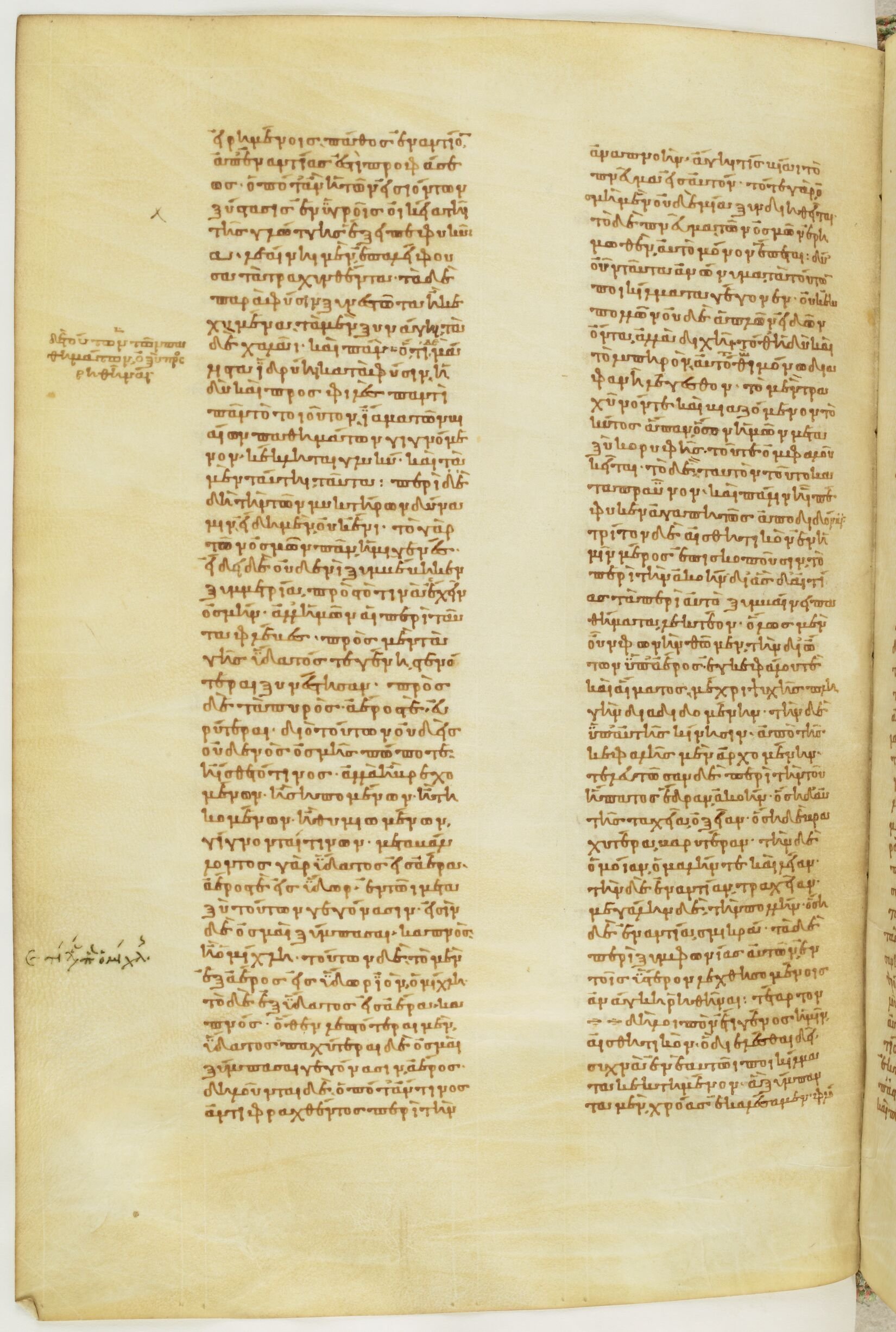
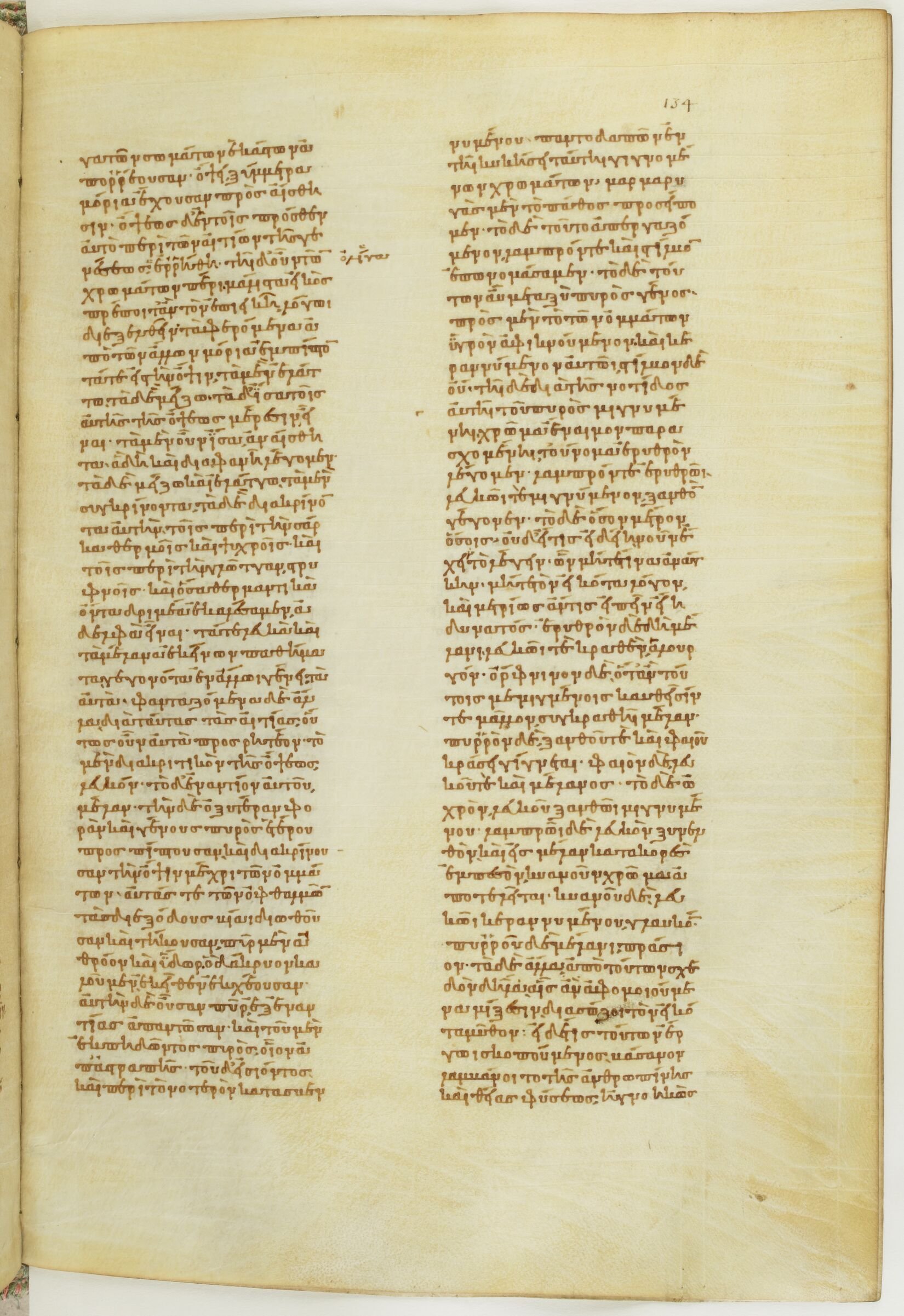
The manuscript is Paris, Bibliothèque nationale de France, grec 1807, known to editors as Plato A. It was copied in Constantinople around 850-875 by the scribe of the so-called philosophical collection, and is the oldest surviving medieval manuscript of the Timaeus and Critias (tetralogies VIII-IX: Clitophon, Republic, Timaeus, Critias, Minos, Laws, Epinomis, Letters). Each page has two columns of 44 lines. The Timaeus fills fol. 114r-144v and the Critias fol. 145r-151r.
On the manuscript this page of text runs over fol. 133v col. b to fol. 134r col. a. Each section below is linked to the folio side(s) that carry it. The mapping comes from reading the first words of every column on the images and finding them in Burnet's text: fol. 133v col. b begins ‹ἀναπνοὴν ἄγῃ τις βίᾳ τὸ πνεῦμα› (Tim. 66e); fol. 134r col. a begins ‹-γα τῶν σωμάτων ἑκάστων ἀπορρέουσαν, ὄψει› (Tim. 67c).
The Greek is John Burnet's critical text (Oxford, 1902), not a transcription of this manuscript; the scribe's spelling, accents and occasional readings differ from it. The English is R. G. Bury's Loeb translation (1929).
How was this verified? (Provenance)
Where on the image
Tim. 67a stands in Paris gr. 1807, fol. 133v col. b. Checked on the image (column openings read on the BnF photographs and found in Burnet's text, quoted in Burnet's spelling): fol. 133v col. b begins ‹ἀναπνοὴν ἄγῃ τις βίᾳ τὸ πνεῦμα› (Tim. 66e).
ἕπεται. δύʼ οὖν ταῦτα ἀνώνυμα τὰ τούτων ποικίλματα γέγονεν, οὐκ ἐκ πολλῶν οὐδὲ ἁπλῶν εἰδῶν ὄντα, ἀλλὰ διχῇ τό θʼ ἡδὺ καὶ τὸ λυπηρὸν αὐτόθι μόνω διαφανῆ λέγεσθον, τὸ μὲν τραχῦνόν τε καὶ βιαζόμενον τὸ κύτος ἅπαν, ὅσον ἡμῶν μεταξὺ κορυφῆς τοῦ τε ὀμφαλοῦ κεῖται, τὸ δὲ ταὐτὸν τοῦτο καταπραῧνον καὶ πάλιν ᾗ πέφυκεν ἀγαπητῶς ἀποδιδόν. τρίτον δὲ αἰσθητικὸν ἐν ἡμῖν μέρος ἐπισκοποῦσιν τὸ περὶ
not being derived either from many or from simple forms, but are indicated by two distinctive terms only, pleasant and painful of which the one kind roughens and violently affects the whole of our bodily cavity which lies between the head and the navel, whereas the other mollifies this same region and restores it agreeably to its natural condition. The third organ of perception within us which we have to describe in our survey is that of hearing,
Where on the image
Tim. 67b stands in Paris gr. 1807, fol. 133v col. b. Checked on the image (column openings read on the BnF photographs and found in Burnet's text, quoted in Burnet's spelling): fol. 133v col. b begins ‹ἀναπνοὴν ἄγῃ τις βίᾳ τὸ πνεῦμα› (Tim. 66e).
τὴν ἀκοήν, διʼ ἃς αἰτίας τὰ περὶ αὐτὸ συμβαίνει παθήματα, λεκτέον. ὅλως μὲν οὖν φωνὴν θῶμεν τὴν διʼ ὤτων ὑπʼ ἀέρος ἐγκεφάλου τε καὶ αἵματος μέχρι ψυχῆς πληγὴν διαδιδομένην, τὴν δὲ ὑπʼ αὐτῆς κίνησιν, ἀπὸ τῆς κεφαλῆς μὲν ἀρχομένην, τελευτῶσαν δὲ περὶ τὴν τοῦ ἥπατος ἕδραν, ἀκοήν· ὅση δʼ αὐτῆς ταχεῖα, ὀξεῖαν, ὅση δὲ βραδυτέρα, βαρυτέραν· τὴν δὲ ὁμοίαν ὁμαλήν τε καὶ λείαν, τὴν δὲ ἐναντίαν τραχεῖαν·
and the causes whereby its affections are produced. In general, then, let us lay it down that sound is a stroke transmitted through the ears, by the action of the air upon the brain and the blood, and reaching to the soul; and that the motion caused thereby, which begins in the head and ends about the seat of the liver, is hearing; and that every rapid motion produces a shrill sound, and every slower motion a more deep sound; and that uniform motion produces an even and smooth sound and the opposite kind of motion a harsh sound;
Where on the image
Tim. 67c stands in Paris gr. 1807, fol. 133v col. b to fol. 134r col. a. Checked on the image (column openings read on the BnF photographs and found in Burnet's text, quoted in Burnet's spelling): fol. 133v col. b begins ‹ἀναπνοὴν ἄγῃ τις βίᾳ τὸ πνεῦμα› (Tim. 66e); fol. 134r col. a begins ‹-γα τῶν σωμάτων ἑκάστων ἀπορρέουσαν, ὄψει› (Tim. 67c).
μεγάλην δὲ τὴν πολλήν, ὅση δὲ ἐναντία, σμικράν. τὰ δὲ περὶ συμφωνίας αὐτῶν ἐν τοῖς ὕστερον λεχθησομένοις ἀνάγκη ῥηθῆναι. τέταρτον δὴ λοιπὸν ἔτι γένος ἡμῖν αἰσθητικόν, ὃ διελέσθαι δεῖ συχνὰ ἐν ἑαυτῷ ποικίλματα κεκτημένον, ἃ σύμπαντα μὲν χρόας ἐκαλέσαμεν, φλόγα τῶν σωμάτων ἑκάστων ἀπορρέουσαν, ὄψει σύμμετρα μόρια ἔχουσαν πρὸς αἴσθησιν· ὄψεως δʼ ἐν τοῖς πρόσθεν αὐτὸ περὶ τῶν αἰτίων τῆς γενέσεως
and that large motion produces loud sound, and motion of the opposite kind soft sound. The subject of concords of sounds must necessarily be treated in a later part of our exposition. We have still remaining a fourth kind of sensation, which we must divide up seeing that it embraces numerous varieties, which, as a whole, we call colors. This consists of a flame which issues from the several bodies, and possesses particles so proportioned to the visual stream as to produce sensation; and as regards the visual stream, we have already stated merely the causes which produced it.
Where on the image
Tim. 67d stands in Paris gr. 1807, fol. 134r col. a. Checked on the image (column openings read on the BnF photographs and found in Burnet's text, quoted in Burnet's spelling): fol. 134r col. a begins ‹-γα τῶν σωμάτων ἑκάστων ἀπορρέουσαν, ὄψει› (Tim. 67c).
ἐρρήθη. τῇδʼ οὖν τῶν χρωμάτων πέρι μάλιστα εἰκὸς πρέποι τʼ ἂν ἐπιεικεῖ λόγῳ διεξελθεῖν· τὰ φερόμενα ἀπὸ τῶν ἄλλων μόρια ἐμπίπτοντά τε εἰς τὴν ὄψιν τὰ μὲν ἐλάττω, τὰ δὲ μείζω, τὰ δʼ ἴσα τοῖς αὐτῆς τῆς ὄψεως μέρεσιν εἶναι· τὰ μὲν οὖν ἴσα ἀναίσθητα, ἃ δὴ καὶ διαφανῆ λέγομεν, τὰ δὲ μείζω καὶ ἐλάττω, τὰ μὲν συγκρίνοντα, τὰ δὲ διακρίνοντα αὐτήν, τοῖς περὶ τὴν σάρκα θερμοῖς καὶ ψυχροῖς καὶ τοῖς
Concerning colors, then, the following explanation will be the most probable and worthy of a judicious account. Of the particles which fly off from the rest and strike into the visual stream some are smaller, some larger, and some equal to the particles of the stream itself; those, then, that are equal are imperceptible, and we term them transparent; while the larger and smaller particles—of which the one kind contracts, the other dilates the visual stream—are akin to the particles of heat and cold which affect the flesh,
Where on the image
Tim. 67e stands in Paris gr. 1807, fol. 134r col. a. Checked on the image (column openings read on the BnF photographs and found in Burnet's text, quoted in Burnet's spelling): fol. 134r col. a begins ‹-γα τῶν σωμάτων ἑκάστων ἀπορρέουσαν, ὄψει› (Tim. 67c).
περὶ τὴν γλῶτταν στρυφνοῖς, καὶ ὅσα θερμαντικὰ ὄντα δριμέα ἐκαλέσαμεν, ἀδελφὰ εἶναι, τά τε λευκὰ καὶ τὰ μέλανα, ἐκείνων παθήματα γεγονότα ἐν ἄλλῳ γένει τὰ αὐτά, φανταζόμενα δὲ ἄλλα διὰ ταύτας τὰς αἰτίας.
οὕτως οὖν αὐτὰ προσρητέον· τὸ μὲν διακριτικὸν τῆς ὄψεως λευκόν, τὸ δʼ ἐναντίον αὐτοῦ μέλαν, τὴν δὲ ὀξυτέραν φορὰν καὶ γένους πυρὸς ἑτέρου προσπίπτουσαν καὶ διακρίνουσαν τὴν ὄψιν μέχρι τῶν ὀμμάτων, αὐτάς τε τῶν ὀφθαλμῶν τὰς διεξόδους
and to the astringent particles which affect the tongue, and to all the heating particles which we call bitter with these white and black are really identical affections, occurring in a separate class of sensation, although they appear different for the causes stated.
These, therefore, are the names we must assign to them: that which dilates the visual stream is white and the opposite thereof black; and the more rapid motion, being that of a different species of fire, which strikes upon the visual stream and dilates it as far as to the eyes, and penetrating
Notes
- Greek: John Burnet, Platonis Opera IV (Oxford, 1902), via Perseus canonical-greekLit; Burnet's text is a critical edition, so its wording can differ from the manuscript shown.
- English: R. G. Bury, Plato IX (Loeb Classical Library, 1929), via Perseus. Bury's footnotes are not reproduced. Quotation marks stand where Perseus marks quoted speech.
- Stephanus sections (a-e) are those of the 1578 Stephanus edition as given by Burnet and Bury; Bury's section breaks can fall a few words away from Burnet's because English word order differs.
Cite
Sources
- Source: Paris, BnF grec 1807 (Plato A, c. 850-875) fol. 133v-134r via BnF IIIF + Burnet's Greek (Perseus) + R. G. Bury's English (Loeb 1929, Perseus) (holding institution)
- Critical edition: Burnet, Platonis Opera IV (1902), via Perseus
← previous · → next · v cycle view · l back to library