Plato, Timaeus 68a-68e: the colours and their mixtures
Introduction
Stephanus page 68 of Plato's Timaeus (68a-68e): the colours and their mixtures.
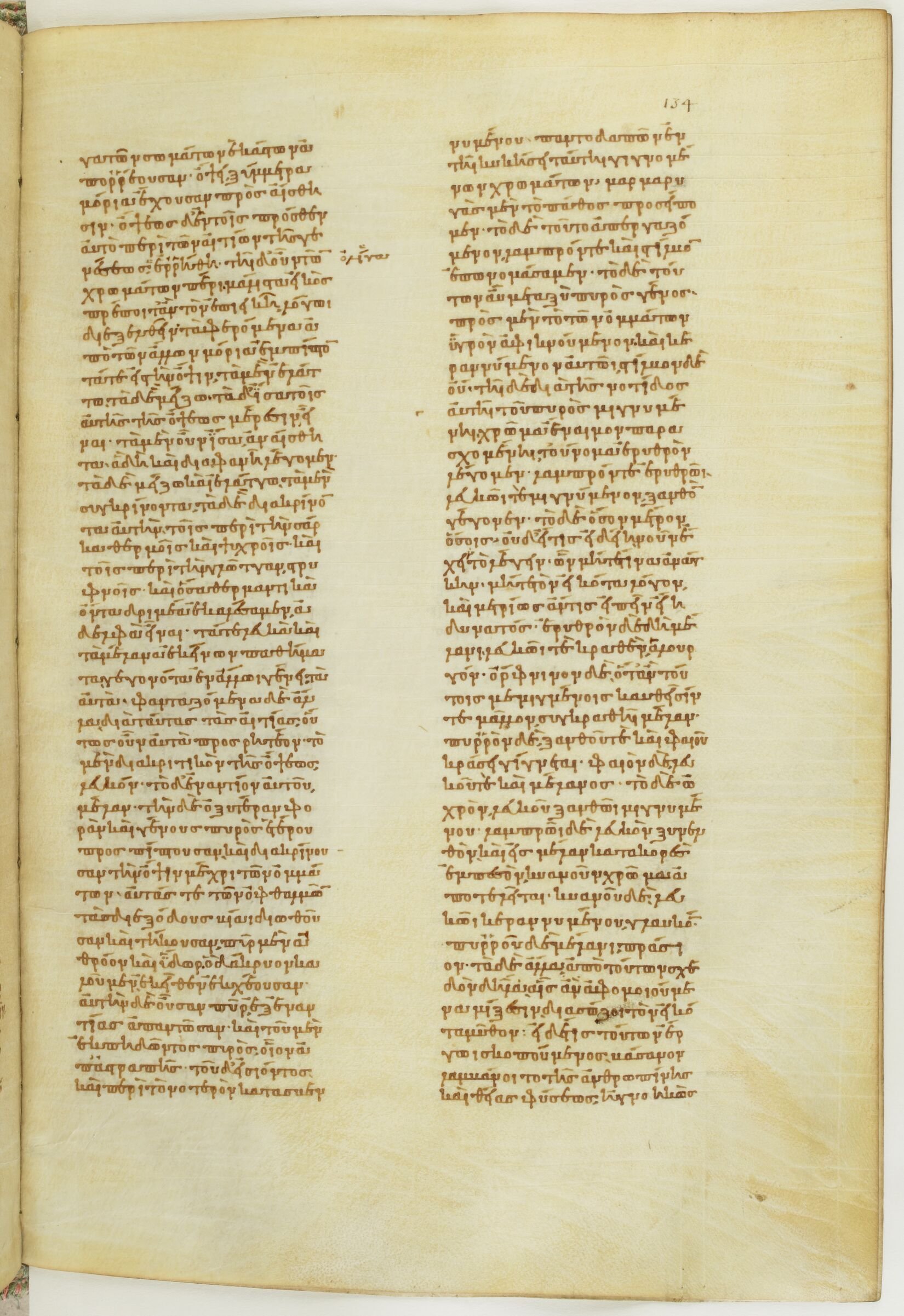
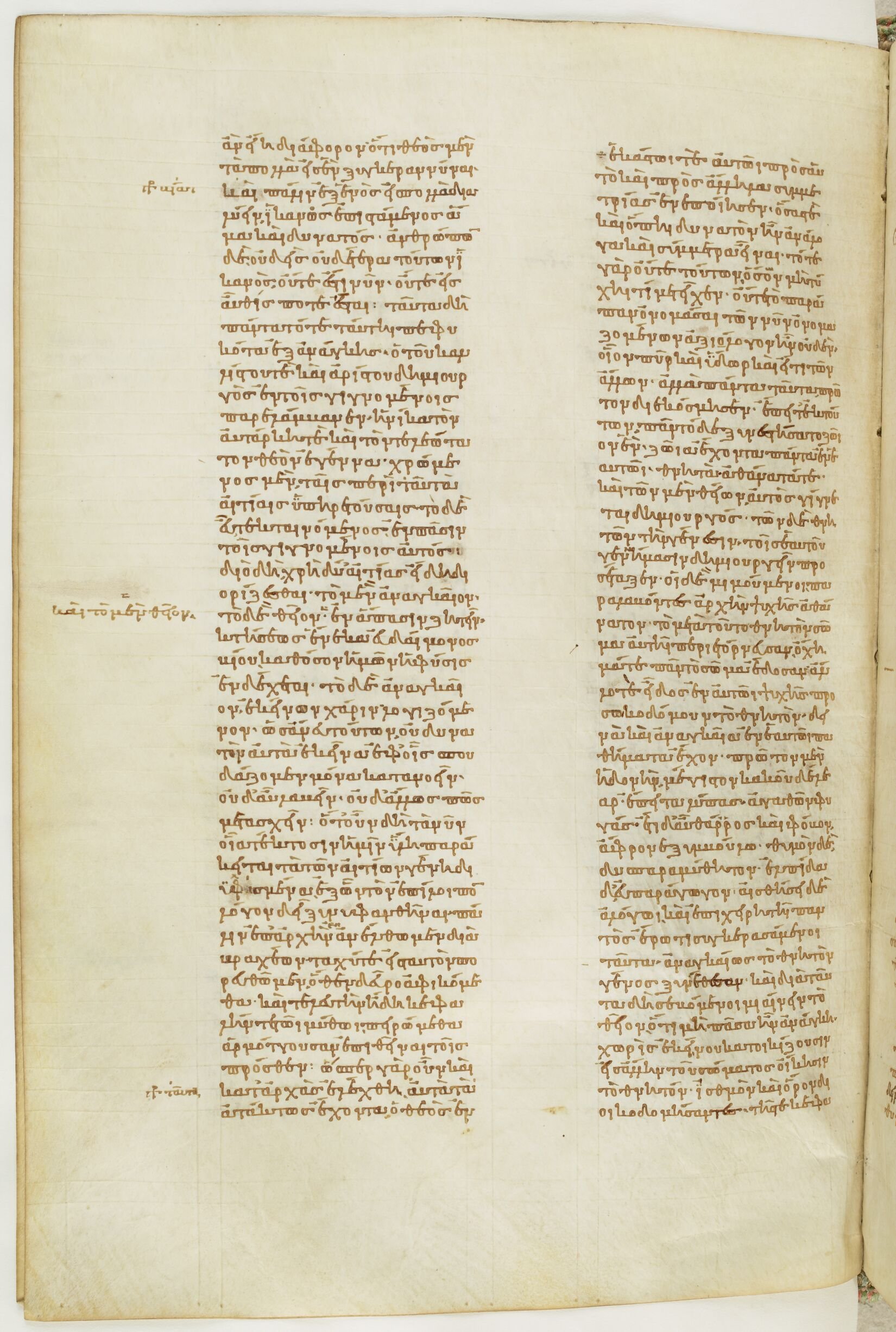
The manuscript is Paris, Bibliothèque nationale de France, grec 1807, known to editors as Plato A. It was copied in Constantinople around 850-875 by the scribe of the so-called philosophical collection, and is the oldest surviving medieval manuscript of the Timaeus and Critias (tetralogies VIII-IX: Clitophon, Republic, Timaeus, Critias, Minos, Laws, Epinomis, Letters). Each page has two columns of 44 lines. The Timaeus fills fol. 114r-144v and the Critias fol. 145r-151r.
On the manuscript this page of text runs over fol. 134r col. a to fol. 134v col. a. Each section below is linked to the folio side(s) that carry it. The mapping comes from reading the first words of every column on the images and finding them in Burnet's text: fol. 134r col. a begins ‹-γα τῶν σωμάτων ἑκάστων ἀπορρέουσαν, ὄψει› (Tim. 67c); fol. 134r col. b begins ‹-νυμένου, παντοδαπῶν ἐν τῇ κυκήσει ταύτῃ› (Tim. 68a); fol. 134v col. a begins ‹ἂν εἴη διάφορον, ὅτι θεὸς μὲν› (Tim. 68d).
The Greek is John Burnet's critical text (Oxford, 1902), not a transcription of this manuscript; the scribe's spelling, accents and occasional readings differ from it. The English is R. G. Bury's Loeb translation (1929).
How was this verified? (Provenance)
Where on the image
Tim. 68a stands in Paris gr. 1807, fol. 134r col. a to fol. 134r col. b. Checked on the image (column openings read on the BnF photographs and found in Burnet's text, quoted in Burnet's spelling): fol. 134r col. a begins ‹-γα τῶν σωμάτων ἑκάστων ἀπορρέουσαν, ὄψει› (Tim. 67c); fol. 134r col. b begins ‹-νυμένου, παντοδαπῶν ἐν τῇ κυκήσει ταύτῃ› (Tim. 68a).
βίᾳ διωθοῦσαν καὶ τήκουσαν, πῦρ μὲν ἁθρόον καὶ ὕδωρ, ὃ δάκρυον καλοῦμεν, ἐκεῖθεν ἐκχέουσαν, αὐτὴν δὲ οὖσαν πῦρ ἐξ ἐναντίας ἀπαντῶσαν, καὶ τοῦ μὲν ἐκπηδῶντος πυρὸς οἷον ἀπʼ ἀστραπῆς, τοῦ δʼ εἰσιόντος καὶ περὶ τὸ νοτερὸν κατασβεννυμένου, παντοδαπῶν ἐν τῇ κυκήσει ταύτῃ γιγνομένων χρωμάτων, μαρμαρυγὰς μὲν τὸ πάθος προσείπομεν, τὸ δὲ τοῦτο ἀπεργαζόμενον λαμπρόν τε καὶ στίλβον ἐπωνομάσαμεν.
and dissolving the very passages of the eyes causes a volume of fire and water to pour from them, which we call tears. And this moving body, being itself fire, meets fire from the opposite direction; and as the one firestream is leaping out like a flash, and the other passing in and being quenched in the moisture, in the resultant mixture colors of all kinds are produced. This sensation we term dazzling and the object which causes it bright or brilliant. Again, when the kind of fire
Where on the image
Tim. 68b stands in Paris gr. 1807, fol. 134r col. b. Checked on the image (column openings read on the BnF photographs and found in Burnet's text, quoted in Burnet's spelling): fol. 134r col. b begins ‹-νυμένου, παντοδαπῶν ἐν τῇ κυκήσει ταύτῃ› (Tim. 68a).
τὸ δὲ τούτων αὖ μεταξὺ πυρὸς γένος, πρὸς μὲν τὸ τῶν ὀμμάτων ὑγρὸν ἀφικνούμενον καὶ κεραννύμενον αὐτῷ, στίλβον δὲ οὔ· τῇ δὲ διὰ τῆς νοτίδος αὐγῇ τοῦ πυρὸς μειγνυμένου χρῶμα ἔναιμον παρασχομένῃ, τοὔνομα ἐρυθρὸν λέγομεν. λαμπρόν τε ἐρυθρῷ λευκῷ τε μειγνύμενον ξανθὸν γέγονεν· τὸ δὲ ὅσον μέτρον ὅσοις, οὐδʼ εἴ τις εἰδείη, νοῦν ἔχει τὸ λέγειν, ὧν μήτε τινὰ ἀνάγκην μήτε τὸν εἰκότα λόγον καὶ μετρίως ἄν τις εἰπεῖν εἴη δυνατός. ἐρυθρὸν δὲ δὴ
which is midway between these reaches to the liquid of the eyes and is mingled therewith, it is not brilliant but, owing to the blending of the fire’s ray through the moisture, it gives off a sanguine color, and we give it the name of red. And bright color when blended with red and white becomes yellow. But in what proportions the colors are blended it were foolish to declare, even if one knew, seeing that in such matters one could not properly adduce any necessary ground or probable reason. Red blended with black and white makes purple;
Where on the image
Tim. 68c stands in Paris gr. 1807, fol. 134r col. b. Checked on the image (column openings read on the BnF photographs and found in Burnet's text, quoted in Burnet's spelling): fol. 134r col. b begins ‹-νυμένου, παντοδαπῶν ἐν τῇ κυκήσει ταύτῃ› (Tim. 68a).
μέλανι λευκῷ τε κραθὲν ἁλουργόν· ὄρφνινον δέ, ὅταν τούτοις μεμειγμένοις καυθεῖσίν τε μᾶλλον συγκραθῇ μέλαν. πυρρὸν δὲ ξανθοῦ τε καὶ φαιοῦ κράσει γίγνεται, φαιὸν δὲ λευκοῦ τε καὶ μέλανος, τὸ δὲ ὠχρὸν λευκοῦ ξανθῷ μειγνυμένου. λαμπρῷ δὲ λευκὸν συνελθὸν καὶ εἰς μέλαν κατακορὲς ἐμπεσὸν κυανοῦν χρῶμα ἀποτελεῖται, κυανοῦ δὲ λευκῷ κεραννυμένου γλαυκόν, πυρροῦ δὲ μέλανι πράσιον. τὰ δὲ
but when these colors are mixed and more completely burned, and black is blended therewith, the result is violet. Chestnut comes from the blending of yellow and grey; and grey from white and black; and ochre from white mixed with yellow. And when white is combined with bright and is steeped in deep black it turns into a dark blue color; and dark blue mixed with white becomes light blue; and chestnut with black becomes green. As to the rest, it is fairly clear from these examples
Where on the image
Tim. 68d stands in Paris gr. 1807, fol. 134r col. b to fol. 134v col. a. Checked on the image (column openings read on the BnF photographs and found in Burnet's text, quoted in Burnet's spelling): fol. 134r col. b begins ‹-νυμένου, παντοδαπῶν ἐν τῇ κυκήσει ταύτῃ› (Tim. 68a); fol. 134v col. a begins ‹ἂν εἴη διάφορον, ὅτι θεὸς μὲν› (Tim. 68d).
ἄλλα ἀπὸ τούτων σχεδὸν δῆλα αἷς ἂν ἀφομοιούμενα μείξεσιν διασῴζοι τὸν εἰκότα μῦθον. εἰ δέ τις τούτων ἔργῳ σκοπούμενος βάσανον λαμβάνοι, τὸ τῆς ἀνθρωπίνης καὶ θείας φύσεως ἠγνοηκὼς ἂν εἴη διάφορον, ὅτι θεὸς μὲν τὰ πολλὰ εἰς ἓν συγκεραννύναι καὶ πάλιν ἐξ ἑνὸς εἰς πολλὰ διαλύειν ἱκανῶς ἐπιστάμενος ἅμα καὶ δυνατός, ἀνθρώπων δὲ οὐδεὶς οὐδέτερα τούτων ἱκανὸς οὔτε ἔστι νῦν οὔτε εἰς αὖθίς ποτε ἔσται.
what are the mixtures with which we ought to identify them if we would preserve probability in our account. But should any inquirer make an experimental test of these facts, he would evince his ignorance of the difference between man’s nature and Gods—how that, whereas God is sufficiently wise and powerful to blend the many into one and to dissolve again the one into many, there exists not now, nor ever will exist hereafter, a child of man sufficient for either of these tasks.
Where on the image
Tim. 68e stands in Paris gr. 1807, fol. 134v col. a. Checked on the image (column openings read on the BnF photographs and found in Burnet's text, quoted in Burnet's spelling): fol. 134v col. a begins ‹ἂν εἴη διάφορον, ὅτι θεὸς μὲν› (Tim. 68d).
ταῦτα δὴ πάντα τότε ταύτῃ πεφυκότα ἐξ ἀνάγκης ὁ τοῦ καλλίστου τε καὶ ἀρίστου δημιουργὸς ἐν τοῖς γιγνομένοις παρελάμβανεν, ἡνίκα τὸν αὐτάρκη τε καὶ τὸν τελεώτατον θεὸν ἐγέννα, χρώμενος μὲν ταῖς περὶ ταῦτα αἰτίαις ὑπηρετούσαις, τὸ δὲ εὖ τεκταινόμενος ἐν πᾶσιν τοῖς γιγνομένοις αὐτός.
διὸ δὴ χρὴ δύʼ αἰτίας εἴδη διορίζεσθαι, τὸ μὲν ἀναγκαῖον, τὸ δὲ θεῖον, καὶ τὸ μὲν θεῖον ἐν ἅπασιν ζητεῖν
Such, then, being the necessary nature of all these things, the Artificer of the most fair and good took them over at that time amongst things generated when He was engendering the self-sufficing and most perfect God; and their inherent properties he used as subservient causes, but Himself designed the Good in all that was being generated.
Wherefore one ought to distinguish two kinds of causes, the necessary and the divine, and in all things to seek after the divine for the sake of gaining a life of blessedness, so far as our nature admits thereof,
Notes
- Greek: John Burnet, Platonis Opera IV (Oxford, 1902), via Perseus canonical-greekLit; Burnet's text is a critical edition, so its wording can differ from the manuscript shown.
- English: R. G. Bury, Plato IX (Loeb Classical Library, 1929), via Perseus. Bury's footnotes are not reproduced. Quotation marks stand where Perseus marks quoted speech.
- Stephanus sections (a-e) are those of the 1578 Stephanus edition as given by Burnet and Bury; Bury's section breaks can fall a few words away from Burnet's because English word order differs.
Cite
Sources
- Source: Paris, BnF grec 1807 (Plato A, c. 850-875) fol. 134r-134v via BnF IIIF + Burnet's Greek (Perseus) + R. G. Bury's English (Loeb 1929, Perseus) (holding institution)
- Critical edition: Burnet, Platonis Opera IV (1902), via Perseus
← previous · → next · v cycle view · l back to library