Plato, Timaeus 69a-69e: the two kinds of cause; the mortal soul placed in the chest
Introduction
Stephanus page 69 of Plato's Timaeus (69a-69e): the two kinds of cause; the mortal soul placed in the chest.
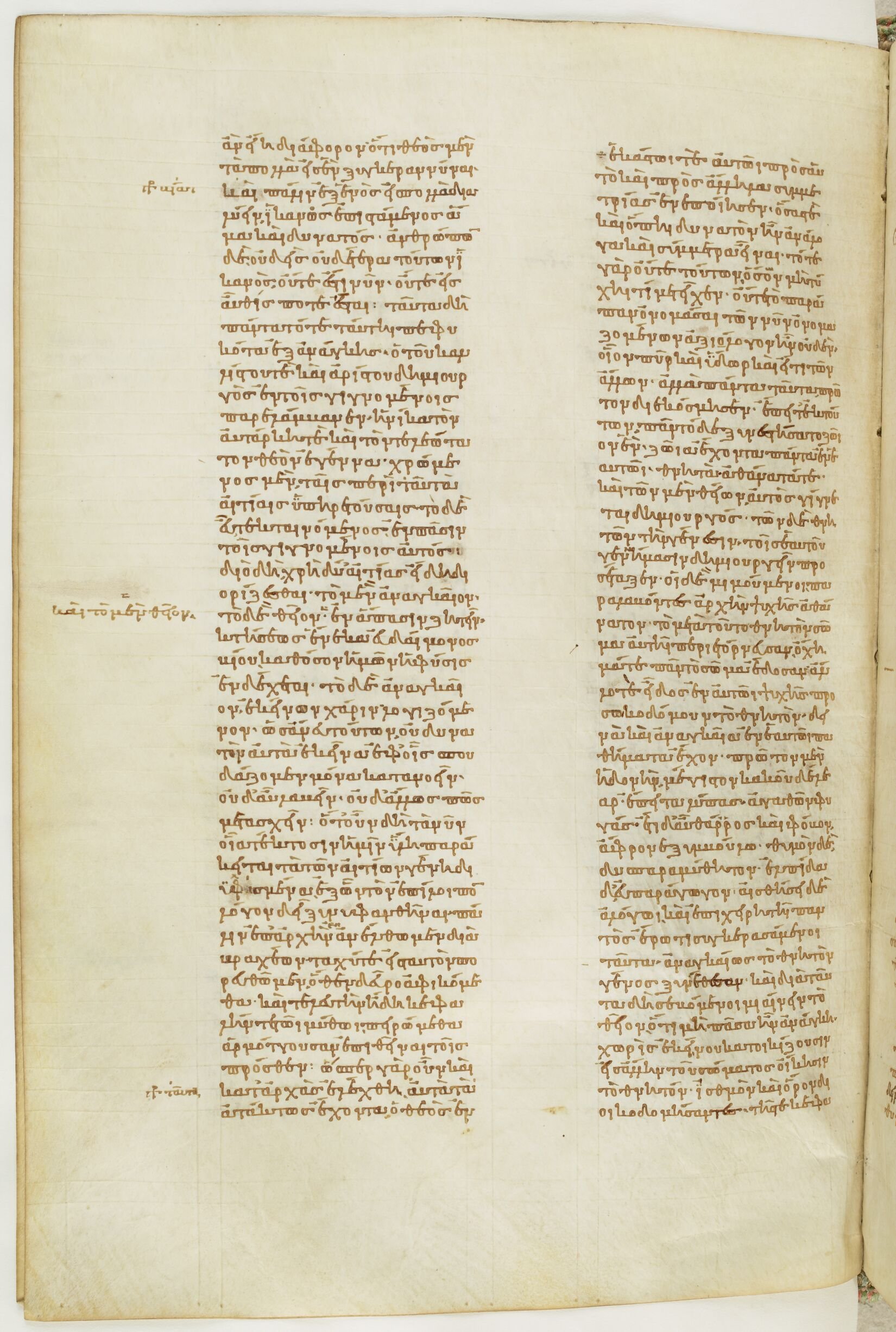
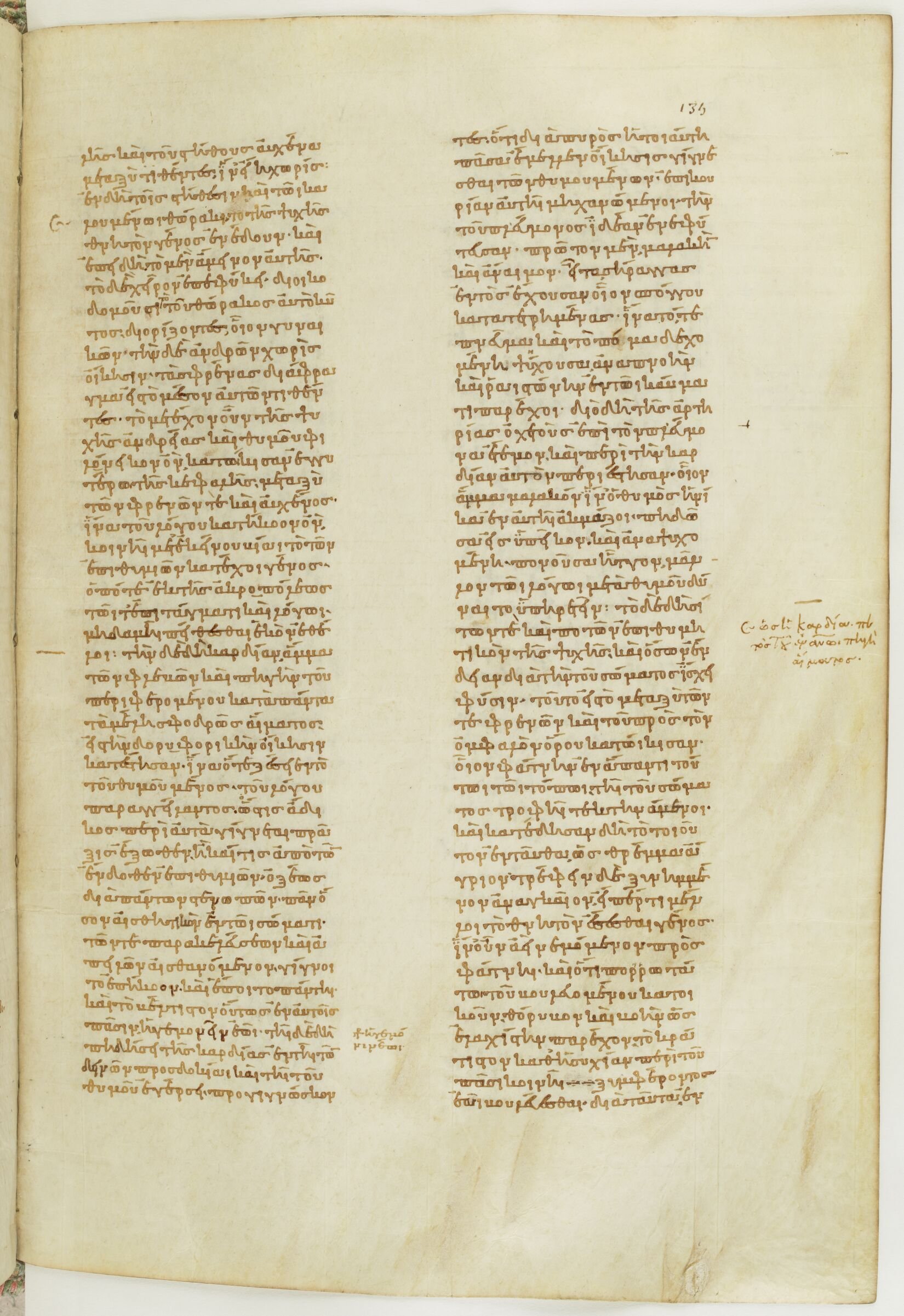
The manuscript is Paris, Bibliothèque nationale de France, grec 1807, known to editors as Plato A. It was copied in Constantinople around 850-875 by the scribe of the so-called philosophical collection, and is the oldest surviving medieval manuscript of the Timaeus and Critias (tetralogies VIII-IX: Clitophon, Republic, Timaeus, Critias, Minos, Laws, Epinomis, Letters). Each page has two columns of 44 lines. The Timaeus fills fol. 114r-144v and the Critias fol. 145r-151r.
On the manuscript this page of text runs over fol. 134v col. a to fol. 135r col. a. Each section below is linked to the folio side(s) that carry it. The mapping comes from reading the first words of every column on the images and finding them in Burnet's text: fol. 134v col. a begins ‹ἂν εἴη διάφορον, ὅτι θεὸς μὲν› (Tim. 68d); fol. 134v col. b begins ‹ἑκάστῳ τε αὐτῷ πρὸς αὑτὸ καὶ› (Tim. 69b); fol. 135r col. a begins ‹καὶ τοῦ στήθους, αὐχένα μεταξὺ τιθέντες› (Tim. 69e).
The Greek is John Burnet's critical text (Oxford, 1902), not a transcription of this manuscript; the scribe's spelling, accents and occasional readings differ from it. The English is R. G. Bury's Loeb translation (1929).
How was this verified? (Provenance)
Where on the image
Tim. 69a stands in Paris gr. 1807, fol. 134v col. a. Checked on the image (column openings read on the BnF photographs and found in Burnet's text, quoted in Burnet's spelling): fol. 134v col. a begins ‹ἂν εἴη διάφορον, ὅτι θεὸς μὲν› (Tim. 68d).
κτήσεως ἕνεκα εὐδαίμονος βίου, καθʼ ὅσον ἡμῶν ἡ φύσις ἐνδέχεται, τὸ δὲ ἀναγκαῖον ἐκείνων χάριν, λογιζόμενον ὡς ἄνευ τούτων οὐ δυνατὰ αὐτὰ ἐκεῖνα ἐφʼ οἷς σπουδάζομεν μόνα κατανοεῖν οὐδʼ αὖ λαβεῖν οὐδʼ ἄλλως πως μετασχεῖν. ὅτʼ οὖν δὴ τὰ νῦν οἷα τέκτοσιν ἡμῖν ὕλη παράκειται τὰ τῶν αἰτίων γένη διυλισμένα, ἐξ ὧν τὸν ἐπίλοιπον λόγον δεῖ συνυφανθῆναι, πάλιν ἐπʼ ἀρχὴν ἐπανέλθωμεν διὰ βραχέων, ταχύ τε εἰς ταὐτὸν πορευθῶμεν ὅθεν δεῦρο ἀφικόμεθα,
and to seek the necessary for the sake of the divine, reckoning that without the former it is impossible to discern by themselves alone the divine objects after which we strive, or to apprehend them or in any way partake thereof. Seeing, then, that we have now lying before us and thoroughly sifted—like wood ready for the joiner, —the various kinds of causes, out of which the rest of our account must be woven together, let us once more for a moment revert to our starting-point, and thence proceed rapidly to the point
Where on the image
Tim. 69b stands in Paris gr. 1807, fol. 134v col. a to fol. 134v col. b. Checked on the image (column openings read on the BnF photographs and found in Burnet's text, quoted in Burnet's spelling): fol. 134v col. a begins ‹ἂν εἴη διάφορον, ὅτι θεὸς μὲν› (Tim. 68d); fol. 134v col. b begins ‹ἑκάστῳ τε αὐτῷ πρὸς αὑτὸ καὶ› (Tim. 69b).
καὶ τελευτὴν ἤδη κεφαλήν τε τῷ μύθῳ πειρώμεθα ἁρμόττουσαν ἐπιθεῖναι τοῖς πρόσθεν. ὥσπερ γὰρ οὖν καὶ κατʼ ἀρχὰς ἐλέχθη, ταῦτα ἀτάκτως ἔχοντα ὁ θεὸς ἐν ἑκάστῳ τε αὐτῷ πρὸς αὑτὸ καὶ πρὸς ἄλληλα συμμετρίας ἐνεποίησεν, ὅσας τε καὶ ὅπῃ δυνατὸν ἦν ἀνάλογα καὶ σύμμετρα εἶναι. τότε γὰρ οὔτε τούτων, ὅσον μὴ τύχῃ, τι μετεῖχεν, οὔτε τὸ παράπαν ὀνομάσαι τῶν νῦν ὀνομαζομένων ἀξιόλογον ἦν οὐδέν, οἷον πῦρ καὶ ὕδωρ καὶ εἴ τι τῶν ἄλλων· ἀλλὰ πάντα ταῦτα
from which we arrived hither. In this way we shall endeavor now to supplement our story with a conclusion and a crown in harmony with what has gone before. As we stated at the commencement, all these things were in a state of disorder, when God implanted in them proportions both severally in relation to themselves and in their relations to one another, so far as it was in any way possible for them to be in harmony and proportion. For at that time nothing partook thereof, save by accident, nor was it possible to name anything worth mentioning which bore the names we now give them, such as fire and water,
Where on the image
Tim. 69c stands in Paris gr. 1807, fol. 134v col. b. Checked on the image (column openings read on the BnF photographs and found in Burnet's text, quoted in Burnet's spelling): fol. 134v col. b begins ‹ἑκάστῳ τε αὐτῷ πρὸς αὑτὸ καὶ› (Tim. 69b).
πρῶτον διεκόσμησεν, ἔπειτʼ ἐκ τούτων πᾶν τόδε συνεστήσατο, ζῷον ἓν ζῷα ἔχον τὰ πάντα ἐν ἑαυτῷ θνητὰ ἀθάνατά τε. καὶ τῶν μὲν θείων αὐτὸς γίγνεται δημιουργός, τῶν δὲ θνητῶν τὴν γένεσιν τοῖς ἑαυτοῦ γεννήμασιν δημιουργεῖν προσέταξεν. οἱ δὲ μιμούμενοι, παραλαβόντες ἀρχὴν ψυχῆς ἀθάνατον, τὸ μετὰ τοῦτο θνητὸν σῶμα αὐτῇ περιετόρνευσαν ὄχημά τε πᾶν τὸ σῶμα ἔδοσαν ἄλλο τε εἶδος ἐν αὐτῷ ψυχῆς προσῳκοδόμουν τὸ θνητόν, δεινὰ καὶ ἀναγκαῖα ἐν ἑαυτῷ
or any of the other elements; but He, in the first place, set all these in order, and then out of these He constructed this present Universe, one single Living Creature containing within itself all living creatures both mortal and immortal. And He Himself acts as the Constructor of things divine, but the structure of the mortal things He commanded His own engendered sons to execute. And they, imitating Him, on receiving the immortal principle of soul, framed around it a mortal body, and gave it all the body to be its vehicle, and housed therein besides another form of soul, even the mortal form,
Where on the image
Tim. 69d stands in Paris gr. 1807, fol. 134v col. b. Checked on the image (column openings read on the BnF photographs and found in Burnet's text, quoted in Burnet's spelling): fol. 134v col. b begins ‹ἑκάστῳ τε αὐτῷ πρὸς αὑτὸ καὶ› (Tim. 69b).
παθήματα ἔχον, πρῶτον μὲν ἡδονήν, μέγιστον κακοῦ δέλεαρ, ἔπειτα λύπας, ἀγαθῶν φυγάς, ἔτι δʼ αὖ θάρρος καὶ φόβον, ἄφρονε συμβούλω, θυμὸν δὲ δυσπαραμύθητον, ἐλπίδα δʼ εὐπαράγωγον· αἰσθήσει δὲ ἀλόγῳ καὶ ἐπιχειρητῇ παντὸς ἔρωτι συγκερασάμενοι ταῦτα, ἀναγκαίως τὸ θνητὸν γένος συνέθεσαν. καὶ διὰ ταῦτα δὴ σεβόμενοι μιαίνειν τὸ θεῖον, ὅτι μὴ πᾶσα ἦν ἀνάγκη, χωρὶς ἐκείνου κατοικίζουσιν εἰς
which has within it passions both fearful and unavoidable—firstly, pleasure, a most mighty lure to evil; next, pains, which put good to rout; and besides these, rashness and fear, foolish counsellors both and anger, hard to dissuade; and hope, ready to seduce. And blending these with irrational sensation and with all-daring lust, they thus compounded in necessary fashion the mortal kind of soul. Wherefore, since they scrupled to pollute the divine, unless through absolute necessity,
Where on the image
Tim. 69e stands in Paris gr. 1807, fol. 134v col. b to fol. 135r col. a. Checked on the image (column openings read on the BnF photographs and found in Burnet's text, quoted in Burnet's spelling): fol. 134v col. b begins ‹ἑκάστῳ τε αὐτῷ πρὸς αὑτὸ καὶ› (Tim. 69b); fol. 135r col. a begins ‹καὶ τοῦ στήθους, αὐχένα μεταξὺ τιθέντες› (Tim. 69e).
ἄλλην τοῦ σώματος οἴκησιν τὸ θνητόν, ἰσθμὸν καὶ ὅρον διοικοδομήσαντες τῆς τε κεφαλῆς καὶ τοῦ στήθους, αὐχένα μεταξὺ τιθέντες, ἵνʼ εἴη χωρίς. ἐν δὴ τοῖς στήθεσιν καὶ τῷ καλουμένῳ θώρακι τὸ τῆς ψυχῆς θνητὸν γένος ἐνέδουν.
καὶ ἐπειδὴ τὸ μὲν ἄμεινον αὐτῆς, τὸ δὲ χεῖρον ἐπεφύκει, διοικοδομοῦσι τοῦ θώρακος αὖ τὸ κύτος, διορίζοντες οἷον
they planted the mortal kind apart therefrom in another chamber of the body, building an isthmus and boundary for the head and chest by setting between them the neck, to the end that they might remain apart. And within the chest—or thorax, as it is called—they fastened the mortal kind of soul.
And inasmuch as one part thereof is better, and one worse, they built a division within the cavity of the thorax—
Notes
- Greek: John Burnet, Platonis Opera IV (Oxford, 1902), via Perseus canonical-greekLit; Burnet's text is a critical edition, so its wording can differ from the manuscript shown.
- English: R. G. Bury, Plato IX (Loeb Classical Library, 1929), via Perseus. Bury's footnotes are not reproduced. Quotation marks stand where Perseus marks quoted speech.
- Stephanus sections (a-e) are those of the 1578 Stephanus edition as given by Burnet and Bury; Bury's section breaks can fall a few words away from Burnet's because English word order differs.
Cite
Sources
- Source: Paris, BnF grec 1807 (Plato A, c. 850-875) fol. 134v-135r via BnF IIIF + Burnet's Greek (Perseus) + R. G. Bury's English (Loeb 1929, Perseus) (holding institution)
- Critical edition: Burnet, Platonis Opera IV (1902), via Perseus
← previous · → next · v cycle view · l back to library