Plato, Timaeus 70a-70e: the heart and lungs; the appetite below the midriff
Introduction
Stephanus page 70 of Plato's Timaeus (70a-70e): the heart and lungs; the appetite below the midriff.
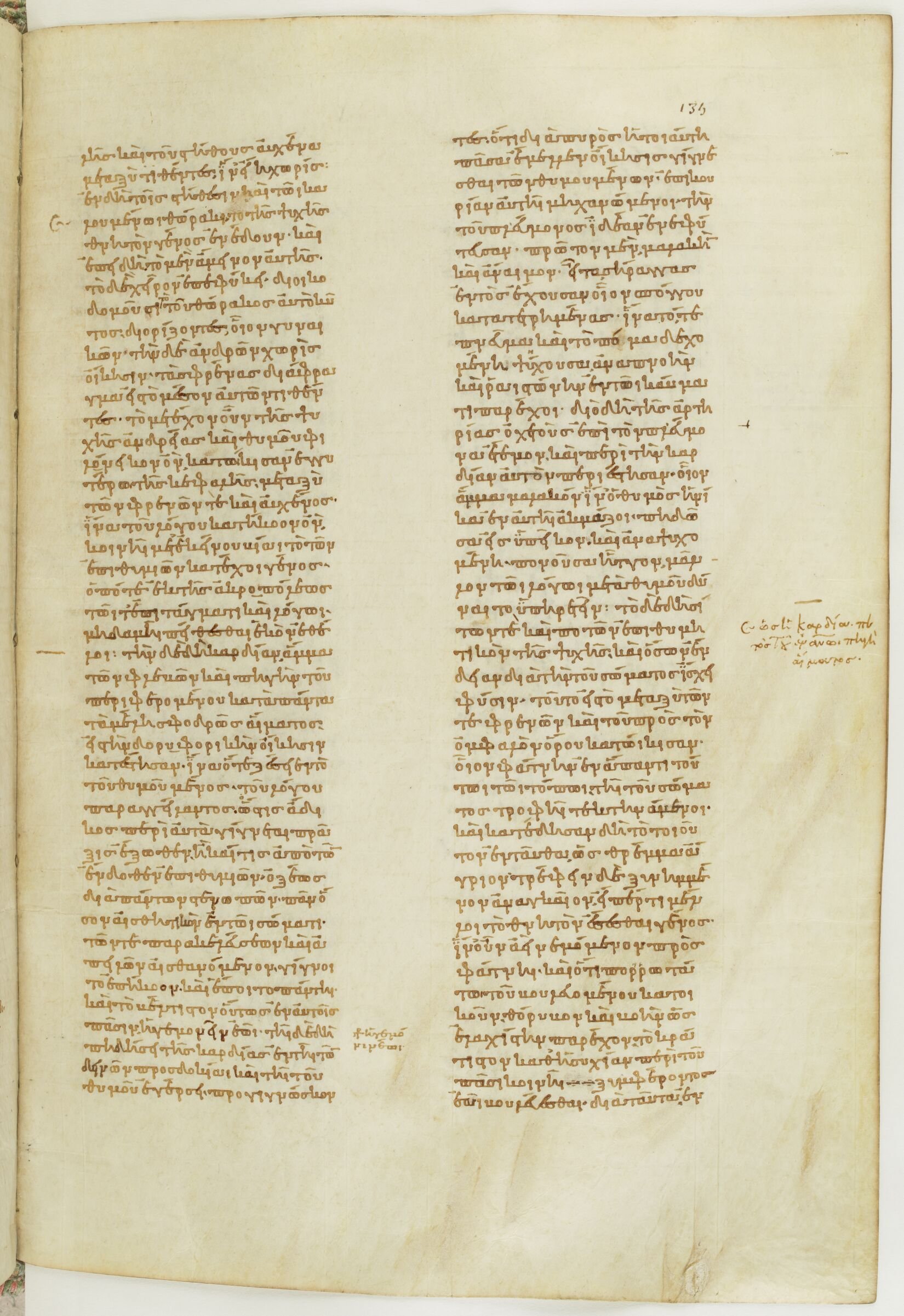
The manuscript is Paris, Bibliothèque nationale de France, grec 1807, known to editors as Plato A. It was copied in Constantinople around 850-875 by the scribe of the so-called philosophical collection, and is the oldest surviving medieval manuscript of the Timaeus and Critias (tetralogies VIII-IX: Clitophon, Republic, Timaeus, Critias, Minos, Laws, Epinomis, Letters). Each page has two columns of 44 lines. The Timaeus fills fol. 114r-144v and the Critias fol. 145r-151r.
On the manuscript this page of text runs over fol. 135r col. a to fol. 135r col. b. Each section below is linked to the folio side(s) that carry it. The mapping comes from reading the first words of every column on the images and finding them in Burnet's text: fol. 135r col. a begins ‹καὶ τοῦ στήθους, αὐχένα μεταξὺ τιθέντες› (Tim. 69e); fol. 135r col. b begins ‹-τες ὅτι διὰ πυρὸς ἡ τοιαύτη› (Tim. 70c).
The Greek is John Burnet's critical text (Oxford, 1902), not a transcription of this manuscript; the scribe's spelling, accents and occasional readings differ from it. The English is R. G. Bury's Loeb translation (1929).
How was this verified? (Provenance)
Where on the image
Tim. 70a stands in Paris gr. 1807, fol. 135r col. a. Checked on the image (column openings read on the BnF photographs and found in Burnet's text, quoted in Burnet's spelling): fol. 135r col. a begins ‹καὶ τοῦ στήθους, αὐχένα μεταξὺ τιθέντες› (Tim. 69e).
γυναικῶν, τὴν δὲ ἀνδρῶν χωρὶς οἴκησιν, τὰς φρένας διάφραγμα εἰς τὸ μέσον αὐτῶν τιθέντες. τὸ μετέχον οὖν τῆς ψυχῆς ἀνδρείας καὶ θυμοῦ, φιλόνικον ὄν, κατῴκισαν ἐγγυτέρω τῆς κεφαλῆς μεταξὺ τῶν φρενῶν τε καὶ αὐχένος, ἵνα τοῦ λόγου κατήκοον ὂν κοινῇ μετʼ ἐκείνου βίᾳ τὸ τῶν ἐπιθυμιῶν κατέχοι γένος, ὁπότʼ ἐκ τῆς ἀκροπόλεως τῷ τʼ ἐπιτάγματι καὶ λόγῳ μηδαμῇ πείθεσθαι ἑκὸν ἐθέλοι· τὴν δὲ δὴ καρδίαν
as if to fence off two separate chambers, for men and for women—by placing the midriff between them as a screen. That part of the soul, then, which partakes of courage and spirit, since it is a lover of victory, they planted more near to the head, between the midriff and the neck, in order that it might hearken to the reason, and, in conjunction therewith, might forcibly subdue the tribe of the desires whensoever they should utterly refuse to yield willing obedience to the word of command from the citadel of reason. And the heart,
Where on the image
Tim. 70b stands in Paris gr. 1807, fol. 135r col. a. Checked on the image (column openings read on the BnF photographs and found in Burnet's text, quoted in Burnet's spelling): fol. 135r col. a begins ‹καὶ τοῦ στήθους, αὐχένα μεταξὺ τιθέντες› (Tim. 69e).
ἅμμα τῶν φλεβῶν καὶ πηγὴν τοῦ περιφερομένου κατὰ πάντα τὰ μέλη σφοδρῶς αἵματος εἰς τὴν δορυφορικὴν οἴκησιν κατέστησαν, ἵνα, ὅτε ζέσειεν τὸ τοῦ θυμοῦ μένος, τοῦ λόγου παραγγείλαντος ὥς τις ἄδικος περὶ αὐτὰ γίγνεται πρᾶξις ἔξωθεν ἢ καί τις ἀπὸ τῶν ἔνδοθεν ἐπιθυμιῶν, ὀξέως διὰ πάντων τῶν στενωπῶν πᾶν ὅσον αἰσθητικὸν ἐν τῷ σώματι, τῶν τε παρακελεύσεων καὶ ἀπειλῶν αἰσθανόμενον, γίγνοιτο ἐπήκοον καὶ ἕποιτο πάντῃ, καὶ τὸ βέλτιστον οὕτως ἐν αὐτοῖς
which is the junction of the veins and the fount of the blood which circulates vigorously through all the limbs, they appointed to be the chamber of the bodyguard, to the end that when the heat of the passion boils up, as soon as reason passes the word round that some unjust action is being done which affects them, either from without or possibly even from the interior desires, every organ of sense in the body might quickly perceive through all the channels both the injunctions and the threats and in all ways obey and follow them, thus allowing their best part
Where on the image
Tim. 70c stands in Paris gr. 1807, fol. 135r col. a to fol. 135r col. b. Checked on the image (column openings read on the BnF photographs and found in Burnet's text, quoted in Burnet's spelling): fol. 135r col. a begins ‹καὶ τοῦ στήθους, αὐχένα μεταξὺ τιθέντες› (Tim. 69e); fol. 135r col. b begins ‹-τες ὅτι διὰ πυρὸς ἡ τοιαύτη› (Tim. 70c).
πᾶσιν ἡγεμονεῖν ἐῷ. τῇ δὲ δὴ πηδήσει τῆς καρδίας ἐν τῇ τῶν δεινῶν προσδοκίᾳ καὶ τῇ τοῦ θυμοῦ ἐγέρσει, προγιγνώσκοντες ὅτι διὰ πυρὸς ἡ τοιαύτη πᾶσα ἔμελλεν οἴδησις γίγνεσθαι τῶν θυμουμένων, ἐπικουρίαν αὐτῇ μηχανώμενοι τὴν τοῦ πλεύμονος ἰδέαν ἐνεφύτευσαν, πρῶτον μὲν μαλακὴν καὶ ἄναιμον, εἶτα σήραγγας ἐντὸς ἔχουσαν οἷον σπόγγου κατατετρημένας, ἵνα τό τε πνεῦμα καὶ τὸ πῶμα δεχομένη,
to be the leader of them all. And as a means of relief for the leaping of the heart, in times when dangers are expected and passion is excited—since they knew that all such swelling of the passionate parts would arise from the action of fire,—they contrived and implanted the form of the lungs. This is, in the first place, soft and bloodless; and, moreover, it contains within it perforated cavities like those of a sponge, so that, when it receives the breath and the drink, it might have a cooling effect and furnish relief and comfort
Where on the image
Tim. 70d stands in Paris gr. 1807, fol. 135r col. b. Checked on the image (column openings read on the BnF photographs and found in Burnet's text, quoted in Burnet's spelling): fol. 135r col. b begins ‹-τες ὅτι διὰ πυρὸς ἡ τοιαύτη› (Tim. 70c).
ψύχουσα, ἀναπνοὴν καὶ ῥᾳστώνην ἐν τῷ καύματι παρέχοι· διὸ δὴ τῆς ἀρτηρίας ὀχετοὺς ἐπὶ τὸν πλεύμονα ἔτεμον, καὶ περὶ τὴν καρδίαν αὐτὸν περιέστησαν οἷον μάλαγμα, ἵνʼ ὁ θυμὸς ἡνίκα ἐν αὐτῇ ἀκμάζοι, πηδῶσα εἰς ὑπεῖκον καὶ ἀναψυχομένη, πονοῦσα ἧττον, μᾶλλον τῷ λόγῳ μετὰ θυμοῦ δύναιτο ὑπηρετεῖν. τὸ δὲ δὴ σίτων τε καὶ ποτῶν ἐπιθυμητικὸν τῆς ψυχῆς καὶ ὅσων ἔνδειαν διὰ τὴν τοῦ σώματος ἴσχει φύσιν, τοῦτο
in the burning heat. To this end they drew the channels of the windpipe to the lungs, and placed the lungs as a kind of padding round the heart, in order that, when the passion therein should be at its height, by leaping upon a yielding substance and becoming cool, the heart might suffer less and thereby be enabled the more to be subservient to the reason in time of passion. And all that part of the Soul which is subject to appetites for foods and drinks, and all the other wants that are due to the nature of the body, they planted in the parts midway between the midriff and the boundary
Where on the image
Tim. 70e stands in Paris gr. 1807, fol. 135r col. b. Checked on the image (column openings read on the BnF photographs and found in Burnet's text, quoted in Burnet's spelling): fol. 135r col. b begins ‹-τες ὅτι διὰ πυρὸς ἡ τοιαύτη› (Tim. 70c).
εἰς τὸ μεταξὺ τῶν τε φρενῶν καὶ τοῦ πρὸς τὸν ὀμφαλὸν ὅρου κατῴκισαν, οἷον φάτνην ἐν ἅπαντι τούτῳ τῷ τόπῳ τῇ τοῦ σώματος τροφῇ τεκτηνάμενοι· καὶ κατέδησαν δὴ τὸ τοιοῦτον ἐνταῦθα ὡς θρέμμα ἄγριον, τρέφειν δὲ συνημμένον ἀναγκαῖον, εἴπερ τι μέλλοι ποτὲ θνητὸν ἔσεσθαι γένος.
ἵνʼ οὖν ἀεὶ νεμόμενον πρὸς φάτνῃ καὶ ὅτι πορρωτάτω τοῦ βουλευομένου κατοικοῦν, θόρυβον καὶ βοὴν ὡς ἐλαχίστην παρέχον,
at the navel, fashioning as it were a manger in all this region for the feeding of the body; and there they tied up this part of the Soul, as though it were a creature which, though savage, they must necessarily keep joined to the rest and feed, if the mortal stock were to exist at all.
In order, then, that this part, feeding thus at its manger and housed as far away as possible from the counselling part, and creating the least possible turmoil and din, should allow the Supreme part to take counsel in peace
Notes
- Greek: John Burnet, Platonis Opera IV (Oxford, 1902), via Perseus canonical-greekLit; Burnet's text is a critical edition, so its wording can differ from the manuscript shown.
- English: R. G. Bury, Plato IX (Loeb Classical Library, 1929), via Perseus. Bury's footnotes are not reproduced. Quotation marks stand where Perseus marks quoted speech.
- Stephanus sections (a-e) are those of the 1578 Stephanus edition as given by Burnet and Bury; Bury's section breaks can fall a few words away from Burnet's because English word order differs.
Cite
Sources
- Source: Paris, BnF grec 1807 (Plato A, c. 850-875) fol. 135r via BnF IIIF + Burnet's Greek (Perseus) + R. G. Bury's English (Loeb 1929, Perseus) (holding institution)
- Critical edition: Burnet, Platonis Opera IV (1902), via Perseus
← previous · → next · v cycle view · l back to library