Plato, Timaeus 71a-71e: the liver and its images
Introduction
Stephanus page 71 of Plato's Timaeus (71a-71e): the liver and its images.
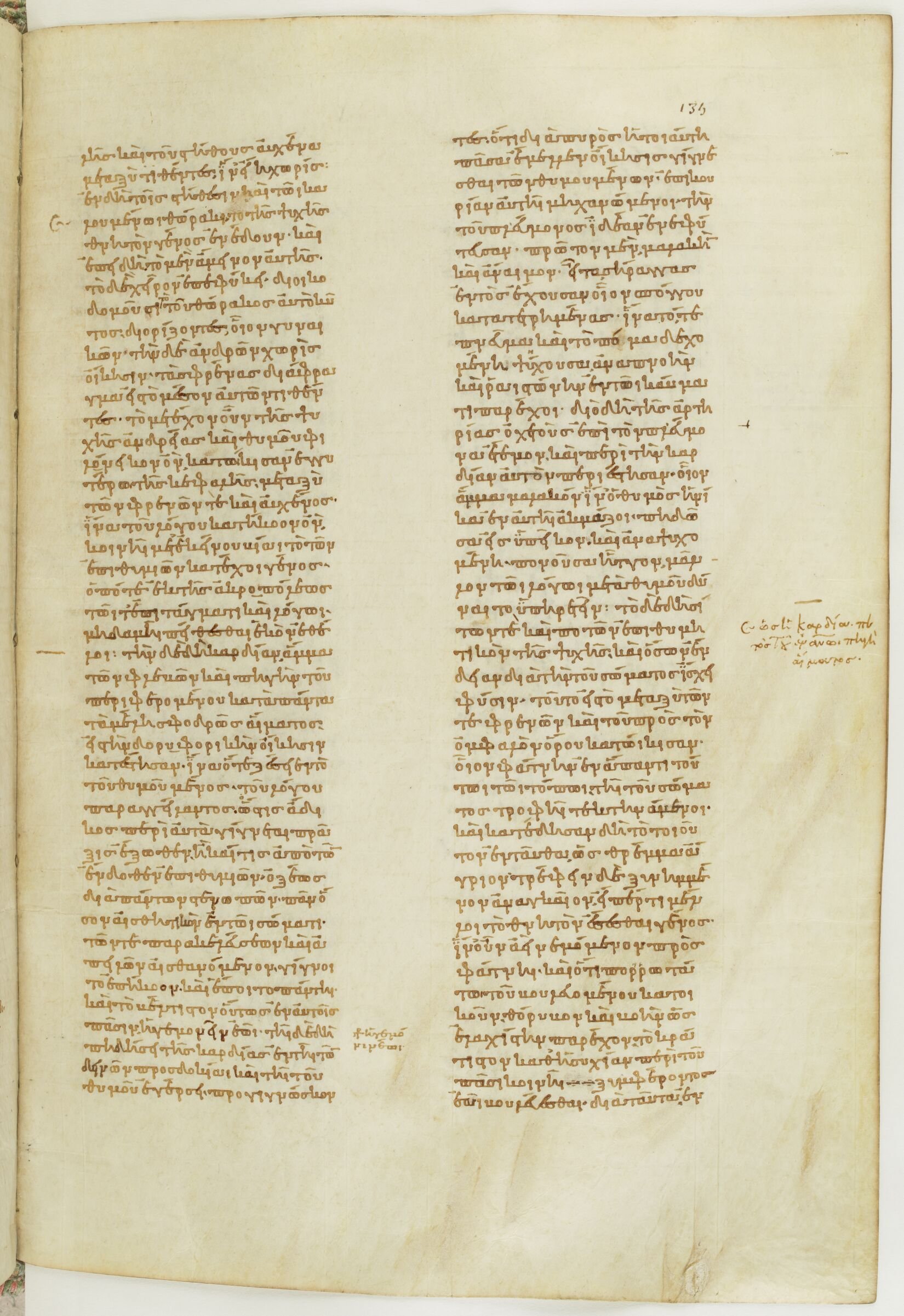
The manuscript is Paris, Bibliothèque nationale de France, grec 1807, known to editors as Plato A. It was copied in Constantinople around 850-875 by the scribe of the so-called philosophical collection, and is the oldest surviving medieval manuscript of the Timaeus and Critias (tetralogies VIII-IX: Clitophon, Republic, Timaeus, Critias, Minos, Laws, Epinomis, Letters). Each page has two columns of 44 lines. The Timaeus fills fol. 114r-144v and the Critias fol. 145r-151r.
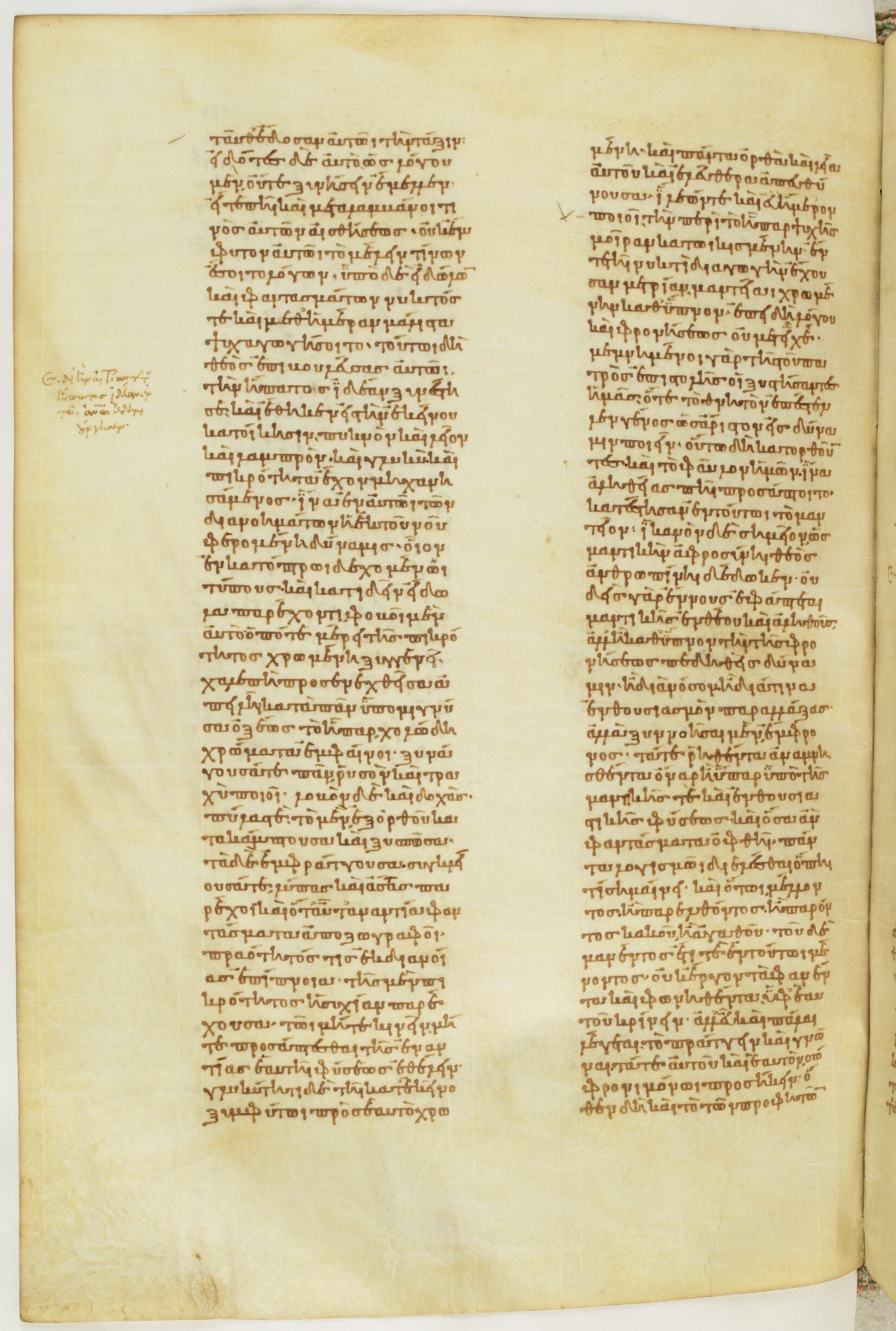
On the manuscript this page of text runs over fol. 135r col. b to fol. 135v col. b. Each section below is linked to the folio side(s) that carry it. The mapping comes from reading the first words of every column on the images and finding them in Burnet's text: fol. 135r col. b begins ‹-τες ὅτι διὰ πυρὸς ἡ τοιαύτη› (Tim. 70c); fol. 135v col. a begins ‹-ταῦθʼ ἔδοσαν αὐτῷ τὴν τάξιν. εἰδότες› (Tim. 71a); fol. 135v col. b begins ‹-μένη καὶ πάντα ὀρθὰ καὶ λεῖα› (Tim. 71c).
The Greek is John Burnet's critical text (Oxford, 1902), not a transcription of this manuscript; the scribe's spelling, accents and occasional readings differ from it. The English is R. G. Bury's Loeb translation (1929).
How was this verified? (Provenance)
Where on the image
Tim. 71a stands in Paris gr. 1807, fol. 135r col. b to fol. 135v col. a. Checked on the image (column openings read on the BnF photographs and found in Burnet's text, quoted in Burnet's spelling): fol. 135r col. b begins ‹-τες ὅτι διὰ πυρὸς ἡ τοιαύτη› (Tim. 70c); fol. 135v col. a begins ‹-ταῦθʼ ἔδοσαν αὐτῷ τὴν τάξιν. εἰδότες› (Tim. 71a).
τὸ κράτιστον καθʼ ἡσυχίαν περὶ τοῦ πᾶσι κοινῇ καὶ ἰδίᾳ συμφέροντος ἐῷ βουλεύεσθαι, διὰ ταῦτα ἐνταῦθʼ ἔδοσαν αὐτῷ τὴν τάξιν. εἰδότες δὲ αὐτὸ ὡς λόγου μὲν οὔτε συνήσειν ἔμελλεν, εἴ τέ πῃ καὶ μεταλαμβάνοι τινὸς αὐτῶν αἰσθήσεως, οὐκ ἔμφυτον αὐτῷ τὸ μέλειν τινῶν ἔσοιτο λόγων, ὑπὸ δὲ εἰδώλων καὶ φαντασμάτων νυκτός τε καὶ μεθʼ ἡμέραν μάλιστα ψυχαγωγήσοιτο, τούτῳ δὴ θεὸς ἐπιβουλεύσας αὐτῷ τὴν ἥπατος
concerning what benefits all, both individually and in the mass,—for these reasons they stationed it in that position. And inasmuch as they knew that it would not understand reason, and that, even if it did have some share in the perception of reasons, it would have no natural instinct to pay heed to any of them but would be bewitched for the most part both day and night by images and phantasms,—to guard against this God devised and constructed the form of the liver and placed it in that part’s abode;
Where on the image
Tim. 71b stands in Paris gr. 1807, fol. 135v col. a. Checked on the image (column openings read on the BnF photographs and found in Burnet's text, quoted in Burnet's spelling): fol. 135v col. a begins ‹-ταῦθʼ ἔδοσαν αὐτῷ τὴν τάξιν. εἰδότες› (Tim. 71a).
ἰδέαν συνέστησε καὶ ἔθηκεν εἰς τὴν ἐκείνου κατοίκησιν, πυκνὸν καὶ λεῖον καὶ λαμπρὸν καὶ γλυκὺ καὶ πικρότητα ἔχον μηχανησάμενος, ἵνα ἐν αὐτῷ τῶν διανοημάτων ἡ ἐκ τοῦ νοῦ φερομένη δύναμις, οἷον ἐν κατόπτρῳ δεχομένῳ τύπους καὶ κατιδεῖν εἴδωλα παρέχοντι, φοβοῖ μὲν αὐτό, ὁπότε μέρει τῆς πικρότητος χρωμένη συγγενεῖ, χαλεπὴ προσενεχθεῖσα ἀπειλῇ, κατὰ πᾶν ὑπομειγνῦσα ὀξέως τὸ ἧπαρ, χολώδη χρώματα ἐμφαίνοι, συνάγουσά τε πᾶν ῥυσὸν καὶ τραχὺ ποιοῖ,
and He fashioned it dense and smooth and bright and sweet, yet containing bitterness, that the power of thoughts which proceed from the mind, moving in the liver as in a mirror which receives impressions and provides visible images, should frighten this part of the soul; for when the mental power bears down upon it with stern threats, it uses a kindred portion of the liver’s bitterness and makes it swiftly suffuse the whole liver, so that it exhibits bilious colors, and by contraction makes it
Where on the image
Tim. 71c stands in Paris gr. 1807, fol. 135v col. a to fol. 135v col. b. Checked on the image (column openings read on the BnF photographs and found in Burnet's text, quoted in Burnet's spelling): fol. 135v col. a begins ‹-ταῦθʼ ἔδοσαν αὐτῷ τὴν τάξιν. εἰδότες› (Tim. 71a); fol. 135v col. b begins ‹-μένη καὶ πάντα ὀρθὰ καὶ λεῖα› (Tim. 71c).
λοβὸν δὲ καὶ δοχὰς πύλας τε τὸ μὲν ἐξ ὀρθοῦ κατακάμπτουσα καὶ συσπῶσα, τὰ δὲ ἐμφράττουσα συγκλείουσά τε, λύπας καὶ ἄσας παρέχοι, καὶ ὅτʼ αὖ τἀναντία φαντάσματα ἀποζωγραφοῖ πρᾳότητός τις ἐκ διανοίας ἐπίπνοια, τῆς μὲν πικρότητος ἡσυχίαν παρέχουσα τῷ μήτε κινεῖν μήτε προσάπτεσθαι τῆς ἐναντίας ἑαυτῇ φύσεως ἐθέλειν, γλυκύτητι δὲ τῇ κατʼ ἐκεῖνο συμφύτῳ πρὸς αὐτὸ χρωμένη καὶ πάντα
all wrinkled and rough; moreover, as regards the lobe and passages and gates of the liver, the first of these it bends back from the straight and compresses, while it blocks the others and closes them up, and thus it produces pains and nausea. On the other hand, when a breath of mildless from the intellect paints on the liver appearances of the opposite kind, and calms down its bitterness by refusing to move or touch the nature opposite to itself, and using upon the liver the sweetness inherent therein
Where on the image
Tim. 71d stands in Paris gr. 1807, fol. 135v col. b. Checked on the image (column openings read on the BnF photographs and found in Burnet's text, quoted in Burnet's spelling): fol. 135v col. b begins ‹-μένη καὶ πάντα ὀρθὰ καὶ λεῖα› (Tim. 71c).
ὀρθὰ καὶ λεῖα αὐτοῦ καὶ ἐλεύθερα ἀπευθύνουσα, ἵλεών τε καὶ εὐήμερον ποιοῖ τὴν περὶ τὸ ἧπαρ ψυχῆς μοῖραν κατῳκισμένην, ἔν τε τῇ νυκτὶ διαγωγὴν ἔχουσαν μετρίαν, μαντείᾳ χρωμένην καθʼ ὕπνον, ἐπειδὴ λόγου καὶ φρονήσεως οὐ μετεῖχε. μεμνημένοι γὰρ τῆς τοῦ πατρὸς ἐπιστολῆς οἱ συστήσαντες ἡμᾶς, ὅτε τὸ θνητὸν ἐπέστελλεν γένος ὡς ἄριστον εἰς δύναμιν ποιεῖν, οὕτω δὴ κατορθοῦντες καὶ τὸ φαῦλον
rectifies all its parts so as to make them straight and smooth and free, it causes the part of the soul planted round the liver to be cheerful and serene, so that in the night it passes its time sensibly, being occupied in its slumbers with divination, seeing that in reason and intelligence it has no share. For they who constructed us, remembering the injunction of their Father, when He enjoined upon them to make the mortal kind
Where on the image
Tim. 71e stands in Paris gr. 1807, fol. 135v col. b. Checked on the image (column openings read on the BnF photographs and found in Burnet's text, quoted in Burnet's spelling): fol. 135v col. b begins ‹-μένη καὶ πάντα ὀρθὰ καὶ λεῖα› (Tim. 71c).
ἡμῶν, ἵνα ἀληθείας πῃ προσάπτοιτο, κατέστησαν ἐν τούτῳ τὸ μαντεῖον. ἱκανὸν δὲ σημεῖον ὡς μαντικὴν ἀφροσύνῃ θεὸς ἀνθρωπίνῃ δέδωκεν· οὐδεὶς γὰρ ἔννους ἐφάπτεται μαντικῆς ἐνθέου καὶ ἀληθοῦς, ἀλλʼ ἢ καθʼ ὕπνον τὴν τῆς φρονήσεως πεδηθεὶς δύναμιν ἢ διὰ νόσον, ἢ διά τινα ἐνθουσιασμὸν παραλλάξας.
ἀλλὰ συννοῆσαι μὲν ἔμφρονος τά τε ῥηθέντα ἀναμνησθέντα ὄναρ ἢ ὕπαρ ὑπὸ τῆς μαντικῆς τε καὶ ἐνθουσιαστικῆς φύσεως, καὶ ὅσα ἂν φαντάσματα
as good as they possibly could, rectified the vile part of us by thus establishing therein the organ of divination, that it might in some degree lay hold on truth. And that God gave unto man’s foolishness the gift of divination a sufficient token is this: no man achieves true and inspired divination when in his rational mind, but only when the power of his intelligence is fettered in sleep or when it is distraught by disease or by reason of some divine inspiration.
But it belongs to a man when in his right mind to recollect and ponder both the things spoken in dream or waking vision by the divining and inspired nature, and all the visionary forms that were seen, and by means of reasoning to discern about them all
Notes
- Greek: John Burnet, Platonis Opera IV (Oxford, 1902), via Perseus canonical-greekLit; Burnet's text is a critical edition, so its wording can differ from the manuscript shown.
- English: R. G. Bury, Plato IX (Loeb Classical Library, 1929), via Perseus. Bury's footnotes are not reproduced. Quotation marks stand where Perseus marks quoted speech.
- Stephanus sections (a-e) are those of the 1578 Stephanus edition as given by Burnet and Bury; Bury's section breaks can fall a few words away from Burnet's because English word order differs.
Cite
Sources
- Source: Paris, BnF grec 1807 (Plato A, c. 850-875) fol. 135r-135v via BnF IIIF + Burnet's Greek (Perseus) + R. G. Bury's English (Loeb 1929, Perseus) (holding institution)
- Critical edition: Burnet, Platonis Opera IV (1902), via Perseus
← previous · → next · v cycle view · l back to library