Plato, Timaeus 72a-72e: divination and its interpreters; the spleen
Introduction
Stephanus page 72 of Plato's Timaeus (72a-72e): divination and its interpreters; the spleen.
The manuscript is Paris, Bibliothèque nationale de France, grec 1807, known to editors as Plato A. It was copied in Constantinople around 850-875 by the scribe of the so-called philosophical collection, and is the oldest surviving medieval manuscript of the Timaeus and Critias (tetralogies VIII-IX: Clitophon, Republic, Timaeus, Critias, Minos, Laws, Epinomis, Letters). Each page has two columns of 44 lines. The Timaeus fills fol. 114r-144v and the Critias fol. 145r-151r.
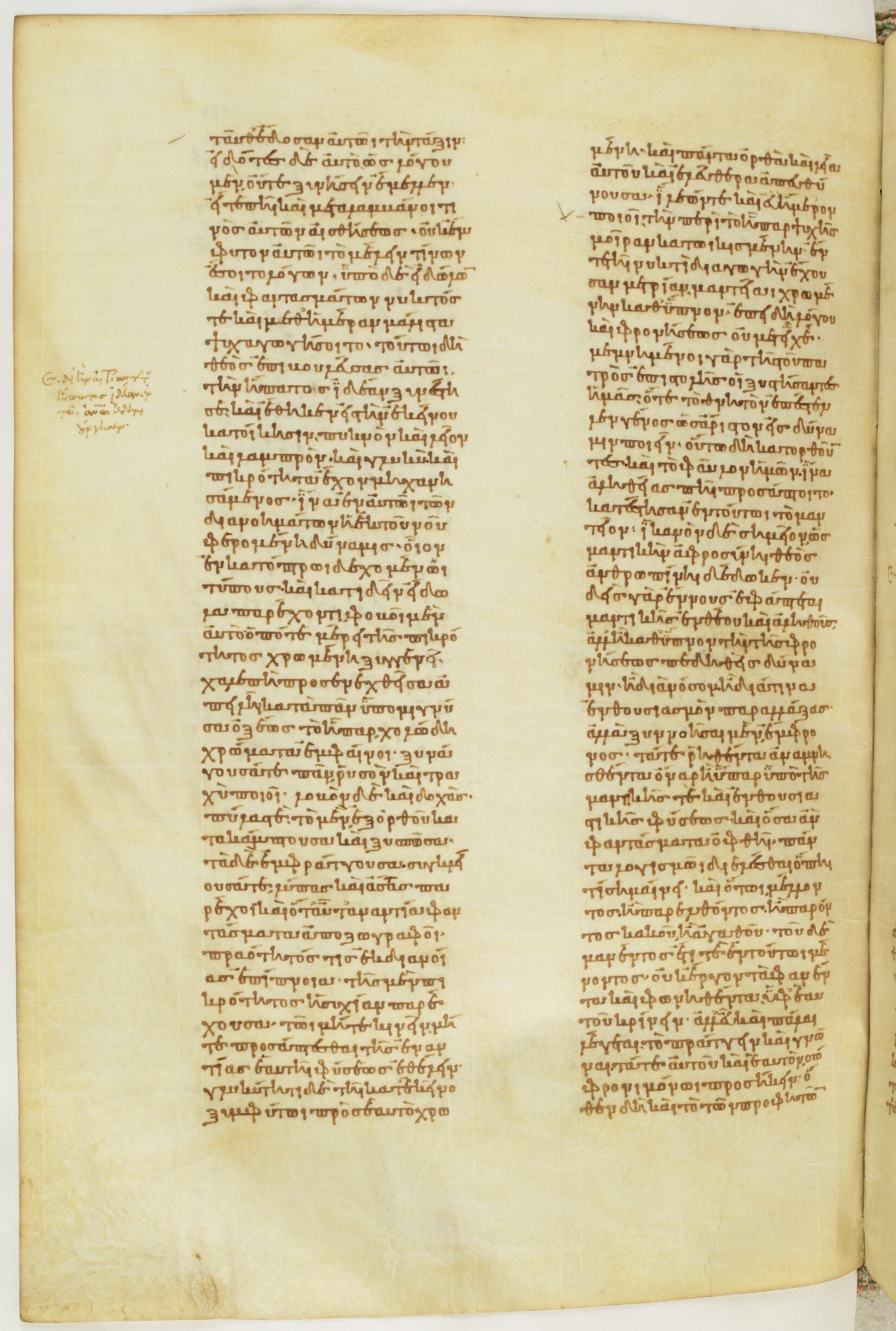
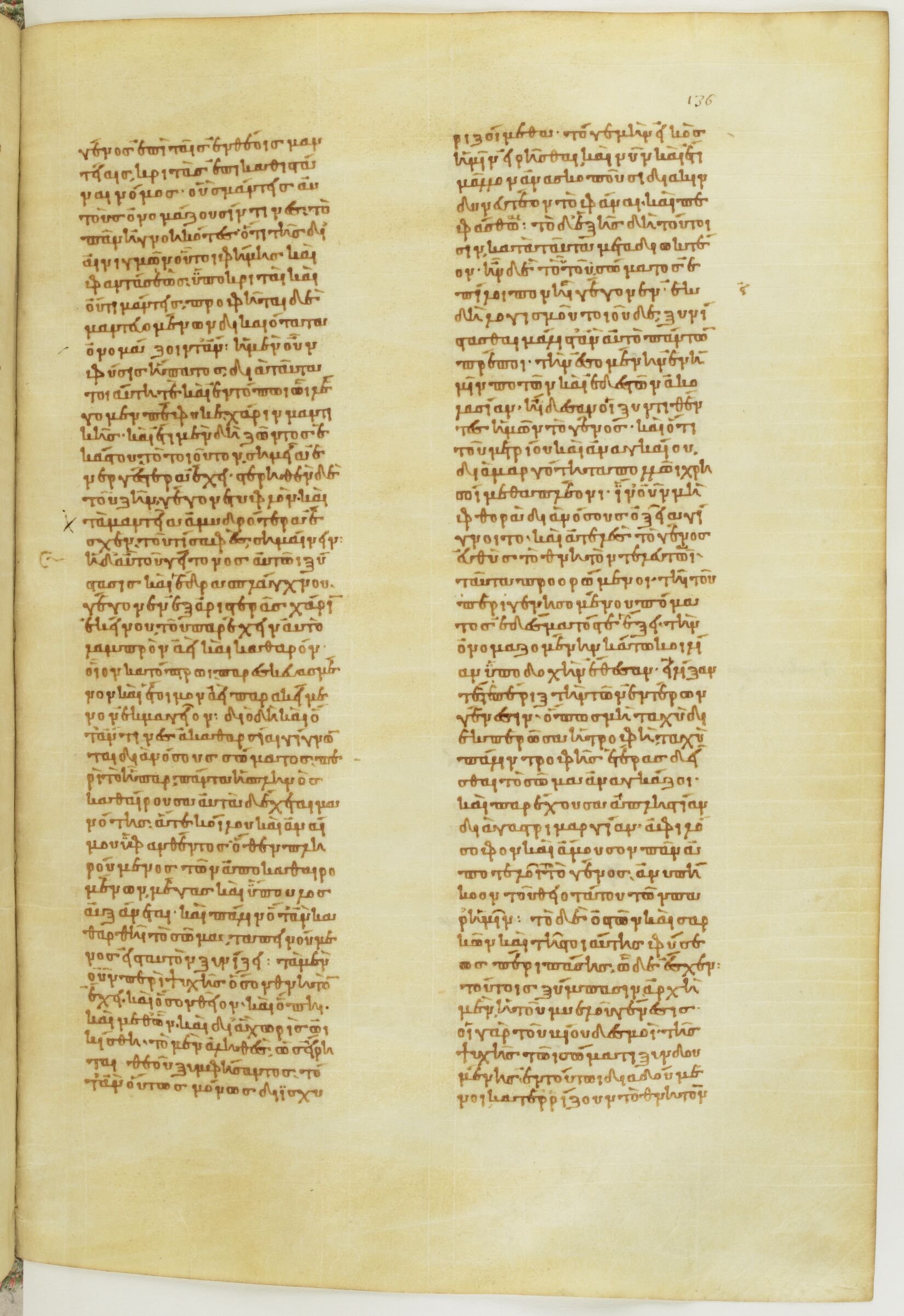
On the manuscript this page of text runs over fol. 135v col. b to fol. 136r col. b. Each section below is linked to the folio side(s) that carry it. The mapping comes from reading the first words of every column on the images and finding them in Burnet's text: fol. 135v col. b begins ‹-μένη καὶ πάντα ὀρθὰ καὶ λεῖα› (Tim. 71c); fol. 136r col. a begins ‹γένος ἐπὶ ταῖς ἐνθέοις μαντείαις κριτὰς› (Tim. 72a); fol. 136r col. b begins ‹-ριζοίμεθα· τό γε μὴν εἰκὸς ἡμῖν› (Tim. 72d).
The Greek is John Burnet's critical text (Oxford, 1902), not a transcription of this manuscript; the scribe's spelling, accents and occasional readings differ from it. The English is R. G. Bury's Loeb translation (1929).
How was this verified? (Provenance)
Where on the image
Tim. 72a stands in Paris gr. 1807, fol. 135v col. b to fol. 136r col. a. Checked on the image (column openings read on the BnF photographs and found in Burnet's text, quoted in Burnet's spelling): fol. 135v col. b begins ‹-μένη καὶ πάντα ὀρθὰ καὶ λεῖα› (Tim. 71c); fol. 136r col. a begins ‹γένος ἐπὶ ταῖς ἐνθέοις μαντείαις κριτὰς› (Tim. 72a).
ὀφθῇ, πάντα λογισμῷ διελέσθαι ὅπῃ τι σημαίνει καὶ ὅτῳ μέλλοντος ἢ παρελθόντος ἢ παρόντος κακοῦ ἢ ἀγαθοῦ· τοῦ δὲ μανέντος ἔτι τε ἐν τούτῳ μένοντος οὐκ ἔργον τὰ φανέντα καὶ φωνηθέντα ὑφʼ ἑαυτοῦ κρίνειν, ἀλλʼ εὖ καὶ πάλαι λέγεται τὸ πράττειν καὶ γνῶναι τά τε αὑτοῦ καὶ ἑαυτὸν σώφρονι μόνῳ προσήκειν. ὅθεν δὴ καὶ τὸ τῶν προφητῶν γένος ἐπὶ
wherein they are significant and for whom they portend evil or good in the future, the past, or the present. But it is not the task of him who has been in a state of frenzy, and still continues therein, to judge the apparitions and voices seen or uttered by himself; for it was well said of old that to do and to know one’s own and oneself belongs only to him who is sound of mind. Wherefore also it is customary to set the tribe of prophets to pass judgement
Where on the image
Tim. 72b stands in Paris gr. 1807, fol. 136r col. a. Checked on the image (column openings read on the BnF photographs and found in Burnet's text, quoted in Burnet's spelling): fol. 136r col. a begins ‹γένος ἐπὶ ταῖς ἐνθέοις μαντείαις κριτὰς› (Tim. 72a).
ταῖς ἐνθέοις μαντείαις κριτὰς ἐπικαθιστάναι νόμος· οὓς μάντεις αὐτοὺς ὀνομάζουσίν τινες, τὸ πᾶν ἠγνοηκότες ὅτι τῆς διʼ αἰνιγμῶν οὗτοι φήμης καὶ φαντάσεως ὑποκριταί, καὶ οὔτι μάντεις, προφῆται δὲ μαντευομένων δικαιότατα ὀνομάζοιντʼ ἄν. ἡ μὲν οὖν φύσις ἥπατος διὰ ταῦτα τοιαύτη τε καὶ ἐν τόπῳ ᾧ λέγομεν πέφυκε, χάριν μαντικῆς· καὶ ἔτι μὲν δὴ ζῶντος ἑκάστου τὸ τοιοῦτον σημεῖα ἐναργέστερα ἔχει, στερηθὲν δὲ τοῦ ζῆν γέγονε τυφλὸν καὶ τὰ μαντεῖα ἀμυδρότερα
upon these inspired divinations; and they, indeed, themselves are named diviners by certain who are wholly ignorant of the truth that they are not diviners but interpreters of the mysterious voice and apparition, for whom the most fitting name would be prophets of things divined. For these reasons, then, the nature of the liver is such as we have stated and situated in the region we have described, for the sake of divination. Moreover, when the individual creature is alive this organ affords signs that are fairly manifest, but when deprived of life it becomes blind and the divinations it presents are too much obscured to have any
Where on the image
Tim. 72c stands in Paris gr. 1807, fol. 136r col. a. Checked on the image (column openings read on the BnF photographs and found in Burnet's text, quoted in Burnet's spelling): fol. 136r col. a begins ‹γένος ἐπὶ ταῖς ἐνθέοις μαντείαις κριτὰς› (Tim. 72a).
ἔσχεν τοῦ τι σαφὲς σημαίνειν. ἡ δʼ αὖ τοῦ γείτονος αὐτῷ σύστασις καὶ ἕδρα σπλάγχνου γέγονεν ἐξ ἀριστερᾶς χάριν ἐκείνου, τοῦ παρέχειν αὐτὸ λαμπρὸν ἀεὶ καὶ καθαρόν, οἷον κατόπτρῳ παρεσκευασμένον καὶ ἕτοιμον ἀεὶ παρακείμενον ἐκμαγεῖον. διὸ δὴ καὶ ὅταν τινὲς ἀκαθαρσίαι γίγνωνται διὰ νόσους σώματος περὶ τὸ ἧπαρ, πάντα ἡ σπληνὸς καθαίρουσα αὐτὰ δέχεται μανότης, ἅτε κοίλου καὶ ἀναίμου ὑφανθέντος·
clear significance. The structure of the organ which adjoins it, with its seat on the left, is for the sake of the liver, to keep it always bright and clean, as a wiper that is laid beside a mirror always prepared and ready to hand. Wherefore also, whenever any impurities due to ailments of the body occur round about the liver, the loose texture of the spleen cleanses and absorbs them all, seeing that it is woven of a stuff that is porous and bloodless: hence, when it is filled with the offscourings, the spleen grows to be large and festered;
Where on the image
Tim. 72d stands in Paris gr. 1807, fol. 136r col. a to fol. 136r col. b. Checked on the image (column openings read on the BnF photographs and found in Burnet's text, quoted in Burnet's spelling): fol. 136r col. a begins ‹γένος ἐπὶ ταῖς ἐνθέοις μαντείαις κριτὰς› (Tim. 72a); fol. 136r col. b begins ‹-ριζοίμεθα· τό γε μὴν εἰκὸς ἡμῖν› (Tim. 72d).
ὅθεν πληρούμενος τῶν ἀποκαθαιρομένων μέγας καὶ ὕπουλος αὐξάνεται, καὶ πάλιν, ὅταν καθαρθῇ τὸ σῶμα, ταπεινούμενος εἰς ταὐτὸν συνίζει. τὰ μὲν οὖν περὶ ψυχῆς, ὅσον θνητὸν ἔχει καὶ ὅσον θεῖον, καὶ ὅπῃ καὶ μεθʼ ὧν καὶ διʼ ἃ χωρὶς ᾠκίσθη, τὸ μὲν ἀληθὲς ὡς εἴρηται, θεοῦ συμφήσαντος τότʼ ἂν οὕτως μόνως διισχυριζοίμεθα· τό γε μὴν εἰκὸς ἡμῖν εἰρῆσθαι, καὶ νῦν καὶ ἔτι μᾶλλον ἀνασκοποῦσι διακινδυνευτέον τὸ φάναι καὶ πεφάσθω.
and conversely, when the body is cleansed, it is reduced and shrinks back to its primal state. Concerning the soul, then, what part of it is mortal, what part immortal, and where and with what companions and for what reasons these have been housed apart, only if God concurred could we dare to affirm that our account is true; but that our account is probable we must dare to affirm now, and to affirm still more positively as our inquiry proceeds: affirmed, therefore, let it be.
Where on the image
Tim. 72e stands in Paris gr. 1807, fol. 136r col. b. Checked on the image (column openings read on the BnF photographs and found in Burnet's text, quoted in Burnet's spelling): fol. 136r col. b begins ‹-ριζοίμεθα· τό γε μὴν εἰκὸς ἡμῖν› (Tim. 72d).
τὸ δʼ ἑξῆς δὴ τούτοισιν κατὰ ταὐτὰ μεταδιωκτέον· ἦν δὲ τὸ τοῦ σώματος ἐπίλοιπον ᾗ γέγονεν. ἐκ δὴ λογισμοῦ τοιοῦδε συνίστασθαι μάλιστʼ ἂν αὐτὸ πάντων πρέποι.
τὴν ἐσομένην ἐν ἡμῖν ποτῶν καὶ ἐδεστῶν ἀκολασίαν ᾔδεσαν οἱ συντιθέντες ἡμῶν τὸ γένος, καὶ ὅτι τοῦ μετρίου καὶ ἀναγκαίου διὰ μαργότητα πολλῷ χρησοίμεθα πλέονι· ἵνʼ οὖν μὴ φθορὰ διὰ νόσους ὀξεῖα γίγνοιτο καὶ ἀτελὲς τὸ γένος εὐθὺς
The subject which comes next to this we must investigate on the same lines; and that subject is the way in which the remainder of the body has been generated. Its construction would most fittingly be ascribed to reasoning such as this.
Those who were constructing our kind were aware of the incontinence that would reside in us in respect of drinks and meats, and how that because of our greed we would consume far more than what was moderate and necessary; wherefore, lest owing to maladies swift destruction should overtake them,
Notes
- Greek: John Burnet, Platonis Opera IV (Oxford, 1902), via Perseus canonical-greekLit; Burnet's text is a critical edition, so its wording can differ from the manuscript shown.
- English: R. G. Bury, Plato IX (Loeb Classical Library, 1929), via Perseus. Bury's footnotes are not reproduced. Quotation marks stand where Perseus marks quoted speech.
- Stephanus sections (a-e) are those of the 1578 Stephanus edition as given by Burnet and Bury; Bury's section breaks can fall a few words away from Burnet's because English word order differs.
Cite
Sources
- Source: Paris, BnF grec 1807 (Plato A, c. 850-875) fol. 135v-136r via BnF IIIF + Burnet's Greek (Perseus) + R. G. Bury's English (Loeb 1929, Perseus) (holding institution)
- Critical edition: Burnet, Platonis Opera IV (1902), via Perseus
← previous · → next · v cycle view · l back to library