Plato, Timaeus 73a-73e: the intestines; the marrow
Introduction
Stephanus page 73 of Plato's Timaeus (73a-73e): the intestines; the marrow.
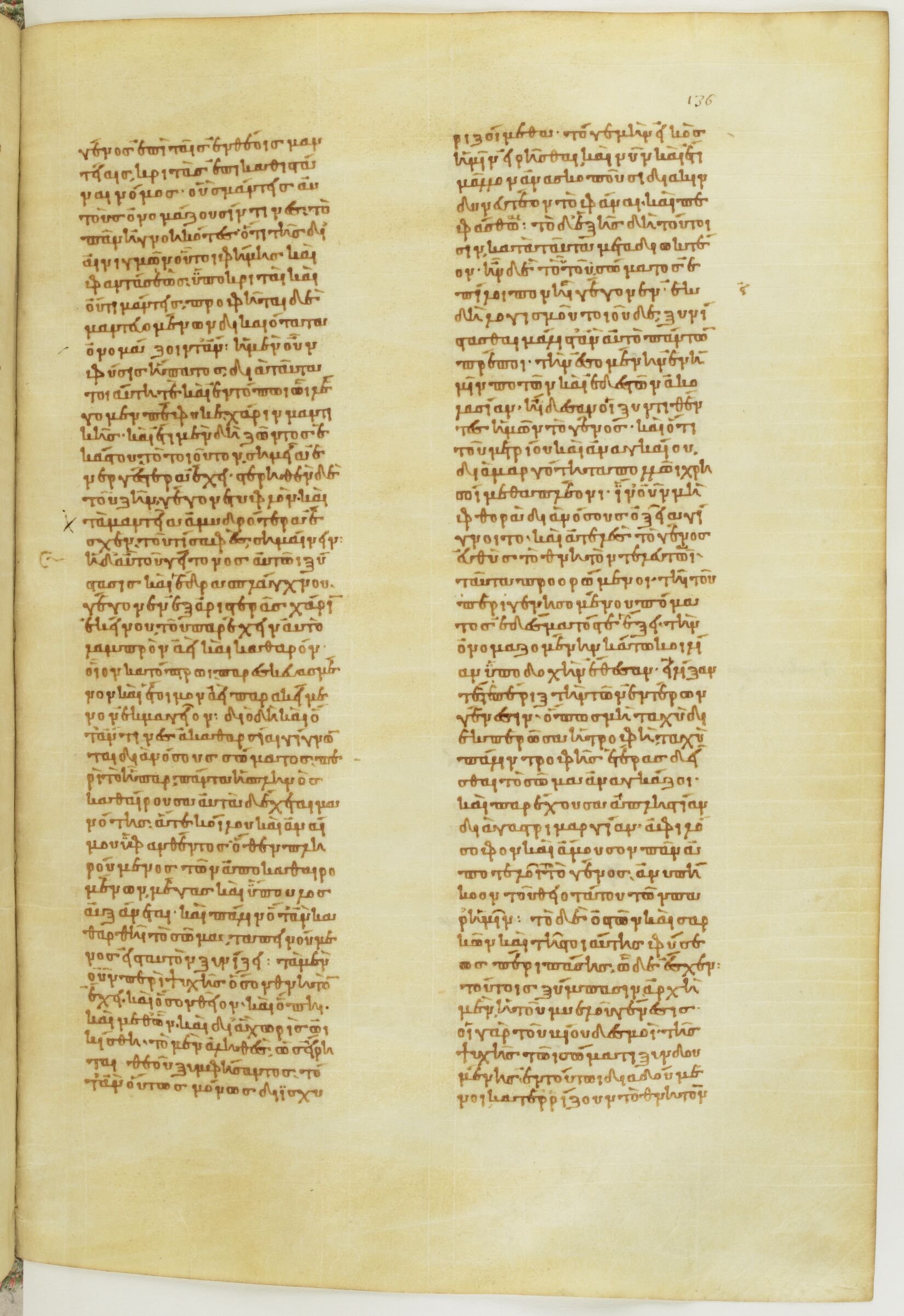
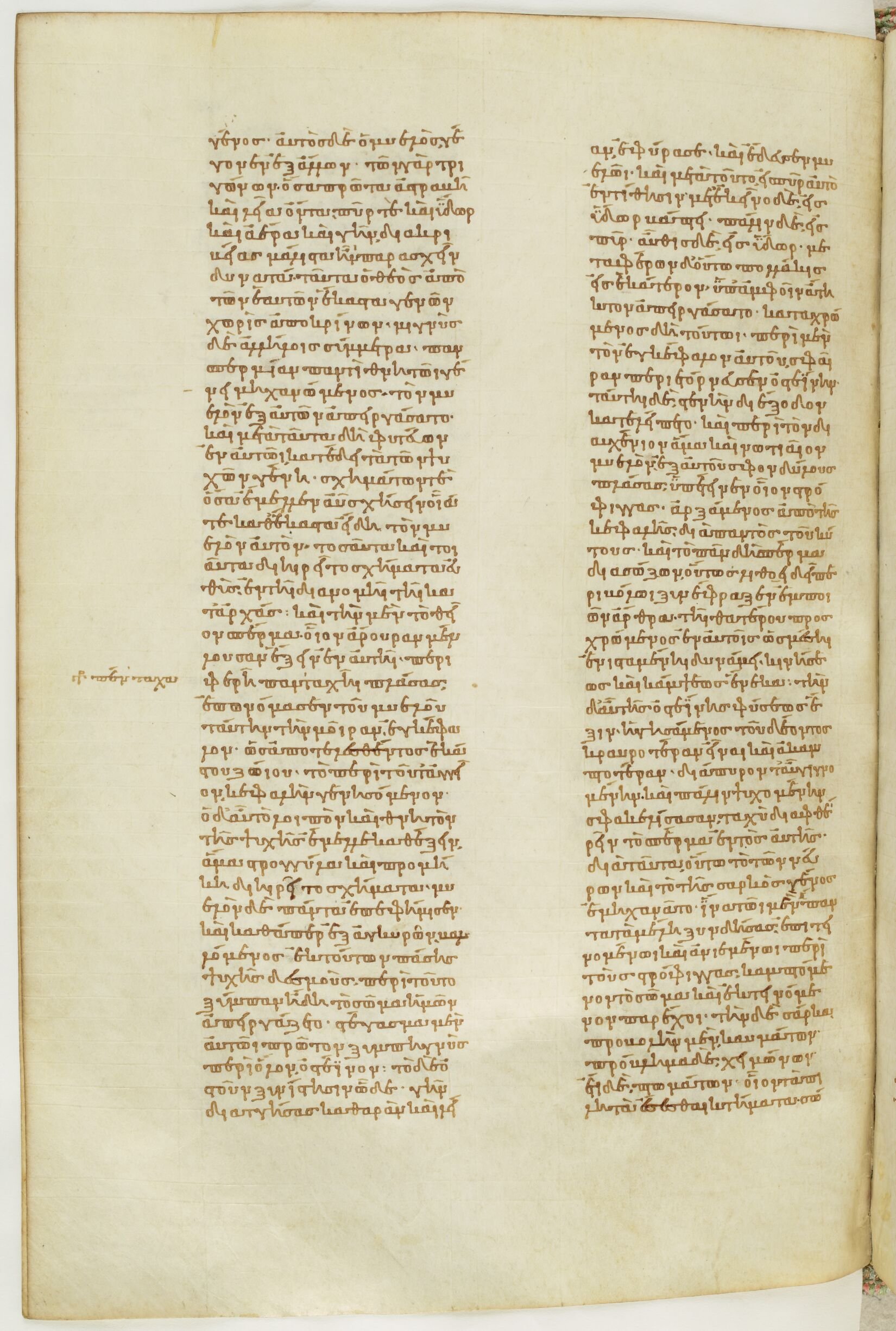
The manuscript is Paris, Bibliothèque nationale de France, grec 1807, known to editors as Plato A. It was copied in Constantinople around 850-875 by the scribe of the so-called philosophical collection, and is the oldest surviving medieval manuscript of the Timaeus and Critias (tetralogies VIII-IX: Clitophon, Republic, Timaeus, Critias, Minos, Laws, Epinomis, Letters). Each page has two columns of 44 lines. The Timaeus fills fol. 114r-144v and the Critias fol. 145r-151r.
On the manuscript this page of text runs over fol. 136r col. b to fol. 136v col. b. Each section below is linked to the folio side(s) that carry it. The mapping comes from reading the first words of every column on the images and finding them in Burnet's text: fol. 136r col. b begins ‹-ριζοίμεθα· τό γε μὴν εἰκὸς ἡμῖν› (Tim. 72d); fol. 136v col. a begins ‹γένος· αὐτὸς δὲ ὁ μυελὸς γέγονεν› (Tim. 73b); fol. 136v col. b begins ‹-αν ἐφύρασε καὶ ἔδευσεν μυελῷ, καὶ› (Tim. 73e).
The Greek is John Burnet's critical text (Oxford, 1902), not a transcription of this manuscript; the scribe's spelling, accents and occasional readings differ from it. The English is R. G. Bury's Loeb translation (1929).
How was this verified? (Provenance)
Where on the image
Tim. 73a stands in Paris gr. 1807, fol. 136r col. b. Checked on the image (column openings read on the BnF photographs and found in Burnet's text, quoted in Burnet's spelling): fol. 136r col. b begins ‹-ριζοίμεθα· τό γε μὴν εἰκὸς ἡμῖν› (Tim. 72d).
τὸ θνητὸν τελευτῷ, ταῦτα προορώμενοι τῇ τοῦ περιγενησομένου πώματος ἐδέσματός τε ἕξει τὴν ὀνομαζομένην κάτω κοιλίαν ὑποδοχὴν ἔθεσαν, εἵλιξάν τε πέριξ τὴν τῶν ἐντέρων γένεσιν, ὅπως μὴ ταχὺ διεκπερῶσα ἡ τροφὴ ταχὺ πάλιν τροφῆς ἑτέρας δεῖσθαι τὸ σῶμα ἀναγκάζοι, καὶ παρέχουσα ἀπληστίαν, διὰ γαστριμαργίαν ἀφιλόσοφον καὶ ἄμουσον πᾶν ἀποτελοῖ τὸ γένος, ἀνυπήκοον τοῦ θειοτάτου τῶν παρʼ ἡμῖν.
and the mortal kind, while still incomplete, come straightway to a complete end,—foreseeing this, the Gods set the abdomen, as it is called, to serve as a receptacle for the holding of the superfluous meat and drink; and round about therein they coiled the structure of the entrails, to prevent the food from passing through quickly and thereby compelling the body to require more food quickly, and causing insatiate appetite, whereby the whole kind by reason of its gluttony would be rendered devoid of philosophy and of culture, and disobedient to the most divine part we possess. As regards the bones and the flesh and all such substances
Where on the image
Tim. 73b stands in Paris gr. 1807, fol. 136r col. b to fol. 136v col. a. Checked on the image (column openings read on the BnF photographs and found in Burnet's text, quoted in Burnet's spelling): fol. 136r col. b begins ‹-ριζοίμεθα· τό γε μὴν εἰκὸς ἡμῖν› (Tim. 72d); fol. 136v col. a begins ‹γένος· αὐτὸς δὲ ὁ μυελὸς γέγονεν› (Tim. 73b).
τὸ δὲ ὀστῶν καὶ σαρκῶν καὶ τῆς τοιαύτης φύσεως πέρι πάσης ὧδε ἔσχεν. τούτοις σύμπασιν ἀρχὴ μὲν ἡ τοῦ μυελοῦ γένεσις· οἱ γὰρ τοῦ βίου δεσμοί, τῆς ψυχῆς τῷ σώματι συνδουμένης, ἐν τούτῳ διαδούμενοι κατερρίζουν τὸ θνητὸν γένος· αὐτὸς δὲ ὁ μυελὸς γέγονεν ἐξ ἄλλων. τῶν γὰρ τριγώνων ὅσα πρῶτα ἀστραβῆ καὶ λεῖα ὄντα πῦρ τε καὶ ὕδωρ καὶ ἀέρα καὶ γῆν διʼ ἀκριβείας μάλιστα ἦν παρασχεῖν δυνατά, ταῦτα ὁ θεὸς ἀπὸ τῶν ἑαυτῶν ἕκαστα γενῶν χωρὶς
the position was this. All these had their origin in the generation of the marrow. For it was in this that the bonds of life by which the Soul is bound to the body were fastened, and implanted the roots of the mortal kind; but the marrow itself was generated out of other elements. Taking all these primary triangles which, being unwarped and smooth, were best able to produce with exactness fire and water and air and earth, God separated them, each apart from his own kind,
Where on the image
Tim. 73c stands in Paris gr. 1807, fol. 136v col. a. Checked on the image (column openings read on the BnF photographs and found in Burnet's text, quoted in Burnet's spelling): fol. 136v col. a begins ‹γένος· αὐτὸς δὲ ὁ μυελὸς γέγονεν› (Tim. 73b).
ἀποκρίνων, μειγνὺς δὲ ἀλλήλοις σύμμετρα, πανσπερμίαν παντὶ θνητῷ γένει μηχανώμενος, τὸν μυελὸν ἐξ αὐτῶν ἀπηργάσατο, καὶ μετὰ ταῦτα δὴ φυτεύων ἐν αὐτῷ κατέδει τὰ τῶν ψυχῶν γένη, σχημάτων τε ὅσα ἔμελλεν αὖ σχήσειν οἷά τε καθʼ ἕκαστα εἴδη, τὸν μυελὸν αὐτὸν τοσαῦτα καὶ τοιαῦτα διῃρεῖτο σχήματα εὐθὺς ἐν τῇ διανομῇ τῇ κατʼ ἀρχάς. καὶ τὴν μὲν τὸ θεῖον σπέρμα οἷον ἄρουραν μέλλουσαν ἕξειν ἐν αὑτῇ περιφερῆ πανταχῇ πλάσας ἐπωνόμασεν τοῦ μυελοῦ
and mixing them one with another in due proportion, He fashioned therefrom the marrow, devising it as a universal seed-stuff for every mortal kind. Next, He engendered therein the various kinds of Soul and bound them down; and He straightway divided the marrow itself, in His original division, into shapes corresponding in their number and their nature to the number and the nature of the shapes which should belong to the several kinds of Soul. And that portion of the marrow which was intended to receive within itself, as it were into a field, the divine seed He molded
Where on the image
Tim. 73d stands in Paris gr. 1807, fol. 136v col. a. Checked on the image (column openings read on the BnF photographs and found in Burnet's text, quoted in Burnet's spelling): fol. 136v col. a begins ‹γένος· αὐτὸς δὲ ὁ μυελὸς γέγονεν› (Tim. 73b).
ταύτην τὴν μοῖραν ἐγκέφαλον, ὡς ἀποτελεσθέντος ἑκάστου ζῴου τὸ περὶ τοῦτʼ ἀγγεῖον κεφαλὴν γενησόμενον· ὃ δʼ αὖ τὸ λοιπὸν καὶ θνητὸν τῆς ψυχῆς ἔμελλε καθέξειν, ἅμα στρογγύλα καὶ προμήκη διῃρεῖτο σχήματα, μυελὸν δὲ πάντα ἐπεφήμισεν, καὶ καθάπερ ἐξ ἀγκυρῶν βαλλόμενος ἐκ τούτων πάσης ψυχῆς δεσμοὺς περὶ τοῦτο σύμπαν ἤδη τὸ σῶμα ἡμῶν ἀπηργάζετο, στέγασμα μὲν αὐτῷ πρῶτον συμπηγνὺς περὶ
in the shape of a perfect globe and bestowed on it the name of brain, purposing that, when each living creature should be completed, the vessel surrounding this should be called the head. But that portion which was to contain the other and mortal part of the Soul He divided into shapes that were at once rounded and elongated, and all these He designated marrow; and from these, as from anchors, He cast out bands of the Whole Soul, and around this He finally wrought the whole of this body of ours, when He had first built round about it for a shelter a framework
Where on the image
Tim. 73e stands in Paris gr. 1807, fol. 136v col. a to fol. 136v col. b. Checked on the image (column openings read on the BnF photographs and found in Burnet's text, quoted in Burnet's spelling): fol. 136v col. a begins ‹γένος· αὐτὸς δὲ ὁ μυελὸς γέγονεν› (Tim. 73b); fol. 136v col. b begins ‹-αν ἐφύρασε καὶ ἔδευσεν μυελῷ, καὶ› (Tim. 73e).
ὅλον ὀστέινον. τὸ δὲ ὀστοῦν συνίστησιν ὧδε. γῆν διαττήσας καθαρὰν καὶ λείαν ἐφύρασε καὶ ἔδευσεν μυελῷ, καὶ μετὰ τοῦτο εἰς πῦρ αὐτὸ ἐντίθησιν, μετʼ ἐκεῖνο δὲ εἰς ὕδωρ βάπτει, πάλιν δὲ εἰς πῦρ, αὖθίς τε εἰς ὕδωρ· μεταφέρων δʼ οὕτω πολλάκις εἰς ἑκάτερον ὑπʼ ἀμφοῖν ἄτηκτον ἀπηργάσατο.
καταχρώμενος δὴ τούτῳ περὶ μὲν τὸν ἐγκέφαλον αὐτοῦ σφαῖραν περιετόρνευσεν ὀστεΐνην, ταύτῃ δὲ στενὴν διέξοδον
all of bone. And bone He compounded in this wise. Having sifted earth till it was pure and smooth, He kneaded it and moistened it with marrow; then He placed it in fire, and after that dipped it in water, and from this back to fire, and once again in water; and by thus transferring it many times from the one element to the other He made it so that it was soluble by neither.
This, then, He used, and fashioned thereof, by turning, a bony sphere round about the brain; and therein he left a narrow opening; and around the marrow
Notes
- Greek: John Burnet, Platonis Opera IV (Oxford, 1902), via Perseus canonical-greekLit; Burnet's text is a critical edition, so its wording can differ from the manuscript shown.
- English: R. G. Bury, Plato IX (Loeb Classical Library, 1929), via Perseus. Bury's footnotes are not reproduced. Quotation marks stand where Perseus marks quoted speech.
- Stephanus sections (a-e) are those of the 1578 Stephanus edition as given by Burnet and Bury; Bury's section breaks can fall a few words away from Burnet's because English word order differs.
Cite
Sources
- Source: Paris, BnF grec 1807 (Plato A, c. 850-875) fol. 136r-136v via BnF IIIF + Burnet's Greek (Perseus) + R. G. Bury's English (Loeb 1929, Perseus) (holding institution)
- Critical edition: Burnet, Platonis Opera IV (1902), via Perseus
← previous · → next · v cycle view · l back to library