Plato, Timaeus 74a-74e: vertebrae, bone, sinew and flesh
Introduction
Stephanus page 74 of Plato's Timaeus (74a-74e): vertebrae, bone, sinew and flesh.
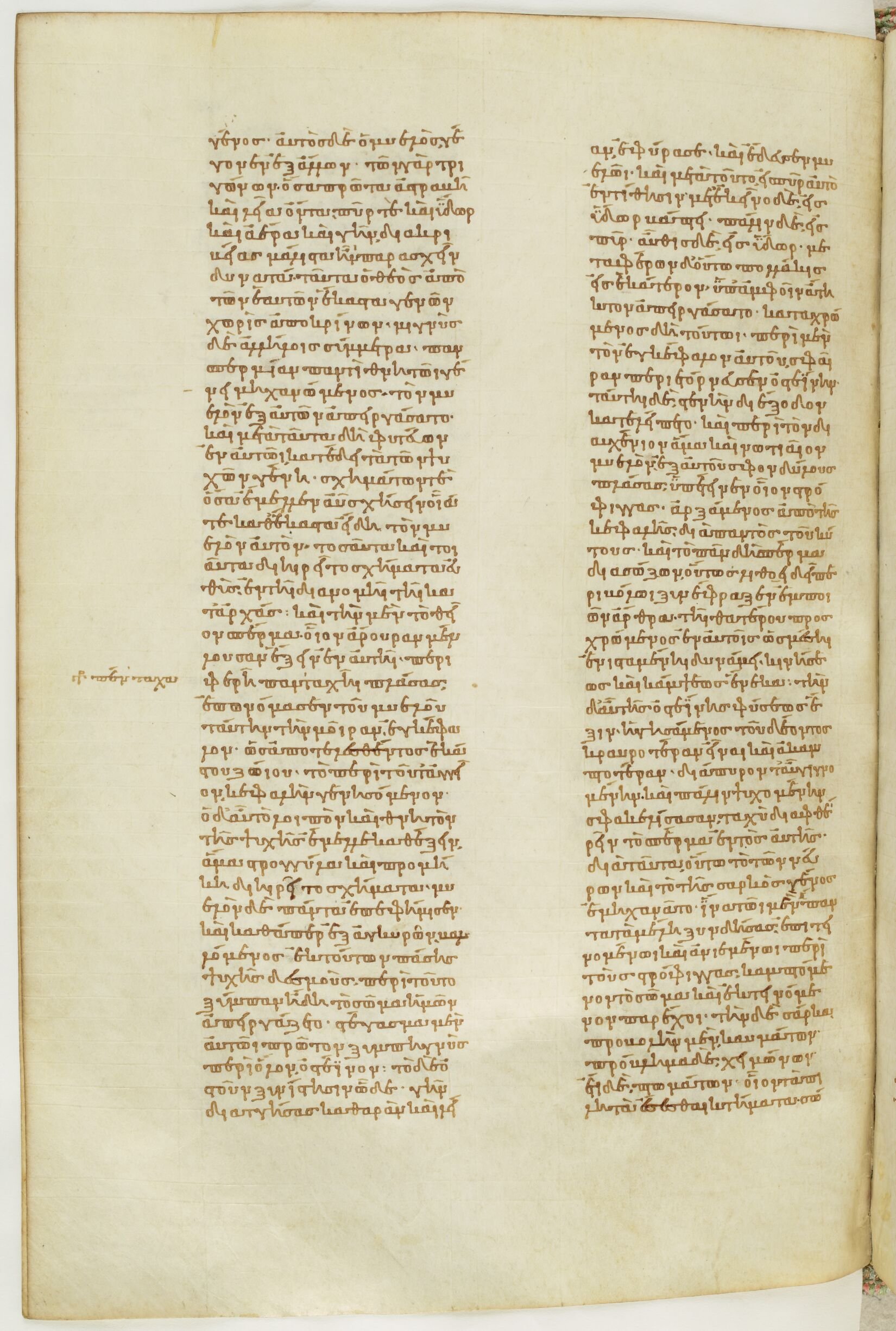
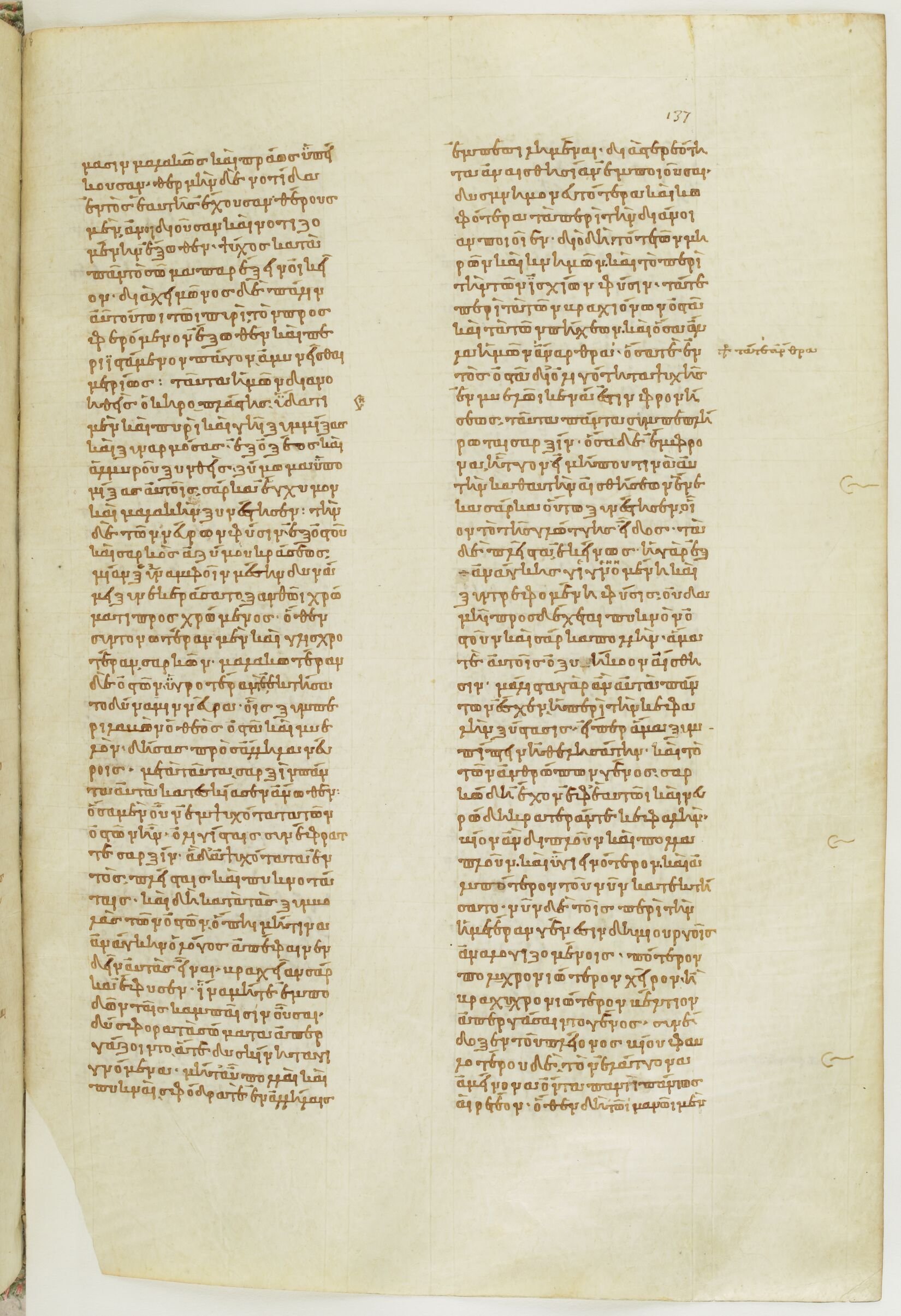
The manuscript is Paris, Bibliothèque nationale de France, grec 1807, known to editors as Plato A. It was copied in Constantinople around 850-875 by the scribe of the so-called philosophical collection, and is the oldest surviving medieval manuscript of the Timaeus and Critias (tetralogies VIII-IX: Clitophon, Republic, Timaeus, Critias, Minos, Laws, Epinomis, Letters). Each page has two columns of 44 lines. The Timaeus fills fol. 114r-144v and the Critias fol. 145r-151r.
On the manuscript this page of text runs over fol. 136v col. b to fol. 137r col. b. Each section below is linked to the folio side(s) that carry it. The mapping comes from reading the first words of every column on the images and finding them in Burnet's text: fol. 136v col. b begins ‹-αν ἐφύρασε καὶ ἔδευσεν μυελῷ, καὶ› (Tim. 73e); fol. 137r col. a begins ‹σώμασιν μαλακῶς καὶ πρᾴως ὑπείκουσαν, θερμὴν› (Tim. 74c); fol. 137r col. b begins ‹ἐμπεπιλημέναι, διὰ στερεότητα ἀναισθησίαν ἐμποιοῦσαι, δυσμνη› (Tim. 74e).
The Greek is John Burnet's critical text (Oxford, 1902), not a transcription of this manuscript; the scribe's spelling, accents and occasional readings differ from it. The English is R. G. Bury's Loeb translation (1929).
How was this verified? (Provenance)
Where on the image
Tim. 74a stands in Paris gr. 1807, fol. 136v col. b. Checked on the image (column openings read on the BnF photographs and found in Burnet's text, quoted in Burnet's spelling): fol. 136v col. b begins ‹-αν ἐφύρασε καὶ ἔδευσεν μυελῷ, καὶ› (Tim. 73e).
κατελείπετο· καὶ περὶ τὸν διαυχένιον ἅμα καὶ νωτιαῖον μυελὸν ἐξ αὐτοῦ σφονδύλους πλάσας ὑπέτεινεν οἷον στρόφιγγας, ἀρξάμενος ἀπὸ τῆς κεφαλῆς, διὰ παντὸς τοῦ κύτους. καὶ τὸ πᾶν δὴ σπέρμα διασῴζων οὕτως λιθοειδεῖ περιβόλῳ συνέφραξεν, ἐμποιῶν ἄρθρα, τῇ θατέρου προσχρώμενος ἐν αὐτοῖς ὡς μέσῃ ἐνισταμένῃ δυνάμει, κινήσεως καὶ κάμψεως ἕνεκα. τὴν δʼ αὖ τῆς ὀστεΐνης φύσεως ἕξιν ἡγησάμενος
of both neck and back He molded vertebrae of bone, and set them, like pivots, in a vertical row, throughout all the trunk, beginning from the head. And thus for preserving the whole seed He closed it in with a ring-fence of stony substance; and therein He made joints, using as an aid the power of the Other as an intermediary between them, for the sake of movement and bending.
Where on the image
Tim. 74b stands in Paris gr. 1807, fol. 136v col. b. Checked on the image (column openings read on the BnF photographs and found in Burnet's text, quoted in Burnet's spelling): fol. 136v col. b begins ‹-αν ἐφύρασε καὶ ἔδευσεν μυελῷ, καὶ› (Tim. 73e).
τοῦ δέοντος κραυροτέραν εἶναι καὶ ἀκαμπτοτέραν, διάπυρόν τʼ αὖ γιγνομένην καὶ πάλιν ψυχομένην σφακελίσασαν ταχὺ διαφθερεῖν τὸ σπέρμα ἐντὸς αὑτῆς, διὰ ταῦτα οὕτω τὸ τῶν νεύρων καὶ τὸ τῆς σαρκὸς γένος ἐμηχανᾶτο, ἵνα τῷ μὲν πάντα τὰ μέλη συνδήσας ἐπιτεινομένῳ καὶ ἀνιεμένῳ περὶ τοὺς στρόφιγγας καμπτόμενον τὸ σῶμα καὶ ἐκτεινόμενον παρέχοι, τὴν δὲ σάρκα προβολὴν μὲν καυμάτων, πρόβλημα δὲ χειμώνων, ἔτι δὲ πτωμάτων οἷον τὰ πιλητὰ ἔσεσθαι κτήματα,
And inasmuch as He deemed that the texture of the bony substance was too hard and inflexible, and that if it were fired and cooled again it would decay and speedily destroy the seed within it, for these reasons He contrived the species known as sinew and flesh. He designed to bind all the limbs together by means of the former, which tightens and relaxes itself around the pivots, and thus cause the body to bend and stretch itself. And the flesh He designed to be a shield against the heat and a shelter against the cold; and, moreover, that in case of falls it should yield to the body softly and gently, like padded garments;
Where on the image
Tim. 74c stands in Paris gr. 1807, fol. 137r col. a. Checked on the image (column openings read on the BnF photographs and found in Burnet's text, quoted in Burnet's spelling): fol. 137r col. a begins ‹σώμασιν μαλακῶς καὶ πρᾴως ὑπείκουσαν, θερμὴν› (Tim. 74c).
σώμασιν μαλακῶς καὶ πρᾴως ὑπείκουσαν, θερμὴν δὲ νοτίδα ἐντὸς ἑαυτῆς ἔχουσαν θέρους μὲν ἀνιδίουσαν καὶ νοτιζομένην ἔξωθεν ψῦχος κατὰ πᾶν τὸ σῶμα παρέξειν οἰκεῖον, διὰ χειμῶνος δὲ πάλιν αὖ τούτῳ τῷ πυρὶ τὸν προσφερόμενον ἔξωθεν καὶ περιιστάμενον πάγον ἀμυνεῖσθαι μετρίως. ταῦτα ἡμῶν διανοηθεὶς ὁ κηροπλάστης, ὕδατι μὲν καὶ πυρὶ καὶ γῇ συμμείξας καὶ συναρμόσας, ἐξ ὀξέος καὶ ἁλμυροῦ συνθεὶς
and, inasmuch as it contains within it warm moisture, that it should supply in summer, by its perspiration and dampness, a congenial coolness over the exterior of the whole body, and contrariwise in winter defend the body sufficiently, by means of its fire, from the frost which attacks and surrounds it from without. Wherefore, with this intent, our Modeller mixed and blended together water and fire and earth, and compounding a ferment of acid and salt
Where on the image
Tim. 74d stands in Paris gr. 1807, fol. 137r col. a. Checked on the image (column openings read on the BnF photographs and found in Burnet's text, quoted in Burnet's spelling): fol. 137r col. a begins ‹σώμασιν μαλακῶς καὶ πρᾴως ὑπείκουσαν, θερμὴν› (Tim. 74c).
ζύμωμα ὑπομείξας αὐτοῖς, σάρκα ἔγχυμον καὶ μαλακὴν συνέστησεν· τὴν δὲ τῶν νεύρων φύσιν ἐξ ὀστοῦ καὶ σαρκὸς ἀζύμου κράσεως μίαν ἐξ ἀμφοῖν μέσην δυνάμει συνεκεράσατο, ξανθῷ χρώματι προσχρώμενος. ὅθεν συντονωτέραν μὲν καὶ γλισχροτέραν σαρκῶν, μαλακωτέραν δὲ ὀστῶν ὑγροτέραν τε ἐκτήσατο δύναμιν νεῦρα· οἷς συμπεριλαβὼν ὁ θεὸς ὀστᾶ καὶ μυελόν, δήσας πρὸς ἄλληλα νεύροις, μετὰ ταῦτα σαρξὶν
mixed it in therewith, and thus molded flesh full of sap and soft. And the substance of the sinews He compounded of a mixture of bone and unfermented flesh, forming a single substance blended of both and intermediate in quality, and he used yellow also for its coloring. Hence it is that the sinews have acquired a quality that is firmer and more rigid than flesh, but softer and more elastic than bone. With these, then, God enclosed the bones and marrow, first binding them one to another with the sinews, and then shrouding them all over with flesh.
Where on the image
Tim. 74e stands in Paris gr. 1807, fol. 137r col. a to fol. 137r col. b. Checked on the image (column openings read on the BnF photographs and found in Burnet's text, quoted in Burnet's spelling): fol. 137r col. a begins ‹σώμασιν μαλακῶς καὶ πρᾴως ὑπείκουσαν, θερμὴν› (Tim. 74c); fol. 137r col. b begins ‹ἐμπεπιλημέναι, διὰ στερεότητα ἀναισθησίαν ἐμποιοῦσαι, δυσμνη› (Tim. 74e).
πάντα αὐτὰ κατεσκίασεν ἄνωθεν. ὅσα μὲν οὖν ἐμψυχότατα τῶν ὀστῶν ἦν, ὀλιγίσταις συνέφραττε σαρξίν, ἃ δʼ ἀψυχότατα ἐντός, πλείσταις καὶ πυκνοτάταις, καὶ δὴ κατὰ τὰς συμβολὰς τῶν ὀστῶν, ὅπῃ μήτινα ἀνάγκην ὁ λόγος ἀπέφαινεν δεῖν αὐτὰς εἶναι, βραχεῖαν σάρκα ἔφυσεν, ἵνα μήτε ἐμποδὼν ταῖς καμπαῖσιν οὖσαι δύσφορα τὰ σώματα ἀπεργάζοιντο, ἅτε δυσκίνητα γιγνόμενα, μήτʼ αὖ πολλαὶ καὶ πυκναὶ σφόδρα τε ἐν ἀλλήλαις ἐμπεπιλημέναι, διὰ στερεότητα ἀναισθησίαν ἐμποιοῦσαι, δυσμνημονευτότερα καὶ κωφότερα τὰ περὶ τὴν διάνοιαν ποιοῖεν.
διὸ δὴ τό τε τῶν μηρῶν καὶ κνημῶν καὶ
All the bones, then, that possessed most soul He enclosed in least flesh, but the bones which contained least soul with most and most dense flesh; moreover, at the junctions of the bones, except where reason revealed some necessity for its existence, He made but little flesh to grow, lest by hindering the flexions it should make the bodies unwieldy, because stiff in movement, or else through its size and density, when thickly massed together, it should produce insensitiveness, owing to its rigidity, and thereby cause the intellectual parts to be more forgetful and more obtuse.
Wherefore
Notes
- Greek: John Burnet, Platonis Opera IV (Oxford, 1902), via Perseus canonical-greekLit; Burnet's text is a critical edition, so its wording can differ from the manuscript shown.
- English: R. G. Bury, Plato IX (Loeb Classical Library, 1929), via Perseus. Bury's footnotes are not reproduced. Quotation marks stand where Perseus marks quoted speech.
- Stephanus sections (a-e) are those of the 1578 Stephanus edition as given by Burnet and Bury; Bury's section breaks can fall a few words away from Burnet's because English word order differs.
Cite
Sources
- Source: Paris, BnF grec 1807 (Plato A, c. 850-875) fol. 136v-137r via BnF IIIF + Burnet's Greek (Perseus) + R. G. Bury's English (Loeb 1929, Perseus) (holding institution)
- Critical edition: Burnet, Platonis Opera IV (1902), via Perseus
← previous · → next · v cycle view · l back to library