Plato, Timaeus 75a-75e: flesh and intelligence; the head and the mouth
Introduction
Stephanus page 75 of Plato's Timaeus (75a-75e): flesh and intelligence; the head and the mouth.
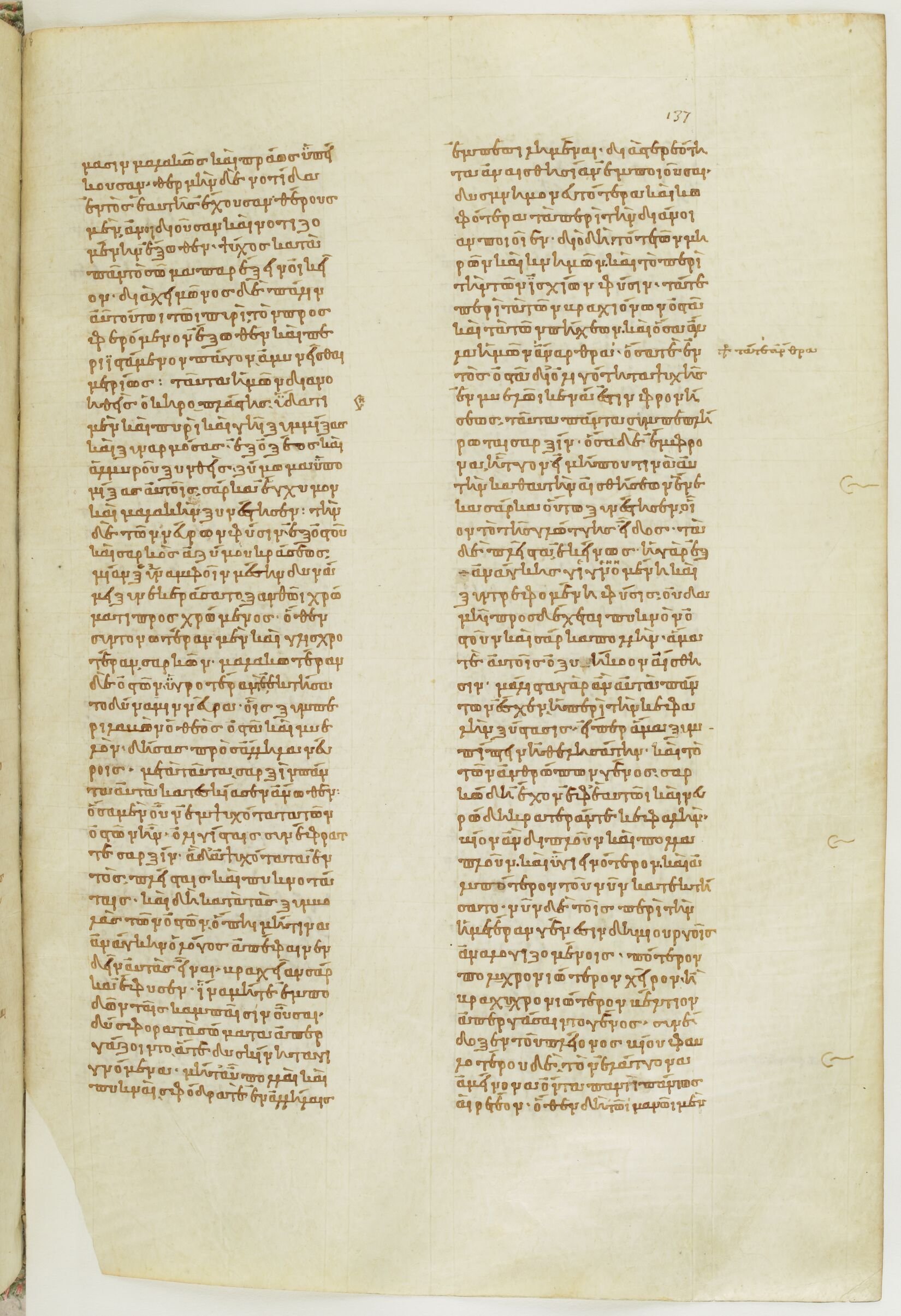
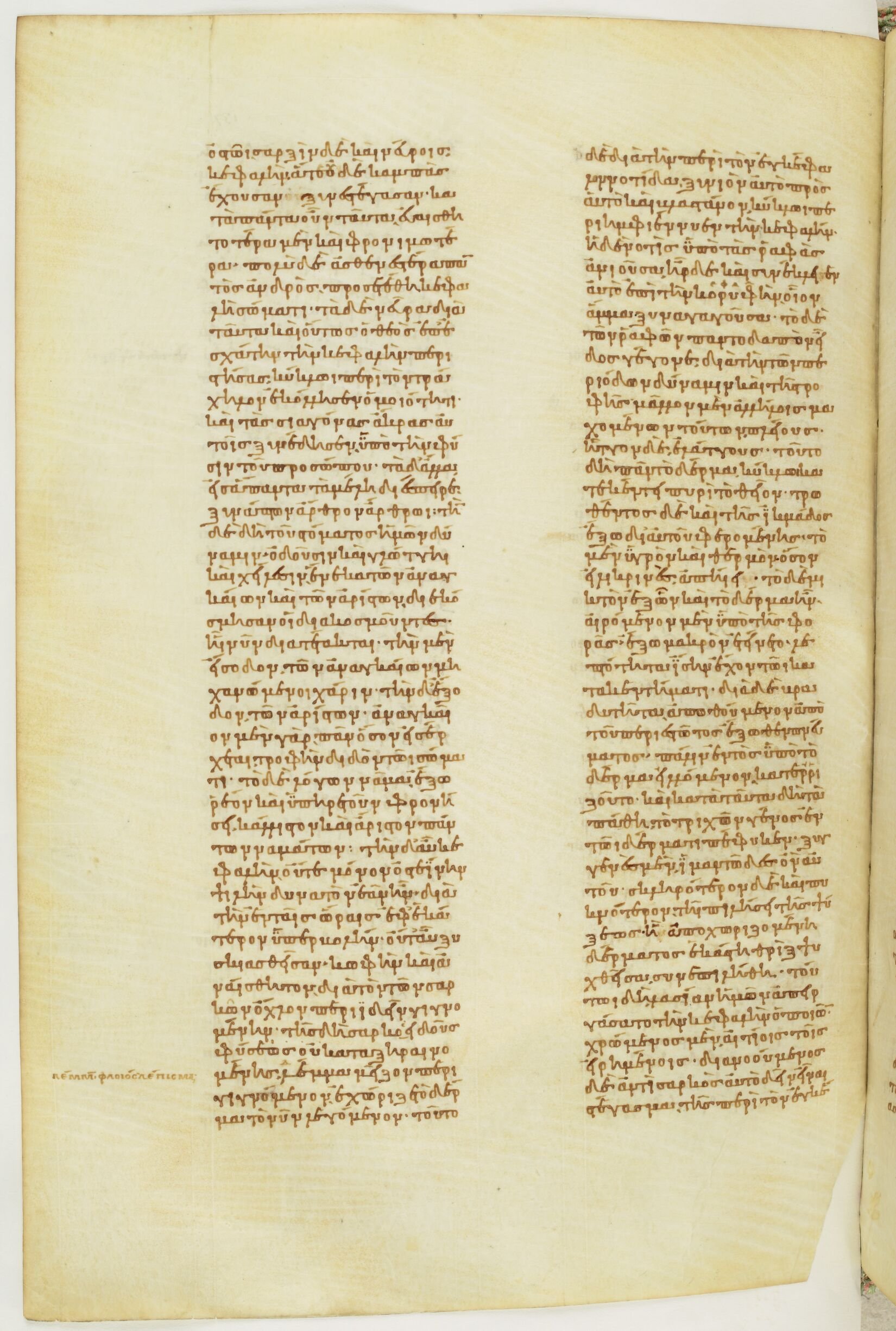
The manuscript is Paris, Bibliothèque nationale de France, grec 1807, known to editors as Plato A. It was copied in Constantinople around 850-875 by the scribe of the so-called philosophical collection, and is the oldest surviving medieval manuscript of the Timaeus and Critias (tetralogies VIII-IX: Clitophon, Republic, Timaeus, Critias, Minos, Laws, Epinomis, Letters). Each page has two columns of 44 lines. The Timaeus fills fol. 114r-144v and the Critias fol. 145r-151r.
On the manuscript this page of text runs over fol. 137r col. b to fol. 137v col. a. Each section below is linked to the folio side(s) that carry it. The mapping comes from reading the first words of every column on the images and finding them in Burnet's text: fol. 137r col. b begins ‹ἐμπεπιλημέναι, διὰ στερεότητα ἀναισθησίαν ἐμποιοῦσαι, δυσμνη› (Tim. 74e); fol. 137v col. a begins ‹ὀστῷ, σαρξὶν δὲ καὶ νεύροις κεφαλήν› (Tim. 75c).
The Greek is John Burnet's critical text (Oxford, 1902), not a transcription of this manuscript; the scribe's spelling, accents and occasional readings differ from it. The English is R. G. Bury's Loeb translation (1929).
How was this verified? (Provenance)
Where on the image
Tim. 75a stands in Paris gr. 1807, fol. 137r col. b. Checked on the image (column openings read on the BnF photographs and found in Burnet's text, quoted in Burnet's spelling): fol. 137r col. b begins ‹ἐμπεπιλημέναι, διὰ στερεότητα ἀναισθησίαν ἐμποιοῦσαι, δυσμνη› (Tim. 74e).
τὸ περὶ τὴν τῶν ἰσχίων φύσιν τά τε περὶ τὰ τῶν βραχιόνων ὀστᾶ καὶ τὰ τῶν πήχεων, καὶ ὅσα ἄλλα ἡμῶν ἄναρθρα, ὅσα τε ἐντὸς ὀστᾶ διʼ ὀλιγότητα ψυχῆς ἐν μυελῷ κενά ἐστιν φρονήσεως, ταῦτα πάντα συμπεπλήρωται σαρξίν· ὅσα δὲ ἔμφρονα, ἧττον—εἰ μή πού τινα αὐτὴν καθʼ αὑτὴν αἰσθήσεων ἕνεκα σάρκα οὕτω συνέστησεν, οἷον τὸ τῆς γλώττης εἶδος— τὰ δὲ πλεῖστα ἐκείνως· ἡ γὰρ ἐξ ἀνάγκης γιγνομένη καὶ
the thighs and the shins and the region of the loins and the bones of the upper and lower arm, and all our other parts which are jointless, and all those bones which are void of intelligence within, owing to the small quantity of soul in the marrow—all these are abundantly supplied with flesh; but those parts which are intelligent are supplied less abundantly—except possibly where He so fashioned the flesh that it can of itself convey sensations, as is the case with the tongue; but most of these parts He made in the way described above. For the substance which is generated by necessity and grows up with us
Where on the image
Tim. 75b stands in Paris gr. 1807, fol. 137r col. b. Checked on the image (column openings read on the BnF photographs and found in Burnet's text, quoted in Burnet's spelling): fol. 137r col. b begins ‹ἐμπεπιλημέναι, διὰ στερεότητα ἀναισθησίαν ἐμποιοῦσαι, δυσμνη› (Tim. 74e).
συντρεφομένη φύσις οὐδαμῇ προσδέχεται πυκνὸν ὀστοῦν καὶ σάρκα πολλὴν ἅμα τε αὐτοῖς ὀξυήκοον αἴσθησιν. μάλιστα γὰρ ἂν αὐτὰ πάντων ἔσχεν ἡ περὶ τὴν κεφαλὴν σύστασις, εἴπερ ἅμα συμπίπτειν ἠθελησάτην, καὶ τὸ τῶν ἀνθρώπων γένος σαρκώδη ἔχον ἐφʼ ἑαυτῷ καὶ νευρώδη κρατεράν τε κεφαλὴν βίον ἂν διπλοῦν καὶ πολλαπλοῦν καὶ ὑγιεινότερον καὶ ἀλυπότερον τοῦ νῦν κατεκτήσατο. νῦν δὲ τοῖς περὶ τὴν ἡμετέραν γένεσιν δημιουργοῖς, ἀναλογιζομένοις πότερον πολυχρονιώτερον
in no wise admits of quick perception coexisting with dense bone and abundant flesh. For if these characteristics were willing to consort together, then the structure of the head would have acquired them most of all, and mankind, crowned with a head that was fleshy and sinewy and strong, would have enjoyed a life that was twice (nay, many times) as long as our present life, and healthier, to boot, and more free from pain. But as it is, when the Constructors of our being were cogitating
Where on the image
Tim. 75c stands in Paris gr. 1807, fol. 137r col. b to fol. 137v col. a. Checked on the image (column openings read on the BnF photographs and found in Burnet's text, quoted in Burnet's spelling): fol. 137r col. b begins ‹ἐμπεπιλημέναι, διὰ στερεότητα ἀναισθησίαν ἐμποιοῦσαι, δυσμνη› (Tim. 74e); fol. 137v col. a begins ‹ὀστῷ, σαρξὶν δὲ καὶ νεύροις κεφαλήν› (Tim. 75c).
χεῖρον ἢ βραχυχρονιώτερον βέλτιον ἀπεργάσαιντο γένος, συνέδοξεν τοῦ πλείονος βίου, φαυλοτέρου δέ, τὸν ἐλάττονα ἀμείνονα ὄντα παντὶ πάντως αἱρετέον· ὅθεν δὴ μανῷ μὲν ὀστῷ, σαρξὶν δὲ καὶ νεύροις κεφαλήν, ἅτε οὐδὲ καμπὰς ἔχουσαν, οὐ συνεστέγασαν. κατὰ πάντα οὖν ταῦτα εὐαισθητοτέρα μὲν καὶ φρονιμωτέρα, πολὺ δὲ ἀσθενεστέρα παντὸς ἀνδρὸς προσετέθη κεφαλὴ σώματι. τὰ δὲ νεῦρα διὰ
whether they should make a kind that was more long-lived and worse or more short-lived and better, they agreed that the shorter and superior life should by all means be chosen by all rather than the longer and inferior. Wherefore they covered the head closely with thin bone, but not with flesh and sinews, since it was also without flexions. For all these reasons, then, the head that was joined to the body in every man was more perceptive and more intelligent but less strong. It was on these grounds and in this way that God set the sinews at the bottom of the head
Where on the image
Tim. 75d stands in Paris gr. 1807, fol. 137v col. a. Checked on the image (column openings read on the BnF photographs and found in Burnet's text, quoted in Burnet's spelling): fol. 137v col. a begins ‹ὀστῷ, σαρξὶν δὲ καὶ νεύροις κεφαλήν› (Tim. 75c).
ταῦτα καὶ οὕτως ὁ θεὸς ἐπʼ ἐσχάτην τὴν κεφαλὴν περιστήσας κύκλῳ περὶ τὸν τράχηλον ἐκόλλησεν ὁμοιότητι, καὶ τὰς σιαγόνας ἄκρας αὐτοῖς συνέδησεν ὑπὸ τὴν φύσιν τοῦ προσώπου· τὰ δʼ ἄλλα εἰς ἅπαντα τὰ μέλη διέσπειρε, συνάπτων ἄρθρον ἄρθρῳ. τὴν δὲ δὴ τοῦ στόματος ἡμῶν δύναμιν ὀδοῦσιν καὶ γλώττῃ καὶ χείλεσιν ἕνεκα τῶν ἀναγκαίων καὶ τῶν ἀρίστων διεκόσμησαν οἱ διακοσμοῦντες ᾗ νῦν
round about the neck and glued them there symmetrically; and with these He fastened the extremities of the jaws below the substance of the face; and the rest of the sinews He distributed amongst all the limbs, attaching joint to joint. And those who fashioned the features of our mouth fashioned it with teeth and tongue and lips, even as it is fashioned now,
Where on the image
Tim. 75e stands in Paris gr. 1807, fol. 137v col. a. Checked on the image (column openings read on the BnF photographs and found in Burnet's text, quoted in Burnet's spelling): fol. 137v col. a begins ‹ὀστῷ, σαρξὶν δὲ καὶ νεύροις κεφαλήν› (Tim. 75c).
διατέτακται, τὴν μὲν εἴσοδον τῶν ἀναγκαίων μηχανώμενοι χάριν, τὴν δʼ ἔξοδον τῶν ἀρίστων· ἀναγκαῖον μὲν γὰρ πᾶν ὅσον εἰσέρχεται τροφὴν διδὸν τῷ σώματι, τὸ δὲ λόγων νᾶμα ἔξω ῥέον καὶ ὑπηρετοῦν φρονήσει κάλλιστον καὶ ἄριστον πάντων ναμάτων.
τὴν δʼ αὖ κεφαλὴν οὔτε μόνον ὀστεΐνην ψιλὴν δυνατὸν ἐᾶν ἦν διὰ τὴν ἐν ταῖς ὥραις ἐφʼ ἑκάτερον ὑπερβολήν, οὔτʼ αὖ συσκιασθεῖσαν κωφὴν καὶ ἀναίσθητον διὰ τὸν τῶν σαρκῶν ὄχλον περιιδεῖν γιγνομένην· τῆς δὴ
for ends both necessary and most good, contriving it as an entrance with a view to necessary ends, and as an outlet with a view to the ends most good. For all that enters in and supplies food to the body is necessary; while the stream of speech which flows out and ministers to intelligence is of all streams the fairest and most good.
Moreover, it was not possible to leave the head to consist of bare bone only, because of the excessive variations of temperature in either direction, due to the seasons; nor yet was it possible to allow it to be shrouded up, and to become, in consequence, stupid and insensitive owing to its burdensome mass of flesh.
Notes
- Greek: John Burnet, Platonis Opera IV (Oxford, 1902), via Perseus canonical-greekLit; Burnet's text is a critical edition, so its wording can differ from the manuscript shown.
- English: R. G. Bury, Plato IX (Loeb Classical Library, 1929), via Perseus. Bury's footnotes are not reproduced. Quotation marks stand where Perseus marks quoted speech.
- Stephanus sections (a-e) are those of the 1578 Stephanus edition as given by Burnet and Bury; Bury's section breaks can fall a few words away from Burnet's because English word order differs.
Cite
Sources
- Source: Paris, BnF grec 1807 (Plato A, c. 850-875) fol. 137r-137v via BnF IIIF + Burnet's Greek (Perseus) + R. G. Bury's English (Loeb 1929, Perseus) (holding institution)
- Critical edition: Burnet, Platonis Opera IV (1902), via Perseus
← previous · → next · v cycle view · l back to library