Plato, Timaeus 76a-76e: skin, hair and nails
Introduction
Stephanus page 76 of Plato's Timaeus (76a-76e): skin, hair and nails.
The manuscript is Paris, Bibliothèque nationale de France, grec 1807, known to editors as Plato A. It was copied in Constantinople around 850-875 by the scribe of the so-called philosophical collection, and is the oldest surviving medieval manuscript of the Timaeus and Critias (tetralogies VIII-IX: Clitophon, Republic, Timaeus, Critias, Minos, Laws, Epinomis, Letters). Each page has two columns of 44 lines. The Timaeus fills fol. 114r-144v and the Critias fol. 145r-151r.
On the manuscript this page of text runs over fol. 137v col. a to fol. 138r col. a. Each section below is linked to the folio side(s) that carry it. The mapping comes from reading the first words of every column on the images and finding them in Burnet's text: fol. 137v col. a begins ‹ὀστῷ, σαρξὶν δὲ καὶ νεύροις κεφαλήν› (Tim. 75c); fol. 137v col. b begins ‹δὲ διὰ τὴν περὶ τὸν ἐγκέφαλον› (Tim. 76a); fol. 138r col. a begins ‹-φαλον ἕνεκα ἀσφαλείας κοῦφον καὶ θέρους› (Tim. 76d).
The Greek is John Burnet's critical text (Oxford, 1902), not a transcription of this manuscript; the scribe's spelling, accents and occasional readings differ from it. The English is R. G. Bury's Loeb translation (1929).
How was this verified? (Provenance)
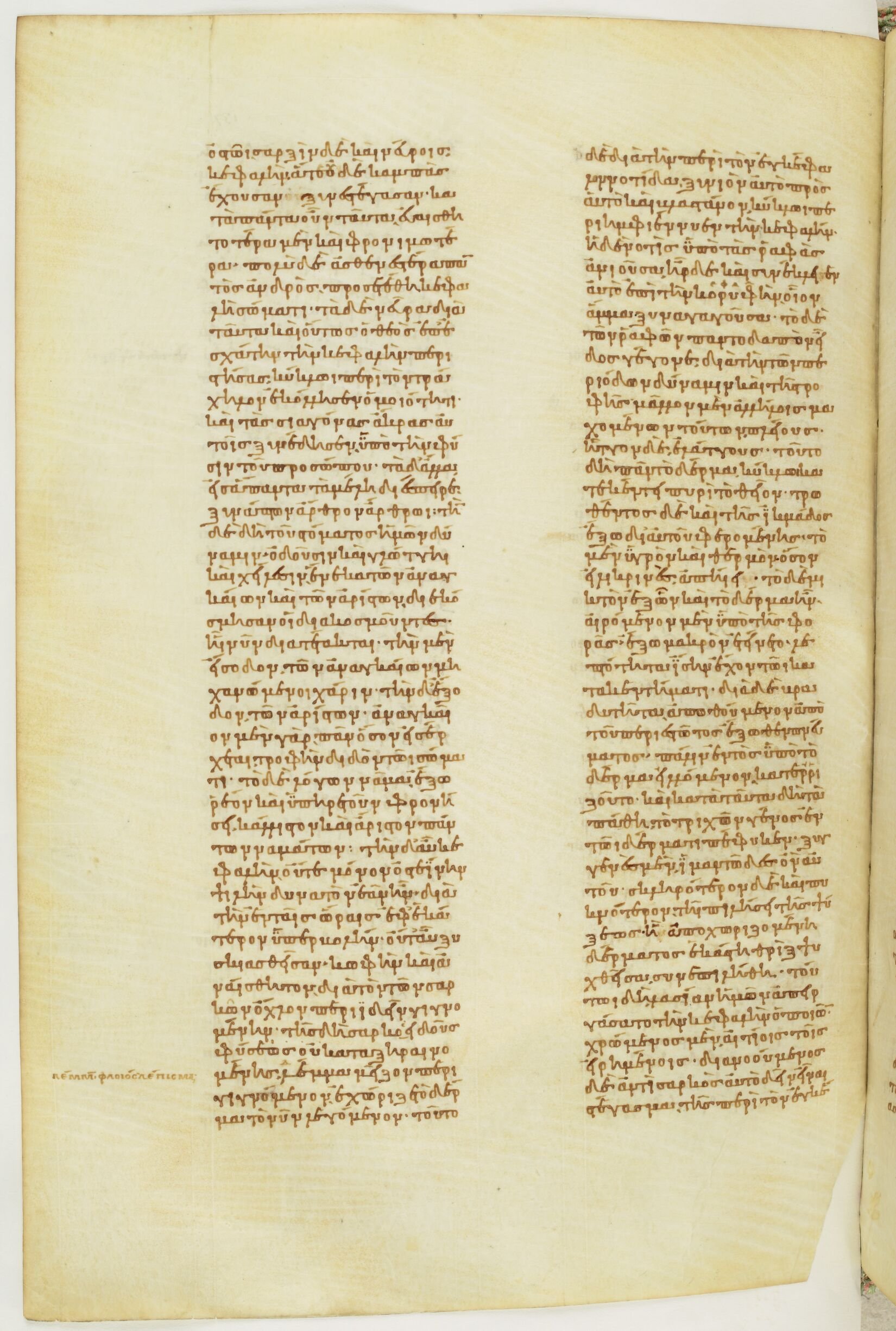
Where on the image
Tim. 76a stands in Paris gr. 1807, fol. 137v col. a to fol. 137v col. b. Checked on the image (column openings read on the BnF photographs and found in Burnet's text, quoted in Burnet's spelling): fol. 137v col. a begins ‹ὀστῷ, σαρξὶν δὲ καὶ νεύροις κεφαλήν› (Tim. 75c); fol. 137v col. b begins ‹δὲ διὰ τὴν περὶ τὸν ἐγκέφαλον› (Tim. 76a).
σαρκοειδοῦς φύσεως οὐ καταξηραινομένης λέμμα μεῖζον περιγιγνόμενον ἐχωρίζετο, δέρμα τὸ νῦν λεγόμενον. τοῦτο δὲ διὰ τὴν περὶ τὸν ἐγκέφαλον νοτίδα συνιὸν αὐτὸ πρὸς αὑτὸ καὶ βλαστάνον κύκλῳ περιημφιέννυεν τὴν κεφαλήν· ἡ δὲ νοτὶς ὑπὸ τὰς ῥαφὰς ἀνιοῦσα ἦρδε καὶ συνέκλεισεν αὐτὸ ἐπὶ τὴν κορυφήν, οἷον ἅμμα συναγαγοῦσα, τὸ δὲ τῶν ῥαφῶν παντοδαπὸν εἶδος γέγονε διὰ τὴν τῶν περιόδων δύναμιν καὶ τῆς τροφῆς, μᾶλλον μὲν ἀλλήλοις μαχομένων τούτων πλείους,
Accordingly, of the fleshy substance which was not being fully dried up a larger enveloping film was separated off, forming what is now called skin. And this, having united with itself because of the moisture round the brain and spreading, formed a vesture round about the head; and this was damped by the moisture ascending under the seams and closed down over the crown, being drawn together as it were in a knot; and the seams had all kinds of shapes owing to the force of the soul’s revolutions and of her food, being more in number when these are more in conflict with one another, and less when they are less in conflict.
Where on the image
Tim. 76b stands in Paris gr. 1807, fol. 137v col. b. Checked on the image (column openings read on the BnF photographs and found in Burnet's text, quoted in Burnet's spelling): fol. 137v col. b begins ‹δὲ διὰ τὴν περὶ τὸν ἐγκέφαλον› (Tim. 76a).
ἧττον δὲ ἐλάττους. τοῦτο δὴ πᾶν τὸ δέρμα κύκλῳ κατεκέντει πυρὶ τὸ θεῖον, τρηθέντος δὲ καὶ τῆς ἰκμάδος ἔξω διʼ αὐτοῦ φερομένης τὸ μὲν ὑγρὸν καὶ θερμὸν ὅσον εἰλικρινὲς ἀπῄειν, τὸ δὲ μεικτὸν ἐξ ὧν καὶ τὸ δέρμα ἦν, αἰρόμενον μὲν ὑπὸ τῆς φορᾶς ἔξω μακρὸν ἐτείνετο, λεπτότητα ἴσην ἔχον τῷ κατακεντήματι, διὰ δὲ βραδυτῆτα ἀπωθούμενον ὑπὸ τοῦ περιεστῶτος ἔξωθεν πνεύματος πάλιν ἐντὸς ὑπὸ τὸ δέρμα
And the Deity kept puncturing all this skin round about with fire; and when the skin was pierced and the moisture flew out through it, all the liquid and heat that was pure went away, but such as was mixed with the substance whereof the skin also was composed was lifted up by the motion and extended far beyond the skin, being of a fineness to match the puncture; but since it was thrust back, because of its slowness, by the external air that surrounded it, it coiled itself round inside and rooted itself under the skin.
Where on the image
Tim. 76c stands in Paris gr. 1807, fol. 137v col. b. Checked on the image (column openings read on the BnF photographs and found in Burnet's text, quoted in Burnet's spelling): fol. 137v col. b begins ‹δὲ διὰ τὴν περὶ τὸν ἐγκέφαλον› (Tim. 76a).
εἱλλόμενον κατερριζοῦτο· καὶ κατὰ ταῦτα δὴ τὰ πάθη τὸ τριχῶν γένος ἐν τῷ δέρματι πέφυκεν, συγγενὲς μὲν ἱμαντῶδες ὂν αὐτοῦ, σκληρότερον δὲ καὶ πυκνότερον τῇ πιλήσει τῆς ψύξεως, ἣν ἀποχωριζομένη δέρματος ἑκάστη θρὶξ ψυχθεῖσα συνεπιλήθη. τούτῳ δὴ λασίαν ἡμῶν ἀπηργάσατο τὴν κεφαλὴν ὁ ποιῶν, χρώμενος μὲν αἰτίοις τοῖς εἰρημένοις, διανοούμενος δὲ ἀντὶ σαρκὸς αὐτὸ δεῖν εἶναι στέγασμα τῆς
Such, then, were the processes by which hair grew in the skin, it being a cord-like species akin to the skin but harder and denser owing to the constriction of the cold, whereby each hair as it separated off from the skin was chilled and constricted. Making use, then, of the causes mentioned our Maker fashioned the head shaggy with hair, purposing that, in place of flesh, the hair should serve as a light roofing for the part about the brain for safety’s sake,
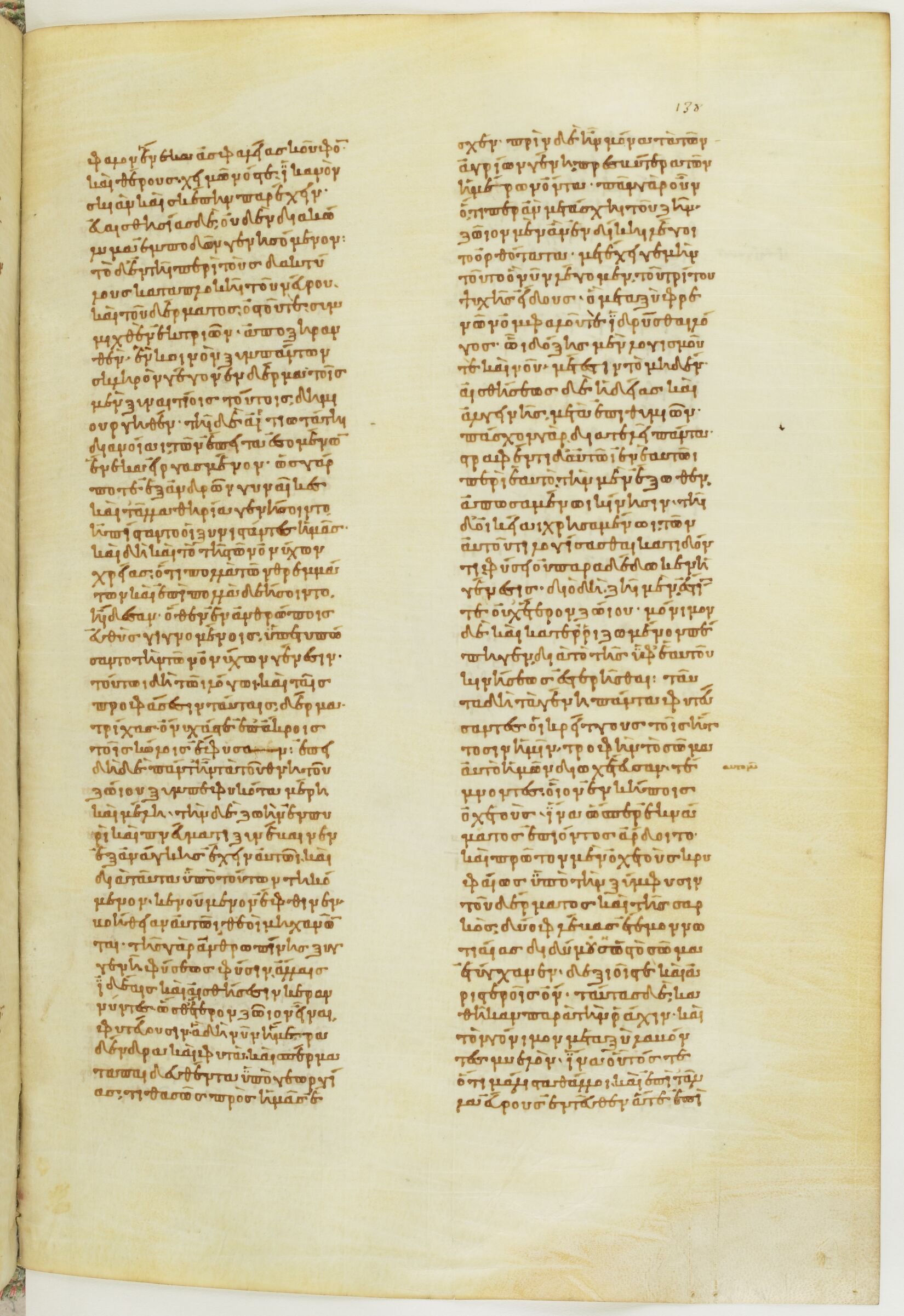
Where on the image
Tim. 76d stands in Paris gr. 1807, fol. 137v col. b to fol. 138r col. a. Checked on the image (column openings read on the BnF photographs and found in Burnet's text, quoted in Burnet's spelling): fol. 137v col. b begins ‹δὲ διὰ τὴν περὶ τὸν ἐγκέφαλον› (Tim. 76a); fol. 138r col. a begins ‹-φαλον ἕνεκα ἀσφαλείας κοῦφον καὶ θέρους› (Tim. 76d).
περὶ τὸν ἐγκέφαλον ἕνεκα ἀσφαλείας κοῦφον καὶ θέρους χειμῶνός τε ἱκανὸν σκιὰν καὶ σκέπην παρέχειν, εὐαισθησίας δὲ οὐδὲν διακώλυμα ἐμποδὼν γενησόμενον. τὸ δʼ ἐν τῇ περὶ τοὺς δακτύλους καταπλοκῇ τοῦ νεύρου καὶ τοῦ δέρματος ὀστοῦ τε, συμμειχθὲν ἐκ τριῶν, ἀποξηρανθὲν ἓν κοινὸν συμπάντων σκληρὸν γέγονεν δέρμα, τοῖς μὲν συναιτίοις τούτοις δημιουργηθέν, τῇ δὲ αἰτιωτάτῃ διανοίᾳ τῶν ἔπειτα ἐσομένων ἕνεκα εἰργασμένον. ὡς γάρ ποτε ἐξ ἀνδρῶν γυναῖκες καὶ τἆλλα
providing a sufficient shade and screen alike in summer and in winter, while proving no obstacle in the way of easy perception. And at the place in the fingers where sinew and skin and bone were interlaced there was formed a material blended of these three; and this when it was dried off became a single hard skin compounded of them all and whereas these were the auxiliary causes whereby it was fashioned, it was wrought by the greatest of causes, divine Purpose, for the sake of what should come to pass hereafter. For those who were constructing us knew that out of men women should one day spring
Where on the image
Tim. 76e stands in Paris gr. 1807, fol. 138r col. a. Checked on the image (column openings read on the BnF photographs and found in Burnet's text, quoted in Burnet's spelling): fol. 138r col. a begins ‹-φαλον ἕνεκα ἀσφαλείας κοῦφον καὶ θέρους› (Tim. 76d).
θηρία γενήσοιντο, ἠπίσταντο οἱ συνιστάντες ἡμᾶς, καὶ δὴ καὶ τῆς τῶν ὀνύχων χρείας ὅτι πολλὰ τῶν θρεμμάτων καὶ ἐπὶ πολλὰ δεήσοιτο ᾔδεσαν, ὅθεν ἐν ἀνθρώποις εὐθὺς γιγνομένοις ὑπετυπώσαντο τὴν τῶν ὀνύχων γένεσιν. τούτῳ δὴ τῷ λόγῳ καὶ ταῖς προφάσεσιν ταύταις δέρμα τρίχας ὄνυχάς τε ἐπʼ ἄκροις τοῖς κώλοις ἔφυσαν.
ἐπειδὴ δὲ πάντʼ ἦν τὰ τοῦ θνητοῦ ζῴου συμπεφυκότα
and all other animals; and they understood, moreover, that many of these creatures would need for many purposes the help of nails; wherefore they impressed upon men at their very birth the rudimentary structure of finger-nails. Upon this account and with these designs they caused skin to grow into hair and nails upon the extremities of the limbs.
And when all the limbs and parts of the mortal living creature had been naturally joined together,
Notes
- Greek: John Burnet, Platonis Opera IV (Oxford, 1902), via Perseus canonical-greekLit; Burnet's text is a critical edition, so its wording can differ from the manuscript shown.
- English: R. G. Bury, Plato IX (Loeb Classical Library, 1929), via Perseus. Bury's footnotes are not reproduced. Quotation marks stand where Perseus marks quoted speech.
- Stephanus sections (a-e) are those of the 1578 Stephanus edition as given by Burnet and Bury; Bury's section breaks can fall a few words away from Burnet's because English word order differs.
Cite
Sources
- Source: Paris, BnF grec 1807 (Plato A, c. 850-875) fol. 137v-138r via BnF IIIF + Burnet's Greek (Perseus) + R. G. Bury's English (Loeb 1929, Perseus) (holding institution)
- Critical edition: Burnet, Platonis Opera IV (1902), via Perseus
← previous · → next · v cycle view · l back to library