Plato, Timaeus 77a-77e: plants; the channels of the body
Introduction
Stephanus page 77 of Plato's Timaeus (77a-77e): plants; the channels of the body.
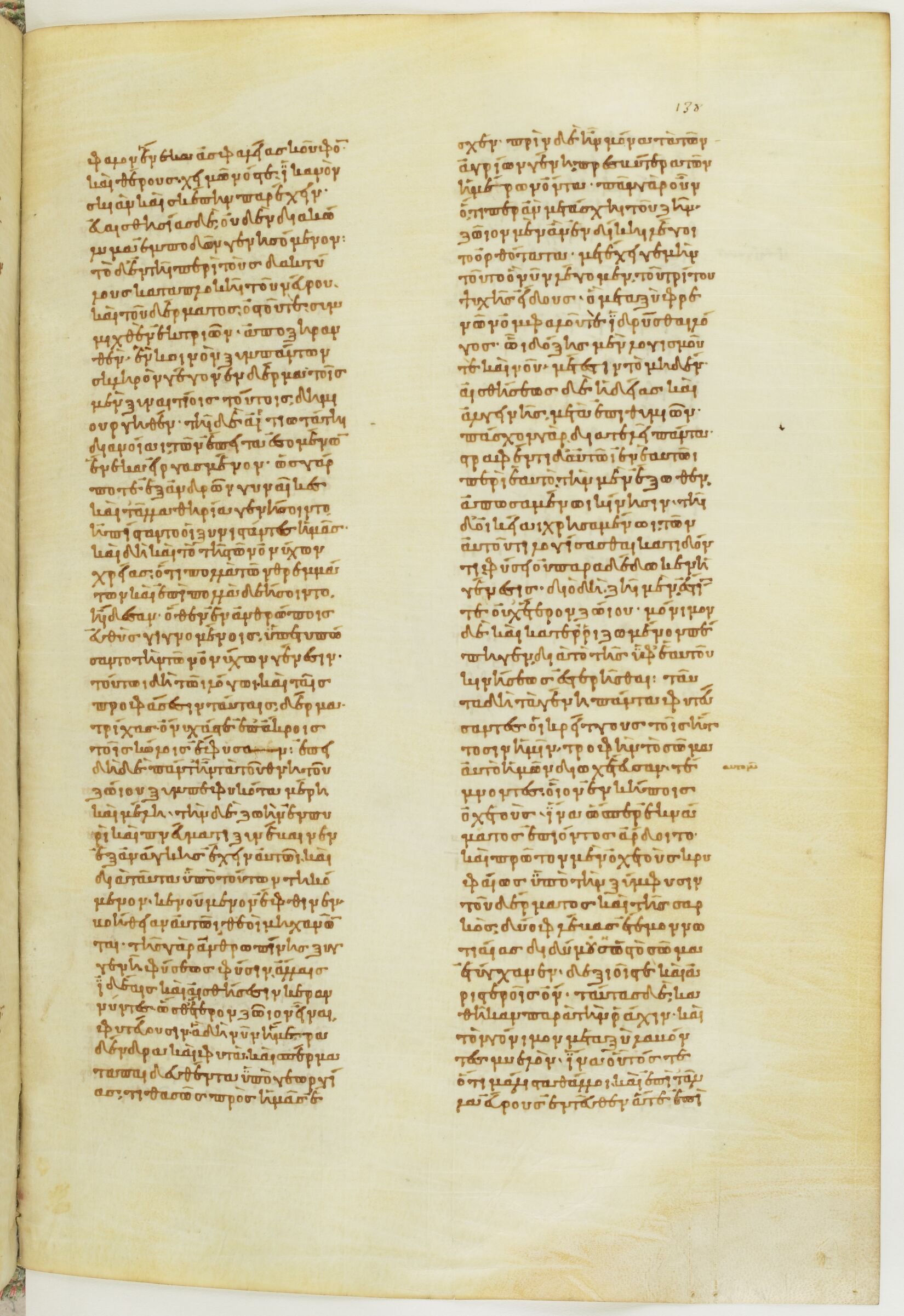
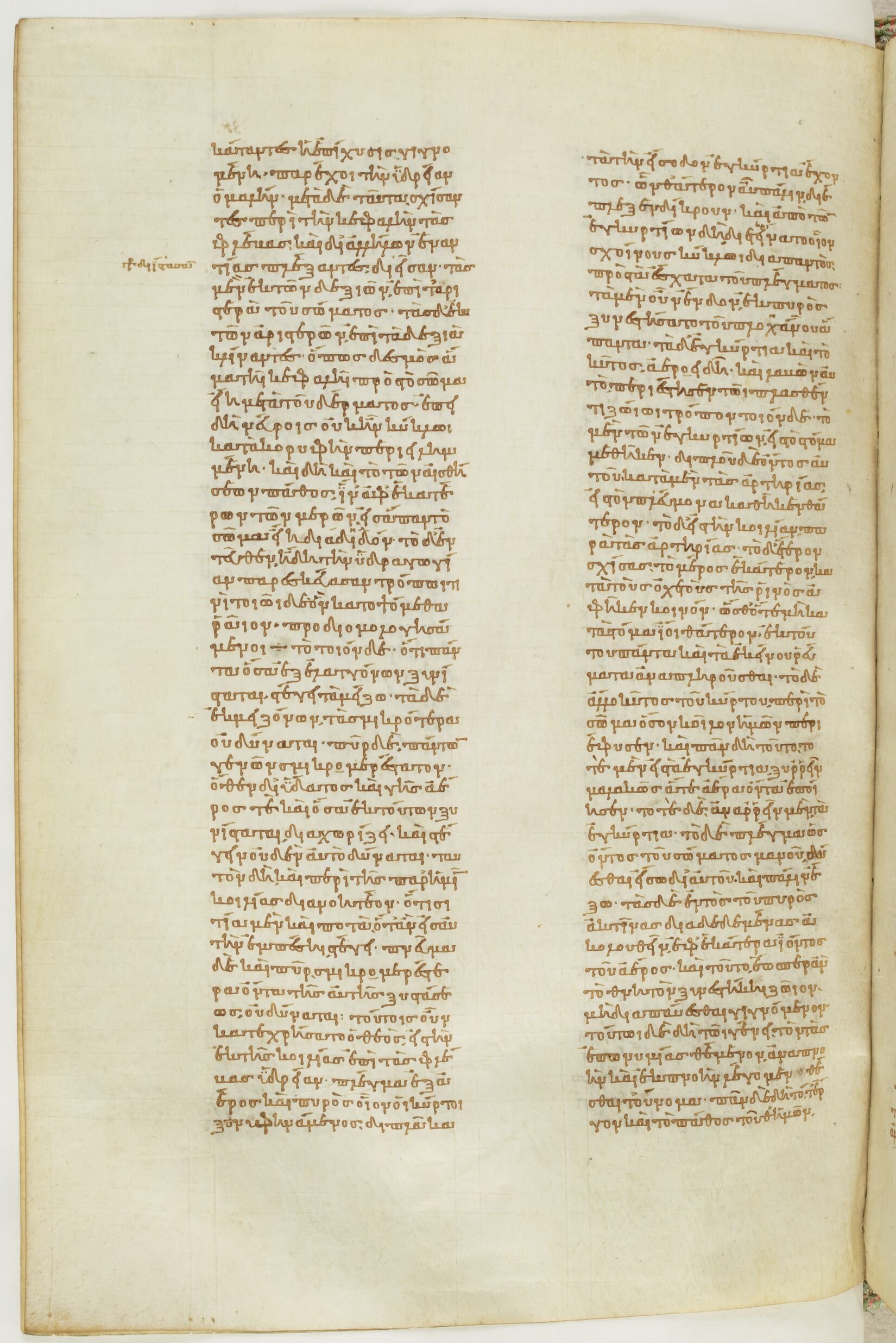
The manuscript is Paris, Bibliothèque nationale de France, grec 1807, known to editors as Plato A. It was copied in Constantinople around 850-875 by the scribe of the so-called philosophical collection, and is the oldest surviving medieval manuscript of the Timaeus and Critias (tetralogies VIII-IX: Clitophon, Republic, Timaeus, Critias, Minos, Laws, Epinomis, Letters). Each page has two columns of 44 lines. The Timaeus fills fol. 114r-144v and the Critias fol. 145r-151r.
On the manuscript this page of text runs over fol. 138r col. a to fol. 138v col. a. Each section below is linked to the folio side(s) that carry it. The mapping comes from reading the first words of every column on the images and finding them in Burnet's text: fol. 138r col. a begins ‹-φαλον ἕνεκα ἀσφαλείας κοῦφον καὶ θέρους› (Tim. 76d); fol. 138r col. b begins ‹-σχεν, πρὶν δὲ ἦν μόνα τὰ› (Tim. 77a); fol. 138v col. a begins ‹κάταντες ἡ ἐπίχυσις γιγνομένη παρέχοι τὴν› (Tim. 77d).
The Greek is John Burnet's critical text (Oxford, 1902), not a transcription of this manuscript; the scribe's spelling, accents and occasional readings differ from it. The English is R. G. Bury's Loeb translation (1929).
How was this verified? (Provenance)
Where on the image
Tim. 77a stands in Paris gr. 1807, fol. 138r col. a to fol. 138r col. b. Checked on the image (column openings read on the BnF photographs and found in Burnet's text, quoted in Burnet's spelling): fol. 138r col. a begins ‹-φαλον ἕνεκα ἀσφαλείας κοῦφον καὶ θέρους› (Tim. 76d); fol. 138r col. b begins ‹-σχεν, πρὶν δὲ ἦν μόνα τὰ› (Tim. 77a).
μέρη καὶ μέλη, τὴν δὲ ζωὴν ἐν πυρὶ καὶ πνεύματι συνέβαινεν ἐξ ἀνάγκης ἔχειν αὐτῷ, καὶ διὰ ταῦτα ὑπὸ τούτων τηκόμενον κενούμενόν τʼ ἔφθινεν, βοήθειαν αὐτῷ θεοὶ μηχανῶνται. τῆς γὰρ ἀνθρωπίνης συγγενῆ φύσεως φύσιν ἄλλαις ἰδέαις καὶ αἰσθήσεσιν κεραννύντες, ὥσθʼ ἕτερον ζῷον εἶναι, φυτεύουσιν· ἃ δὴ νῦν ἥμερα δένδρα καὶ φυτὰ καὶ σπέρματα παιδευθέντα ὑπὸ γεωργίας τιθασῶς πρὸς ἡμᾶς ἔσχεν, πρὶν δὲ ἦν μόνα τὰ
it was so that of necessity its life consisted in fire and air; and because of this it wasted away when dissolved by these elements or left empty thereby; wherefore the Gods contrived succour for the creature. Blending it with other shapes and senses they engendered a substance akin to that of man, so as to form another living creature: such are the cultivated trees and plants and seeds which have been trained by husbandry and are now domesticated amongst us; but formerly the wild kinds only existed,
Where on the image
Tim. 77b stands in Paris gr. 1807, fol. 138r col. b. Checked on the image (column openings read on the BnF photographs and found in Burnet's text, quoted in Burnet's spelling): fol. 138r col. b begins ‹-σχεν, πρὶν δὲ ἦν μόνα τὰ› (Tim. 77a).
τῶν ἀγρίων γένη, πρεσβύτερα τῶν ἡμέρων ὄντα. πᾶν γὰρ οὖν ὅτιπερ ἂν μετάσχῃ τοῦ ζῆν, ζῷον μὲν ἂν ἐν δίκῃ λέγοιτο ὀρθότατα· μετέχει γε μὴν τοῦτο ὃ νῦν λέγομεν τοῦ τρίτου ψυχῆς εἴδους, ὃ μεταξὺ φρενῶν ὀμφαλοῦ τε ἱδρῦσθαι λόγος, ᾧ δόξης μὲν λογισμοῦ τε καὶ νοῦ μέτεστιν τὸ μηδέν, αἰσθήσεως δὲ ἡδείας καὶ ἀλγεινῆς μετὰ ἐπιθυμιῶν. πάσχον γὰρ διατελεῖ πάντα, στραφέντι δʼ αὐτῷ ἐν ἑαυτῷ περὶ ἑαυτό, τὴν
these being older than the cultivated kinds. For everything, in fact, which partakes of life may justly and with perfect truth be termed a living creature. Certainly that creature which we are now describing partakes of the third kind of soul, which is seated, as we affirm, between the midriff and the navel, and which shares not at all in opinion and reasoning and mind but in sensation, pleasant and painful, together with desires. For inasmuch as it continues wholly passive and does not turn within itself around itself, repelling motion from without
Where on the image
Tim. 77c stands in Paris gr. 1807, fol. 138r col. b. Checked on the image (column openings read on the BnF photographs and found in Burnet's text, quoted in Burnet's spelling): fol. 138r col. b begins ‹-σχεν, πρὶν δὲ ἦν μόνα τὰ› (Tim. 77a).
μὲν ἔξωθεν ἀπωσαμένῳ κίνησιν, τῇ δʼ οἰκείᾳ χρησαμένῳ, τῶν αὑτοῦ τι λογίσασθαι κατιδόντι φύσει οὐ παραδέδωκεν ἡ γένεσις. διὸ δὴ ζῇ μὲν ἔστιν τε οὐχ ἕτερον ζῴου, μόνιμον δὲ καὶ κατερριζωμένον πέπηγεν διὰ τὸ τῆς ὑφʼ ἑαυτοῦ κινήσεως ἐστερῆσθαι. ταῦτα δὴ τὰ γένη πάντα φυτεύσαντες οἱ κρείττους τοῖς ἥττοσιν ἡμῖν τροφήν, τὸ σῶμα αὐτὸ ἡμῶν διωχέτευσαν τέμνοντες οἷον ἐν κήποις ὀχετούς, ἵνα ὥσπερ ἐκ νάματος ἐπιόντος ἄρδοιτο. καὶ πρῶτον μὲν ὀχετοὺς κρυφαίους ὑπὸ
and using its own native motion, it is not endowed by its original constitution with a natural capacity for discerning or reflecting upon any of its own experiences. Wherefore it lives indeed and is not other than a living creature, but it remains stationary and rooted down owing to its being deprived of the power of self-movement. And when our Superiors had generated all these kinds as nutriment for us inferior beings, they channelled out our body itself, like as if they were cutting channels in gardens, to the end that it might be irrigated as it were by an inflowing stream. And firstly, beneath the junction
Where on the image
Tim. 77d stands in Paris gr. 1807, fol. 138r col. b to fol. 138v col. a. Checked on the image (column openings read on the BnF photographs and found in Burnet's text, quoted in Burnet's spelling): fol. 138r col. b begins ‹-σχεν, πρὶν δὲ ἦν μόνα τὰ› (Tim. 77a); fol. 138v col. a begins ‹κάταντες ἡ ἐπίχυσις γιγνομένη παρέχοι τὴν› (Tim. 77d).
τὴν σύμφυσιν τοῦ δέρματος καὶ τῆς σαρκὸς δύο φλέβας ἔτεμον νωτιαίας, δίδυμον ὡς τὸ σῶμα ἐτύγχανεν δεξιοῖς τε καὶ ἀριστεροῖς ὄν· ταύτας δὲ καθῆκαν παρὰ τὴν ῥάχιν, καὶ τὸν γόνιμον μεταξὺ λαβόντες μυελόν, ἵνα οὗτός τε ὅτι μάλιστα θάλλοι, καὶ ἐπὶ τἆλλα εὔρους ἐντεῦθεν ἅτε ἐπὶ κάταντες ἡ ἐπίχυσις γιγνομένη παρέχοι τὴν ὑδρείαν ὁμαλήν. μετὰ δὲ ταῦτα σχίσαντες περὶ τὴν κεφαλὴν τὰς φλέβας καὶ διʼ
of the skin and flesh they cut for hidden channels two veins along the back, seeing that the body was in fact double, with right side and left; and these they drew down along by the spine, keeping between them the spermatic marrow, in order that this might thrive as much as possible, and that the stream of moisture from there, being in a downward course, might flow easily to the other parts and cause the irrigation to be uniform. After this
Where on the image
Tim. 77e stands in Paris gr. 1807, fol. 138v col. a. Checked on the image (column openings read on the BnF photographs and found in Burnet's text, quoted in Burnet's spelling): fol. 138v col. a begins ‹κάταντες ἡ ἐπίχυσις γιγνομένη παρέχοι τὴν› (Tim. 77d).
ἀλλήλων ἐναντίας πλέξαντες διεῖσαν, τὰς μὲν ἐκ τῶν δεξιῶν ἐπὶ τἀριστερὰ τοῦ σώματος, τὰς δʼ ἐκ τῶν ἀριστερῶν ἐπὶ τὰ δεξιὰ κλίναντες, ὅπως δεσμὸς ἅμα τῇ κεφαλῇ πρὸς τὸ σῶμα εἴη μετὰ τοῦ δέρματος, ἐπειδὴ νεύροις οὐκ ἦν κύκλῳ κατὰ κορυφὴν περιειλημμένη, καὶ δὴ καὶ τὸ τῶν αἰσθήσεων πάθος ἵνʼ ἀφʼ ἑκατέρων τῶν μερῶν εἰς ἅπαν τὸ σῶμα εἴη διάδηλον.
τὸ δʼ ἐντεῦθεν ἤδη τὴν ὑδραγωγίαν παρεσκεύασαν τρόπῳ τινὶ
they clave the veins round the head and interlaced them, and drew them opposite ways, bending those from the right of the head to the left and those from the left to the right, in order that they, together with the skin, might serve as a bond between the head and the body, seeing that the head was not encircled by sinews at the crown; and in order, also, that the sense-impressions derived from the parts on either side might be manifest to the whole body.
Notes
- Greek: John Burnet, Platonis Opera IV (Oxford, 1902), via Perseus canonical-greekLit; Burnet's text is a critical edition, so its wording can differ from the manuscript shown.
- English: R. G. Bury, Plato IX (Loeb Classical Library, 1929), via Perseus. Bury's footnotes are not reproduced. Quotation marks stand where Perseus marks quoted speech.
- Stephanus sections (a-e) are those of the 1578 Stephanus edition as given by Burnet and Bury; Bury's section breaks can fall a few words away from Burnet's because English word order differs.
Cite
Sources
- Source: Paris, BnF grec 1807 (Plato A, c. 850-875) fol. 138r-138v via BnF IIIF + Burnet's Greek (Perseus) + R. G. Bury's English (Loeb 1929, Perseus) (holding institution)
- Critical edition: Burnet, Platonis Opera IV (1902), via Perseus
← previous · → next · v cycle view · l back to library