Plato, Timaeus 78a-78e: the fish-trap: the mechanism of breathing
Introduction
Stephanus page 78 of Plato's Timaeus (78a-78e): the fish-trap: the mechanism of breathing.
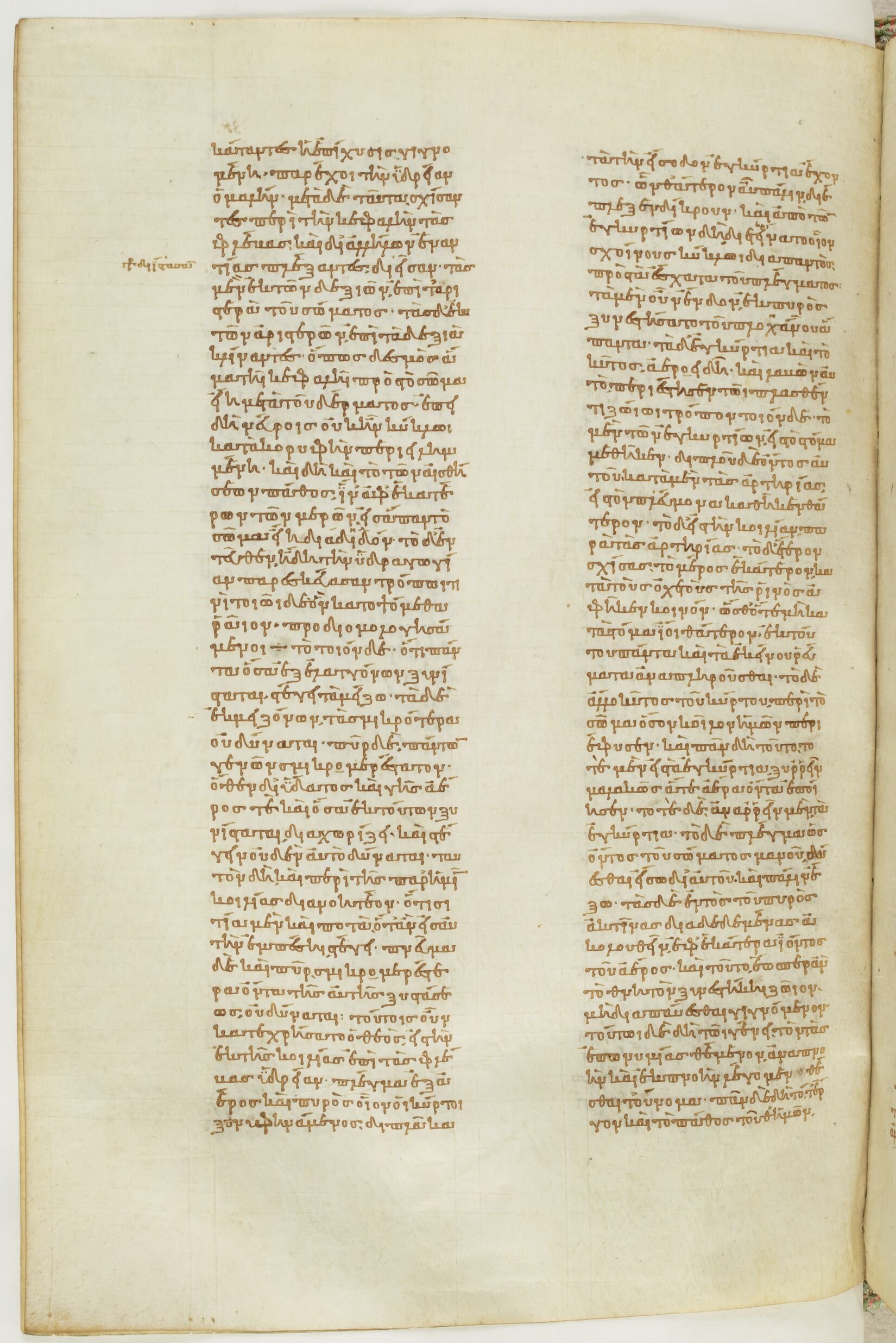
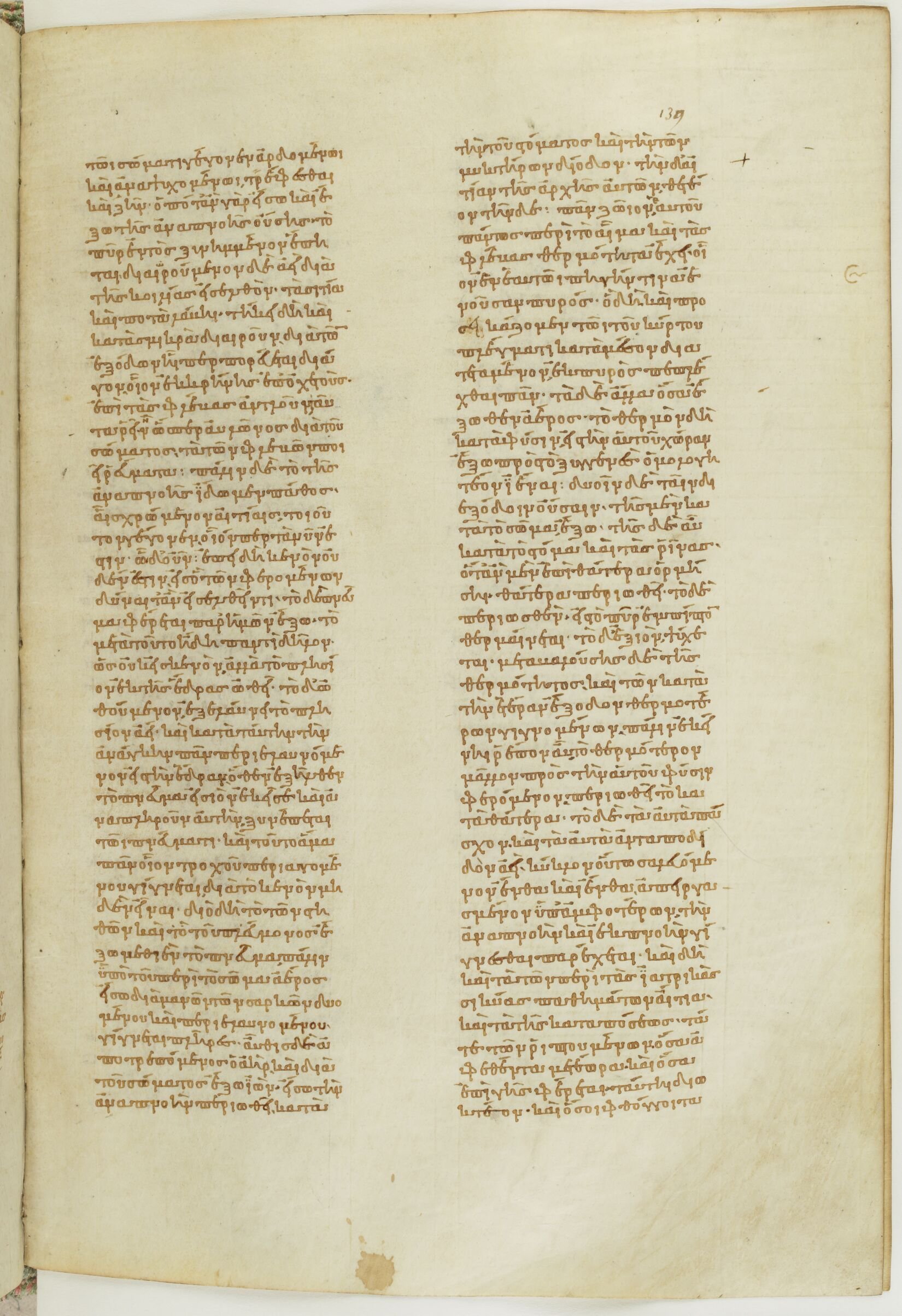
The manuscript is Paris, Bibliothèque nationale de France, grec 1807, known to editors as Plato A. It was copied in Constantinople around 850-875 by the scribe of the so-called philosophical collection, and is the oldest surviving medieval manuscript of the Timaeus and Critias (tetralogies VIII-IX: Clitophon, Republic, Timaeus, Critias, Minos, Laws, Epinomis, Letters). Each page has two columns of 44 lines. The Timaeus fills fol. 114r-144v and the Critias fol. 145r-151r.
On the manuscript this page of text runs over fol. 138v col. a to fol. 139r col. a. Each section below is linked to the folio side(s) that carry it. The mapping comes from reading the first words of every column on the images and finding them in Burnet's text: fol. 138v col. a begins ‹κάταντες ἡ ἐπίχυσις γιγνομένη παρέχοι τὴν› (Tim. 77d); fol. 138v col. b begins ‹κατὰ τὴν εἴσοδον ἐγκύρτια ἔχον, ὧν› (Tim. 78b); fol. 139r col. a begins ‹τῷ σώματι γέγονεν ἀρδομένῳ καὶ ἀναψυχομένῳ› (Tim. 78e).
The Greek is John Burnet's critical text (Oxford, 1902), not a transcription of this manuscript; the scribe's spelling, accents and occasional readings differ from it. The English is R. G. Bury's Loeb translation (1929).
How was this verified? (Provenance)
Where on the image
Tim. 78a stands in Paris gr. 1807, fol. 138v col. a. Checked on the image (column openings read on the BnF photographs and found in Burnet's text, quoted in Burnet's spelling): fol. 138v col. a begins ‹κάταντες ἡ ἐπίχυσις γιγνομένη παρέχοι τὴν› (Tim. 77d).
τοιῷδε, ὃν κατοψόμεθα ῥᾷον προδιομολογησάμενοι τὸ τοιόνδε, ὅτι πάντα ὅσα ἐξ ἐλαττόνων συνίσταται στέγει τὰ μείζω, τὰ δὲ ἐκ μειζόνων τὰ σμικρότερα οὐ δύναται, πῦρ δὲ πάντων γενῶν σμικρομερέστατον, ὅθεν διʼ ὕδατος καὶ γῆς ἀέρος τε καὶ ὅσα ἐκ τούτων συνίσταται διαχωρεῖ καὶ στέγειν οὐδὲν αὐτὸ δύναται. ταὐτὸν δὴ καὶ περὶ τῆς παρʼ ἡμῖν κοιλίας διανοητέον, ὅτι σιτία μὲν καὶ ποτὰ ὅταν εἰς αὐτὴν ἐμπέσῃ,
Thereupon they arranged the irrigation on some such plan as this—a plan which we shall perceive more easily when we have first agreed upon the following postulates. All bodies composed of smaller particles shut in the larger, but those composed of larger particles cannot shut in the smaller; and fire, because of all the elements it has the smallest particles, passes through water and earth and air and all things composed thereof, and nothing can shut it in. We must conceive that the same law holds good of the action of our belly. Whenever foods and drinks flow into it
Where on the image
Tim. 78b stands in Paris gr. 1807, fol. 138v col. a to fol. 138v col. b. Checked on the image (column openings read on the BnF photographs and found in Burnet's text, quoted in Burnet's spelling): fol. 138v col. a begins ‹κάταντες ἡ ἐπίχυσις γιγνομένη παρέχοι τὴν› (Tim. 77d); fol. 138v col. b begins ‹κατὰ τὴν εἴσοδον ἐγκύρτια ἔχον, ὧν› (Tim. 78b).
στέγει, πνεῦμα δὲ καὶ πῦρ σμικρομερέστερα ὄντα τῆς αὑτῆς συστάσεως οὐ δύναται. τούτοις οὖν κατεχρήσατο ὁ θεὸς εἰς τὴν ἐκ τῆς κοιλίας ἐπὶ τὰς φλέβας ὑδρείαν, πλέγμα ἐξ ἀέρος καὶ πυρὸς οἷον οἱ κύρτοι συνυφηνάμενος, διπλᾶ κατὰ τὴν εἴσοδον ἐγκύρτια ἔχον, ὧν θάτερον αὖ πάλιν διέπλεξεν δίκρουν· καὶ ἀπὸ τῶν ἐγκυρτίων δὴ διετείνατο οἷον σχοίνους κύκλῳ διὰ παντὸς πρὸς τὰ ἔσχατα τοῦ πλέγματος. τὰ μὲν
it shuts them in, but air and fire, being of smaller particles than its own structure, it cannot shut in. These elements, therefore, God employed to provide irrigation from the belly to the veins, weaving out of air and fire a veil of mesh-work like unto a fish-weel, having two innerweels at its entrance; and one of these inner-weels He wove over again so as to make it bifurcated; and from the inner-weels He stretched as it were ropes all over it in a circle up to the extremities of the veil. Now the inward parts of the veil
Where on the image
Tim. 78c stands in Paris gr. 1807, fol. 138v col. b. Checked on the image (column openings read on the BnF photographs and found in Burnet's text, quoted in Burnet's spelling): fol. 138v col. b begins ‹κατὰ τὴν εἴσοδον ἐγκύρτια ἔχον, ὧν› (Tim. 78b).
οὖν ἔνδον ἐκ πυρὸς συνεστήσατο τοῦ πλοκάνου ἅπαντα, τὰ δʼ ἐγκύρτια καὶ τὸ κύτος ἀεροειδῆ, καὶ λαβὼν αὐτὸ περιέστησεν τῷ πλασθέντι ζῴῳ τρόπον τοιόνδε. τὸ μὲν τῶν ἐγκυρτίων εἰς τὸ στόμα μεθῆκεν· διπλοῦ δὲ ὄντος αὐτοῦ κατὰ μὲν τὰς ἀρτηρίας εἰς τὸν πλεύμονα καθῆκεν θάτερον, τὸ δʼ εἰς τὴν κοιλίαν παρὰ τὰς ἀρτηρίας· τὸ δʼ ἕτερον σχίσας τὸ μέρος ἑκάτερον κατὰ τοὺς ὀχετοὺς τῆς ῥινὸς ἀφῆκεν κοινόν, ὥσθʼ ὅτε μὴ κατὰ στόμα ἴοι θάτερον, ἐκ τούτου πάντα καὶ τὰ
He constructed wholly of fire, but the inner-weels and the envelope of air; and taking this He placed it round about the living creature that was molded in the following manner. The part consisting of the inner-weels He let down into the mouth; and since this part was twofold, He let down one inner-weel by way of the windpipe into the lungs, and the other into the belly alongside the windpipe. And cleaving the former of these weels in two He gave to both sections a common outlet by way of the channels of the nose, so that when the first conduit by way of the mouth failed to act,
Where on the image
Tim. 78d stands in Paris gr. 1807, fol. 138v col. b. Checked on the image (column openings read on the BnF photographs and found in Burnet's text, quoted in Burnet's spelling): fol. 138v col. b begins ‹κατὰ τὴν εἴσοδον ἐγκύρτια ἔχον, ὧν› (Tim. 78b).
ἐκείνου ῥεύματα ἀναπληροῦσθαι. τὸ δὲ ἄλλο κύτος τοῦ κύρτου περὶ τὸ σῶμα ὅσον κοῖλον ἡμῶν περιέφυσεν, καὶ πᾶν δὴ τοῦτο τοτὲ μὲν εἰς τὰ ἐγκύρτια συρρεῖν μαλακῶς, ἅτε ἀέρα ὄντα, ἐποίησεν, τοτὲ δὲ ἀναρρεῖν μὲν τὰ ἐγκύρτια, τὸ δὲ πλέγμα, ὡς ὄντος τοῦ σώματος μανοῦ, δύεσθαι εἴσω διʼ αὐτοῦ καὶ πάλιν ἔξω, τὰς δὲ ἐντὸς τοῦ πυρὸς ἀκτῖνας διαδεδεμένας ἀκολουθεῖν ἐφʼ ἑκάτερα ἰόντος τοῦ ἀέρος, καὶ τοῦτο,
its streams as well should be plenished from this. The rest of the enveloping mesh-work He made to grow round all the hollow part of our body; and He caused all this at one time to flow gently into the inner-weels, seeing they were of air, and at another time the weels to flow back into it. And inasmuch as the body was porous, He caused the veil to pass in through it and out again; and the inner rays of fire that were enclosed within it He made to follow the air as it moved in either direction; whence it comes that, so long as the mortal living creature preserves its structure, this process goes on unceasingly.
Where on the image
Tim. 78e stands in Paris gr. 1807, fol. 138v col. b to fol. 139r col. a. Checked on the image (column openings read on the BnF photographs and found in Burnet's text, quoted in Burnet's spelling): fol. 138v col. b begins ‹κατὰ τὴν εἴσοδον ἐγκύρτια ἔχον, ὧν› (Tim. 78b); fol. 139r col. a begins ‹τῷ σώματι γέγονεν ἀρδομένῳ καὶ ἀναψυχομένῳ› (Tim. 78e).
ἕωσπερ ἂν τὸ θνητὸν συνεστήκῃ ζῷον, μὴ διαπαύεσθαι γιγνόμενον· τούτῳ δὲ δὴ τῷ γένει τὸν τὰς ἐπωνυμίας θέμενον ἀναπνοὴν καὶ ἐκπνοὴν λέγομεν θέσθαι τοὔνομα. πᾶν δὲ δὴ τό τʼ ἔργον καὶ τὸ πάθος τοῦθʼ ἡμῶν τῷ σώματι γέγονεν ἀρδομένῳ καὶ ἀναψυχομένῳ τρέφεσθαι καὶ ζῆν·
ὁπόταν γὰρ εἴσω καὶ ἔξω τῆς ἀναπνοῆς ἰούσης τὸ πῦρ ἐντὸς συνημμένον ἕπηται, διαιωρούμενον δὲ ἀεὶ διὰ τῆς κοιλίας εἰσελθὸν τὰ
And to this kind of process the Giver of Titles gave, as we say, the names of inspiration and expiration. And the whole of this mechanism and its effects have been created in order to secure nourishment and life for our body, by means of moistening and cooling.
For as the respiration goes in and out the inward fire attached thereto follows it; and whenever in its constant oscillations this fire enters in through the belly
Notes
- Greek: John Burnet, Platonis Opera IV (Oxford, 1902), via Perseus canonical-greekLit; Burnet's text is a critical edition, so its wording can differ from the manuscript shown.
- English: R. G. Bury, Plato IX (Loeb Classical Library, 1929), via Perseus. Bury's footnotes are not reproduced. Quotation marks stand where Perseus marks quoted speech.
- Stephanus sections (a-e) are those of the 1578 Stephanus edition as given by Burnet and Bury; Bury's section breaks can fall a few words away from Burnet's because English word order differs.
Cite
Sources
- Source: Paris, BnF grec 1807 (Plato A, c. 850-875) fol. 138v-139r via BnF IIIF + Burnet's Greek (Perseus) + R. G. Bury's English (Loeb 1929, Perseus) (holding institution)
- Critical edition: Burnet, Platonis Opera IV (1902), via Perseus
← previous · → next · v cycle view · l back to library