Plato, Timaeus 79a-79e: breathing continued
Introduction
Stephanus page 79 of Plato's Timaeus (79a-79e): breathing continued.
The manuscript is Paris, Bibliothèque nationale de France, grec 1807, known to editors as Plato A. It was copied in Constantinople around 850-875 by the scribe of the so-called philosophical collection, and is the oldest surviving medieval manuscript of the Timaeus and Critias (tetralogies VIII-IX: Clitophon, Republic, Timaeus, Critias, Minos, Laws, Epinomis, Letters). Each page has two columns of 44 lines. The Timaeus fills fol. 114r-144v and the Critias fol. 145r-151r.
On the manuscript this page of text runs over fol. 139r col. a to fol. 139r col. b. Each section below is linked to the folio side(s) that carry it. The mapping comes from reading the first words of every column on the images and finding them in Burnet's text: fol. 139r col. a begins ‹τῷ σώματι γέγονεν ἀρδομένῳ καὶ ἀναψυχομένῳ› (Tim. 78e); fol. 139r col. b begins ‹τὴν τοῦ στόματος καὶ τὴν τῶν› (Tim. 79c).
The Greek is John Burnet's critical text (Oxford, 1902), not a transcription of this manuscript; the scribe's spelling, accents and occasional readings differ from it. The English is R. G. Bury's Loeb translation (1929).
How was this verified? (Provenance)
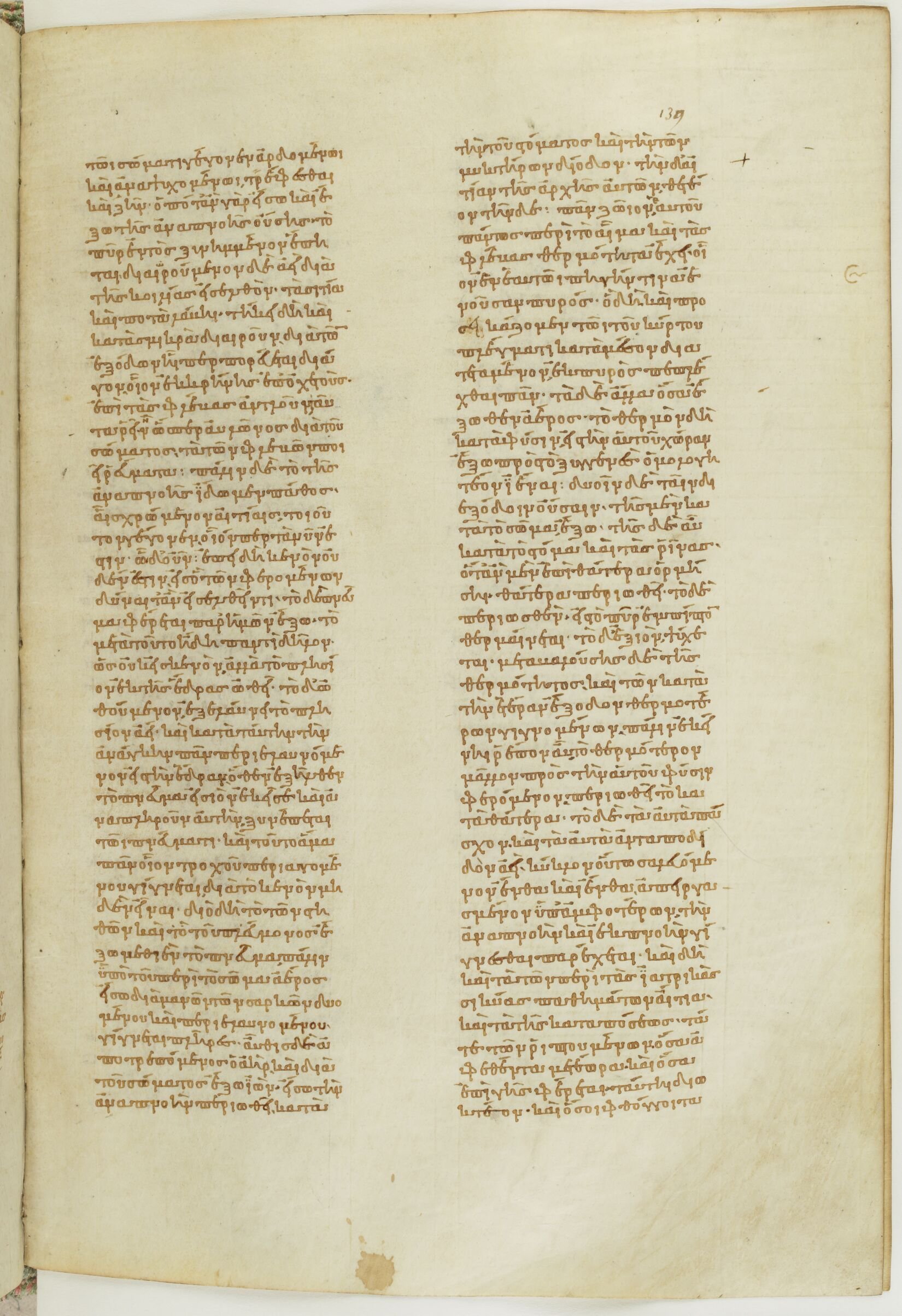
Where on the image
Tim. 79a stands in Paris gr. 1807, fol. 139r col. a. Checked on the image (column openings read on the BnF photographs and found in Burnet's text, quoted in Burnet's spelling): fol. 139r col. a begins ‹τῷ σώματι γέγονεν ἀρδομένῳ καὶ ἀναψυχομένῳ› (Tim. 78e).
σιτία καὶ ποτὰ λάβῃ, τήκει δή, καὶ κατὰ σμικρὰ διαιροῦν, διὰ τῶν ἐξόδων ᾗπερ πορεύεται διάγον, οἷον ἐκ κρήνης ἐπʼ ὀχετοὺς ἐπὶ τὰς φλέβας ἀντλοῦν αὐτά, ῥεῖν ὥσπερ αὐλῶνος διὰ τοῦ σώματος τὰ τῶν φλεβῶν ποιεῖ ῥεύματα. πάλιν δὲ τὸ τῆς ἀναπνοῆς ἴδωμεν πάθος, αἷς χρώμενον αἰτίαις τοιοῦτον γέγονεν οἷόνπερ τὰ νῦν ἐστιν. ὧδʼ οὖν.
and lays hold on the meats and drinks, it dissolves them, and dividing them into small particles it disperses them through the outlets by which it passes and draws them off to the veins, like water drawn into channels from a spring; and thus it causes the streams of the veins to flow through the body as through a pipe. Once again let us consider the process of respiration, and the causes in virtue of which it has come to be such as it now is.
Where on the image
Tim. 79b stands in Paris gr. 1807, fol. 139r col. a. Checked on the image (column openings read on the BnF photographs and found in Burnet's text, quoted in Burnet's spelling): fol. 139r col. a begins ‹τῷ σώματι γέγονεν ἀρδομένῳ καὶ ἀναψυχομένῳ› (Tim. 78e).
ἐπειδὴ κενὸν οὐδέν ἐστιν εἰς ὃ τῶν φερομένων δύναιτʼ ἂν εἰσελθεῖν τι, τὸ δὲ πνεῦμα φέρεται παρʼ ἡμῶν ἔξω, τὸ μετὰ τοῦτο ἤδη παντὶ δῆλον ὡς οὐκ εἰς κενόν, ἀλλὰ τὸ πλησίον ἐκ τῆς ἕδρας ὠθεῖ· τὸ δʼ ὠθούμενον ἐξελαύνει τὸ πλησίον ἀεί, καὶ κατὰ ταύτην τὴν ἀνάγκην πᾶν περιελαυνόμενον εἰς τὴν ἕδραν ὅθεν ἐξῆλθεν τὸ πνεῦμα, εἰσιὸν ἐκεῖσε καὶ ἀναπληροῦν αὐτὴν συνέπεται τῷ πνεύματι, καὶ τοῦτο ἅμα πᾶν
This, then, is the way of it. Inasmuch as no void exists into which any of the moving bodies could enter, while the breath from us moves outwards, what follows is plain to everyone— namely, that the breath does not enter a void but pushes the adjacent body from its seat; and the body thus displaced drives out in turn the next; and by this law of necessity every such body is driven round towards the seat from which the breath went out and enters therein, filling it up and following the breath; and all this takes place as one simultaneous process, like a revolving wheel, because that no void exists.
Where on the image
Tim. 79c stands in Paris gr. 1807, fol. 139r col. a to fol. 139r col. b. Checked on the image (column openings read on the BnF photographs and found in Burnet's text, quoted in Burnet's spelling): fol. 139r col. a begins ‹τῷ σώματι γέγονεν ἀρδομένῳ καὶ ἀναψυχομένῳ› (Tim. 78e); fol. 139r col. b begins ‹τὴν τοῦ στόματος καὶ τὴν τῶν› (Tim. 79c).
οἷον τροχοῦ περιαγομένου γίγνεται διὰ τὸ κενὸν μηδὲν εἶναι. διὸ δὴ τὸ τῶν στηθῶν καὶ τὸ τοῦ πλεύμονος ἔξω μεθιὲν τὸ πνεῦμα πάλιν ὑπὸ τοῦ περὶ τὸ σῶμα ἀέρος, εἴσω διὰ μανῶν τῶν σαρκῶν δυομένου καὶ περιελαυνομένου, γίγνεται πλῆρες· αὖθις δὲ ἀποτρεπόμενος ὁ ἀὴρ καὶ διὰ τοῦ σώματος ἔξω ἰὼν εἴσω τὴν ἀναπνοὴν περιωθεῖ κατὰ τὴν τοῦ στόματος καὶ τὴν τῶν μυκτήρων δίοδον. τὴν δʼ αἰτίαν τῆς ἀρχῆς αὐτῶν θετέον
Wherefore the region of the chest and that of the lungs when they let out the breath become filled again by the air surrounding the body, which filters in through the porous flesh and circulates round. And again, when the air is repelled and passes out through the body it pushes the inspired air round and in by way of the passages of the mouth and of the nostrils. The originating cause
Where on the image
Tim. 79d stands in Paris gr. 1807, fol. 139r col. b. Checked on the image (column openings read on the BnF photographs and found in Burnet's text, quoted in Burnet's spelling): fol. 139r col. b begins ‹τὴν τοῦ στόματος καὶ τὴν τῶν› (Tim. 79c).
τήνδε. πᾶν ζῷον αὑτοῦ τἀντὸς περὶ τὸ αἷμα καὶ τὰς φλέβας θερμότατα ἔχει, οἷον ἐν ἑαυτῷ πηγήν τινα ἐνοῦσαν πυρός· ὃ δὴ καὶ προσῃκάζομεν τῷ τοῦ κύρτου πλέγματι, κατὰ μέσον διατεταμένον ἐκ πυρὸς πεπλέχθαι πᾶν, τὰ δὲ ἄλλα ὅσα ἔξωθεν, ἀέρος. τὸ θερμὸν δὴ κατὰ φύσιν εἰς τὴν αὑτοῦ χώραν ἔξω πρὸς τὸ συγγενὲς ὁμολογητέον ἰέναι· δυοῖν δὲ τοῖν διεξόδοιν οὔσαιν, τῆς μὲν κατὰ τὸ σῶμα ἔξω, τῆς δὲ αὖ
of these processes we must assume to be this. Every living creature has its inward parts round the blood and the veins extremely hot, as it were a fount of fire residing within it; and this region we have, in fact, likened to the envelope of the fish-weel, saying that all that was extended at its middle was woven of fire, whereas all the other and outward parts were of air. Now we must agree that heat, by Nature’s law, goes out into its own region to its kindred substance; and inasmuch as there are two outlets, the one out by way of the body,
Where on the image
Tim. 79e stands in Paris gr. 1807, fol. 139r col. b. Checked on the image (column openings read on the BnF photographs and found in Burnet's text, quoted in Burnet's spelling): fol. 139r col. b begins ‹τὴν τοῦ στόματος καὶ τὴν τῶν› (Tim. 79c).
κατὰ τὸ στόμα καὶ τὰς ῥῖνας, ὅταν μὲν ἐπὶ θάτερα ὁρμήσῃ, θάτερα περιωθεῖ, τὸ δὲ περιωσθὲν εἰς τὸ πῦρ ἐμπῖπτον θερμαίνεται, τὸ δʼ ἐξιὸν ψύχεται. μεταβαλλούσης δὲ τῆς θερμότητος καὶ τῶν κατὰ τὴν ἑτέραν ἔξοδον θερμοτέρων γιγνομένων πάλιν ἐκείνῃ ῥέπον αὖ τὸ θερμότερον μᾶλλον, πρὸς τὴν αὑτοῦ φύσιν φερόμενον, περιωθεῖ τὸ κατὰ θάτερα· τὸ δὲ τὰ αὐτὰ πάσχον καὶ τὰ αὐτὰ ἀνταποδιδὸν ἀεί, κύκλον οὕτω σαλευόμενον ἔνθα καὶ ἔνθα ἀπειργασμένον ὑπʼ ἀμφοτέρων τὴν ἀναπνοὴν καὶ ἐκπνοὴν γίγνεσθαι παρέχεται.
καὶ δὴ καὶ τὰ τῶν περὶ τὰς ἰατρικὰς σικύας παθημάτων
the other by way of the mouth and the nose, whenever the fire rushes in one direction it propels the air round to the other, and the air which is thus propelled round becomes heated by streaming into the fire, whereas the air which passes out becomes cooled. And as the heat changes its situation and the particles about the other outlet become hotter, the hotter body in its turn tends in that direction, and moving towards its own substance propels round the air which is at the former outlet; and thus the air, by continually undergoing and transmitting the same affections, causes inspiration and expiration to come about as a result of this double process, as it were a wheel that oscillates backwards and forwards.
Moreover, we must trace out in this way the causes of the phenomena connected with medical cupping-glasses,
Notes
- Greek: John Burnet, Platonis Opera IV (Oxford, 1902), via Perseus canonical-greekLit; Burnet's text is a critical edition, so its wording can differ from the manuscript shown.
- English: R. G. Bury, Plato IX (Loeb Classical Library, 1929), via Perseus. Bury's footnotes are not reproduced. Quotation marks stand where Perseus marks quoted speech.
- Stephanus sections (a-e) are those of the 1578 Stephanus edition as given by Burnet and Bury; Bury's section breaks can fall a few words away from Burnet's because English word order differs.
Cite
Sources
- Source: Paris, BnF grec 1807 (Plato A, c. 850-875) fol. 139r via BnF IIIF + Burnet's Greek (Perseus) + R. G. Bury's English (Loeb 1929, Perseus) (holding institution)
- Critical edition: Burnet, Platonis Opera IV (1902), via Perseus
← previous · → next · v cycle view · l back to library