Plato, Timaeus 80a-80e: projectiles, sounds and other motions; digestion and the blood
Introduction
Stephanus page 80 of Plato's Timaeus (80a-80e): projectiles, sounds and other motions; digestion and the blood.
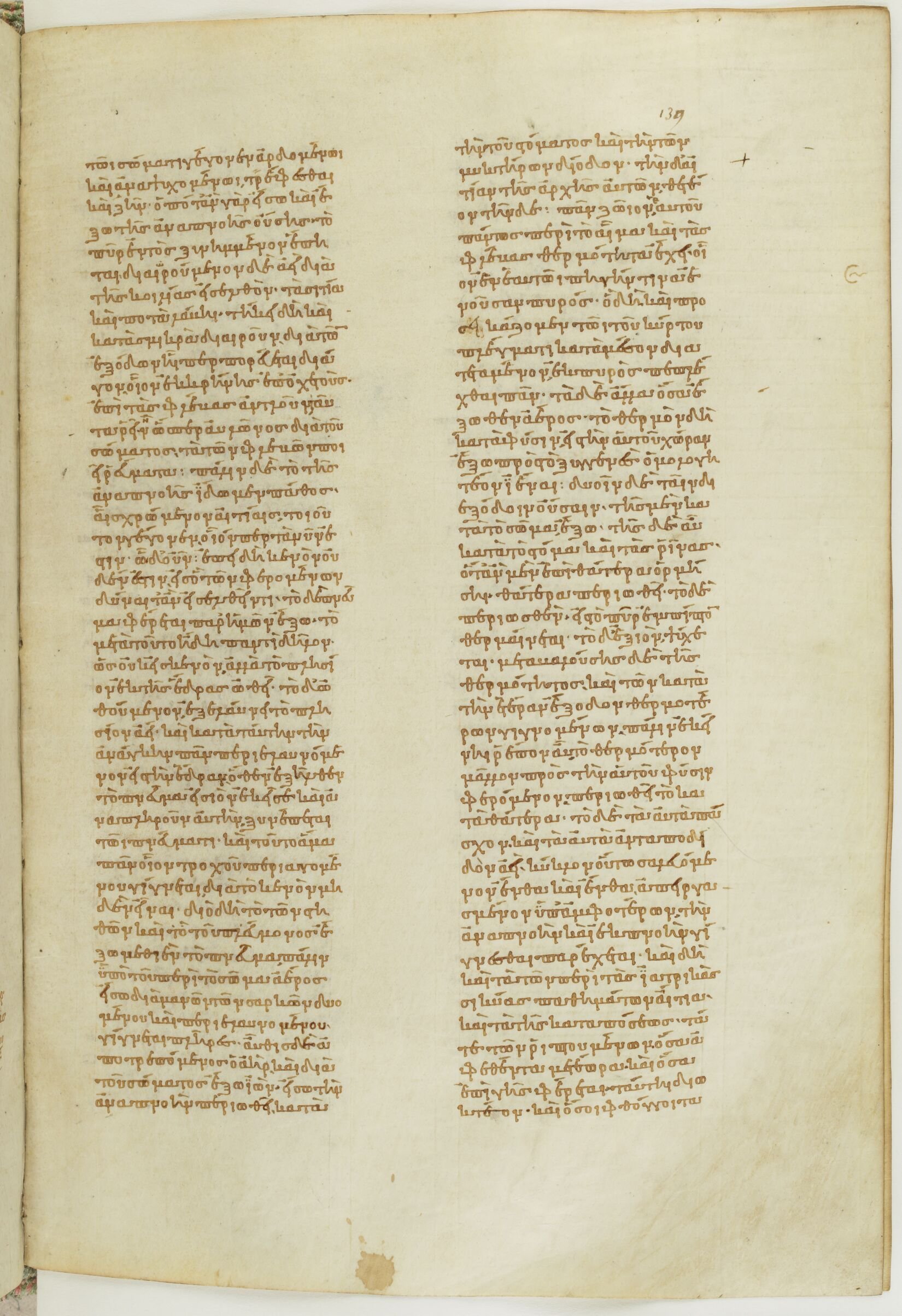
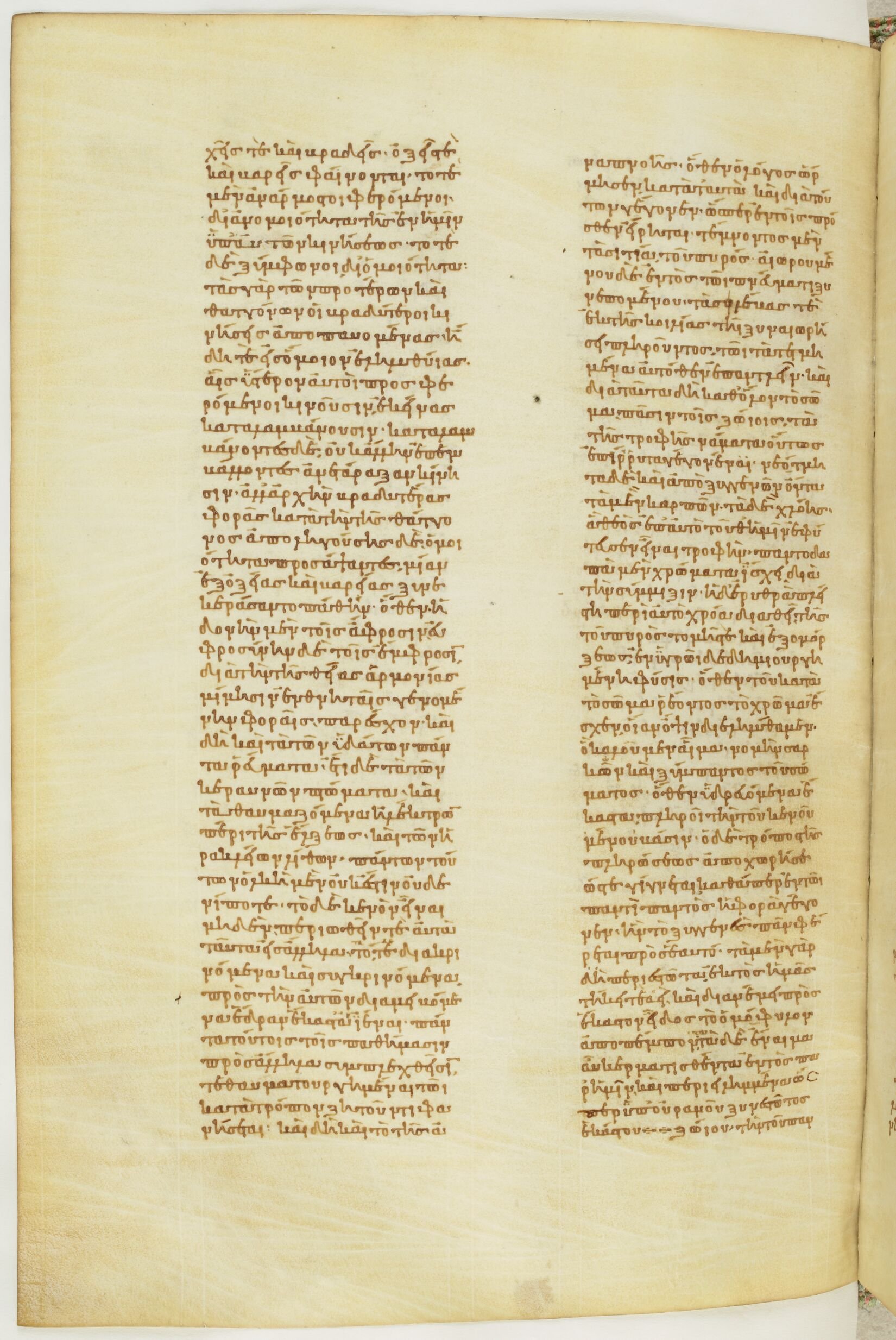
The manuscript is Paris, Bibliothèque nationale de France, grec 1807, known to editors as Plato A. It was copied in Constantinople around 850-875 by the scribe of the so-called philosophical collection, and is the oldest surviving medieval manuscript of the Timaeus and Critias (tetralogies VIII-IX: Clitophon, Republic, Timaeus, Critias, Minos, Laws, Epinomis, Letters). Each page has two columns of 44 lines. The Timaeus fills fol. 114r-144v and the Critias fol. 145r-151r.
On the manuscript this page of text runs over fol. 139r col. b to fol. 139v col. b. Each section below is linked to the folio side(s) that carry it. The mapping comes from reading the first words of every column on the images and finding them in Burnet's text: fol. 139r col. b begins ‹τὴν τοῦ στόματος καὶ τὴν τῶν› (Tim. 79c); fol. 139v col. a begins ‹-χεῖς τε καὶ βραδεῖς ὀξεῖς τε› (Tim. 80a); fol. 139v col. b begins ‹-ναπνοῆς, ὅθεν ὁ λόγος ὥρμησεν, κατὰ› (Tim. 80d).
The Greek is John Burnet's critical text (Oxford, 1902), not a transcription of this manuscript; the scribe's spelling, accents and occasional readings differ from it. The English is R. G. Bury's Loeb translation (1929).
How was this verified? (Provenance)
Where on the image
Tim. 80a stands in Paris gr. 1807, fol. 139r col. b to fol. 139v col. a. Checked on the image (column openings read on the BnF photographs and found in Burnet's text, quoted in Burnet's spelling): fol. 139r col. b begins ‹τὴν τοῦ στόματος καὶ τὴν τῶν› (Tim. 79c); fol. 139v col. a begins ‹-χεῖς τε καὶ βραδεῖς ὀξεῖς τε› (Tim. 80a).
αἴτια καὶ τὰ τῆς καταπόσεως τά τε τῶν ῥιπτουμένων, ὅσα ἀφεθέντα μετέωρα καὶ ὅσα ἐπὶ γῆς φέρεται, ταύτῃ διωκτέον, καὶ ὅσοι φθόγγοι ταχεῖς τε καὶ βραδεῖς ὀξεῖς τε καὶ βαρεῖς φαίνονται, τοτὲ μὲν ἀνάρμοστοι φερόμενοι διʼ ἀνομοιότητα τῆς ἐν ἡμῖν ὑπʼ αὐτῶν κινήσεως, τοτὲ δὲ σύμφωνοι διʼ ὁμοιότητα. τὰς γὰρ τῶν προτέρων καὶ θαττόνων οἱ βραδύτεροι κινήσεις ἀποπαυομένας ἤδη τε εἰς ὅμοιον ἐληλυθυίας,
and the causes of deglutition, and of projectiles, whether discharged aloft or flying over the surface of the earth; and the causes also of all the sounds which because of their quickness or slowness seem shrill or deep, and the movement of which is at one time discordant because of the irregularity of the motion they cause within us, and at another time concordant because of its regularity. For the slower sounds overtake the motions of the earlier and quicker sounds when the latter begin to stop
Where on the image
Tim. 80b stands in Paris gr. 1807, fol. 139v col. a. Checked on the image (column openings read on the BnF photographs and found in Burnet's text, quoted in Burnet's spelling): fol. 139v col. a begins ‹-χεῖς τε καὶ βραδεῖς ὀξεῖς τε› (Tim. 80a).
αἷς ὕστερον αὐτοὶ προσφερόμενοι κινοῦσιν ἐκείνας, καταλαμβάνουσιν, καταλαμβάνοντες δὲ οὐκ ἄλλην ἐπεμβάλλοντες ἀνετάραξαν κίνησιν, ἀλλʼ ἀρχὴν βραδυτέρας φορᾶς κατὰ τὴν τῆς θάττονος, ἀποληγούσης δέ, ὁμοιότητα προσάψαντες, μίαν ἐξ ὀξείας καὶ βαρείας συνεκεράσαντο πάθην· ὅθεν ἡδονὴν μὲν τοῖς ἄφροσιν, εὐφροσύνην δὲ τοῖς ἔμφροσιν διὰ τὴν τῆς θείας ἁρμονίας μίμησιν ἐν θνηταῖς γενομένην φοραῖς παρέσχον. καὶ δὴ καὶ τὰ τῶν ὑδάτων πάντα ῥεύματα, ἔτι δὲ
and have already fallen to a speed similar to that with which the slower sounds collide with them afterwards and move them; and when the slower overtake the quicker sounds they do not perturb them by imposing upon them a different motion, but they attach to them the beginning of a slower motion in accord with that which was quicker but is tending to cease; and thus from shrill and deep they blend one single sensation, furnishing pleasure thereby to the unintelligent, and to the intelligent that intellectual delight which is caused by the imitation of the divine harmony manifested in mortal motions. Furthermore, as regards all flowings of waters, and fallings
Where on the image
Tim. 80c stands in Paris gr. 1807, fol. 139v col. a. Checked on the image (column openings read on the BnF photographs and found in Burnet's text, quoted in Burnet's spelling): fol. 139v col. a begins ‹-χεῖς τε καὶ βραδεῖς ὀξεῖς τε› (Tim. 80a).
τὰ τῶν κεραυνῶν πτώματα καὶ τὰ θαυμαζόμενα ἠλέκτρων περὶ τῆς ἕλξεως καὶ τῶν Ἡρακλείων λίθων, πάντων τούτων ὁλκὴ μὲν οὐκ ἔστιν οὐδενί ποτε, τὸ δὲ κενὸν εἶναι μηδὲν περιωθεῖν τε αὑτὰ ταῦτα εἰς ἄλληλα, τό τε διακρινόμενα καὶ συγκρινόμενα πρὸς τὴν αὑτῶν διαμειβόμενα ἕδραν ἕκαστα ἰέναι πάντα, τούτοις τοῖς παθήμασιν πρὸς ἄλληλα συμπλεχθεῖσιν τεθαυματουργημένα τῷ κατὰ τρόπον ζητοῦντι φανήσεται.
of thunderbolts, and the marvels concerning the attraction of electron and of the Heraclean stone—not one of all these ever possesses any real power of attraction; but the fact that there is no void, and that these bodies propel themselves round one into another, and that according as they separate or unite they all exchange places and proceed severally each to its own region,—it is by means of these complex and reciprocal processes that such marvels are wrought, as will be evident to him who investigates them properly.
Where on the image
Tim. 80d stands in Paris gr. 1807, fol. 139v col. a to fol. 139v col. b. Checked on the image (column openings read on the BnF photographs and found in Burnet's text, quoted in Burnet's spelling): fol. 139v col. a begins ‹-χεῖς τε καὶ βραδεῖς ὀξεῖς τε› (Tim. 80a); fol. 139v col. b begins ‹-ναπνοῆς, ὅθεν ὁ λόγος ὥρμησεν, κατὰ› (Tim. 80d).
καὶ δὴ καὶ τὸ τῆς ἀναπνοῆς, ὅθεν ὁ λόγος ὥρμησεν, κατὰ ταῦτα καὶ διὰ τούτων γέγονεν, ὥσπερ ἐν τοῖς πρόσθεν εἴρηται, τέμνοντος μὲν τὰ σιτία τοῦ πυρός, αἰωρουμένου δὲ ἐντὸς τῷ πνεύματι συνεπομένου, τὰς φλέβας τε ἐκ τῆς κοιλίας τῇ συναιωρήσει πληροῦντος τῷ τὰ τετμημένα αὐτόθεν ἐπαντλεῖν· καὶ διὰ ταῦτα δὴ καθʼ ὅλον τὸ σῶμα πᾶσιν τοῖς ζῴοις τὰ τῆς τροφῆς νάματα οὕτως ἐπίρρυτα γέγονεν. νεότμητα δὲ καὶ ἀπὸ συγγενῶν ὄντα, τὰ μὲν καρπῶν, τὰ δὲ χλόης,
Moreover, the process of respiration—with which our account commenced—came about, as we previously stated, in this manner and by these means. The fire divides the foods, and rises through the body following after the breath; and as it rises, with the breath it fills the veins from the belly by drawing into them from thence the divided particles. And it is owing to this that in all living creatures the streams of nutriment course in this way through the whole body. And inasmuch as these nutritive particles are freshly divided
Where on the image
Tim. 80e stands in Paris gr. 1807, fol. 139v col. b. Checked on the image (column openings read on the BnF photographs and found in Burnet's text, quoted in Burnet's spelling): fol. 139v col. b begins ‹-ναπνοῆς, ὅθεν ὁ λόγος ὥρμησεν, κατὰ› (Tim. 80d).
ἃ θεὸς ἐπʼ αὐτὸ τοῦθʼ ἡμῖν ἐφύτευσεν, εἶναι τροφήν, παντοδαπὰ μὲν χρώματα ἴσχει διὰ τὴν σύμμειξιν, ἡ δʼ ἐρυθρὰ πλείστη περὶ αὐτὰ χρόα διαθεῖ, τῆς τοῦ πυρὸς τομῆς τε καὶ ἐξομόρξεως ἐν ὑγρῷ δεδημιουργημένη φύσις.
ὅθεν τοῦ κατὰ τὸ σῶμα ῥέοντος τὸ χρῶμα ἔσχεν οἵαν ὄψιν διεληλύθαμεν ὃ καλοῦμεν αἷμα, νομὴν σαρκῶν καὶ σύμπαντος τοῦ σώματος,
and derived from kindred substances,—some from fruits, and some from cereals, which God planted for us for the express purpose of serving as food,—they get all varieties of colors because of their commingling, but red is the color that runs through them most of all, it being a natural product of the action of the fire in dividing the liquid food and imprinting itself thereon.
Wherefore the color of the stream which flows through the body acquired an appearance such as we have described; and this stream we call blood, which is the nutriment of the flesh
Notes
- Greek: John Burnet, Platonis Opera IV (Oxford, 1902), via Perseus canonical-greekLit; Burnet's text is a critical edition, so its wording can differ from the manuscript shown.
- English: R. G. Bury, Plato IX (Loeb Classical Library, 1929), via Perseus. Bury's footnotes are not reproduced. Quotation marks stand where Perseus marks quoted speech.
- Stephanus sections (a-e) are those of the 1578 Stephanus edition as given by Burnet and Bury; Bury's section breaks can fall a few words away from Burnet's because English word order differs.
Cite
Sources
- Source: Paris, BnF grec 1807 (Plato A, c. 850-875) fol. 139r-139v via BnF IIIF + Burnet's Greek (Perseus) + R. G. Bury's English (Loeb 1929, Perseus) (holding institution)
- Critical edition: Burnet, Platonis Opera IV (1902), via Perseus
← previous · → next · v cycle view · l back to library