Plato, Timaeus 82a-82e: diseases arising from the four elements
Introduction
Stephanus page 82 of Plato's Timaeus (82a-82e): diseases arising from the four elements.
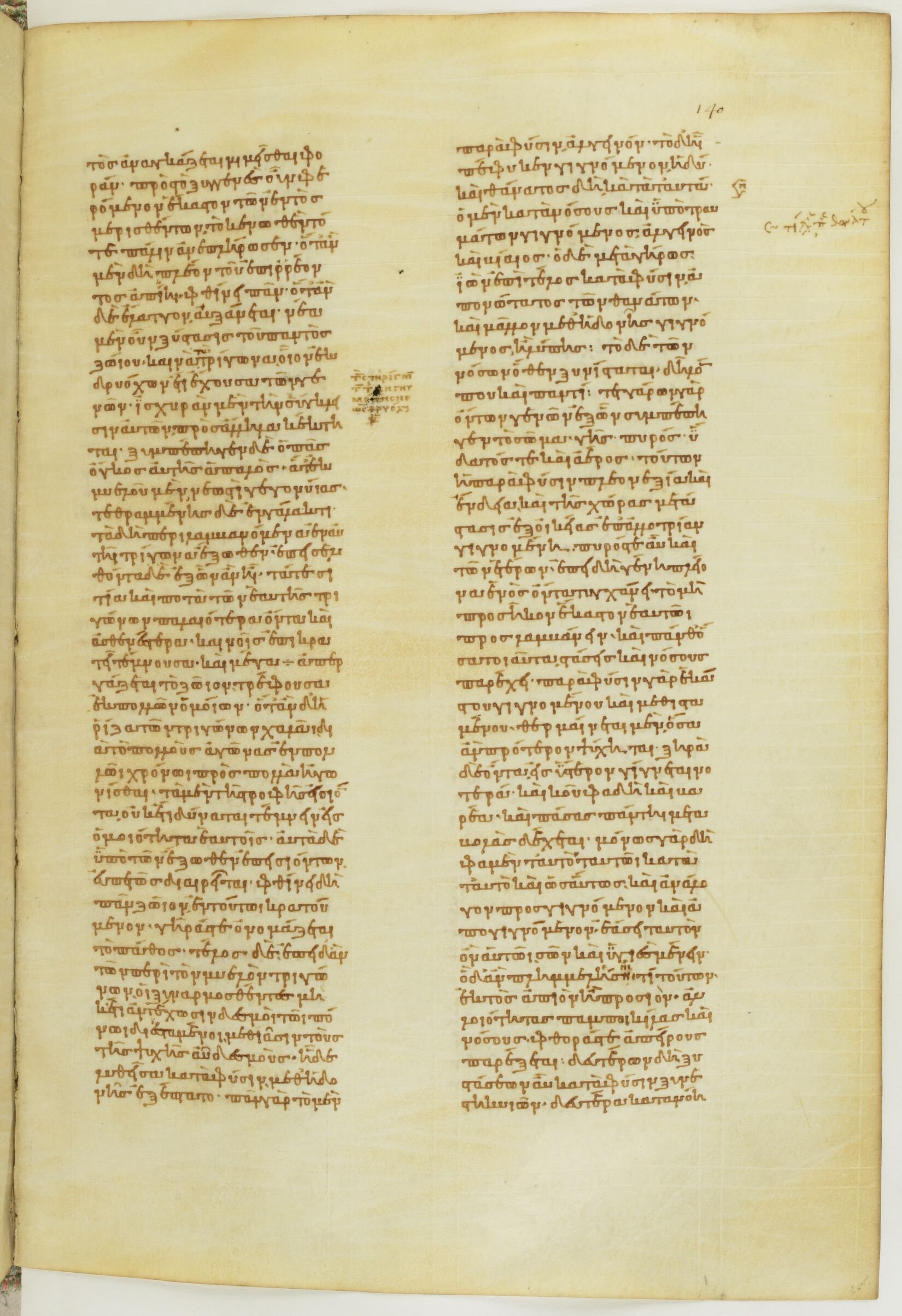
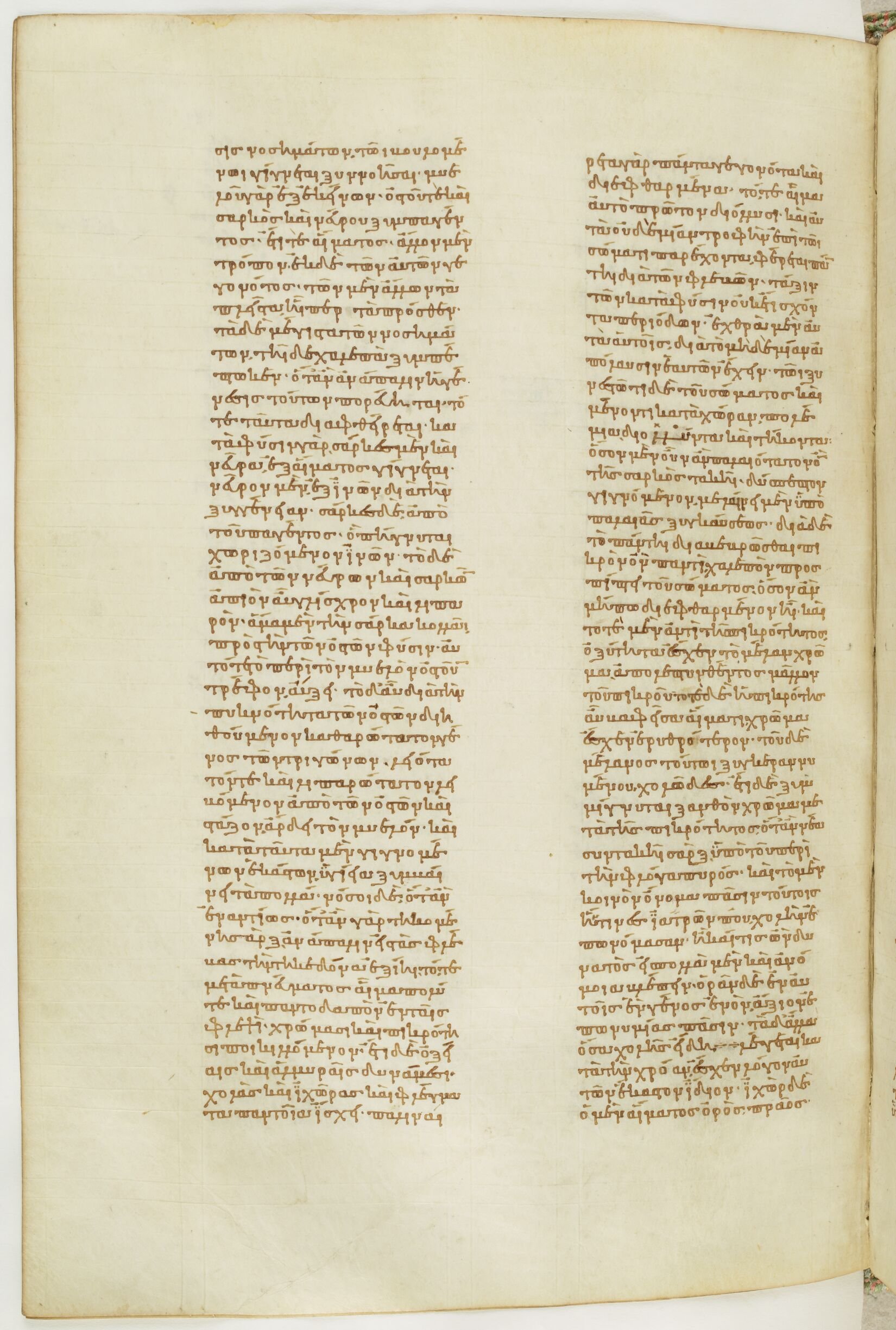
The manuscript is Paris, Bibliothèque nationale de France, grec 1807, known to editors as Plato A. It was copied in Constantinople around 850-875 by the scribe of the so-called philosophical collection, and is the oldest surviving medieval manuscript of the Timaeus and Critias (tetralogies VIII-IX: Clitophon, Republic, Timaeus, Critias, Minos, Laws, Epinomis, Letters). Each page has two columns of 44 lines. The Timaeus fills fol. 114r-144v and the Critias fol. 145r-151r.
On the manuscript this page of text runs over fol. 140r col. b to fol. 140v col. b. Each section below is linked to the folio side(s) that carry it. The mapping comes from reading the first words of every column on the images and finding them in Burnet's text: fol. 140r col. b begins ‹παρὰ φύσιν ἀλγεινόν, τὸ δʼ ᾗ› (Tim. 81e); fol. 140v col. a begins ‹-σις νοσημάτων τῷ βουλομένῳ γίγνεται συννοῆσαι› (Tim. 82c); fol. 140v col. b begins ‹-ρετα γὰρ πάντα γεγονότα καὶ διεφθαρμένα› (Tim. 82e).
The Greek is John Burnet's critical text (Oxford, 1902), not a transcription of this manuscript; the scribe's spelling, accents and occasional readings differ from it. The English is R. G. Bury's Loeb translation (1929).
How was this verified? (Provenance)
Where on the image
Tim. 82a stands in Paris gr. 1807, fol. 140r col. b. Checked on the image (column openings read on the BnF photographs and found in Burnet's text, quoted in Burnet's spelling): fol. 140r col. b begins ‹παρὰ φύσιν ἀλγεινόν, τὸ δʼ ᾗ› (Tim. 81e).
τεττάρων γὰρ ὄντων γενῶν ἐξ ὧν συμπέπηγεν τὸ σῶμα, γῆς πυρὸς ὕδατός τε καὶ ἀέρος, τούτων ἡ παρὰ φύσιν πλεονεξία καὶ ἔνδεια καὶ τῆς χώρας μετάστασις ἐξ οἰκείας ἐπʼ ἀλλοτρίαν γιγνομένη, πυρός τε αὖ καὶ τῶν ἑτέρων ἐπειδὴ γένη πλείονα ἑνὸς ὄντα τυγχάνει, τὸ μὴ προσῆκον ἕκαστον ἑαυτῷ προσλαμβάνειν, καὶ πάνθʼ ὅσα τοιαῦτα, στάσεις καὶ νόσους παρέχει· παρὰ φύσιν γὰρ ἑκάστου γιγνομένου καὶ μεθισταμένου θερμαίνεται μὲν ὅσα ἂν πρότερον ψύχηται,
For seeing that there are four elements of which the body is compacted,—earth, fire, water and air,—when, contrary to nature, there occurs either an excess or a deficiency of these elements, or a transference thereof from their native region to an alien region; or again, seeing that fire and the rest have each more than one variety, every time that the body admits an inappropriate variety, then these and all similar occurrences bring about internal disorders and disease. For when any one element suffers a change of condition that is contrary to nature, all its particles that formerly were being cooled
Where on the image
Tim. 82b stands in Paris gr. 1807, fol. 140r col. b. Checked on the image (column openings read on the BnF photographs and found in Burnet's text, quoted in Burnet's spelling): fol. 140r col. b begins ‹παρὰ φύσιν ἀλγεινόν, τὸ δʼ ᾗ› (Tim. 81e).
ξηρὰ δὲ ὄντα εἰς ὕστερον γίγνεται νοτερά, καὶ κοῦφα δὴ καὶ βαρέα, καὶ πάσας πάντῃ μεταβολὰς δέχεται. μόνως γὰρ δή, φαμέν, ταὐτὸν ταὐτῷ κατὰ ταὐτὸν καὶ ὡσαύτως καὶ ἀνὰ λόγον προσγιγνόμενον καὶ ἀπογιγνόμενον ἐάσει ταὐτὸν ὂν αὑτῷ σῶν καὶ ὑγιὲς μένειν· ὃ δʼ ἂν πλημμελήσῃ τι τούτων ἐκτὸς ἀπιὸν ἢ προσιόν, ἀλλοιότητας παμποικίλας καὶ νόσους φθοράς τε ἀπείρους παρέξεται. δευτέρων δὴ συστάσεων αὖ κατὰ φύσιν συνεστηκυιῶν,
become heated, and the dry presently become moist, and the light heavy, and they undergo every variety of change in every respect. For, as we maintain, it is only the addition or subtraction of the same substance from the same substance in the same order and in the same manner and in due proportion which will allow the latter to remain safe and sound in its sameness with itself. But whatsoever oversteps any of these conditions in its going out or its coming in will produce alterations of every variety and countless diseases and corruptions.
Where on the image
Tim. 82c stands in Paris gr. 1807, fol. 140r col. b to fol. 140v col. a. Checked on the image (column openings read on the BnF photographs and found in Burnet's text, quoted in Burnet's spelling): fol. 140r col. b begins ‹παρὰ φύσιν ἀλγεινόν, τὸ δʼ ᾗ› (Tim. 81e); fol. 140v col. a begins ‹-σις νοσημάτων τῷ βουλομένῳ γίγνεται συννοῆσαι› (Tim. 82c).
δευτέρα κατανόησις νοσημάτων τῷ βουλομένῳ γίγνεται συννοῆσαι. μυελοῦ γὰρ ἐξ ἐκείνων ὀστοῦ τε καὶ σαρκὸς καὶ νεύρου συμπαγέντος, ἔτι τε αἵματος ἄλλον μὲν τρόπον, ἐκ δὲ τῶν αὐτῶν γεγονότος, τῶν μὲν ἄλλων τὰ πλεῖστα ᾗπερ τὰ πρόσθεν, τὰ δὲ μέγιστα τῶν νοσημάτων τῇδε χαλεπὰ συμπέπτωκεν· ὅταν ἀνάπαλιν ἡ γένεσις τούτων πορεύηται, τότε ταῦτα διαφθείρεται. κατὰ φύσιν γὰρ σάρκες μὲν καὶ νεῦρα ἐξ αἵματος γίγνεται, νεῦρον μὲν ἐξ ἰνῶν διὰ τὴν συγγένειαν,
Again, in the structures which are naturally secondary in order of construction, there is a second class of diseases to be noted by him who has a mind to take cognizance of them. For inasmuch as marrow and bone and flesh and sinew are compacted from the elements,—and blood also is formed from the same constituents, although in a different way,— most of the other maladies come about like those previously described, but the most severe of them have dangerous results for the reason following: whenever the production of these secondary substances proceeds in the reverse direction, then they are corrupted. For in the order of nature flesh and sinews arise from blood,
Where on the image
Tim. 82d stands in Paris gr. 1807, fol. 140v col. a. Checked on the image (column openings read on the BnF photographs and found in Burnet's text, quoted in Burnet's spelling): fol. 140v col. a begins ‹-σις νοσημάτων τῷ βουλομένῳ γίγνεται συννοῆσαι› (Tim. 82c).
σάρκες δὲ ἀπὸ τοῦ παγέντος ὃ πήγνυται χωριζόμενον ἰνῶν· τὸ δὲ ἀπὸ τῶν νεύρων καὶ σαρκῶν ἀπιὸν αὖ γλίσχρον καὶ λιπαρὸν ἅμα μὲν τὴν σάρκα κολλᾷ πρὸς τὴν τῶν ὀστῶν φύσιν αὐτό τε τὸ περὶ τὸν μυελὸν ὀστοῦν τρέφον αὔξει, τὸ δʼ αὖ διὰ τὴν πυκνότητα τῶν ὀστῶν διηθούμενον καθαρώτατον γένος τῶν τριγώνων λειότατόν τε καὶ λιπαρώτατον, λειβόμενον ἀπὸ τῶν ὀστῶν καὶ στάζον, ἄρδει τὸν
the sinew from the fibrine because of its kindred quality, and flesh from the coagulated substance which coagulates on its separation from the fibrine; and further, the substance which is derived from the sinews and flesh, being viscid and oily, not only glues the flesh to the substance of the bones but also feeds and increases the bone itself which encloses the marrow, while that which is formed of the purest kind of triangles, very smooth and very oily, filters through
Where on the image
Tim. 82e stands in Paris gr. 1807, fol. 140v col. a to fol. 140v col. b. Checked on the image (column openings read on the BnF photographs and found in Burnet's text, quoted in Burnet's spelling): fol. 140v col. a begins ‹-σις νοσημάτων τῷ βουλομένῳ γίγνεται συννοῆσαι› (Tim. 82c); fol. 140v col. b begins ‹-ρετα γὰρ πάντα γεγονότα καὶ διεφθαρμένα› (Tim. 82e).
μυελόν. καὶ κατὰ ταῦτα μὲν γιγνομένων ἑκάστων ὑγίεια συμβαίνει τὰ πολλά· νόσοι δέ, ὅταν ἐναντίως. ὅταν γὰρ τηκομένη σὰρξ ἀνάπαλιν εἰς τὰς φλέβας τὴν τηκεδόνα ἐξιῇ, τότε μετὰ πνεύματος αἷμα πολύ τε καὶ παντοδαπὸν ἐν ταῖς φλεψὶ χρώμασι καὶ πικρότησι ποικιλλόμενον, ἔτι δὲ ὀξείαις καὶ ἁλμυραῖς δυνάμεσι, χολὰς καὶ ἰχῶρας καὶ φλέγματα παντοῖα ἴσχει·
παλιναίρετα γὰρ πάντα γεγονότα καὶ διεφθαρμένα τό τε αἷμα αὐτὸ πρῶτον διόλλυσι, καὶ αὐτὰ οὐδεμίαν
the density of the bones, and, as it oozes and drips from the bones, moistens the marrow. Now when each of these substances is produced in this order, health as a rule results; but if in the reverse order, disease. For whenever the flesh is decomposed and sends its decomposed matter back again into the veins, then, uniting with the air, the blood in the veins, which is large in volume and of every variety, is diversified by colors and bitter flavors, as well as by sharp and saline properties, and contains bile and serum and phlegm of every sort.
For when all the substances become reversed and corrupted, they begin by destroying the blood itself, and then they themselves cease to supply
Notes
- Greek: John Burnet, Platonis Opera IV (Oxford, 1902), via Perseus canonical-greekLit; Burnet's text is a critical edition, so its wording can differ from the manuscript shown.
- English: R. G. Bury, Plato IX (Loeb Classical Library, 1929), via Perseus. Bury's footnotes are not reproduced. Quotation marks stand where Perseus marks quoted speech.
- Stephanus sections (a-e) are those of the 1578 Stephanus edition as given by Burnet and Bury; Bury's section breaks can fall a few words away from Burnet's because English word order differs.
Cite
Sources
- Source: Paris, BnF grec 1807 (Plato A, c. 850-875) fol. 140r-140v via BnF IIIF + Burnet's Greek (Perseus) + R. G. Bury's English (Loeb 1929, Perseus) (holding institution)
- Critical edition: Burnet, Platonis Opera IV (1902), via Perseus
← previous · → next · v cycle view · l back to library