Plato, Timaeus 83a-83e: diseases of flesh and blood; bile
Introduction
Stephanus page 83 of Plato's Timaeus (83a-83e): diseases of flesh and blood; bile.
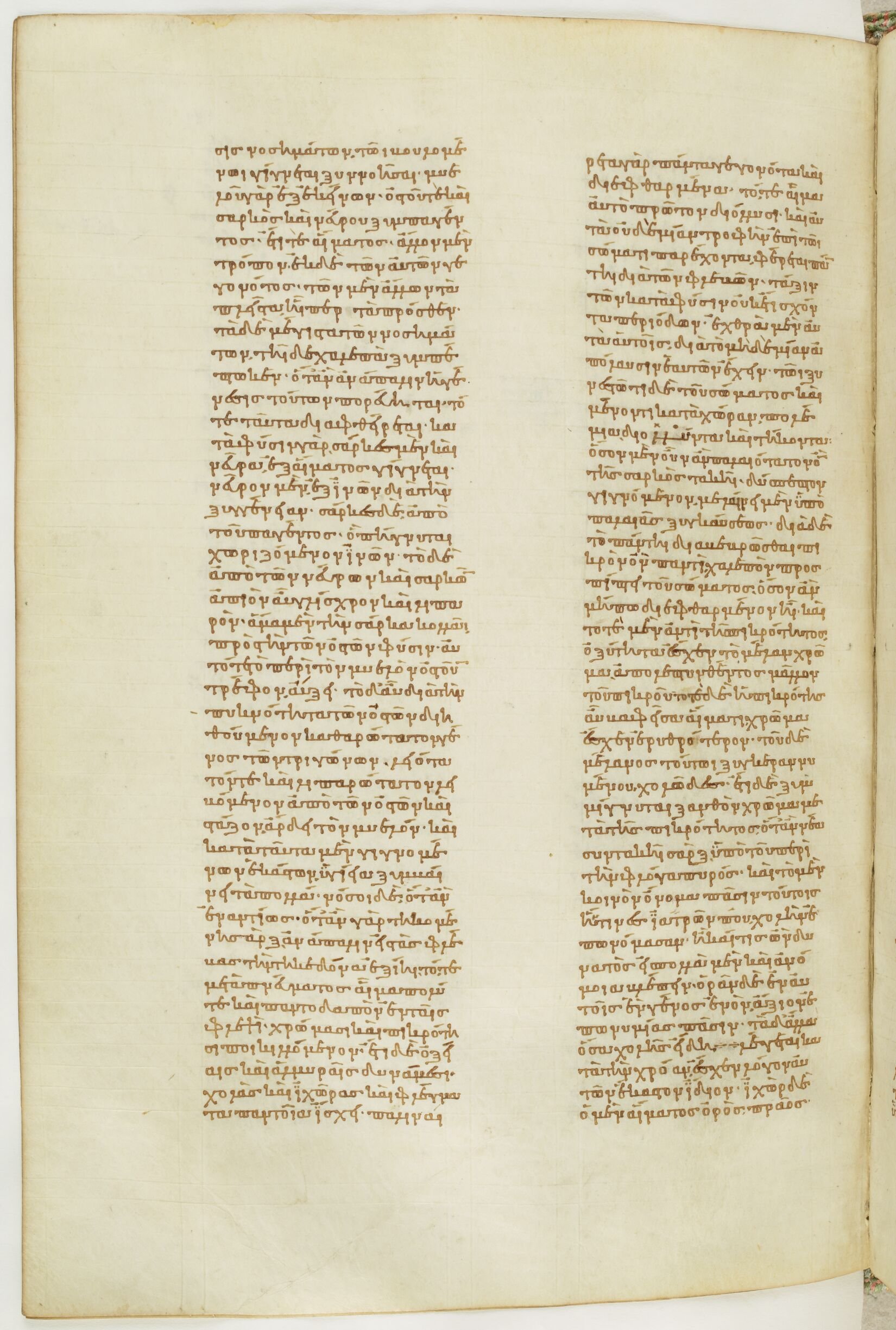
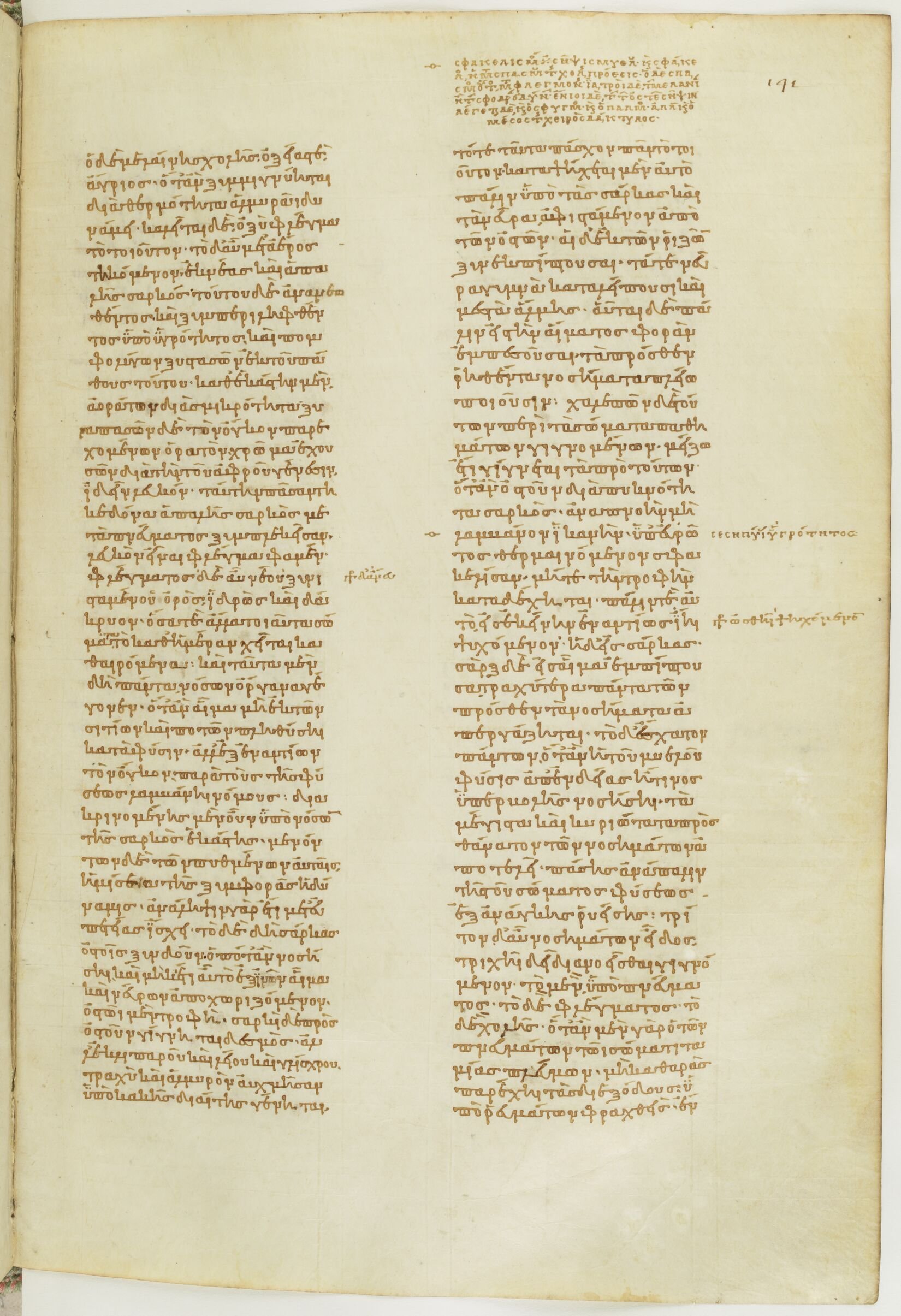
The manuscript is Paris, Bibliothèque nationale de France, grec 1807, known to editors as Plato A. It was copied in Constantinople around 850-875 by the scribe of the so-called philosophical collection, and is the oldest surviving medieval manuscript of the Timaeus and Critias (tetralogies VIII-IX: Clitophon, Republic, Timaeus, Critias, Minos, Laws, Epinomis, Letters). Each page has two columns of 44 lines. The Timaeus fills fol. 114r-144v and the Critias fol. 145r-151r.
On the manuscript this page of text runs over fol. 140v col. b to fol. 141r col. a. Each section below is linked to the folio side(s) that carry it. The mapping comes from reading the first words of every column on the images and finding them in Burnet's text: fol. 140v col. b begins ‹-ρετα γὰρ πάντα γεγονότα καὶ διεφθαρμένα› (Tim. 82e); fol. 141r col. a begins ‹ὁ δὲ μελαίνης χολῆς ὀξείας τε› (Tim. 83c).
The Greek is John Burnet's critical text (Oxford, 1902), not a transcription of this manuscript; the scribe's spelling, accents and occasional readings differ from it. The English is R. G. Bury's Loeb translation (1929).
How was this verified? (Provenance)
Where on the image
Tim. 83a stands in Paris gr. 1807, fol. 140v col. b. Checked on the image (column openings read on the BnF photographs and found in Burnet's text, quoted in Burnet's spelling): fol. 140v col. b begins ‹-ρετα γὰρ πάντα γεγονότα καὶ διεφθαρμένα› (Tim. 82e).
τροφὴν ἔτι τῷ σώματι παρέχοντα φέρεται πάντῃ διὰ τῶν φλεβῶν, τάξιν τῶν κατὰ φύσιν οὐκέτʼ ἴσχοντα περιόδων, ἐχθρὰ μὲν αὐτὰ αὑτοῖς διὰ τὸ μηδεμίαν ἀπόλαυσιν ἑαυτῶν ἔχειν, τῷ συνεστῶτι δὲ τοῦ σώματος καὶ μένοντι κατὰ χώραν πολέμια, διολλύντα καὶ τήκοντα. ὅσον μὲν οὖν ἂν παλαιότατον ὂν τῆς σαρκὸς τακῇ, δύσπεπτον γιγνόμενον μελαίνει μὲν ὑπὸ παλαιᾶς συγκαύσεως, διὰ δὲ τὸ πάντῃ διαβεβρῶσθαι
any nourishment to the body; for they move through the veins in all directions and no longer preserve the order of their natural revolutions, being at enmity with themselves because they have no enjoyment of themselves, and being at war also with the established and regular constitution of the body, which they corrupt and dissolve. Therefore all the oldest part of the flesh that is decomposed becomes tough and is blackened by the continued combustion; and because it is eaten away on every side it is bitter, and therefore dangerous
Where on the image
Tim. 83b stands in Paris gr. 1807, fol. 140v col. b. Checked on the image (column openings read on the BnF photographs and found in Burnet's text, quoted in Burnet's spelling): fol. 140v col. b begins ‹-ρετα γὰρ πάντα γεγονότα καὶ διεφθαρμένα› (Tim. 82e).
πικρὸν ὂν παντὶ χαλεπὸν προσπίπτει τοῦ σώματος ὅσον ἂν μήπω διεφθαρμένον ᾖ, καὶ τοτὲ μὲν ἀντὶ τῆς πικρότητος ὀξύτητα ἔσχεν τὸ μέλαν χρῶμα, ἀπολεπτυνθέντος μᾶλλον τοῦ πικροῦ, τοτὲ δὲ ἡ πικρότης αὖ βαφεῖσα αἵματι χρῶμα ἔσχεν ἐρυθρώτερον, τοῦ δὲ μέλανος τούτῳ συγκεραννυμένου χλοῶδες· ἔτι δὲ συμμείγνυται ξανθὸν χρῶμα μετὰ τῆς πικρότητος, ὅταν νέα συντακῇ σὰρξ ὑπὸ τοῦ περὶ τὴν φλόγα πυρός. καὶ τὸ μὲν κοινὸν ὄνομα πᾶσιν τούτοις ἤ τινες
in its attack on any part of the body that is not as yet corrupted. And at one time the black matter acquires a sharpness in place of its bitterness, when the bitter substance becomes more diluted; and at another time the bitter substance acquires a redder color through being dipped in blood, while if the black matter is blended with this it turns greenish; and again, whenever new flesh also is decomposed by the fire of the inflammation, a yellow matter is commingled with the bitter substance.
Where on the image
Tim. 83c stands in Paris gr. 1807, fol. 140v col. b to fol. 141r col. a. Checked on the image (column openings read on the BnF photographs and found in Burnet's text, quoted in Burnet's spelling): fol. 140v col. b begins ‹-ρετα γὰρ πάντα γεγονότα καὶ διεφθαρμένα› (Tim. 82e); fol. 141r col. a begins ‹ὁ δὲ μελαίνης χολῆς ὀξείας τε› (Tim. 83c).
ἰατρῶν που χολὴν ἐπωνόμασαν, ἢ καί τις ὢν δυνατὸς εἰς πολλὰ μὲν καὶ ἀνόμοια βλέπειν, ὁρᾶν δὲ ἐν αὐτοῖς ἓν γένος ἐνὸν ἄξιον ἐπωνυμίας πᾶσιν· τὰ δʼ ἄλλα ὅσα χολῆς εἴδη λέγεται, κατὰ τὴν χρόαν ἔσχεν λόγον αὐτῶν ἕκαστον ἴδιον. ἰχὼρ δέ, ὁ μὲν αἵματος ὀρὸς πρᾷος, ὁ δὲ μελαίνης χολῆς ὀξείας τε ἄγριος, ὅταν συμμειγνύηται διὰ θερμότητα ἁλμυρᾷ δυνάμει· καλεῖται δὲ ὀξὺ φλέγμα τὸ τοιοῦτον. τὸ δʼ αὖ μετʼ ἀέρος τηκόμενον ἐκ νέας καὶ ἁπαλῆς σαρκός, τούτου δὲ
To all these humors the general designation bile has been given, either by certain physicians or by someone who was capable of surveying a number of dissimilar cases and discerning amongst them one single type worthy to give its name to them all. All the rest that are counted as species of bile have gained their special descriptions in each case from their colors. Serum is of two kinds: one is the mild whey of the blood; the other, being derived from black and acid bile, is malignant whenever it is imbued with a saline quality through the action of heat; and this kind is termed acid phlegm. Another kind involves air and is produced by dissolution from new and tender flesh. And when this is inflated
Where on the image
Tim. 83d stands in Paris gr. 1807, fol. 141r col. a. Checked on the image (column openings read on the BnF photographs and found in Burnet's text, quoted in Burnet's spelling): fol. 141r col. a begins ‹ὁ δὲ μελαίνης χολῆς ὀξείας τε› (Tim. 83c).
ἀνεμωθέντος καὶ συμπεριληφθέντος ὑπὸ ὑγρότητος, καὶ πομφολύγων συστασῶν ἐκ τοῦ πάθους τούτου καθʼ ἑκάστην μὲν ἀοράτων διὰ σμικρότητα, συναπασῶν δὲ τὸν ὄγκον παρεχομένων ὁρατόν, χρῶμα ἐχουσῶν διὰ τὴν τοῦ ἀφροῦ γένεσιν ἰδεῖν λευκόν, ταύτην πᾶσαν τηκεδόνα ἁπαλῆς σαρκὸς μετὰ πνεύματος συμπλακεῖσαν λευκὸν εἶναι φλέγμα φαμέν. φλέγματος δὲ αὖ νέου συνισταμένου ὀρὸς ἱδρὼς καὶ δάκρυον,
and enclosed by a fluid, and when as a result of this process bubbles are formed which individually are invisible because of their small size but in the aggregate form a mass which is visible, and which possess a color which appears white owing to the foam created,—then we describe all this decomposition of tender flesh intermixed with air as white phlegm. And the whey of phlegm that is newly formed is sweat and tears,
Where on the image
Tim. 83e stands in Paris gr. 1807, fol. 141r col. a. Checked on the image (column openings read on the BnF photographs and found in Burnet's text, quoted in Burnet's spelling): fol. 141r col. a begins ‹ὁ δὲ μελαίνης χολῆς ὀξείας τε› (Tim. 83c).
ὅσα τε ἄλλα τοιαῦτα σώματα τὸ καθʼ ἡμέραν χεῖται καθαιρόμενα· καὶ ταῦτα μὲν δὴ πάντα νόσων ὄργανα γέγονεν, ὅταν αἷμα μὴ ἐκ τῶν σιτίων καὶ ποτῶν πληθύσῃ κατὰ φύσιν, ἀλλʼ ἐξ ἐναντίων τὸν ὄγκον παρὰ τοὺς τῆς φύσεως λαμβάνῃ νόμους.
διακρινομένης μὲν οὖν ὑπὸ νόσων τῆς σαρκὸς ἑκάστης, μενόντων δὲ τῶν πυθμένων αὐταῖς ἡμίσεια τῆς συμφορᾶς ἡ δύναμις—ἀνάληψιν γὰρ ἔτι μετʼ εὐπετείας ἴσχει—
and all other such humors as pour forth in the daily purgings of the body. And all these are factors in disease, whenever the blood is not replenished naturally from meats and drinks but receives its mass from opposite substances contrary to Nature’s laws.
Now, when the flesh in any part is being decomposed by disease, but the bases thereof still remain firm, the force of the attack is reduced by half, for it still admits of easy recovery;
Notes
- Greek: John Burnet, Platonis Opera IV (Oxford, 1902), via Perseus canonical-greekLit; Burnet's text is a critical edition, so its wording can differ from the manuscript shown.
- English: R. G. Bury, Plato IX (Loeb Classical Library, 1929), via Perseus. Bury's footnotes are not reproduced. Quotation marks stand where Perseus marks quoted speech.
- Stephanus sections (a-e) are those of the 1578 Stephanus edition as given by Burnet and Bury; Bury's section breaks can fall a few words away from Burnet's because English word order differs.
Cite
Sources
- Source: Paris, BnF grec 1807 (Plato A, c. 850-875) fol. 140v-141r via BnF IIIF + Burnet's Greek (Perseus) + R. G. Bury's English (Loeb 1929, Perseus) (holding institution)
- Critical edition: Burnet, Platonis Opera IV (1902), via Perseus
← previous · → next · v cycle view · l back to library