Plato, Timaeus 84a-84e: diseases of bone and marrow; of breath
Introduction
Stephanus page 84 of Plato's Timaeus (84a-84e): diseases of bone and marrow; of breath.
The manuscript is Paris, Bibliothèque nationale de France, grec 1807, known to editors as Plato A. It was copied in Constantinople around 850-875 by the scribe of the so-called philosophical collection, and is the oldest surviving medieval manuscript of the Timaeus and Critias (tetralogies VIII-IX: Clitophon, Republic, Timaeus, Critias, Minos, Laws, Epinomis, Letters). Each page has two columns of 44 lines. The Timaeus fills fol. 114r-144v and the Critias fol. 145r-151r.
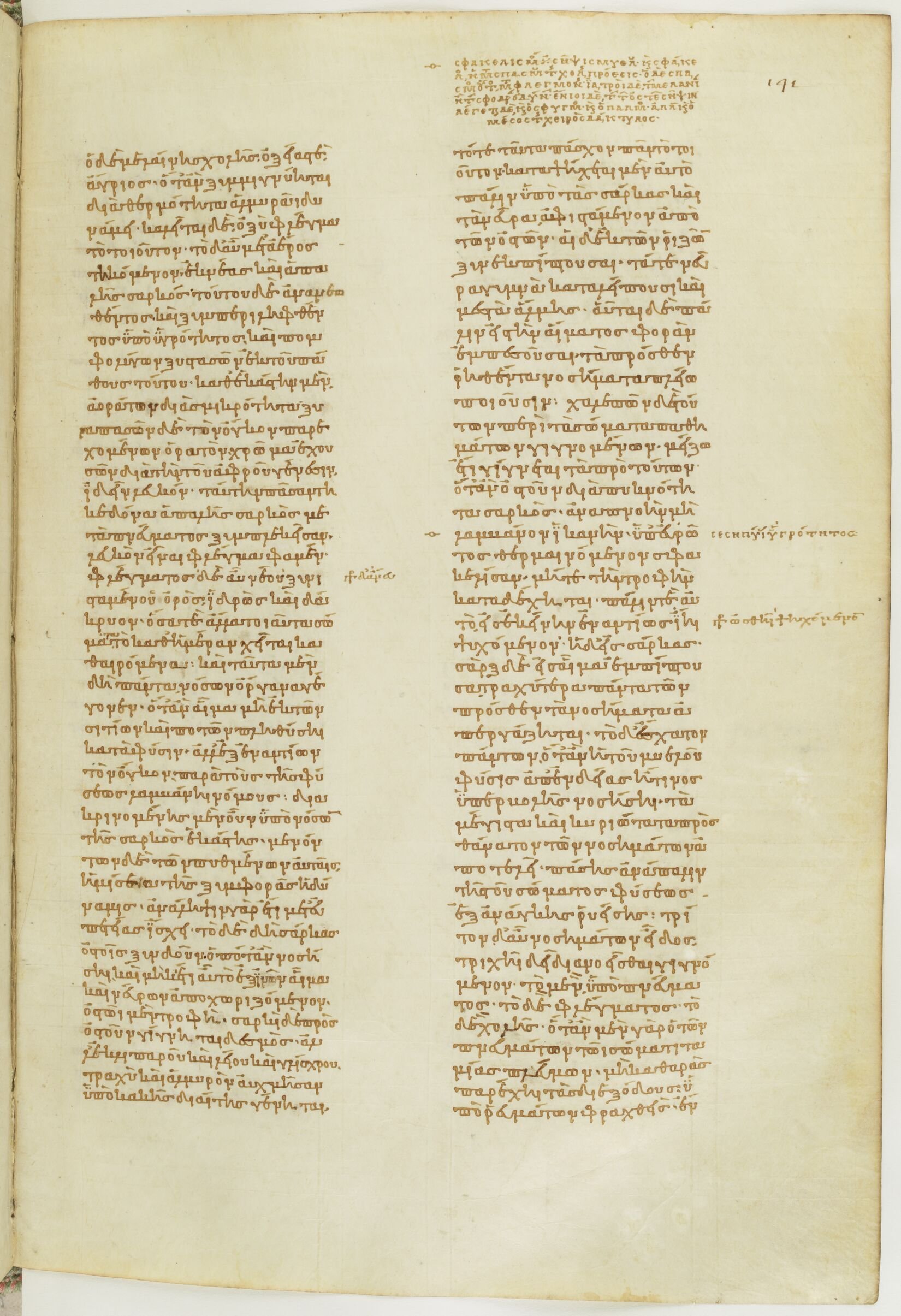
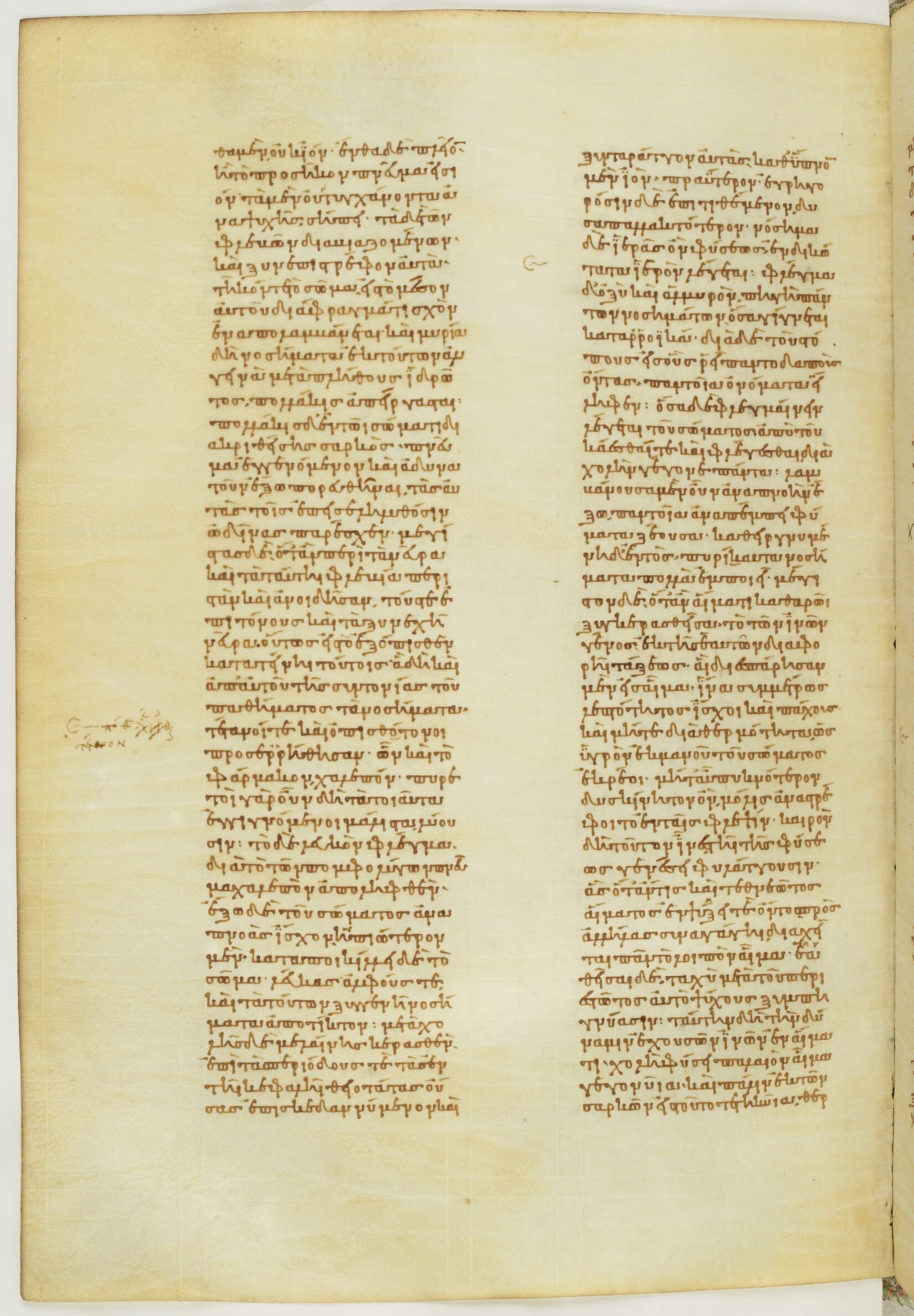
On the manuscript this page of text runs over fol. 141r col. a to fol. 141v col. a. Each section below is linked to the folio side(s) that carry it. The mapping comes from reading the first words of every column on the images and finding them in Burnet's text: fol. 141r col. a begins ‹ὁ δὲ μελαίνης χολῆς ὀξείας τε› (Tim. 83c); fol. 141r col. b begins ‹τότε ταῦτα πάσχον πᾶν τὸ τοιοῦτον› (Tim. 84a); fol. 141v col. a begins ‹-θα μὲν οὐκ ἰόν, ἔνθα δὲ› (Tim. 84d).
The Greek is John Burnet's critical text (Oxford, 1902), not a transcription of this manuscript; the scribe's spelling, accents and occasional readings differ from it. The English is R. G. Bury's Loeb translation (1929).
How was this verified? (Provenance)
Where on the image
Tim. 84a stands in Paris gr. 1807, fol. 141r col. a to fol. 141r col. b. Checked on the image (column openings read on the BnF photographs and found in Burnet's text, quoted in Burnet's spelling): fol. 141r col. a begins ‹ὁ δὲ μελαίνης χολῆς ὀξείας τε› (Tim. 83c); fol. 141r col. b begins ‹τότε ταῦτα πάσχον πᾶν τὸ τοιοῦτον› (Tim. 84a).
τὸ δὲ δὴ σάρκας ὀστοῖς συνδοῦν ὁπότʼ ἂν νοσήσῃ, καὶ μηκέτι αὐτὸ ἐξ ἰνῶν αἷμα καὶ νεύρων ἀποχωριζόμενον ὀστῷ μὲν τροφή, σαρκὶ δὲ πρὸς ὀστοῦν γίγνηται δεσμός, ἀλλʼ ἐκ λιπαροῦ καὶ λείου καὶ γλίσχρου τραχὺ καὶ ἁλμυρὸν αὐχμῆσαν ὑπὸ κακῆς διαίτης γένηται, τότε ταῦτα πάσχον πᾶν τὸ τοιοῦτον καταψήχεται μὲν αὐτὸ πάλιν ὑπὸ τὰς σάρκας καὶ τὰ νεῦρα, ἀφιστάμενον ἀπὸ τῶν ὀστῶν, αἱ δʼ ἐκ τῶν
but whenever the substance which binds the flesh to the bones becomes diseased and no longer separates itself at once from them and from the sinews, so as to provide food for the bone and to serve as a bond between flesh and bone, but becomes rough and saline instead of being oily and smooth and viscid, owing to its being starved by a bad regimen,—then, every such substance, as it undergoes these affections, molders away beneath the flesh and the sinews
Where on the image
Tim. 84b stands in Paris gr. 1807, fol. 141r col. b. Checked on the image (column openings read on the BnF photographs and found in Burnet's text, quoted in Burnet's spelling): fol. 141r col. b begins ‹τότε ταῦτα πάσχον πᾶν τὸ τοιοῦτον› (Tim. 84a).
ῥιζῶν συνεκπίπτουσαι τά τε νεῦρα γυμνὰ καταλείπουσι καὶ μεστὰ ἅλμης· αὐταὶ δὲ πάλιν εἰς τὴν αἵματος φορὰν ἐμπεσοῦσαι τὰ πρόσθεν ῥηθέντα νοσήματα πλείω ποιοῦσιν. χαλεπῶν δὲ τούτων περὶ τὰ σώματα παθημάτων γιγνομένων μείζω ἔτι γίγνεται τὰ πρὸ τούτων, ὅταν ὀστοῦν διὰ πυκνότητα σαρκὸς ἀναπνοὴν μὴ λαμβάνον ἱκανήν, ὑπʼ εὐρῶτος θερμαινόμενον, σφακελίσαν μήτε τὴν τροφὴν καταδέχηται
and withdraws from the bones; while the flesh falls away with it from the roots and leaves the sinews bare and full of saline matter, and by falling back itself into the stream of the blood it augments the maladies previously described. But although these bodily ailments are severe, still more grave are those which precede them, whenever the bone by reason of the density of the flesh fails to receive sufficient inspiration, and becoming heated because of its moldiness decays and does not admit its nutriment, but, on the contrary, falls back itself,
Where on the image
Tim. 84c stands in Paris gr. 1807, fol. 141r col. b. Checked on the image (column openings read on the BnF photographs and found in Burnet's text, quoted in Burnet's spelling): fol. 141r col. b begins ‹τότε ταῦτα πάσχον πᾶν τὸ τοιοῦτον› (Tim. 84a).
πάλιν τε αὐτὸ εἰς ἐκείνην ἐναντίως ἴῃ ψηχόμενον, ἡ δʼ εἰς σάρκας, σὰρξ δὲ εἰς αἷμα ἐμπίπτουσα τραχύτερα πάντα τῶν πρόσθεν τὰ νοσήματα ἀπεργάζηται· τὸ δʼ ἔσχατον πάντων, ὅταν ἡ τοῦ μυελοῦ φύσις ἀπʼ ἐνδείας ἤ τινος ὑπερβολῆς νοσήσῃ, τὰ μέγιστα καὶ κυριώτατα πρὸς θάνατον τῶν νοσημάτων ἀποτελεῖ, πάσης ἀνάπαλιν τῆς τοῦ σώματος φύσεως ἐξ ἀνάγκης ῥυείσης. τρίτον δʼ αὖ νοσημάτων εἶδος τριχῇ δεῖ διανοεῖσθαι
as it crumbles, into its nutriment which then passes into flesh, and this flesh falling into, the blood causes all such maladies to be more violent than those previously described. And the most extreme case of all occurs whenever the substance of the marrow becomes diseased either from deficiency or from excess; for this results in the gravest of diseases and the most potent in causing death, inasmuch as the whole substance of the body, by the force of necessity, streams in the reverse direction. A third class of diseases takes place, as we must conceive, in three ways,
Where on the image
Tim. 84d stands in Paris gr. 1807, fol. 141r col. b to fol. 141v col. a. Checked on the image (column openings read on the BnF photographs and found in Burnet's text, quoted in Burnet's spelling): fol. 141r col. b begins ‹τότε ταῦτα πάσχον πᾶν τὸ τοιοῦτον› (Tim. 84a); fol. 141v col. a begins ‹-θα μὲν οὐκ ἰόν, ἔνθα δὲ› (Tim. 84d).
γιγνόμενον, τὸ μὲν ὑπὸ πνεύματος, τὸ δὲ φλέγματος, τὸ δὲ χολῆς. ὅταν μὲν γὰρ ὁ τῶν πνευμάτων τῷ σώματι ταμίας πλεύμων μὴ καθαρὰς παρέχῃ τὰς διεξόδους ὑπὸ ῥευμάτων φραχθείς, ἔνθα μὲν οὐκ ἰόν, ἔνθα δὲ πλεῖον ἢ τὸ προσῆκον πνεῦμα εἰσιὸν τὰ μὲν οὐ τυγχάνοντα ἀναψυχῆς σήπει, τὰ δὲ τῶν φλεβῶν διαβιαζόμενον καὶ συνεπιστρέφον αὐτὰ τῆκόν τε τὸ σῶμα εἰς τὸ μέσον αὐτοῦ διάφραγμά τʼ ἴσχον
being due partly to air, partly to phlegm, and partly to bile. Whenever the lungs, which are the dispensers of air to the body, fail to keep their outlets clean through being blocked up with rheums, then the air, being unable to pass one way while entering by another way in more than its proper volume, causes the parts deprived of respiration to rot, but forces and distorts the vessels of the veins, and as it thus dissolves the body it is itself shut off within the center thereof which contains the midriff; and as a result of this
Where on the image
Tim. 84e stands in Paris gr. 1807, fol. 141v col. a. Checked on the image (column openings read on the BnF photographs and found in Burnet's text, quoted in Burnet's spelling): fol. 141v col. a begins ‹-θα μὲν οὐκ ἰόν, ἔνθα δὲ› (Tim. 84d).
ἐναπολαμβάνεται, καὶ μυρία δὴ νοσήματα ἐκ τούτων ἀλγεινὰ μετὰ πλήθους ἱδρῶτος πολλάκις ἀπείργασται. πολλάκις δʼ ἐν τῷ σώματι διακριθείσης σαρκὸς πνεῦμα ἐγγενόμενον καὶ ἀδυνατοῦν ἔξω πορευθῆναι τὰς αὐτὰς τοῖς ἐπεισεληλυθόσιν ὠδῖνας παρέσχεν, μεγίστας δέ, ὅταν περὶ τὰ νεῦρα καὶ τὰ ταύτῃ φλέβια περιστὰν καὶ ἀνοιδῆσαν τούς τε ἐπιτόνους καὶ τὰ συνεχῆ νεῦρα οὕτως εἰς τὸ ἐξόπισθεν κατατείνῃ τούτοις· ἃ δὴ καὶ ἀπʼ αὐτοῦ τῆς συντονίας τοῦ παθήματος τὰ νοσήματα τέτανοί τε καὶ ὀπισθότονοι προσερρήθησαν.
ὧν καὶ τὸ φάρμακον χαλεπόν· πυρετοὶ γὰρ οὖν δὴ τὰ τοιαῦτα ἐπιγιγνόμενοι
countless diseases of a painful kind are produced, accompanied by much sweating. And often, when the flesh is disintegrated, air which is enclosed in the body and is unable to pass out brings about the same pangs as those caused by the air that enters from without; and these pangs are most severe when the air surrounds the sinews and the adjacent veins and by its swelling up strains backwards the tendons and the sinews attached to them; hence it is actually from this process of intense strain that these maladies have derived their names of tetanus and opisthotonus.
Of these maladies the cure also is severe for what does most to relieve them is, in fact, an attack of fever.
Notes
- Greek: John Burnet, Platonis Opera IV (Oxford, 1902), via Perseus canonical-greekLit; Burnet's text is a critical edition, so its wording can differ from the manuscript shown.
- English: R. G. Bury, Plato IX (Loeb Classical Library, 1929), via Perseus. Bury's footnotes are not reproduced. Quotation marks stand where Perseus marks quoted speech.
- Stephanus sections (a-e) are those of the 1578 Stephanus edition as given by Burnet and Bury; Bury's section breaks can fall a few words away from Burnet's because English word order differs.
Cite
Sources
- Source: Paris, BnF grec 1807 (Plato A, c. 850-875) fol. 141r-141v via BnF IIIF + Burnet's Greek (Perseus) + R. G. Bury's English (Loeb 1929, Perseus) (holding institution)
- Critical edition: Burnet, Platonis Opera IV (1902), via Perseus
← previous · → next · v cycle view · l back to library