Plato, Timaeus 85a-85e: phlegm; the sacred disease; fevers
Introduction
Stephanus page 85 of Plato's Timaeus (85a-85e): phlegm; the sacred disease; fevers.
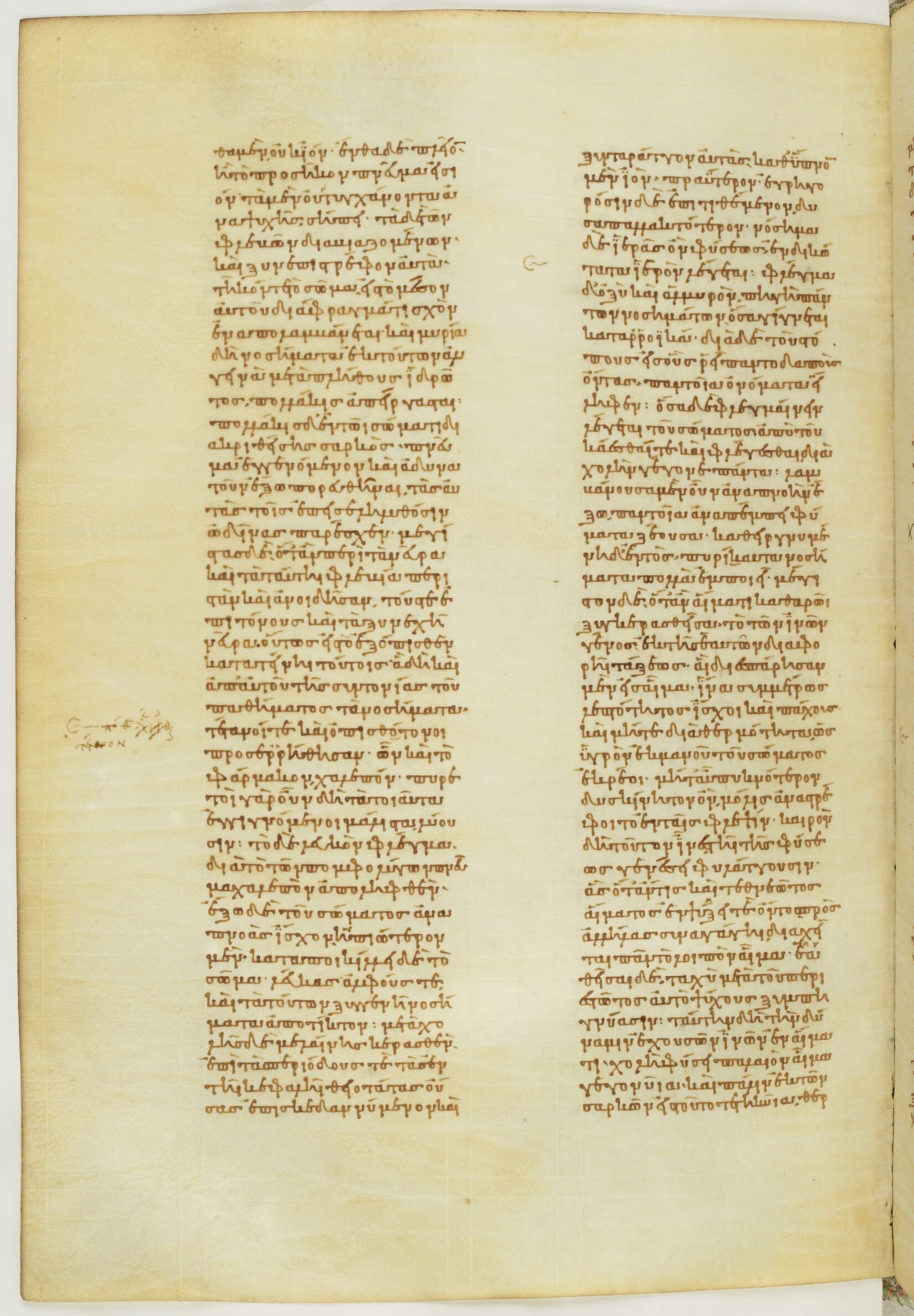
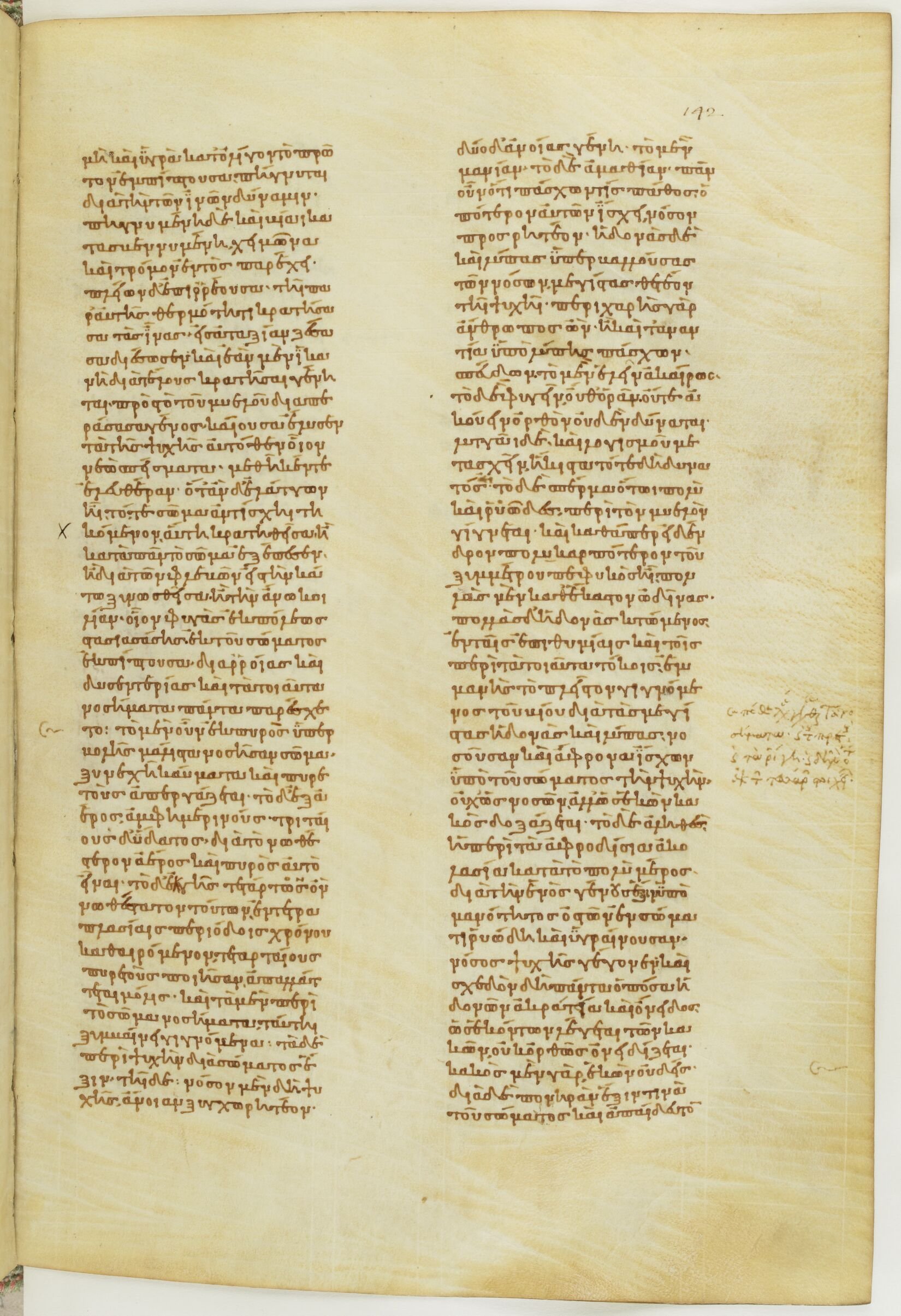
The manuscript is Paris, Bibliothèque nationale de France, grec 1807, known to editors as Plato A. It was copied in Constantinople around 850-875 by the scribe of the so-called philosophical collection, and is the oldest surviving medieval manuscript of the Timaeus and Critias (tetralogies VIII-IX: Clitophon, Republic, Timaeus, Critias, Minos, Laws, Epinomis, Letters). Each page has two columns of 44 lines. The Timaeus fills fol. 114r-144v and the Critias fol. 145r-151r.
On the manuscript this page of text runs over fol. 141v col. a to fol. 142r col. a. Each section below is linked to the folio side(s) that carry it. The mapping comes from reading the first words of every column on the images and finding them in Burnet's text: fol. 141v col. a begins ‹-θα μὲν οὐκ ἰόν, ἔνθα δὲ› (Tim. 84d); fol. 141v col. b begins ‹-ταράττον αὐτάς, καθʼ ὕπνον μὲν ἰὸν› (Tim. 85a); fol. 142r col. a begins ‹καὶ ὑγρὰ κατʼ ὀλίγον τὸ πρῶτον› (Tim. 85d).
The Greek is John Burnet's critical text (Oxford, 1902), not a transcription of this manuscript; the scribe's spelling, accents and occasional readings differ from it. The English is R. G. Bury's Loeb translation (1929).
How was this verified? (Provenance)
Where on the image
Tim. 85a stands in Paris gr. 1807, fol. 141v col. a to fol. 141v col. b. Checked on the image (column openings read on the BnF photographs and found in Burnet's text, quoted in Burnet's spelling): fol. 141v col. a begins ‹-θα μὲν οὐκ ἰόν, ἔνθα δὲ› (Tim. 84d); fol. 141v col. b begins ‹-ταράττον αὐτάς, καθʼ ὕπνον μὲν ἰὸν› (Tim. 85a).
μάλιστα λύουσιν. τὸ δὲ λευκὸν φλέγμα διὰ τὸ τῶν πομφολύγων πνεῦμα χαλεπὸν ἀποληφθέν, ἔξω δὲ τοῦ σώματος ἀναπνοὰς ἴσχον ἠπιώτερον μέν, καταποικίλλει δὲ τὸ σῶμα λεύκας ἀλφούς τε καὶ τὰ τούτων συγγενῆ νοσήματα ἀποτίκτον. μετὰ χολῆς δὲ μελαίνης κερασθὲν ἐπὶ τὰς περιόδους τε τὰς ἐν τῇ κεφαλῇ θειοτάτας οὔσας ἐπισκεδαννύμενον καὶ συνταράττον αὐτάς, καθʼ ὕπνον μὲν ἰὸν πρᾳΰτερον,
White phlegm, also, is dangerous when it is blocked inside because of the air in its bubbles; but when it has air-vents outside the body it is milder, although it marks the body with spots by breeding white scabs and tetters and the maladies akin thereto. And when this phlegm is blended with black bile and spreads over the revolutions of the head, which are the most divine, and perturbs them,
Where on the image
Tim. 85b stands in Paris gr. 1807, fol. 141v col. b. Checked on the image (column openings read on the BnF photographs and found in Burnet's text, quoted in Burnet's spelling): fol. 141v col. b begins ‹-ταράττον αὐτάς, καθʼ ὕπνον μὲν ἰὸν› (Tim. 85a).
ἐγρηγορόσιν δὲ ἐπιτιθέμενον δυσαπαλλακτότερον· νόσημα δὲ ἱερᾶς ὂν φύσεως ἐνδικώτατα ἱερὸν λέγεται. φλέγμα δʼ ὀξὺ καὶ ἁλμυρὸν πηγὴ πάντων νοσημάτων ὅσα γίγνεται καταρροϊκά· διὰ δὲ τοὺς τόπους εἰς οὓς ῥεῖ παντοδαποὺς ὄντας παντοῖα ὀνόματα εἴληφεν. ὅσα δὲ φλεγμαίνειν λέγεται τοῦ σώματος, ἀπὸ τοῦ κάεσθαί τε καὶ φλέγεσθαι, διὰ χολὴν γέγονε πάντα. λαμβάνουσα μὲν οὖν ἀναπνοὴν ἔξω παντοῖα
its action is more gentle during sleep, but when it attacks persons who are awake it is harder to shake off; and because it is a disease of the sacred substance it is most justly termed the sacred disease. Phlegm that is sharp and saline is the fount of all the maladies which are of the nature of catarrhs; and these have received all kinds of names because the regions into which they flow are of all varieties. All those diseases which are called inflammations, owing to the burning and inflaming of the body which they involve, are caused by bile. This, when it gains an external outlet,
Where on the image
Tim. 85c stands in Paris gr. 1807, fol. 141v col. b. Checked on the image (column openings read on the BnF photographs and found in Burnet's text, quoted in Burnet's spelling): fol. 141v col. b begins ‹-ταράττον αὐτάς, καθʼ ὕπνον μὲν ἰὸν› (Tim. 85a).
ἀναπέμπει φύματα ζέουσα, καθειργνυμένη δʼ ἐντὸς πυρίκαυτα νοσήματα πολλὰ ἐμποιεῖ, μέγιστον δέ, ὅταν αἵματι καθαρῷ συγκερασθεῖσα τὸ τῶν ἰνῶν γένος ἐκ τῆς ἑαυτῶν διαφορῇ τάξεως, αἳ διεσπάρησαν μὲν εἰς αἷμα, ἵνα συμμέτρως λεπτότητος ἴσχοι καὶ πάχους καὶ μήτε διὰ θερμότητα ὡς ὑγρὸν ἐκ μανοῦ τοῦ σώματος ἐκρέοι, μήτʼ αὖ πυκνότερον δυσκίνητον
boils and sends up all kinds of eruptions; but when it is confined inside it produces many burning diseases; and of these the gravest occurs when the bile, being mixed with pure blood, displaces the matter of the fibrine from its proper position. For this fibrine is dispersed through the blood in order that the blood may have a due proportion of both rarity and density, and may neither flow out from the porous body through being liquefied by heat, nor yet prove immobile
Where on the image
Tim. 85d stands in Paris gr. 1807, fol. 141v col. b to fol. 142r col. a. Checked on the image (column openings read on the BnF photographs and found in Burnet's text, quoted in Burnet's spelling): fol. 141v col. b begins ‹-ταράττον αὐτάς, καθʼ ὕπνον μὲν ἰὸν› (Tim. 85a); fol. 142r col. a begins ‹καὶ ὑγρὰ κατʼ ὀλίγον τὸ πρῶτον› (Tim. 85d).
ὂν μόλις ἀναστρέφοιτο ἐν ταῖς φλεψίν. καιρὸν δὴ τούτων ἶνες τῇ τῆς φύσεως γενέσει φυλάττουσιν· ἃς ὅταν τις καὶ τεθνεῶτος αἵματος ἐν ψύξει τε ὄντος πρὸς ἀλλήλας συναγάγῃ, διαχεῖται πᾶν τὸ λοιπὸν αἷμα, ἐαθεῖσαι δὲ ταχὺ μετὰ τοῦ περιεστῶτος αὐτὸ ψύχους συμπηγνύασιν. ταύτην δὴ τὴν δύναμιν ἐχουσῶν ἰνῶν ἐν αἵματι χολὴ φύσει παλαιὸν αἷμα γεγονυῖα καὶ πάλιν ἐκ τῶν σαρκῶν εἰς τοῦτο τετηκυῖα, θερμὴ καὶ ὑγρὰ κατʼ ὀλίγον τὸ πρῶτον ἐμπίπτουσα πήγνυται
through its density and circulate with difficulty in the veins. Of these qualities the fibrine preserves the due amount owing to the nature of its formation. Even when anyone collects together the fibrine of blood that is dead and in process of cooling, all the rest of the blood turns liquid; but if the fibrine is left alone as it is, it acts in combination with the surrounding cold and rapidly congeals the blood. As the fibrine, then, has this property, bile, which is naturally formed of old blood and dissolved again into blood from flesh, penetrates the blood gradually at first, while it is hot and moist,
Where on the image
Tim. 85e stands in Paris gr. 1807, fol. 142r col. a. Checked on the image (column openings read on the BnF photographs and found in Burnet's text, quoted in Burnet's spelling): fol. 142r col. a begins ‹καὶ ὑγρὰ κατʼ ὀλίγον τὸ πρῶτον› (Tim. 85d).
διὰ τὴν τῶν ἰνῶν δύναμιν, πηγνυμένη δὲ καὶ βίᾳ κατασβεννυμένη χειμῶνα καὶ τρόμον ἐντὸς παρέχει.
πλείων δʼ ἐπιρρέουσα, τῇ παρʼ αὐτῆς θερμότητι κρατήσασα τὰς ἶνας εἰς ἀταξίαν ζέσασα διέσεισεν· καὶ ἐὰν μὲν ἱκανὴ διὰ τέλους κρατῆσαι γένηται, πρὸς τὸ τοῦ μυελοῦ διαπεράσασα γένος κάουσα ἔλυσεν τὰ τῆς ψυχῆς αὐτόθεν οἷον νεὼς πείσματα μεθῆκέν τε ἐλευθέραν, ὅταν δʼ ἐλάττων ᾖ τό τε σῶμα ἀντίσχῃ τηκόμενον, αὐτὴ κρατηθεῖσα ἢ κατὰ πᾶν τὸ σῶμα ἐξέπεσεν, ἢ διὰ τῶν φλεβῶν εἰς τὴν κάτω συνωσθεῖσα ἢ τὴν ἄνω κοιλίαν, οἷον φυγὰς ἐκ πόλεως στασιασάσης ἐκ
and is congealed by this property of the fibrine; and as it becomes congealed and forcibly chilled it causes internal cold and shivering.
But when the bile flows in with more volume, it overpowers the fibrine by the heat it contains, and shakes it into disorder by its boiling up; and should it be capable of thus overpowering the fibrine continuously, it penetrates to the substance of the marrow and loosens from thence, by burning, the mooring-ropes of the soul, as it were of a ship, and sets it free. But when the bile is in smaller quantity and the body resists dissolution, then the bile itself is overpowered, and either it is ejected over the whole surface of the body, or else it is forced through the veins into the lower or the upper belly, being ejected from the body like fugitives from a city in revolt;
Notes
- Greek: John Burnet, Platonis Opera IV (Oxford, 1902), via Perseus canonical-greekLit; Burnet's text is a critical edition, so its wording can differ from the manuscript shown.
- English: R. G. Bury, Plato IX (Loeb Classical Library, 1929), via Perseus. Bury's footnotes are not reproduced. Quotation marks stand where Perseus marks quoted speech.
- Stephanus sections (a-e) are those of the 1578 Stephanus edition as given by Burnet and Bury; Bury's section breaks can fall a few words away from Burnet's because English word order differs.
Cite
Sources
- Source: Paris, BnF grec 1807 (Plato A, c. 850-875) fol. 141v-142r via BnF IIIF + Burnet's Greek (Perseus) + R. G. Bury's English (Loeb 1929, Perseus) (holding institution)
- Critical edition: Burnet, Platonis Opera IV (1902), via Perseus
← previous · → next · v cycle view · l back to library