Plato, Timaeus 86a-86e: diseases of the soul: madness and ignorance
Introduction
Stephanus page 86 of Plato's Timaeus (86a-86e): diseases of the soul: madness and ignorance.
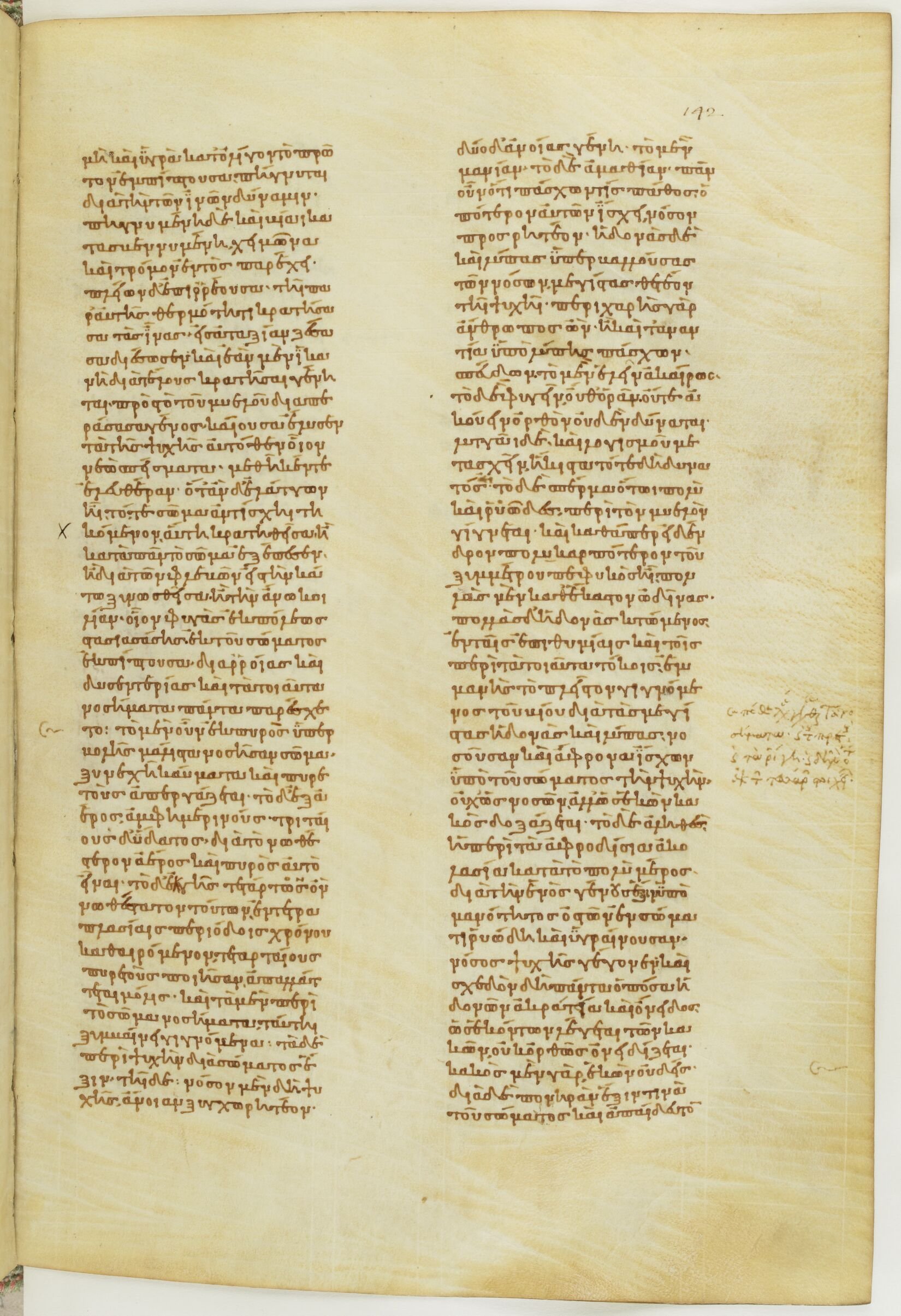
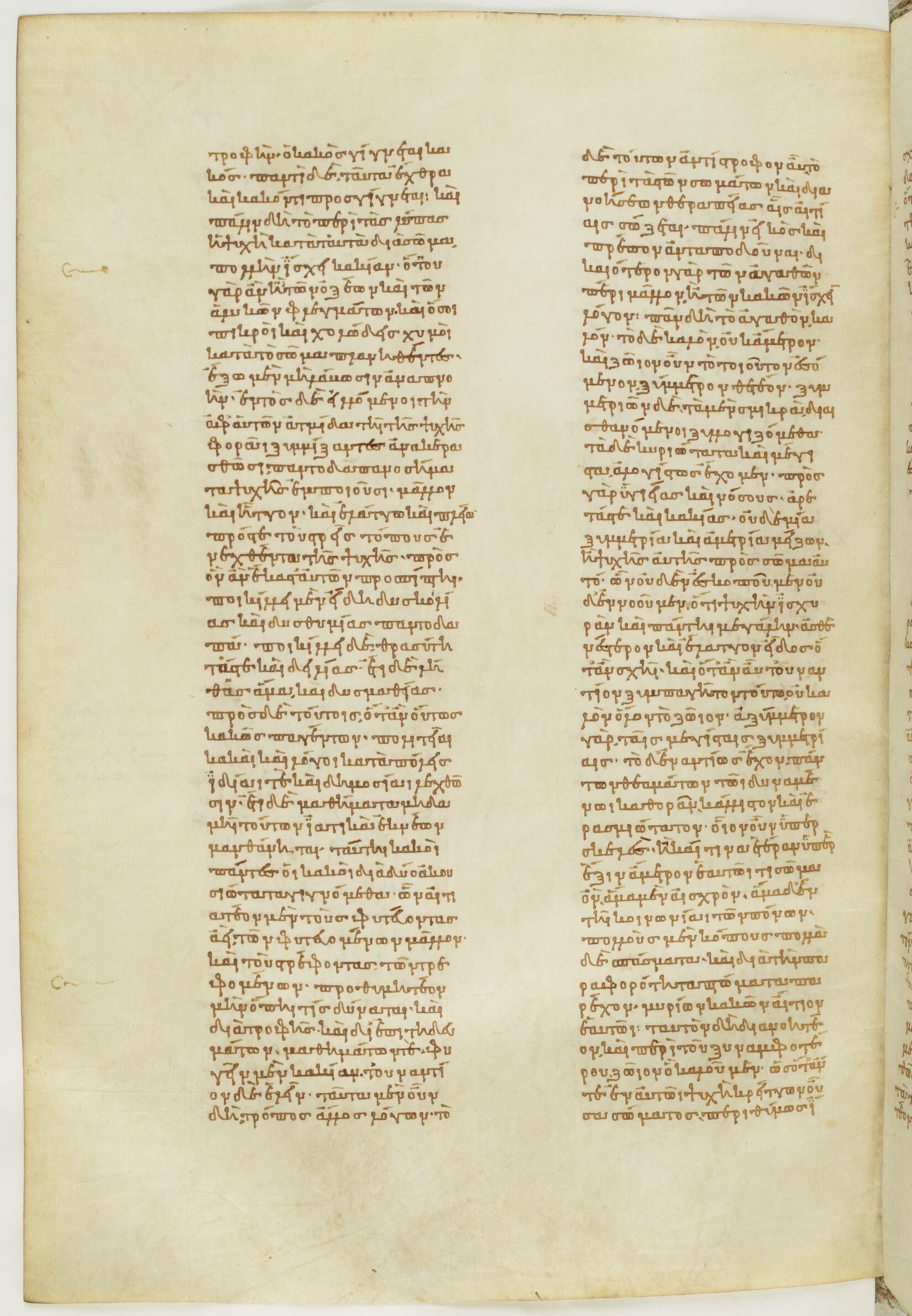
The manuscript is Paris, Bibliothèque nationale de France, grec 1807, known to editors as Plato A. It was copied in Constantinople around 850-875 by the scribe of the so-called philosophical collection, and is the oldest surviving medieval manuscript of the Timaeus and Critias (tetralogies VIII-IX: Clitophon, Republic, Timaeus, Critias, Minos, Laws, Epinomis, Letters). Each page has two columns of 44 lines. The Timaeus fills fol. 114r-144v and the Critias fol. 145r-151r.
On the manuscript this page of text runs over fol. 142r col. a to fol. 142v col. a. Each section below is linked to the folio side(s) that carry it. The mapping comes from reading the first words of every column on the images and finding them in Burnet's text: fol. 142r col. a begins ‹καὶ ὑγρὰ κατʼ ὀλίγον τὸ πρῶτον› (Tim. 85d); fol. 142r col. b begins ‹δύο δʼ ἀνοίας γένη, τὸ μὲν› (Tim. 86b); fol. 142v col. a begins ‹τροφὴν ὁ κακὸς γίγνεται κακός, παντὶ› (Tim. 86e).
The Greek is John Burnet's critical text (Oxford, 1902), not a transcription of this manuscript; the scribe's spelling, accents and occasional readings differ from it. The English is R. G. Bury's Loeb translation (1929).
How was this verified? (Provenance)
Where on the image
Tim. 86a stands in Paris gr. 1807, fol. 142r col. a. Checked on the image (column openings read on the BnF photographs and found in Burnet's text, quoted in Burnet's spelling): fol. 142r col. a begins ‹καὶ ὑγρὰ κατʼ ὀλίγον τὸ πρῶτον› (Tim. 85d).
τοῦ σώματος ἐκπίπτουσα, διαρροίας καὶ δυσεντερίας καὶ τὰ τοιαῦτα νοσήματα πάντα παρέσχετο. τὸ μὲν οὖν ἐκ πυρὸς ὑπερβολῆς μάλιστα νοσῆσαν σῶμα συνεχῆ καύματα καὶ πυρετοὺς ἀπεργάζεται, τὸ δʼ ἐξ ἀέρος ἀμφημερινούς, τριταίους δʼ ὕδατος διὰ τὸ νωθέστερον ἀέρος καὶ πυρὸς αὐτὸ εἶναι· τὸ δὲ γῆς, τετάρτως ὂν νωθέστατον τούτων, ἐν τετραπλασίαις περιόδοις χρόνου καθαιρόμενον, τεταρταίους πυρετοὺς ποιῆσαν ἀπαλλάττεται μόλις.
and it produces diarrhoea and dysentery and all suchlike maladies. When a body has become diseased mainly from an excess of fire, it produces constant inflammations and fevers; when from air, quotidian fevers; when from water, tertian fevers, because that element is more sluggish than air or fire; and when from earth, which is the fourth and most sluggish of the elements and is purged in four-fold periods of time, it causes quartan fevers and is cured with difficulty.
Where on the image
Tim. 86b stands in Paris gr. 1807, fol. 142r col. a to fol. 142r col. b. Checked on the image (column openings read on the BnF photographs and found in Burnet's text, quoted in Burnet's spelling): fol. 142r col. a begins ‹καὶ ὑγρὰ κατʼ ὀλίγον τὸ πρῶτον› (Tim. 85d); fol. 142r col. b begins ‹δύο δʼ ἀνοίας γένη, τὸ μὲν› (Tim. 86b).
καὶ τὰ μὲν περὶ τὸ σῶμα νοσήματα ταύτῃ συμβαίνει γιγνόμενα, τὰ δὲ περὶ ψυχὴν διὰ σώματος ἕξιν τῇδε. νόσον μὲν δὴ ψυχῆς ἄνοιαν συγχωρητέον, δύο δʼ ἀνοίας γένη, τὸ μὲν μανίαν, τὸ δὲ ἀμαθίαν. πᾶν οὖν ὅτι πάσχων τις πάθος ὁπότερον αὐτῶν ἴσχει, νόσον προσρητέον, ἡδονὰς δὲ καὶ λύπας ὑπερβαλλούσας τῶν νόσων μεγίστας θετέον τῇ ψυχῇ· περιχαρὴς γὰρ ἄνθρωπος ὢν ἢ καὶ τἀναντία ὑπὸ
Such is the manner in which diseases of the body come about; and those of the soul which are due to the condition of the body arise in the following way. We must agree that folly is a disease of the soul; and of folly there are two kinds, the one of which is madness, the other ignorance. Whatever affection a man suffers from, if it involves either of these conditions it must be termed disease; and we must maintain that pleasures and pains in excess are the greatest of the soul’s diseases. For when a man is overjoyed or contrariwise suffering excessively
Where on the image
Tim. 86c stands in Paris gr. 1807, fol. 142r col. b. Checked on the image (column openings read on the BnF photographs and found in Burnet's text, quoted in Burnet's spelling): fol. 142r col. b begins ‹δύο δʼ ἀνοίας γένη, τὸ μὲν› (Tim. 86b).
λύπης πάσχων, σπεύδων τὸ μὲν ἑλεῖν ἀκαίρως, τὸ δὲ φυγεῖν, οὔθʼ ὁρᾶν οὔτε ἀκούειν ὀρθὸν οὐδὲν δύναται, λυττᾷ δὲ καὶ λογισμοῦ μετασχεῖν ἥκιστα τότε δὴ δυνατός. τὸ δὲ σπέρμα ὅτῳ πολὺ καὶ ῥυῶδες περὶ τὸν μυελὸν γίγνεται καὶ καθαπερεὶ δένδρον πολυκαρπότερον τοῦ συμμέτρου πεφυκὸς ᾖ, πολλὰς μὲν καθʼ ἕκαστον ὠδῖνας, πολλὰς δʼ ἡδονὰς κτώμενος ἐν ταῖς ἐπιθυμίαις καὶ τοῖς περὶ τὰ τοιαῦτα τόκοις, ἐμμανὴς τὸ πλεῖστον γιγνόμενος τοῦ βίου διὰ τὰς μεγίστας ἡδονὰς
from pain, being in haste to seize on the one and avoid the other beyond measure, he is unable either to see or to hear anything correctly, and he is at such a time distraught and wholly incapable of exercising reason. And whenever a man’s seed grows to abundant volume in his marrow, as it were a tree that is overladen beyond measure with fruit, he brings on himself time after time many pangs and many pleasures owing to his desires and the issue thereof, and comes to be in a state of madness
Where on the image
Tim. 86d stands in Paris gr. 1807, fol. 142r col. b. Checked on the image (column openings read on the BnF photographs and found in Burnet's text, quoted in Burnet's spelling): fol. 142r col. b begins ‹δύο δʼ ἀνοίας γένη, τὸ μὲν› (Tim. 86b).
καὶ λύπας, νοσοῦσαν καὶ ἄφρονα ἴσχων ὑπὸ τοῦ σώματος τὴν ψυχήν, οὐχ ὡς νοσῶν ἀλλʼ ὡς ἑκὼν κακὸς δοξάζεται· τὸ δὲ ἀληθὲς ἡ περὶ τὰ ἀφροδίσια ἀκολασία κατὰ τὸ πολὺ μέρος διὰ τὴν ἑνὸς γένους ἕξιν ὑπὸ μανότητος ὀστῶν ἐν σώματι ῥυώδη καὶ ὑγραίνουσαν νόσος ψυχῆς γέγονεν. καὶ σχεδὸν δὴ πάντα ὁπόσα ἡδονῶν ἀκράτεια καὶ ὄνειδος ὡς ἑκόντων λέγεται τῶν κακῶν, οὐκ ὀρθῶς ὀνειδίζεται· κακὸς
for the most part of his life because of those greatest of pleasures and pains, and keeps his soul diseased and senseless by reason of the action of his body. Yet such a man is reputed to be voluntarily wicked and not diseased; although, in truth, this sexual incontinence, which is due for the most part to the abundance and fluidity of one substance because of the porosity of the bones, constitutes a disease of the soul. And indeed almost all those affections which are called by way of reproach incontinence in pleasure, as though the wicked acted voluntarily, are wrongly so reproached; for no one is voluntarily wicked,
Where on the image
Tim. 86e stands in Paris gr. 1807, fol. 142r col. b to fol. 142v col. a. Checked on the image (column openings read on the BnF photographs and found in Burnet's text, quoted in Burnet's spelling): fol. 142r col. b begins ‹δύο δʼ ἀνοίας γένη, τὸ μὲν› (Tim. 86b); fol. 142v col. a begins ‹τροφὴν ὁ κακὸς γίγνεται κακός, παντὶ› (Tim. 86e).
μὲν γὰρ ἑκὼν οὐδείς, διὰ δὲ πονηρὰν ἕξιν τινὰ τοῦ σώματος καὶ ἀπαίδευτον τροφὴν ὁ κακὸς γίγνεται κακός, παντὶ δὲ ταῦτα ἐχθρὰ καὶ ἄκοντι προσγίγνεται. καὶ πάλιν δὴ τὸ περὶ τὰς λύπας ἡ ψυχὴ κατὰ ταὐτὰ διὰ σῶμα πολλὴν ἴσχει κακίαν.
ὅτου γὰρ ἂν ἢ τῶν ὀξέων καὶ τῶν ἁλυκῶν φλεγμάτων καὶ ὅσοι πικροὶ καὶ χολώδεις χυμοὶ κατὰ τὸ σῶμα πλανηθέντες ἔξω μὲν μὴ λάβωσιν ἀναπνοήν, ἐντὸς δὲ εἱλλόμενοι
but the wicked man becomes wicked by reason of some evil condition of body and unskilled nurture, and these are experiences which are hateful to everyone and involuntary. And again, in respect of pains likewise the soul acquires much evil because of the body.
For whenever the humors which arise from acid and saline phlegms, and all humors that are bitter and bilious wander through the body and find no external vent
Notes
- Greek: John Burnet, Platonis Opera IV (Oxford, 1902), via Perseus canonical-greekLit; Burnet's text is a critical edition, so its wording can differ from the manuscript shown.
- English: R. G. Bury, Plato IX (Loeb Classical Library, 1929), via Perseus. Bury's footnotes are not reproduced. Quotation marks stand where Perseus marks quoted speech.
- Stephanus sections (a-e) are those of the 1578 Stephanus edition as given by Burnet and Bury; Bury's section breaks can fall a few words away from Burnet's because English word order differs.
Cite
Sources
- Source: Paris, BnF grec 1807 (Plato A, c. 850-875) fol. 142r-142v via BnF IIIF + Burnet's Greek (Perseus) + R. G. Bury's English (Loeb 1929, Perseus) (holding institution)
- Critical edition: Burnet, Platonis Opera IV (1902), via Perseus
← previous · → next · v cycle view · l back to library