Plato, Timaeus 87a-87e: bad constitution and education; proportion between body and soul
Introduction
Stephanus page 87 of Plato's Timaeus (87a-87e): bad constitution and education; proportion between body and soul.
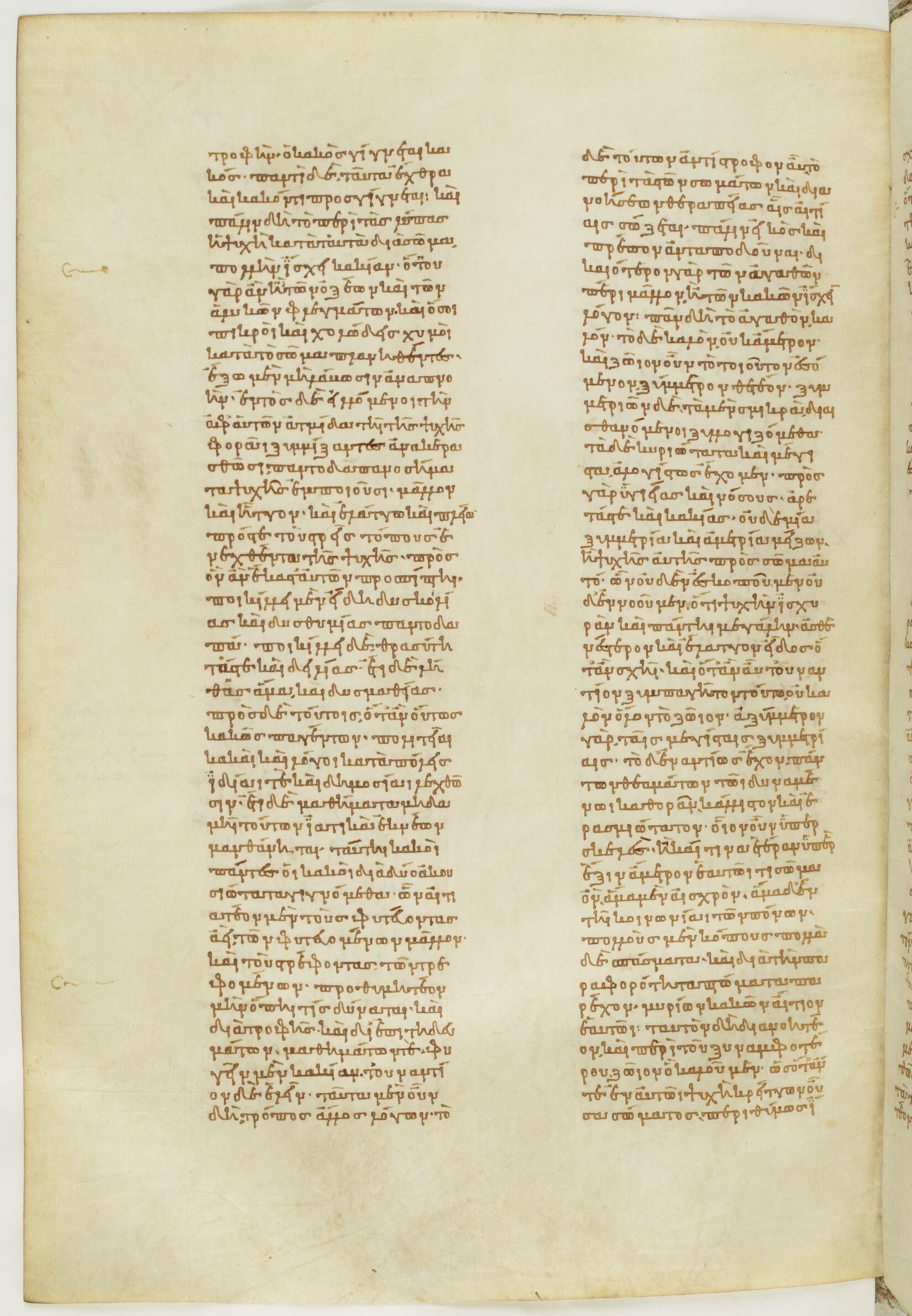
The manuscript is Paris, Bibliothèque nationale de France, grec 1807, known to editors as Plato A. It was copied in Constantinople around 850-875 by the scribe of the so-called philosophical collection, and is the oldest surviving medieval manuscript of the Timaeus and Critias (tetralogies VIII-IX: Clitophon, Republic, Timaeus, Critias, Minos, Laws, Epinomis, Letters). Each page has two columns of 44 lines. The Timaeus fills fol. 114r-144v and the Critias fol. 145r-151r.
On the manuscript this page of text runs over fol. 142v col. a to fol. 142v col. b. Each section below is linked to the folio side(s) that carry it. The mapping comes from reading the first words of every column on the images and finding them in Burnet's text: fol. 142v col. a begins ‹τροφὴν ὁ κακὸς γίγνεται κακός, παντὶ› (Tim. 86e); fol. 142v col. b begins ‹δὲ τούτων ἀντίστροφον αὖ, τὸ περὶ› (Tim. 87c).
The Greek is John Burnet's critical text (Oxford, 1902), not a transcription of this manuscript; the scribe's spelling, accents and occasional readings differ from it. The English is R. G. Bury's Loeb translation (1929).
How was this verified? (Provenance)
Where on the image
Tim. 87a stands in Paris gr. 1807, fol. 142v col. a. Checked on the image (column openings read on the BnF photographs and found in Burnet's text, quoted in Burnet's spelling): fol. 142v col. a begins ‹τροφὴν ὁ κακὸς γίγνεται κακός, παντὶ› (Tim. 86e).
τὴν ἀφʼ αὑτῶν ἀτμίδα τῇ τῆς ψυχῆς φορᾷ συμμείξαντες ἀνακερασθῶσι, παντοδαπὰ νοσήματα ψυχῆς ἐμποιοῦσι μᾶλλον καὶ ἧττον καὶ ἐλάττω καὶ πλείω, πρός τε τοὺς τρεῖς τόπους ἐνεχθέντα τῆς ψυχῆς, πρὸς ὃν ἂν ἕκαστʼ αὐτῶν προσπίπτῃ, ποικίλλει μὲν εἴδη δυσκολίας καὶ δυσθυμίας παντοδαπά, ποικίλλει δὲ θρασύτητός τε καὶ δειλίας, ἔτι δὲ λήθης ἅμα καὶ δυσμαθίας. πρὸς δὲ τούτοις, ὅταν οὕτως
but are confined within, and mingle their vapor with the movement of the soul and are blended therewith, they implant diseases of the soul of all kinds, varying in intensity and in extent; and as these humors penetrate to the three regions of the Soul, according to the region which they severally attack, they give rise to all varieties of bad temper and bad spirits, and they give rise to all manner of rashness and cowardice, and of forgetfulness also, as well as of stupidity. Furthermore, when, with men in such an evil condition,
Where on the image
Tim. 87b stands in Paris gr. 1807, fol. 142v col. a. Checked on the image (column openings read on the BnF photographs and found in Burnet's text, quoted in Burnet's spelling): fol. 142v col. a begins ‹τροφὴν ὁ κακὸς γίγνεται κακός, παντὶ› (Tim. 86e).
κακῶς παγέντων πολιτεῖαι κακαὶ καὶ λόγοι κατὰ πόλεις ἰδίᾳ τε καὶ δημοσίᾳ λεχθῶσιν, ἔτι δὲ μαθήματα μηδαμῇ τούτων ἰατικὰ ἐκ νέων μανθάνηται, ταύτῃ κακοὶ πάντες οἱ κακοὶ διὰ δύο ἀκουσιώτατα γιγνόμεθα· ὧν αἰτιατέον μὲν τοὺς φυτεύοντας ἀεὶ τῶν φυτευομένων μᾶλλον καὶ τοὺς τρέφοντας τῶν τρεφομένων, προθυμητέον μήν, ὅπῃ τις δύναται, καὶ διὰ τροφῆς καὶ διʼ ἐπιτηδευμάτων μαθημάτων τε φυγεῖν μὲν κακίαν, τοὐναντίον δὲ ἑλεῖν. ταῦτα μὲν οὖν δὴ τρόπος ἄλλος λόγων.
the political administration also is evil, and the speech in the cities, both public and private, is evil; and when, moreover, no lessons that would cure these evils are anywhere learnt from childhood,—thus it comes to pass that all of us who are wicked become wicked owing to two quite involuntary causes. And for these we must always blame the begetters more than the begotten, and the nurses more than the nurslings; yet each man must endeavor, as best he can, by means of nurture and by his pursuits and studies to flee the evil and to pursue the good. This, however, forms a separate subject of discussion.
Where on the image
Tim. 87c stands in Paris gr. 1807, fol. 142v col. a to fol. 142v col. b. Checked on the image (column openings read on the BnF photographs and found in Burnet's text, quoted in Burnet's spelling): fol. 142v col. a begins ‹τροφὴν ὁ κακὸς γίγνεται κακός, παντὶ› (Tim. 86e); fol. 142v col. b begins ‹δὲ τούτων ἀντίστροφον αὖ, τὸ περὶ› (Tim. 87c).
τὸ δὲ τούτων ἀντίστροφον αὖ, τὸ περὶ τὰς τῶν σωμάτων καὶ διανοήσεων θεραπείας αἷς αἰτίαις σῴζεται, πάλιν εἰκὸς καὶ πρέπον ἀνταποδοῦναι· δικαιότερον γὰρ τῶν ἀγαθῶν πέρι μᾶλλον ἢ τῶν κακῶν ἴσχειν λόγον. πᾶν δὴ τὸ ἀγαθὸν καλόν, τὸ δὲ καλὸν οὐκ ἄμετρον· καὶ ζῷον οὖν τὸ τοιοῦτον ἐσόμενον σύμμετρον θετέον. συμμετριῶν δὲ τὰ μὲν σμικρὰ διαισθανόμενοι συλλογιζόμεθα, τὰ δὲ κυριώτατα καὶ μέγιστα
Again, it is reasonable and proper to set forth in turn the subject complementary to the foregoing, namely the remedial treatment of body and mind, and the causes which conserve this. For what is good merits description more than what is evil. All that is good is fair, and the fair is not void of due measure; wherefore also the living creature that is to be fair must be symmetrical. Of symmetries we distinguish and reason about such as are small, but of the most important and the greatest we have no rational comprehension. For with respect to health and disease,
Where on the image
Tim. 87d stands in Paris gr. 1807, fol. 142v col. b. Checked on the image (column openings read on the BnF photographs and found in Burnet's text, quoted in Burnet's spelling): fol. 142v col. b begins ‹δὲ τούτων ἀντίστροφον αὖ, τὸ περὶ› (Tim. 87c).
ἀλογίστως ἔχομεν. πρὸς γὰρ ὑγιείας καὶ νόσους ἀρετάς τε καὶ κακίας οὐδεμία συμμετρία καὶ ἀμετρία μείζων ἢ ψυχῆς αὐτῆς πρὸς σῶμα αὐτό· ὧν οὐδὲν σκοποῦμεν οὐδʼ ἐννοοῦμεν, ὅτι ψυχὴν ἰσχυρὰν καὶ πάντῃ μεγάλην ἀσθενέστερον καὶ ἔλαττον εἶδος ὅταν ὀχῇ, καὶ ὅταν αὖ τοὐναντίον συμπαγῆτον τούτω, οὐ καλὸν ὅλον τὸ ζῷον—ἀσύμμετρον γὰρ ταῖς μεγίσταις συμμετρίαις—τὸ δὲ ἐναντίως ἔχον πάντων θεαμάτων τῷ δυναμένῳ καθορᾶν κάλλιστον καὶ ἐρασμιώτατον.
virtue and vice, there is no symmetry or want of symmetry greater than that which exists between the soul itself and the body itself. But as regards these, we wholly fail to perceive or reflect that, whenever a weaker and inferior type of body is the vehicle of a soul that is strong and in all ways great,—or conversely, when each of these two is of the opposite kind,—then the creature as a whole is not fair, seeing that it is unsymmetrical in respect of the greatest of symmetries; whereas a creature in the opposite condition is of all sights, for him who has eyes to see,
Where on the image
Tim. 87e stands in Paris gr. 1807, fol. 142v col. b. Checked on the image (column openings read on the BnF photographs and found in Burnet's text, quoted in Burnet's spelling): fol. 142v col. b begins ‹δὲ τούτων ἀντίστροφον αὖ, τὸ περὶ› (Tim. 87c).
οἷον οὖν ὑπερσκελὲς ἢ καί τινα ἑτέραν ὑπέρεξιν ἄμετρον ἑαυτῷ τι σῶμα ὂν ἅμα μὲν αἰσχρόν, ἅμα δʼ ἐν τῇ κοινωνίᾳ τῶν πόνων πολλοὺς μὲν κόπους, πολλὰ δὲ σπάσματα καὶ διὰ τὴν παραφορότητα πτώματα παρέχον μυρίων κακῶν αἴτιον ἑαυτῷ,
ταὐτὸν δὴ διανοητέον καὶ περὶ τοῦ συναμφοτέρου, ζῷον ὃ καλοῦμεν, ὡς ὅταν τε ἐν αὐτῷ ψυχὴ κρείττων
the fairest and most admirable. A body, for example, which is too long in the legs, or otherwise disproportioned owing to some excess, is not only ugly, but, when joint effort is required, it is also the source of much fatigue and many sprains and falls by reason of its clumsy motion, whereby it causes itself countless evils.
So likewise we must conceive of that compound of soul and body which we call the living creature. Whenever the soul within it is stronger than the body
Notes
- Greek: John Burnet, Platonis Opera IV (Oxford, 1902), via Perseus canonical-greekLit; Burnet's text is a critical edition, so its wording can differ from the manuscript shown.
- English: R. G. Bury, Plato IX (Loeb Classical Library, 1929), via Perseus. Bury's footnotes are not reproduced. Quotation marks stand where Perseus marks quoted speech.
- Stephanus sections (a-e) are those of the 1578 Stephanus edition as given by Burnet and Bury; Bury's section breaks can fall a few words away from Burnet's because English word order differs.
Cite
Sources
- Source: Paris, BnF grec 1807 (Plato A, c. 850-875) fol. 142v via BnF IIIF + Burnet's Greek (Perseus) + R. G. Bury's English (Loeb 1929, Perseus) (holding institution)
- Critical edition: Burnet, Platonis Opera IV (1902), via Perseus
← previous · → next · v cycle view · l back to library