Plato, Timaeus 88a-88e: exercise of body and soul
Introduction
Stephanus page 88 of Plato's Timaeus (88a-88e): exercise of body and soul.
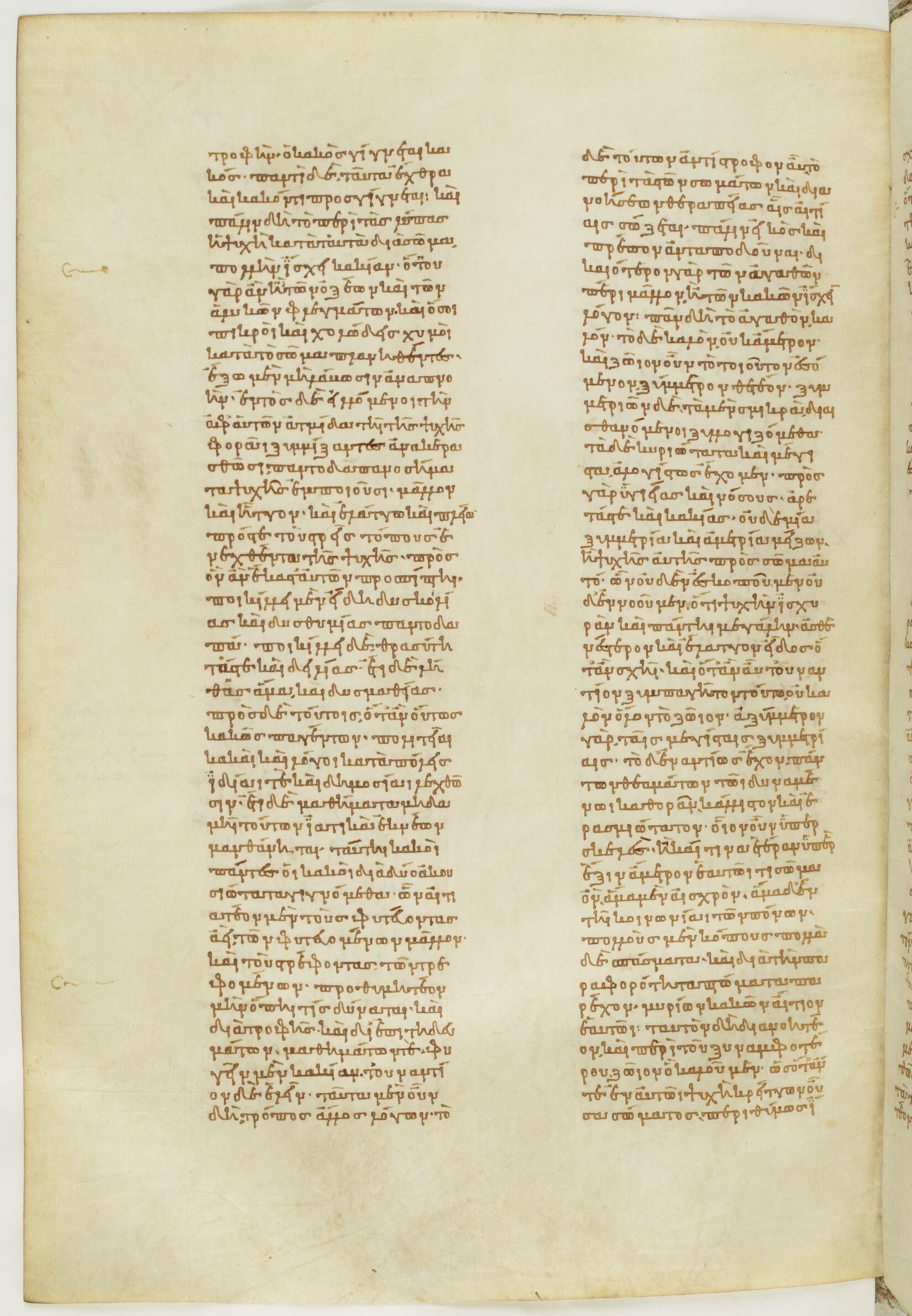
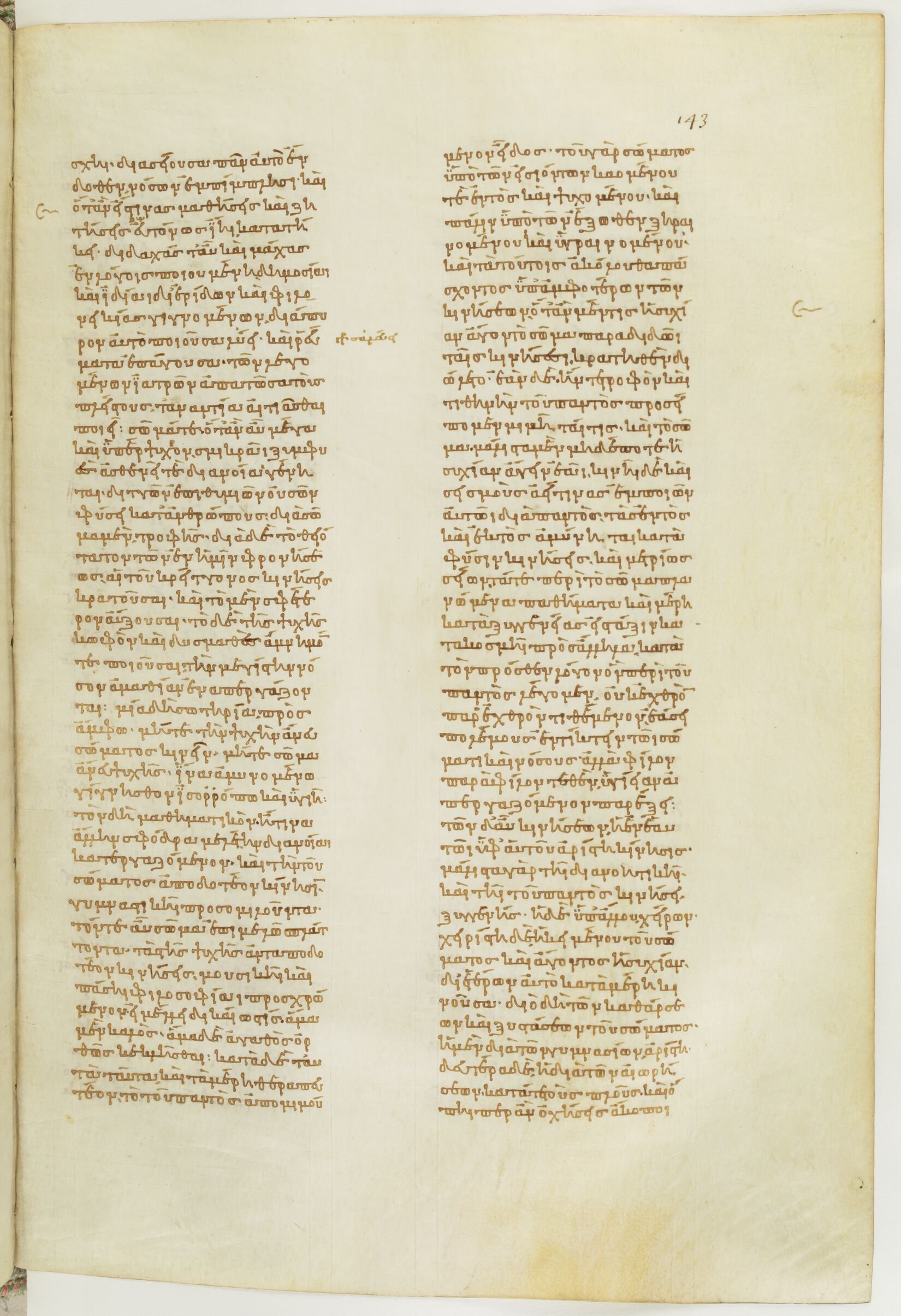
The manuscript is Paris, Bibliothèque nationale de France, grec 1807, known to editors as Plato A. It was copied in Constantinople around 850-875 by the scribe of the so-called philosophical collection, and is the oldest surviving medieval manuscript of the Timaeus and Critias (tetralogies VIII-IX: Clitophon, Republic, Timaeus, Critias, Minos, Laws, Epinomis, Letters). Each page has two columns of 44 lines. The Timaeus fills fol. 114r-144v and the Critias fol. 145r-151r.
On the manuscript this page of text runs over fol. 142v col. b to fol. 143r col. b. Each section below is linked to the folio side(s) that carry it. The mapping comes from reading the first words of every column on the images and finding them in Burnet's text: fol. 142v col. b begins ‹δὲ τούτων ἀντίστροφον αὖ, τὸ περὶ› (Tim. 87c); fol. 143r col. a begins ‹διασείουσα πᾶν αὐτὸ ἔνδοθεν νόσων ἐμπίμπλησι› (Tim. 88a); fol. 143r col. b begins ‹-μενον εἶδος. τοῦ γὰρ σώματος ὑπὸ› (Tim. 88d).
The Greek is John Burnet's critical text (Oxford, 1902), not a transcription of this manuscript; the scribe's spelling, accents and occasional readings differ from it. The English is R. G. Bury's Loeb translation (1929).
How was this verified? (Provenance)
Where on the image
Tim. 88a stands in Paris gr. 1807, fol. 142v col. b to fol. 143r col. a. Checked on the image (column openings read on the BnF photographs and found in Burnet's text, quoted in Burnet's spelling): fol. 142v col. b begins ‹δὲ τούτων ἀντίστροφον αὖ, τὸ περὶ› (Tim. 87c); fol. 143r col. a begins ‹διασείουσα πᾶν αὐτὸ ἔνδοθεν νόσων ἐμπίμπλησι› (Tim. 88a).
οὖσα σώματος περιθύμως ἴσχῃ, διασείουσα πᾶν αὐτὸ ἔνδοθεν νόσων ἐμπίμπλησι, καὶ ὅταν εἴς τινας μαθήσεις καὶ ζητήσεις συντόνως ἴῃ, κατατήκει, διδαχάς τʼ αὖ καὶ μάχας ἐν λόγοις ποιουμένη δημοσίᾳ καὶ ἰδίᾳ διʼ ἐρίδων καὶ φιλονικίας γιγνομένων διάπυρον αὐτὸ ποιοῦσα σαλεύει, καὶ ῥεύματα ἐπάγουσα, τῶν λεγομένων ἰατρῶν ἀπατῶσα τοὺς πλείστους, τἀναίται αἰτιᾶσθαι ποιεῖ· σῶμά τε ὅταν αὖ μέγα καὶ ὑπέρψυχον σμικρᾷ συμφυὲς ἀσθενεῖ τε διανοίᾳ γένηται, διττῶν
and is in a very passionate state, it shakes up the whole body from within and fills it with maladies; and whenever the soul ardently pursues some study or investigation, it wastes the body; and again, when the soul engages, in public or in private, in teachings and battles of words carried on with controversy and contention, it makes the body inflamed and shakes it to pieces, and induces catarrhs; and thereby it deceives the majority of so-called physicians and makes them ascribe the malady to the wrong cause. And, on the other hand, when a large and overbearing body is united to a small
Where on the image
Tim. 88b stands in Paris gr. 1807, fol. 143r col. a. Checked on the image (column openings read on the BnF photographs and found in Burnet's text, quoted in Burnet's spelling): fol. 143r col. a begins ‹διασείουσα πᾶν αὐτὸ ἔνδοθεν νόσων ἐμπίμπλησι› (Tim. 88a).
ἐπιθυμιῶν οὐσῶν φύσει κατʼ ἀνθρώπους, διὰ σῶμα μὲν τροφῆς, διὰ δὲ τὸ θειότατον τῶν ἐν ἡμῖν φρονήσεως, αἱ τοῦ κρείττονος κινήσεις κρατοῦσαι καὶ τὸ μὲν σφέτερον αὔξουσαι, τὸ δὲ τῆς ψυχῆς κωφὸν καὶ δυσμαθὲς ἀμνῆμόν τε ποιοῦσαι, τὴν μεγίστην νόσον ἀμαθίαν ἐναπεργάζονται. μία δὴ σωτηρία πρὸς ἄμφω, μήτε τὴν ψυχὴν ἄνευ σώματος κινεῖν μήτε σῶμα ἄνευ ψυχῆς, ἵνα ἀμυνομένω γίγνησθον ἰσορρόπω καὶ
and weak intellect, inasmuch as two desires naturally exist amongst men, —the desire of food for the body’s sake, and the desire of wisdom for the sake of the most divine part we have,—the motions of the stronger part prevail and augment their own power, but they make that of the soul obtuse and dull of wit and forgetful, and thereby they produce within it that greatest of diseases, ignorance. From both these evils the one means of salvation is this—neither to exercise the soul without the body nor the body without the soul, so that they may be evenly matched and sound of health. Thus the student of mathematics,
Where on the image
Tim. 88c stands in Paris gr. 1807, fol. 143r col. a. Checked on the image (column openings read on the BnF photographs and found in Burnet's text, quoted in Burnet's spelling): fol. 143r col. a begins ‹διασείουσα πᾶν αὐτὸ ἔνδοθεν νόσων ἐμπίμπλησι› (Tim. 88a).
ὑγιῆ. τὸν δὴ μαθηματικὸν ἤ τινα ἄλλην σφόδρα μελέτην διανοίᾳ κατεργαζόμενον καὶ τὴν τοῦ σώματος ἀποδοτέον κίνησιν, γυμναστικῇ προσομιλοῦντα, τόν τε αὖ σῶμα ἐπιμελῶς πλάττοντα τὰς τῆς ψυχῆς ἀνταποδοτέον κινήσεις, μουσικῇ καὶ πάσῃ φιλοσοφίᾳ προσχρώμενον, εἰ μέλλει δικαίως τις ἅμα μὲν καλός, ἅμα δὲ ἀγαθὸς ὀρθῶς κεκλῆσθαι. κατὰ δὲ ταὐτὰ ταῦτα καὶ τὰ μέρη θεραπευτέον, τὸ τοῦ παντὸς
or of any other subject, who works very hard with his intellect must also provide his body with exercise by practising gymnastics; while he who is diligent in molding his body must, in turn, provide his soul with motion by cultivating music and philosophy in general, if either is to deserve to be called truly both fair and good. The various parts, likewise, must be treated in the same manner, in imitation of the form of the Universe. For as the body
Where on the image
Tim. 88d stands in Paris gr. 1807, fol. 143r col. a to fol. 143r col. b. Checked on the image (column openings read on the BnF photographs and found in Burnet's text, quoted in Burnet's spelling): fol. 143r col. a begins ‹διασείουσα πᾶν αὐτὸ ἔνδοθεν νόσων ἐμπίμπλησι› (Tim. 88a); fol. 143r col. b begins ‹-μενον εἶδος. τοῦ γὰρ σώματος ὑπὸ› (Tim. 88d).
ἀπομιμούμενον εἶδος. τοῦ γὰρ σώματος ὑπὸ τῶν εἰσιόντων καομένου τε ἐντὸς καὶ ψυχομένου, καὶ πάλιν ὑπὸ τῶν ἔξωθεν ξηραινομένου καὶ ὑγραινομένου καὶ τὰ τούτοις ἀκόλουθα πάσχοντος ὑπʼ ἀμφοτέρων τῶν κινήσεων, ὅταν μέν τις ἡσυχίαν ἄγον τὸ σῶμα παραδιδῷ ταῖς κινήσεσι, κρατηθὲν διώλετο, ἐὰν δὲ ἥν τε τροφὸν καὶ τιθήνην τοῦ παντὸς προσείπομεν μιμῆταί τις, καὶ τὸ σῶμα μάλιστα μὲν μηδέποτε ἡσυχίαν ἄγειν ἐᾷ, κινῇ δὲ καὶ σεισμοὺς ἀεί τινας ἐμποιῶν αὐτῷ διὰ
is inflamed or chilled within by the particles that enter it, and again is dried or moistened by those without, and suffers the affections consequent on both these motions, whenever a man delivers his body, in a state of rest, to these motions, it is overpowered and utterly perishes; whereas if a man imitates that which we have called the nurturer and nurse of the Universe, and never, if possible, allows the body to be at rest but keeps it moving, and by continually producing internal vibrations defends it in nature’s way against the inward and outward motions, and by means of moderate vibrations
Where on the image
Tim. 88e stands in Paris gr. 1807, fol. 143r col. b. Checked on the image (column openings read on the BnF photographs and found in Burnet's text, quoted in Burnet's spelling): fol. 143r col. b begins ‹-μενον εἶδος. τοῦ γὰρ σώματος ὑπὸ› (Tim. 88d).
παντὸς τὰς ἐντὸς καὶ ἐκτὸς ἀμύνηται κατὰ φύσιν κινήσεις, καὶ μετρίως σείων τά τε περὶ τὸ σῶμα πλανώμενα παθήματα καὶ μέρη κατὰ συγγενείας εἰς τάξιν κατακοσμῇ πρὸς ἄλληλα, κατὰ τὸν πρόσθεν λόγον ὃν περὶ τοῦ παντὸς ἐλέγομεν, οὐκ ἐχθρὸν παρʼ ἐχθρὸν τιθέμενον ἐάσει πολέμους ἐντίκτειν τῷ σώματι καὶ νόσους, ἀλλὰ φίλον παρὰ φίλον τεθὲν ὑγίειαν
arranges the affections and particles which stray about in the body in their due reciprocal order, according to their affinities,—as described in the previous account which we have given of the Universe—then he will not suffer foe set beside foe to breed war in the body and disease, but he will cause friend to be set beside friend so as to produce sound health.
Notes
- Greek: John Burnet, Platonis Opera IV (Oxford, 1902), via Perseus canonical-greekLit; Burnet's text is a critical edition, so its wording can differ from the manuscript shown.
- English: R. G. Bury, Plato IX (Loeb Classical Library, 1929), via Perseus. Bury's footnotes are not reproduced. Quotation marks stand where Perseus marks quoted speech.
- Stephanus sections (a-e) are those of the 1578 Stephanus edition as given by Burnet and Bury; Bury's section breaks can fall a few words away from Burnet's because English word order differs.
Cite
Sources
- Source: Paris, BnF grec 1807 (Plato A, c. 850-875) fol. 142v-143r via BnF IIIF + Burnet's Greek (Perseus) + R. G. Bury's English (Loeb 1929, Perseus) (holding institution)
- Critical edition: Burnet, Platonis Opera IV (1902), via Perseus
← previous · → next · v cycle view · l back to library