Plato, Timaeus 89a-89e: gymnastics and medicine; regimen
Introduction
Stephanus page 89 of Plato's Timaeus (89a-89e): gymnastics and medicine; regimen.
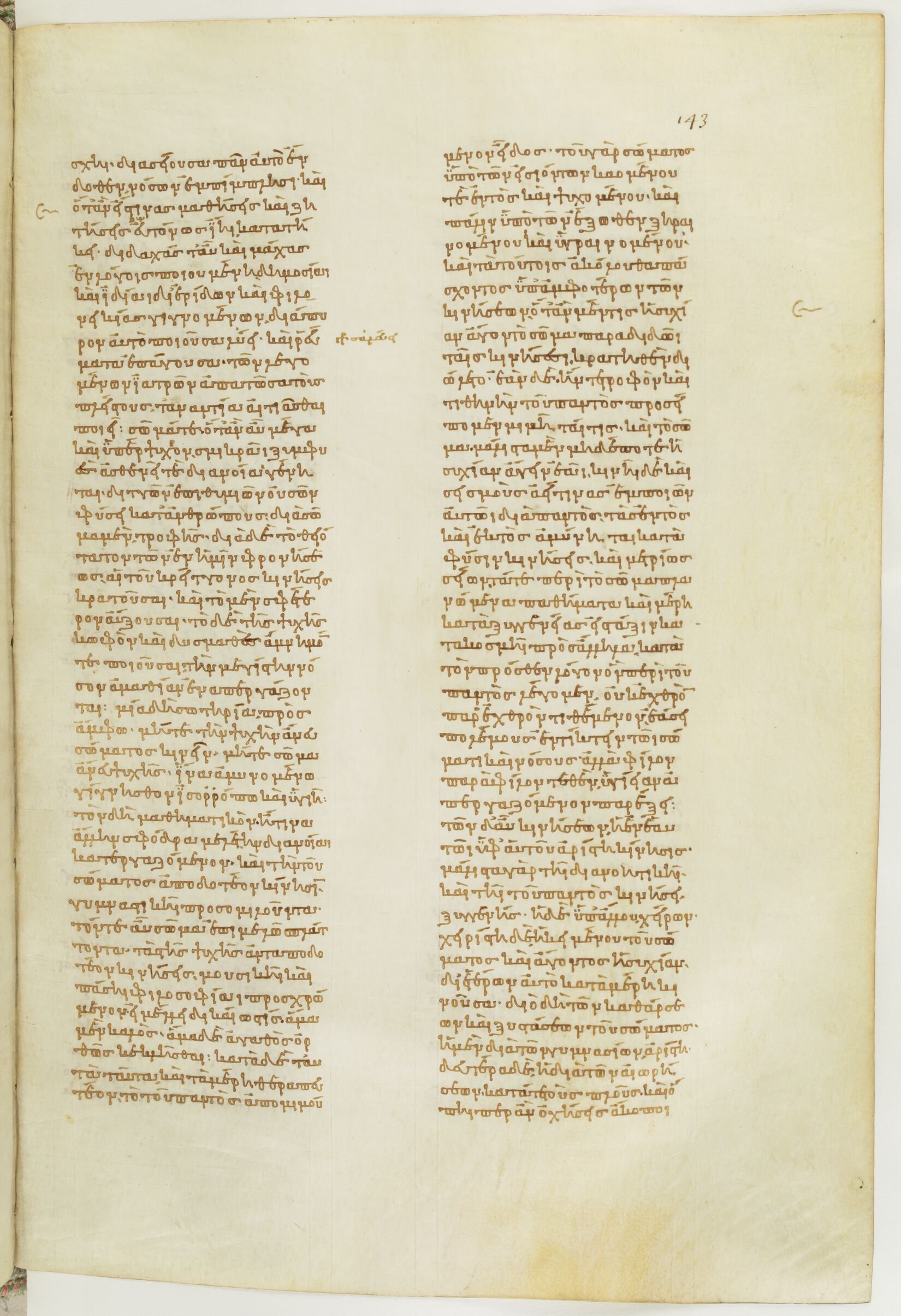
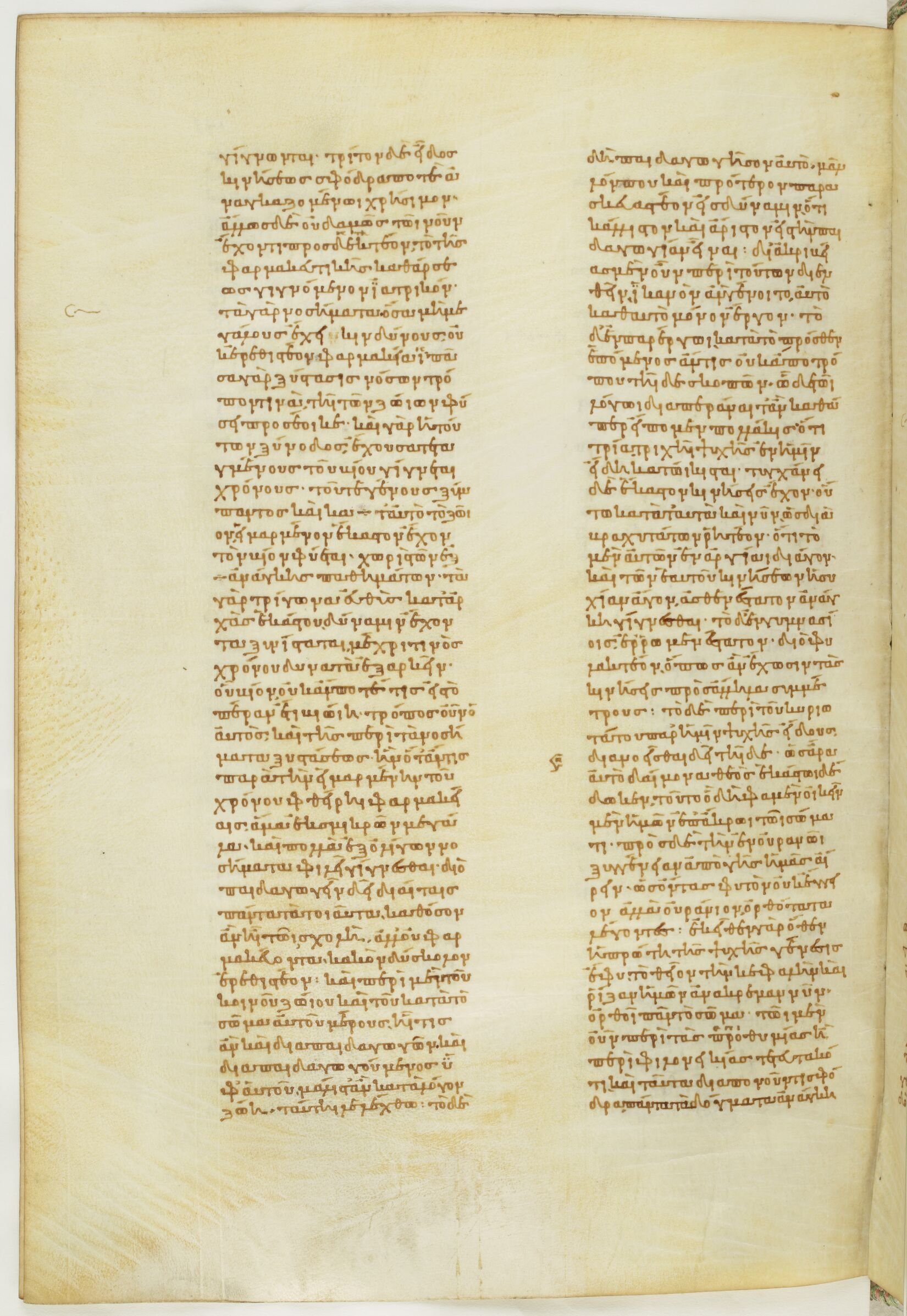
The manuscript is Paris, Bibliothèque nationale de France, grec 1807, known to editors as Plato A. It was copied in Constantinople around 850-875 by the scribe of the so-called philosophical collection, and is the oldest surviving medieval manuscript of the Timaeus and Critias (tetralogies VIII-IX: Clitophon, Republic, Timaeus, Critias, Minos, Laws, Epinomis, Letters). Each page has two columns of 44 lines. The Timaeus fills fol. 114r-144v and the Critias fol. 145r-151r.
On the manuscript this page of text runs over fol. 143r col. b to fol. 143v col. b. Each section below is linked to the folio side(s) that carry it. The mapping comes from reading the first words of every column on the images and finding them in Burnet's text: fol. 143r col. b begins ‹-μενον εἶδος. τοῦ γὰρ σώματος ὑπὸ› (Tim. 88d); fol. 143v col. a begins ‹γίγνωνται· τρίτον δὲ εἶδος κινήσεως σφόδρα› (Tim. 89a); fol. 143v col. b begins ‹παιδαγωγῆσον αὐτὸ μᾶλλόν που καὶ πρότερον› (Tim. 89d).
The Greek is John Burnet's critical text (Oxford, 1902), not a transcription of this manuscript; the scribe's spelling, accents and occasional readings differ from it. The English is R. G. Bury's Loeb translation (1929).
How was this verified? (Provenance)
Where on the image
Tim. 89a stands in Paris gr. 1807, fol. 143r col. b to fol. 143v col. a. Checked on the image (column openings read on the BnF photographs and found in Burnet's text, quoted in Burnet's spelling): fol. 143r col. b begins ‹-μενον εἶδος. τοῦ γὰρ σώματος ὑπὸ› (Tim. 88d); fol. 143v col. a begins ‹γίγνωνται· τρίτον δὲ εἶδος κινήσεως σφόδρα› (Tim. 89a).
ἀπεργαζόμενον παρέξει.
τῶν δʼ αὖ κινήσεων ἡ ἐν ἑαυτῷ ὑφʼ αὑτοῦ ἀρίστη κίνησις—μάλιστα γὰρ τῇ διανοητικῇ καὶ τῇ τοῦ παντὸς κινήσει συγγενής—ἡ δὲ ὑπʼ ἄλλου χείρων· χειρίστη δὲ ἡ κειμένου τοῦ σώματος καὶ ἄγοντος ἡσυχίαν διʼ ἑτέρων αὐτὸ κατὰ μέρη κινοῦσα. διὸ δὴ τῶν καθάρσεων καὶ συστάσεων τοῦ σώματος ἡ μὲν διὰ τῶν γυμνασίων ἀρίστη, δευτέρα δὲ ἡ διὰ τῶν αἰωρήσεων κατά τε τοὺς πλοῦς καὶ ὅπῃπερ ἂν ὀχήσεις ἄκοποι γίγνωνται· τρίτον δὲ εἶδος κινήσεως
Further, as concerns the motions, the best motion of a body is that caused by itself in itself; for this is most nearly akin to the motion of intelligence and the motion of the Universe. Motion due to the agency of another is less good; and the least good motion is that which is imparted to a body lying in a state of rest and which moves it piecemeal and by means of others. Wherefore the motion that is best for purgings and renovations of the body consists in gymnastic exercises; and second-best is the motion provided by swaying vehicles, such as boats or any conveyances that produce no fatigue; while the third kind of motion, although useful for one who is absolutely driven to it,
Where on the image
Tim. 89b stands in Paris gr. 1807, fol. 143v col. a. Checked on the image (column openings read on the BnF photographs and found in Burnet's text, quoted in Burnet's spelling): fol. 143v col. a begins ‹γίγνωνται· τρίτον δὲ εἶδος κινήσεως σφόδρα› (Tim. 89a).
σφόδρα ποτὲ ἀναγκαζομένῳ χρήσιμον, ἄλλως δὲ οὐδαμῶς τῷ νοῦν ἔχοντι προσδεκτέον, τὸ τῆς φαρμακευτικῆς καθάρσεως γιγνόμενον ἰατρικόν. τὰ γὰρ νοσήματα, ὅσα μὴ μεγάλους ἔχει κινδύνους, οὐκ ἐρεθιστέον φαρμακείαις. πᾶσα γὰρ σύστασις νόσων τρόπον τινὰ τῇ τῶν ζῴων φύσει προσέοικε. καὶ γὰρ ἡ τούτων σύνοδος ἔχουσα τεταγμένους τοῦ βίου γίγνεται χρόνους τοῦ τε γένους σύμπαντος, καὶ καθʼ αὑτὸ τὸ ζῷον εἱμαρμένον ἕκαστον ἔχον τὸν βίον φύεται,
is by no means acceptable, under any other conditions, to a man of sense, it being the medical kind of purging by means of drugs. For no diseases which do not involve great danger ought to be irritated by drugging. For in its structure every disease resembles in some sort the nature of the living creature. For, in truth, the constitution of these creatures has prescribed periods of life for the species as a whole, and each individual creature likewise has a naturally predestined term of life,
Where on the image
Tim. 89c stands in Paris gr. 1807, fol. 143v col. a. Checked on the image (column openings read on the BnF photographs and found in Burnet's text, quoted in Burnet's spelling): fol. 143v col. a begins ‹γίγνωνται· τρίτον δὲ εἶδος κινήσεως σφόδρα› (Tim. 89a).
χωρὶς τῶν ἐξ ἀνάγκης παθημάτων· τὰ γὰρ τρίγωνα εὐθὺς κατʼ ἀρχὰς ἑκάστου δύναμιν ἔχοντα συνίσταται μέχρι τινὸς χρόνου δυνατὰ ἐξαρκεῖν, οὗ βίον οὐκ ἄν ποτέ τις εἰς τὸ πέραν ἔτι βιῴη. τρόπος οὖν ὁ αὐτὸς καὶ τῆς περὶ τὰ νοσήματα συστάσεως· ἣν ὅταν τις παρὰ τὴν εἱμαρμένην τοῦ χρόνου φθείρῃ φαρμακείαις, ἅμα ἐκ σμικρῶν μεγάλα καὶ πολλὰ ἐξ ὀλίγων νοσήματα φιλεῖ γίγνεσθαι. διὸ παιδαγωγεῖν δεῖ διαίταις πάντα τὰ τοιαῦτα, καθʼ ὅσον ἂν ᾖ τῳ σχολή,
apart from the accidents due to necessity. For from the very beginning the triangles of each creature are constructed with a capacity for lasting until a certain time, beyond which no one could ever continue to live. With respect to the structure of diseases also the same rule holds good: whenever anyone does violence thereto by drugging, in despite of the predestined period of time, diseases many and grave, in place of few and slight, are wont to occur. Wherefore one ought to control all such diseases, so far as
Where on the image
Tim. 89d stands in Paris gr. 1807, fol. 143v col. a to fol. 143v col. b. Checked on the image (column openings read on the BnF photographs and found in Burnet's text, quoted in Burnet's spelling): fol. 143v col. a begins ‹γίγνωνται· τρίτον δὲ εἶδος κινήσεως σφόδρα› (Tim. 89a); fol. 143v col. b begins ‹παιδαγωγῆσον αὐτὸ μᾶλλόν που καὶ πρότερον› (Tim. 89d).
ἀλλʼ οὐ φαρμακεύοντα κακὸν δύσκολον ἐρεθιστέον. καὶ περὶ μὲν τοῦ κοινοῦ ζῴου καὶ τοῦ κατὰ τὸ σῶμα αὐτοῦ μέρους, ᾗ τις ἂν καὶ διαπαιδαγωγῶν καὶ διαπαιδαγωγούμενος ὑφʼ αὑτοῦ μάλιστʼ ἂν κατὰ λόγον ζῴη, ταύτῃ λελέχθω· τὸ δὲ δὴ παιδαγωγῆσον αὐτὸ μᾶλλόν που καὶ πρότερον παρασκευαστέον εἰς δύναμιν ὅτι κάλλιστον καὶ ἄριστον εἰς τὴν παιδαγωγίαν εἶναι. διʼ ἀκριβείας μὲν οὖν περὶ τούτων
one has the time to spare, by means of dieting rather than irritate a fractious evil by drugging. Concerning both the composite living creature and the bodily part of it, how a man should both guide and be guided by himself so as to live a most rational life, let our statement stand thus. But first and with special care we must make ready the part which is to be the guide to the best of our power, so that it may be as fair and good as possible for the work of guidance. Now to expound this subject alone in accurate detail would in itself be
Where on the image
Tim. 89e stands in Paris gr. 1807, fol. 143v col. b. Checked on the image (column openings read on the BnF photographs and found in Burnet's text, quoted in Burnet's spelling): fol. 143v col. b begins ‹παιδαγωγῆσον αὐτὸ μᾶλλόν που καὶ πρότερον› (Tim. 89d).
διελθεῖν ἱκανὸν ἂν γένοιτο αὐτὸ καθʼ αὑτὸ μόνον ἔργον· τὸ δʼ ἐν παρέργῳ κατὰ τὰ πρόσθεν ἑπόμενος ἄν τις οὐκ ἄπο τρόπου τῇδε σκοπῶν ὧδε τῷ λόγῳ διαπεράναιτʼ ἄν.
καθάπερ εἴπομεν πολλάκις, ὅτι τρία τριχῇ ψυχῆς ἐν ἡμῖν εἴδη κατῴκισται, τυγχάνει δὲ ἕκαστον κινήσεις ἔχον, οὕτω κατὰ ταὐτὰ καὶ νῦν ὡς διὰ βραχυτάτων ῥητέον ὅτι τὸ μὲν αὐτῶν ἐν ἀργίᾳ διάγον καὶ τῶν ἑαυτοῦ κινήσεων ἡσυχίαν ἄγον ἀσθενέστατον ἀνάγκη γίγνεσθαι, τὸ δʼ ἐν γυμνασίοις ἐρρωμενέστατον·
a sufficient task. But treating it merely as a side-issue, if we follow on the lines of our previous exposition, we may consider the matter and state our conclusions not inaptly in the following terms.
We have frequently asserted that there are housed within us in three regions three kinds of soul, and that each of these has its own motions; so now likewise we must repeat, as briefly as possible, that the kind which remains in idleness and stays with its own motions; in repose necessarily becomes weakest, whereas the kind which exercises itself becomes strongest;
Notes
- Greek: John Burnet, Platonis Opera IV (Oxford, 1902), via Perseus canonical-greekLit; Burnet's text is a critical edition, so its wording can differ from the manuscript shown.
- English: R. G. Bury, Plato IX (Loeb Classical Library, 1929), via Perseus. Bury's footnotes are not reproduced. Quotation marks stand where Perseus marks quoted speech.
- Stephanus sections (a-e) are those of the 1578 Stephanus edition as given by Burnet and Bury; Bury's section breaks can fall a few words away from Burnet's because English word order differs.
Cite
Sources
- Source: Paris, BnF grec 1807 (Plato A, c. 850-875) fol. 143r-143v via BnF IIIF + Burnet's Greek (Perseus) + R. G. Bury's English (Loeb 1929, Perseus) (holding institution)
- Critical edition: Burnet, Platonis Opera IV (1902), via Perseus
← previous · → next · v cycle view · l back to library