P46 (P.Mich. inv. 6238): 1 Corinthians 2:3-3:5 (fols. 40r-40v)
Introduction
P46 is a papyrus codex of the letters of Paul copied in Egypt around 200, the oldest surviving collection of Paul's letters. 86 of its 104 leaves survive: 56 in the Chester Beatty Library, Dublin (Biblical Papyrus II, published by Frederic Kenyon in 1934-1937) and 30 in the University of Michigan Library, Ann Arbor (P.Mich. inv. 6238, published by Henry Sanders in 1935). The letters run in the order Romans, Hebrews, 1 and 2 Corinthians, Ephesians, Galatians, Philippians, Colossians and 1 Thessalonians; the first seven leaves (Romans 1:1-5:17) and the end of the book are lost. Hebrews standing after Romans, and the doxology of Romans (16:25-27) standing after 15:33, are among its best-known features.
Each section below is one page side: the holding library's photograph, the NTVMR diplomatic transcription line by line, and the King James Version of every verse that has text on the page. The lower lines of many leaves are lost; the transcribers' restorations are in square brackets.
This entry covers fols. 40r-40v (1 Corinthians 2:3-3:5).
How was this verified? (Provenance)
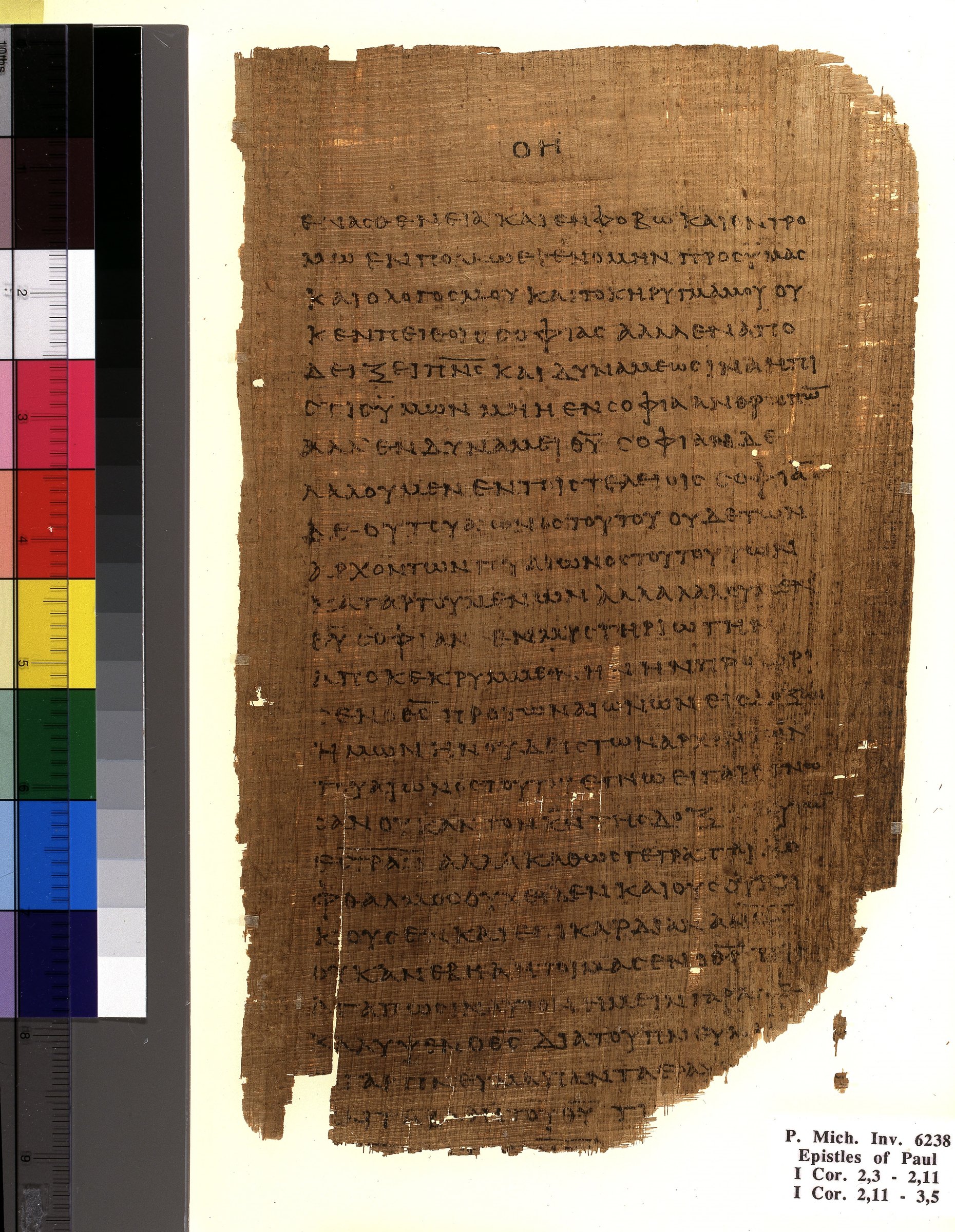
Where on the image
University of Michigan Library photograph 10046x6238_78JP2_UMich.jpg (https://ntmss.info/images/webfriendly/10046/10046x6238_78JP2_UMich.jpg), linked to NTVMR page 610 (folio 40r) in NTVMR's page index. 2:3 begins on the previous page; 2:11 continues on the next page. Checked on the image: the scribe's page number οη (78) at the head of the page, continuing the sequence of the neighbouring pages.
2:3 εν ασθενεια και εν φοβω και ε̣ν τρο
μω εν πολλω εγενομην προς υμας
4 και ο λογος μου και το κηρυγμα μου ου
κ εν πειθοις σοφιας αλλα εν απο
δειξει π̅ν̅ς̅ και δυναμεως 5 ινα η πι
στις υμων μη η εν σοφια ανθρωπων
αλλ εν δυναμει θ̅υ̅ 6 σοφιαν δε
λαλουμεν εν τοις τελειοις σοφιαν
δε ου του αιωνος τουτου ουδε των
αρχοντων το̣υ αιωνος τουτου των
καταργουμενων 7 αλλα λαλουμεν
θ̅υ̅ σοφιαν εν μυστηριω την
αποκεκρυμμενην ην προωρι
σεν ο θ̅ς̅ προ των αιωνων εις δο̣ξαν
ημων 8 ην ουδεις των αρχοντων
του αιωνος τουτου̣ εγνω ει γαρ εγνω
σαν ουκ αν τον κ̅ν̅ της δοξη̣ς̣ α̣υτ̣ων
ε̅σ̅τ̅ρ̅α̅ν̅ 9 αλλα καθως γεγραπται α ο
φθαλμος ουχ ειδεν και ους ουκ η
κουσεν και επι καρδιαν α̅ν̅ο̣̣̅υ̣̣̅
ουκ ανεβη α ητοιμασεν ο θ̅ς̅ το̣ις̣
αγαπωσιν αυτον 10 ημειν γαρ απ̣ε
καλυψεν ο θ̅ς̅ δια του πνευμ̣α̣τ̣[ος]
[το] γαρ πνευμα παντα εραυν̣[α]
[κ]α̣ι τα βαθ̣η του θ̅υ̅ 11 τις̣ [γαρ οιδεν]
[α̅ν̅ω̅ν̅ τ]α̣ τ̣[ο]υ̣ α̣̅ν̣̅[ο̅υ̅ ει μη το π̅ν̅α̅]
2:3And I was with you in weakness, and in fear, and in much trembling. 4And my speech and my preaching was not with enticing words of man’s wisdom, but in demonstration of the Spirit and of power: 5That your faith should not stand in the wisdom of men, but in the power of God. 6Howbeit we speak wisdom among them that are perfect: yet not the wisdom of this world, nor of the princes of this world, that come to nought: 7But we speak the wisdom of God in a mystery, even the hidden wisdom, which God ordained before the world unto our glory: 8Which none of the princes of this world knew: for had they known it, they would not have crucified the Lord of glory. 9But as it is written, Eye hath not seen, nor ear heard, neither have entered into the heart of man, the things which God hath prepared for them that love him. 10But God hath revealed them unto us by his Spirit: for the Spirit searcheth all things, yea, the deep things of God. 11For what man knoweth the things of a man, save the spirit of man which is in him? even so the things of God knoweth no man, but the Spirit of God.
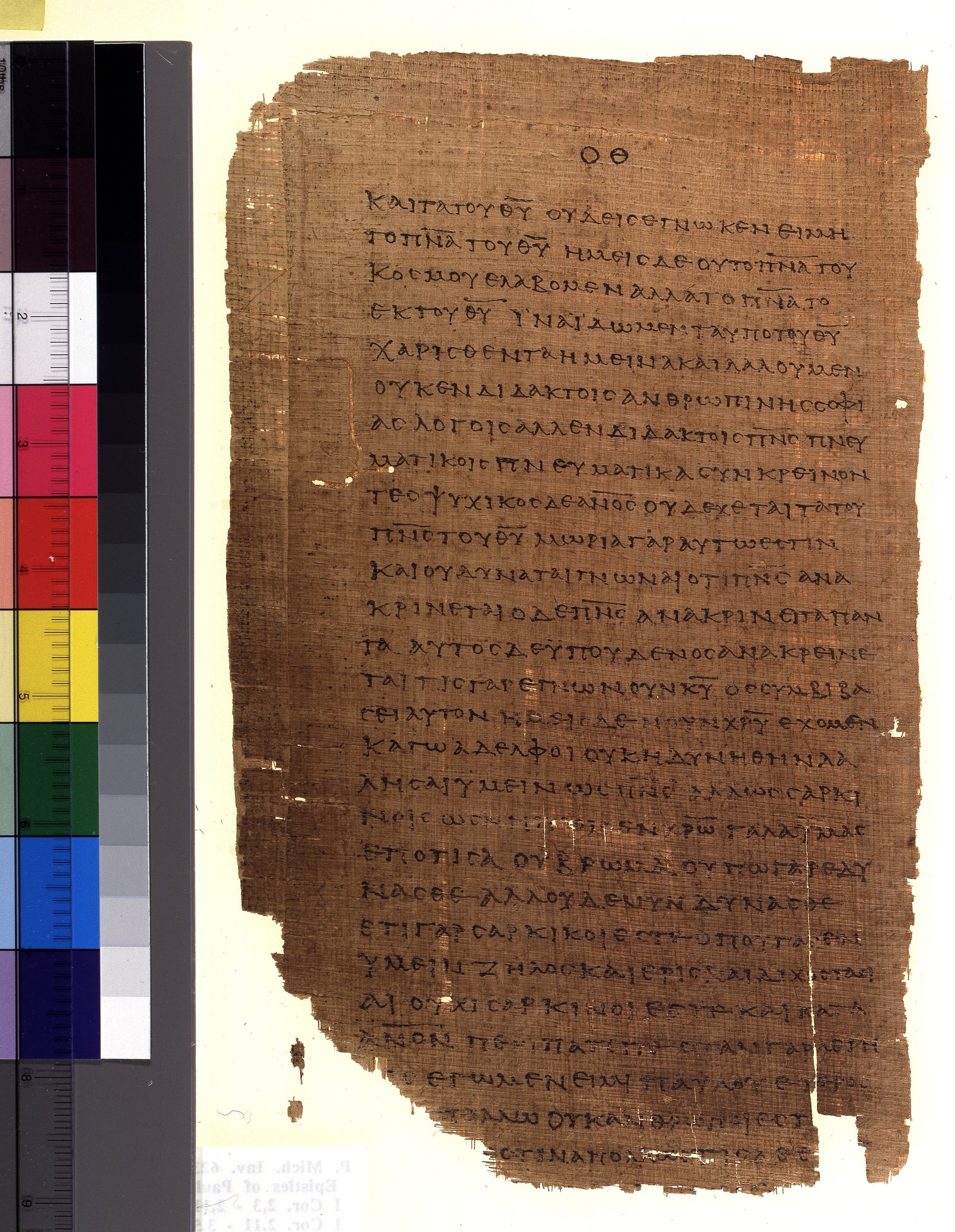
Where on the image
University of Michigan Library photograph 10046x6238_79JP2_UMich.jpg (https://ntmss.info/images/webfriendly/10046/10046x6238_79JP2_UMich.jpg), linked to NTVMR page 620 (folio 40v) in NTVMR's page index. 2:11 begins on the previous page; 3:5 continues on the next page. Checked on the image: the scribe's page number οθ (79) at the head of the page, continuing the sequence of the neighbouring pages.
2:11 και τα του θ̅υ̅ ουδεις εγνωκεν ει μη
το π̅ν̅α̅ του θ̅υ̅ 12 ημεις δε ου το π̅ν̅α̅ του
κοσμου ελαβομεν αλλα το π̅ν̅α̅ το
εκ του θ̅υ̅ ινα ιδωμεν τα υπο του θ̅υ̅
χαρισθεντα ημειν 13 α και λαλουμεν
ουκ εν διδακτοις ανθρωπινης σοφι
ας λογοις αλλ εν διδακτοις π̅ν̅ς̅ πνευ
ματικοις πνευματικα συνκρεινον
τες 14 ψυχικος δε α̅ν̅ο̅ς̅ ου δεχεται τα του
π̅ν̅ς̅ του θ̅υ̅ μωρια γαρ αυτω εστιν
και ου δυναται γνωναι οτι π̅ν̅ς̅ ανα
κρινεται 15 ο δε π̅ν̅ς̅ ανακρινει τα παν
τα αυτος δε υπ ουδενος ανακρεινε
ται 16 τις γαρ εγνω νουν κ̅υ̅ ος συμβιβα
σει αυτον ημεις δε νουν χ̅ρ̅υ̅ εχομεν
3:1 καγω αδελφοι ουκ ηδυνηθην λα
λησαι υμειν ως π̅ν̅ς̅ αλλ ως σαρκι
νοις ως νηπι̣οις εν χ̅ρ̅ω̅ 2 γαλα υμας
εποτισα ου βρωμα ουπω γαρ εδυ
νασθε αλλ ουδε νυν δυνασθε
3 ετι γαρ σαρκικοι εστε οπου γαρ̣ εν
υμειν ζηλος και ερις και διχοστασι
αι ουχι σαρκινοι εστε και κατα
α̅ν̅ο̅ν̅ περιπατειτε 4 οταν γαρ λεγη
[τ]ι̣ς εγω μεν ειμι παυλου ετερος
[δε α]π̣ολλω ουκ ανθρωποι εστ[ε]
5 [τις ουν] ε̣στιν απολλως τις δε ε[στιν]
2:11For what man knoweth the things of a man, save the spirit of man which is in him? even so the things of God knoweth no man, but the Spirit of God. 12Now we have received, not the spirit of the world, but the spirit which is of God; that we might know the things that are freely given to us of God. 13Which things also we speak, not in the words which man’s wisdom teacheth, but which the Holy Ghost teacheth; comparing spiritual things with spiritual. 14But the natural man receiveth not the things of the Spirit of God: for they are foolishness unto him: neither can he know them, because they are spiritually discerned. 15But he that is spiritual judgeth all things, yet he himself is judged of no man. 16For who hath known the mind of the Lord, that he may instruct him? But we have the mind of Christ. 3:1And I, brethren, could not speak unto you as unto spiritual, but as unto carnal, even as unto babes in Christ. 2I have fed you with milk, and not with meat: for hitherto ye were not able to bear it, neither yet now are ye able. 3For ye are yet carnal: for whereas there is among you envying, and strife, and divisions, are ye not carnal, and walk as men? 4For while one saith, I am of Paul; and another, I am of Apollos; are ye not carnal? 5Who then is Paul, and who is Apollos, but ministers by whom ye believed, even as the Lord gave to every man?
Notes
- Greek: the NTVMR diplomatic transcription, line by line as on the papyrus. Square brackets enclose letters that are lost or illegible and were supplied by the transcribers; a dot under a letter marks it as uncertain; [...] marks a gap. Nomina sacra and numerals keep the scribe's overline. Spelling is the scribe's (no accents or breathings). Words broken at a line end stay broken as on the papyrus. Corrections are not shown: the text is the first hand.
- English: the King James Version (1611), whole verses, for every verse that has text on the page. A verse that begins on one page and ends on the next is given in full on both. The KJV translates a later form of the Greek text, so its wording does not always match the papyrus; material differences (such as verses the papyrus does not have) are noted in the section.
Cite
Sources
- Source: P46 (P.Mich. inv. 6238, University of Michigan Library): photographs as published in the INTF New Testament Virtual Manuscript Room; Greek from the INTF NTVMR transcription of P46; English from the King James Version (holding institution)
- Critical edition: INTF NTVMR diplomatic transcription (CC BY 4.0)
← previous · → next · v cycle view · l back to library