P46 (Chester Beatty II): 1 Corinthians 7:4-8:7 (fols. 45r-47r)
Introduction
P46 is a papyrus codex of the letters of Paul copied in Egypt around 200, the oldest surviving collection of Paul's letters. 86 of its 104 leaves survive: 56 in the Chester Beatty Library, Dublin (Biblical Papyrus II, published by Frederic Kenyon in 1934-1937) and 30 in the University of Michigan Library, Ann Arbor (P.Mich. inv. 6238, published by Henry Sanders in 1935). The letters run in the order Romans, Hebrews, 1 and 2 Corinthians, Ephesians, Galatians, Philippians, Colossians and 1 Thessalonians; the first seven leaves (Romans 1:1-5:17) and the end of the book are lost. Hebrews standing after Romans, and the doxology of Romans (16:25-27) standing after 15:33, are among its best-known features.
Each section below is one page side: the holding library's photograph, the NTVMR diplomatic transcription line by line, and the King James Version of every verse that has text on the page. The lower lines of many leaves are lost; the transcribers' restorations are in square brackets.
This entry covers fols. 45r-47r (1 Corinthians 7:4-8:7).
How was this verified? (Provenance)
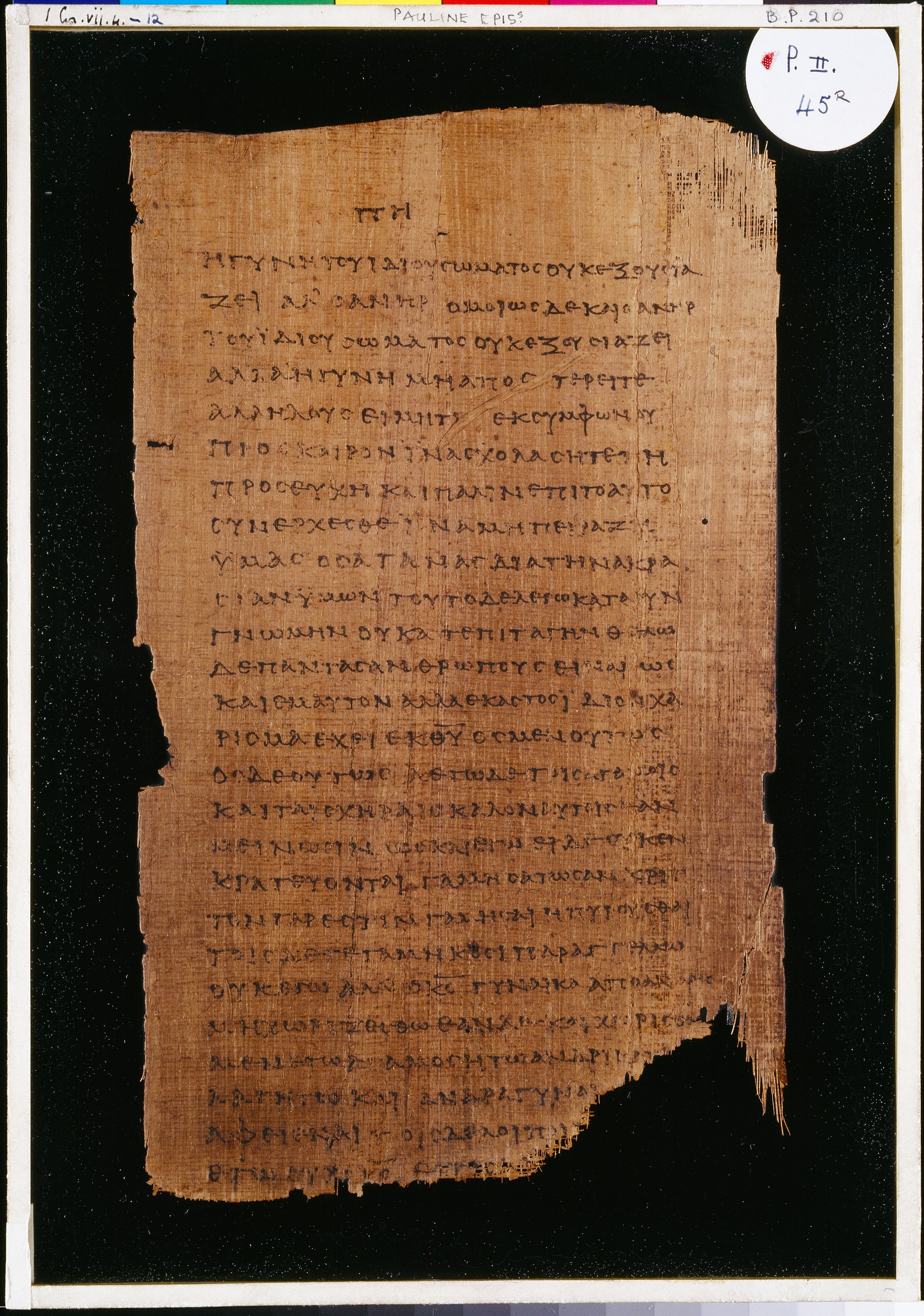
Where on the image
Chester Beatty Library photograph T0005483.jpg (https://ntmss.info/images/webfriendly/10046/T0005483.jpg), linked to NTVMR page 710 (folio 45r) in NTVMR's page index. 7:12 continues on the next page. Checked on the image: the scribe's page number πη (88) at the head of the page, continuing the sequence of the neighbouring pages; the disc on the frame reads ‹P. II 45R›.
7:4 η γυνη του ιδιου σωματος ουκ εξουσια
ζει αλ ο ανηρ ομοιως δε και ο ανηρ
του ιδιου σωματος ουκ εξουσιαζει
αλλα η γυνη 5 μη αποστερειτε
αλληλους ει μητι εκ συμφωνου
προς καιρον ινα σχολασητε τη
προσευχη και παλιν επι το αυτο
συνερχεσθε ινα μη πειραζη̣
υμας ο σατανας δια την ακρα
σιαν υμων 6 τουτο δε λεγω κατα σ̣υν
γνωμην ου κατ επιταγην 7 θελω
δε παντας ανθρωπους ειναι ως
και εμαυτον αλλα εκαστος ιδιον χα
ρισμα εχει εκ θ̅υ̅ ος μεν ουτως
ος δε ουτως 8 λεγω δε τοις αγαμ̣οις
και ταις χηραις καλον αυτοις ε̣αν
μεινωσιν ως και εγω 9 ει δε ουκ εν
κρατευονται γαμησατωσαν κ̣ριτ
τον γαρ εστιν γαμησαι η πυρουσθαι
10 τοις δε γεγαμηκοσι παραγγελλω
ουκ εγω αλλ ο κ̅ς̅ γυναικα απο ανδ̣ρος
μη χωριζεσθω 11 εαν δε̣ και χω̣ρισθη̣
μενετω αγαμος η τω ανδρι κ̣α̣τ̣[αλ]
λαγητω και ανδρα γυναι̣[κα μη]
αφειεναι 12 τοις δε λοιποι[ς λεγω]
ε̣γω ουχ̣ ο̣ κ̣̣̅ς̅ ει τις α̣δ[ελφος γυ]
[ναικα]
7:4The wife hath not power of her own body, but the husband: and likewise also the husband hath not power of his own body, but the wife. 5Defraud ye not one the other, except it be with consent for a time, that ye may give yourselves to fasting and prayer; and come together again, that Satan tempt you not for your incontinency. 6But I speak this by permission, and not of commandment. 7For I would that all men were even as I myself. But every man hath his proper gift of God, one after this manner, and another after that. 8I say therefore to the unmarried and widows, It is good for them if they abide even as I. 9But if they cannot contain, let them marry: for it is better to marry than to burn. 10And unto the married I command, yet not I, but the Lord, Let not the wife depart from her husband: 11But and if she depart, let her remain unmarried, or be reconciled to her husband: and let not the husband put away his wife. 12But to the rest speak I, not the Lord: If any brother hath a wife that believeth not, and she be pleased to dwell with him, let him not put her away.
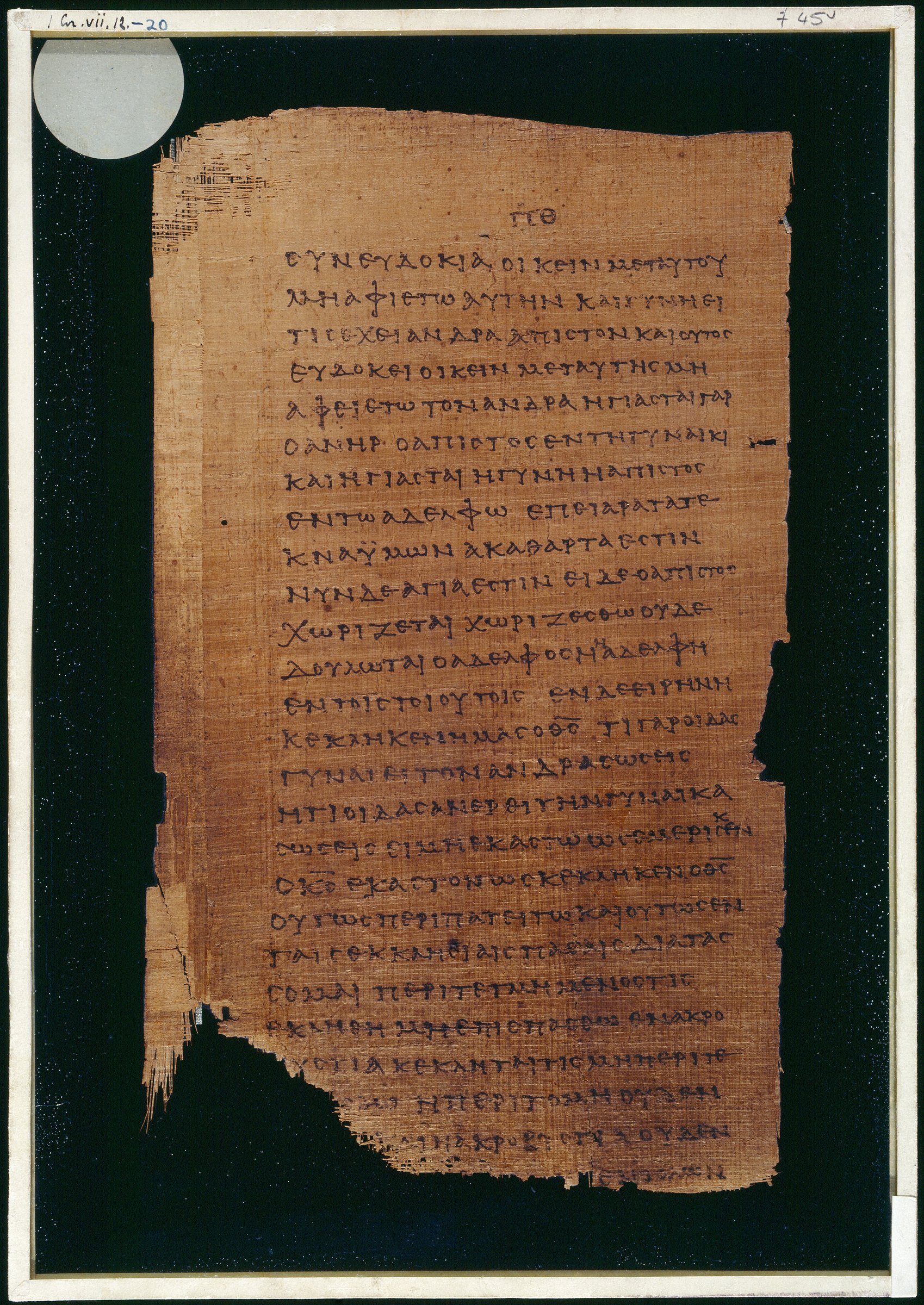
Where on the image
Chester Beatty Library photograph T0005598.jpg (https://ntmss.info/images/webfriendly/10046/T0005598.jpg), linked to NTVMR page 720 (folio 45v) in NTVMR's page index. 7:12 begins on the previous page; 7:19 continues on the next page. Checked on the image: the scribe's page number πθ (89) at the head of the page, continuing the sequence of the neighbouring pages.
7:12 συνευδοκια οικειν μετ αυτου
μη αφιετω αυτην 13 και γυνη ει
τις εχει ανδρα απιστον και ουτος
ευδοκει οικειν μετ αυτης μη
αφειετω τον ανδρα 14 ηγιασται γαρ
ο ανηρ ο απιστος εν τη γυναικι
και ηγιασται η γυνη η απιστος
εν τω αδελφω επει αρα τα τε
κνα υμων ακαθαρτα εστιν
νυν δε αγια εστιν 15 ει δε ο απιστος
χωριζεται χωριζεσθω ου δε
δουλωται ο αδελφος η αδελφη
εν τοις τοιουτοις εν δε ειρηνη
κεκληκεν ημας ο θ̅ς̅ 16 τι γαρ οιδας
γυναι ει τον ανδρα σωσεις
η τι οιδας ανερ ει την γυναικα
σωσεις 17 ει μη εκαστω ως εμερισεν
ο κ̅ς̅ εκαστον ως κεκληκεν ο θ̅ς̅
ουτως περιπατειτω και ουτως εν
ταις εκκλησιαις πασαις διατασ
σομαι 18 περιτετμημενος τις
εκλ̣ηθη μη επισπασθω εν ακρο
[β]υστια κεκληται τις μη περιτε
[μνε]σ̣θ̣ω 19 η περιτομη ουδεν
[εστιν] κ̣α̣ι η ακροβυστια ουδεν
[εστιν αλλα τηρησις] εντ̣ολων
7:12But to the rest speak I, not the Lord: If any brother hath a wife that believeth not, and she be pleased to dwell with him, let him not put her away. 13And the woman which hath an husband that believeth not, and if he be pleased to dwell with her, let her not leave him. 14For the unbelieving husband is sanctified by the wife, and the unbelieving wife is sanctified by the husband: else were your children unclean; but now are they holy. 15But if the unbelieving depart, let him depart. A brother or a sister is not under bondage in such cases: but God hath called us to peace. 16For what knowest thou, O wife, whether thou shalt save thy husband? or how knowest thou, O man, whether thou shalt save thy wife? 17But as God hath distributed to every man, as the Lord hath called every one, so let him walk. And so ordain I in all churches. 18Is any man called being circumcised? let him not become uncircumcised. Is any called in uncircumcision? let him not be circumcised. 19Circumcision is nothing, and uncircumcision is nothing, but the keeping of the commandments of God.
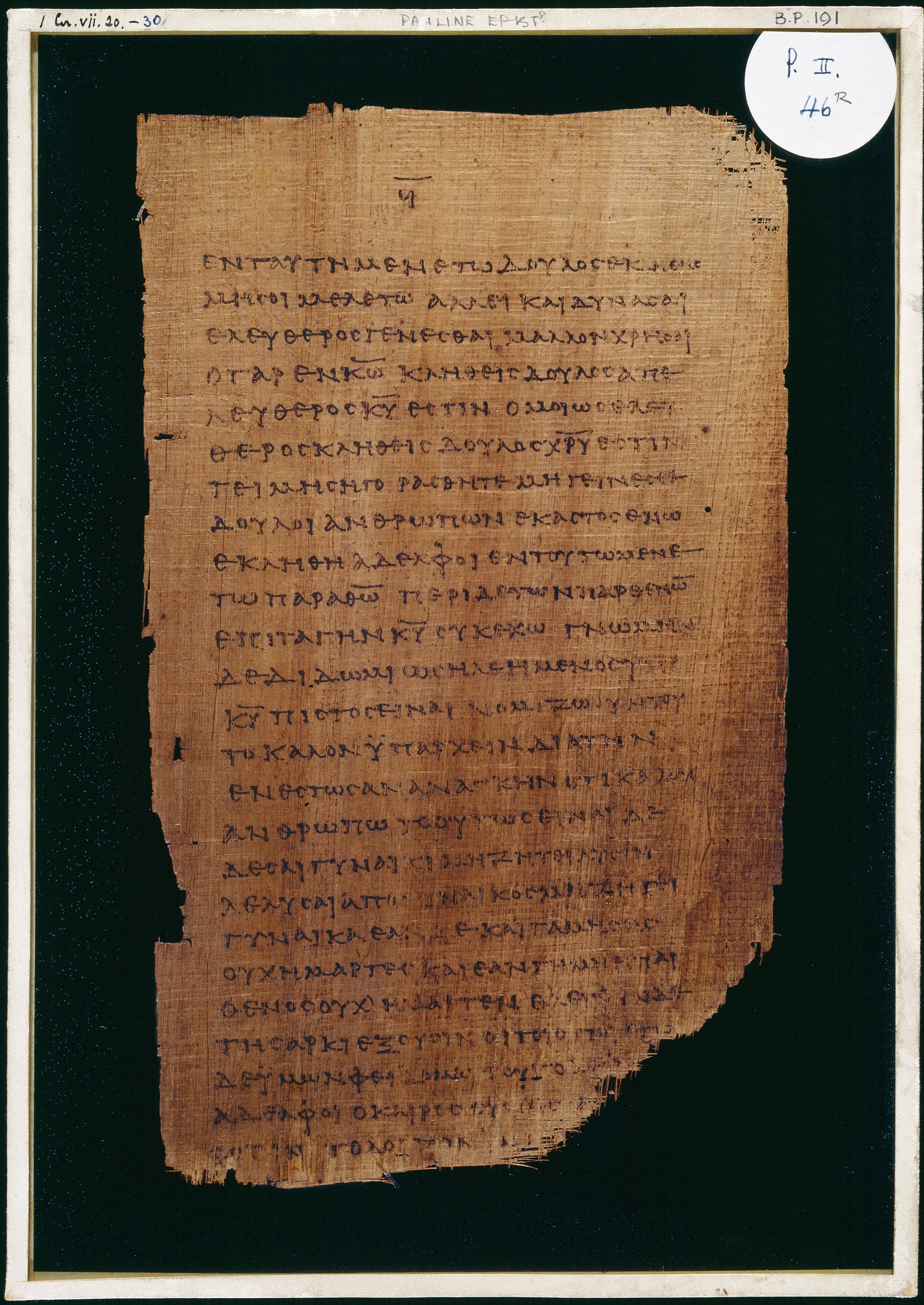
Where on the image
Chester Beatty Library photograph T0005599.jpg (https://ntmss.info/images/webfriendly/10046/T0005599.jpg), linked to NTVMR page 730 (folio 46r) in NTVMR's page index. 7:20 begins on the previous page. Checked on the image: the scribe's page number ϙ (90) at the head of the page, continuing the sequence of the neighbouring pages; the disc on the frame reads ‹P. II 46R›.
7:20 εν ταυτη μενετω 21 δουλος εκλ̣η̣θης
μη σοι μελετω αλλ ει και δυνασαι
ελευθερος γενεσθαι μαλλον χρησαι
22 ο γαρ εν κ̅ω̅ κληθεις δουλος απε
λευθερος κ̅υ̅ εστιν ομοιως ελευ
θερος κληθεις δουλος χ̅ρ̅υ̅ εστιν
23 τειμης ηγορασθητε μη γεινεσθε
δουλοι ανθρωπων 24 εκαστος εν ω
εκληθη αδελφοι εν τουτω μενε
τω παρα θ̅ω̅ 25 περι δε των παρθενων
επιταγην κ̅υ̅ ο̣υκ εχω γνωμην
δε διδωμι ως ηλεημενος υπο̣
κ̅υ̅ πιστος ειναι 26 νομιζω ουν του
το καλον υπαρχειν δια την
ενεστωσαν αναγκην οτι καλον̣
ανθρωπω το ουτως ειναι 27 δε
δεσαι γυναικι μη ζητει λυσιν
λελυσαι απο γ̣υναικος μη ζητει
γυναικα 28 εαν δε και γαμηση̣ς
ουχ ημαρτες και εαν γημη η παρ
θενος ουχ ημαρτεν θλειψιν δε
τη σαρκι εξουσιν οι τοιου̣τοι εγω
δε υμων φειδ̣ομαι 29 τουτ̣ο δ̣ε̣ φ̣[ημι]
αδελφοι ο καιρο̣ς συν̣ε̣στ̣α̣[λμενος]
εστιν το λοι̣πο̣ν ι̣να̣ [και οι εχον]
[τες] γ̣[υ]ν̣[αικας ως μη εχοντες ωσιν]
7:20Let every man abide in the same calling wherein he was called. 21Art thou called being a servant? care not for it: but if thou mayest be made free, use it rather. 22For he that is called in the Lord, being a servant, is the Lord’s freeman: likewise also he that is called, being free, is Christ’s servant. 23Ye are bought with a price; be not ye the servants of men. 24Brethren, let every man, wherein he is called, therein abide with God. 25Now concerning virgins I have no commandment of the Lord: yet I give my judgment, as one that hath obtained mercy of the Lord to be faithful. 26I suppose therefore that this is good for the present distress, I say, that it is good for a man so to be. 27Art thou bound unto a wife? seek not to be loosed. Art thou loosed from a wife? seek not a wife. 28But and if thou marry, thou hast not sinned; and if a virgin marry, she hath not sinned. Nevertheless such shall have trouble in the flesh: but I spare you. 29But this I say, brethren, the time is short: it remaineth, that both they that have wives be as though they had none;
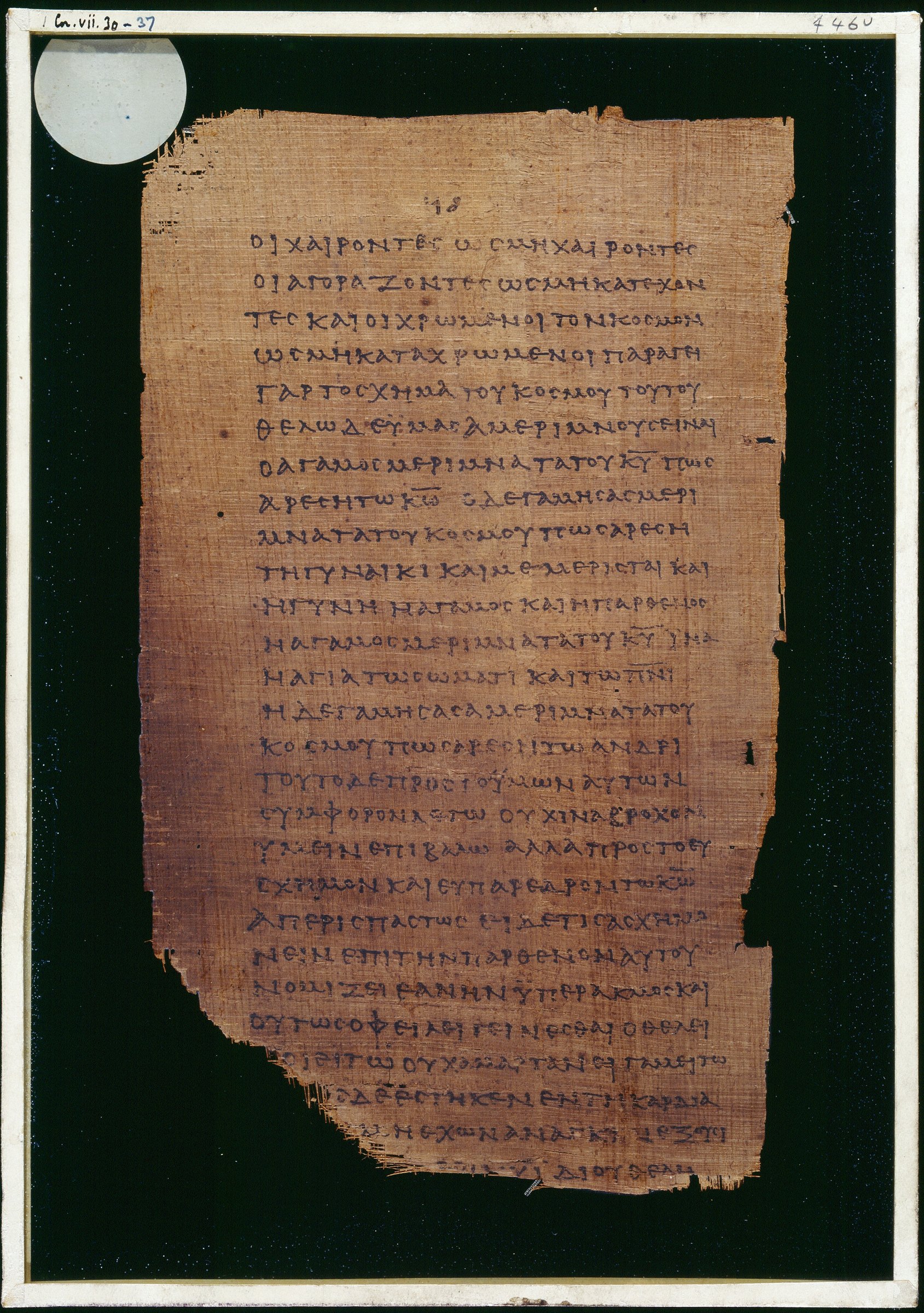
Where on the image
Chester Beatty Library photograph T0005600.jpg (https://ntmss.info/images/webfriendly/10046/T0005600.jpg), linked to NTVMR page 740 (folio 46v) in NTVMR's page index. 7:30 begins on the previous page; 7:37 continues on the next page. Checked on the image: the scribe's page number ϙα (91) at the head of the page, continuing the sequence of the neighbouring pages.
7:30 οι χαιροντες ως μη χαιροντες
οι αγοραζοντες ως μη κατεχον
τες 31 και οι χρωμενοι τον κοσμον
ως μη καταχρωμενοι παραγει
γαρ το σχημα του κοσμου τουτου
32 θελω δε υμας αμεριμνους ειναι
ο αγαμος μεριμνα τα του κ̅υ̅ πως
αρεση τω κ̅ω̅ 33 ο δε γαμησας μερι
μνα τα του κοσμου πως αρεση
τη γυναικι 34 και μεμερισται και
η γυνη η αγαμος και η παρθενος
η αγαμος μεριμνα τα του κ̅υ̅ ινα
η αγια τω σωματι και τω π̅ν̅ι̅
η δε γαμησασα μεριμνα τα του
κοσμου πως αρεση τω ανδρι
35 τουτο δε προς το υμων αυτων
συμφορον λεγω ουχ ινα βροχον
υμειν επιβαλω αλλα προς το ευ
σχημον και ευπαρεδρον τω κ̅ω̅
απερισπαστως 36 ει δε τις ασχημο̣
νειν επι την παρθενον αυτου
νομιζει εαν ην υπερακμος και
ουτως οφειλει γεινεσθαι ο θελει
[π]οιειτω ουχ αμαρτανει γαμειτω
[σαν] 37 [ο]ς δε εστηκεν εν τη καρδια
[αυτου] μη εχων αναγκη̣ν εξουσι
[αν δε εχει π]ε̣ρ̣ι̣ τ̣ο̣υ ιδιου θελη
[ματος]
7:30And they that weep, as though they wept not; and they that rejoice, as though they rejoiced not; and they that buy, as though they possessed not; 31And they that use this world, as not abusing it: for the fashion of this world passeth away. 32But I would have you without carefulness. He that is unmarried careth for the things that belong to the Lord, how he may please the Lord: 33But he that is married careth for the things that are of the world, how he may please his wife. 34There is difference also between a wife and a virgin. The unmarried woman careth for the things of the Lord, that she may be holy both in body and in spirit: but she that is married careth for the things of the world, how she may please her husband. 35And this I speak for your own profit; not that I may cast a snare upon you, but for that which is comely, and that ye may attend upon the Lord without distraction. 36But if any man think that he behaveth himself uncomely toward his virgin, if she pass the flower of her age, and need so require, let him do what he will, he sinneth not: let them marry. 37Nevertheless he that standeth stedfast in his heart, having no necessity, but hath power over his own will, and hath so decreed in his heart that he will keep his virgin, doeth well.
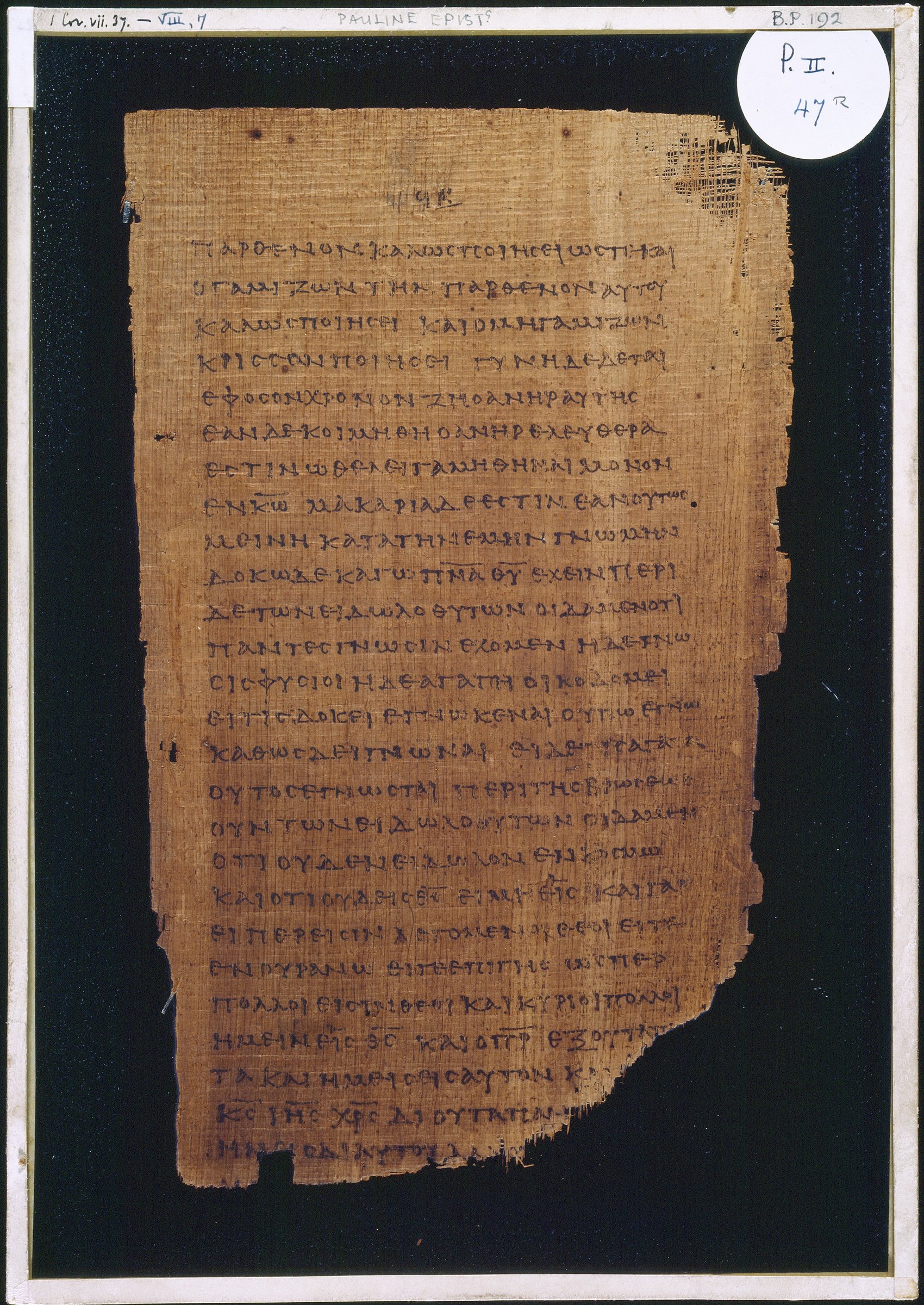
Where on the image
Chester Beatty Library photograph T0005559.jpg (https://ntmss.info/images/webfriendly/10046/T0005559.jpg), linked to NTVMR page 750 (folio 47r) in NTVMR's page index. 7:37 begins on the previous page; 8:7 continues on the next page. Checked on the image: the scribe's page number ϙβ (92) at the head of the page, continuing the sequence of the neighbouring pages; the disc on the frame reads ‹P. II 47R›.
7:37 παρθενον καλως ποιησει 38 ωστε και
ο γαμιζων την παρθενον αυτου
καλως ποιησει και ο μη γαμιζων
κρισσα̣ν ποιησει 39 γυνη δεδεται
εφ οσον χρονον ζη ο ανηρ αυτης
εαν δε κοιμηθη ο ανηρ ελευθερα
εστιν ω θελει γαμηθηναι μονον
εν κ̅ω̅ 40 μακαρια δε εστιν εαν ουτως
μεινη κατα την εμην γνωμην
δοκω δε καγω π̅ν̅α̅ θ̅υ̅ εχειν 8:1 περι
δε των ειδωλοθυτων οιδαμεν οτι
παντες γνωσιν εχομεν η δε γνω
σις φυσιοι η δε αγαπη οικοδομει
2 ει τις δοκει εγνωκεναι ουπω εγνω
καθως δει γνωναι 3 ει δε τ̣ις αγαπ̣α
ουτος εγνωσται 4 περι της βρωσεως
ουν των ειδωλοθυτων οιδαμεν
οτι ουδεν ειδωλον εν κοσμω
και οτι ουδεις θ̅ς̅ ει μη εις 5 και γαρ
ειπερ εισιν λεγομενοι θεοι ειτε
εν ουρανω ειτε επι γης ωσπερ
πολλοι εισιν θεοι και κυριοι πολλοι
6 ημειν εις θ̅ς̅ και ο π̅ρ̅ εξ ου τα π[αν]
τα και ημεις εις αυτον κα̣ι̣ [εις]
κ̅ς̅ ι̅η̅ς̅ χ̅ρ̅ς̅ δι ου τα παν[τα και]
ημε̣ι̣ς δι αυτου 7 αλλ̣ ο̣υ̣[κ εν πασιν]
η̣ γ̣[νω]σ̣[ις τινες δε τη συνηθεια εως]
7:37Nevertheless he that standeth stedfast in his heart, having no necessity, but hath power over his own will, and hath so decreed in his heart that he will keep his virgin, doeth well. 38So then he that giveth her in marriage doeth well; but he that giveth her not in marriage doeth better. 39The wife is bound by the law as long as her husband liveth; but if her husband be dead, she is at liberty to be married to whom she will; only in the Lord. 40But she is happier if she so abide, after my judgment: and I think also that I have the Spirit of God. 8:1Now as touching things offered unto idols, we know that we all have knowledge. Knowledge puffeth up, but charity edifieth. 2And if any man think that he knoweth any thing, he knoweth nothing yet as he ought to know. 3But if any man love God, the same is known of him. 4As concerning therefore the eating of those things that are offered in sacrifice unto idols, we know that an idol is nothing in the world, and that there is none other God but one. 5For though there be that are called gods, whether in heaven or in earth, (as there be gods many, and lords many,) 6But to us there is but one God, the Father, of whom are all things, and we in him; and one Lord Jesus Christ, by whom are all things, and we by him. 7Howbeit there is not in every man that knowledge: for some with conscience of the idol unto this hour eat it as a thing offered unto an idol; and their conscience being weak is defiled.
Notes
- Greek: the NTVMR diplomatic transcription, line by line as on the papyrus. Square brackets enclose letters that are lost or illegible and were supplied by the transcribers; a dot under a letter marks it as uncertain; [...] marks a gap. Nomina sacra and numerals keep the scribe's overline. Spelling is the scribe's (no accents or breathings). Words broken at a line end stay broken as on the papyrus. Corrections are not shown: the text is the first hand.
- English: the King James Version (1611), whole verses, for every verse that has text on the page. A verse that begins on one page and ends on the next is given in full on both. The KJV translates a later form of the Greek text, so its wording does not always match the papyrus; material differences (such as verses the papyrus does not have) are noted in the section.
Cite
Sources
- Source: P46 (Chester Beatty Biblical Papyrus II, Chester Beatty Library, Dublin): photographs as published in the INTF New Testament Virtual Manuscript Room; Greek from the INTF NTVMR transcription of P46; English from the King James Version (holding institution)
- Critical edition: INTF NTVMR diplomatic transcription (CC BY 4.0)
← previous · → next · v cycle view · l back to library