P46 (P.Mich. inv. 6238): 2 Corinthians 10:1-11:2 (fols. 70v-71r)
Introduction
P46 is a papyrus codex of the letters of Paul copied in Egypt around 200, the oldest surviving collection of Paul's letters. 86 of its 104 leaves survive: 56 in the Chester Beatty Library, Dublin (Biblical Papyrus II, published by Frederic Kenyon in 1934-1937) and 30 in the University of Michigan Library, Ann Arbor (P.Mich. inv. 6238, published by Henry Sanders in 1935). The letters run in the order Romans, Hebrews, 1 and 2 Corinthians, Ephesians, Galatians, Philippians, Colossians and 1 Thessalonians; the first seven leaves (Romans 1:1-5:17) and the end of the book are lost. Hebrews standing after Romans, and the doxology of Romans (16:25-27) standing after 15:33, are among its best-known features.
Each section below is one page side: the holding library's photograph, the NTVMR diplomatic transcription line by line, and the King James Version of every verse that has text on the page. The lower lines of many leaves are lost; the transcribers' restorations are in square brackets.
This entry covers fols. 70v-71r (2 Corinthians 10:1-11:2).
How was this verified? (Provenance)
Where on the image
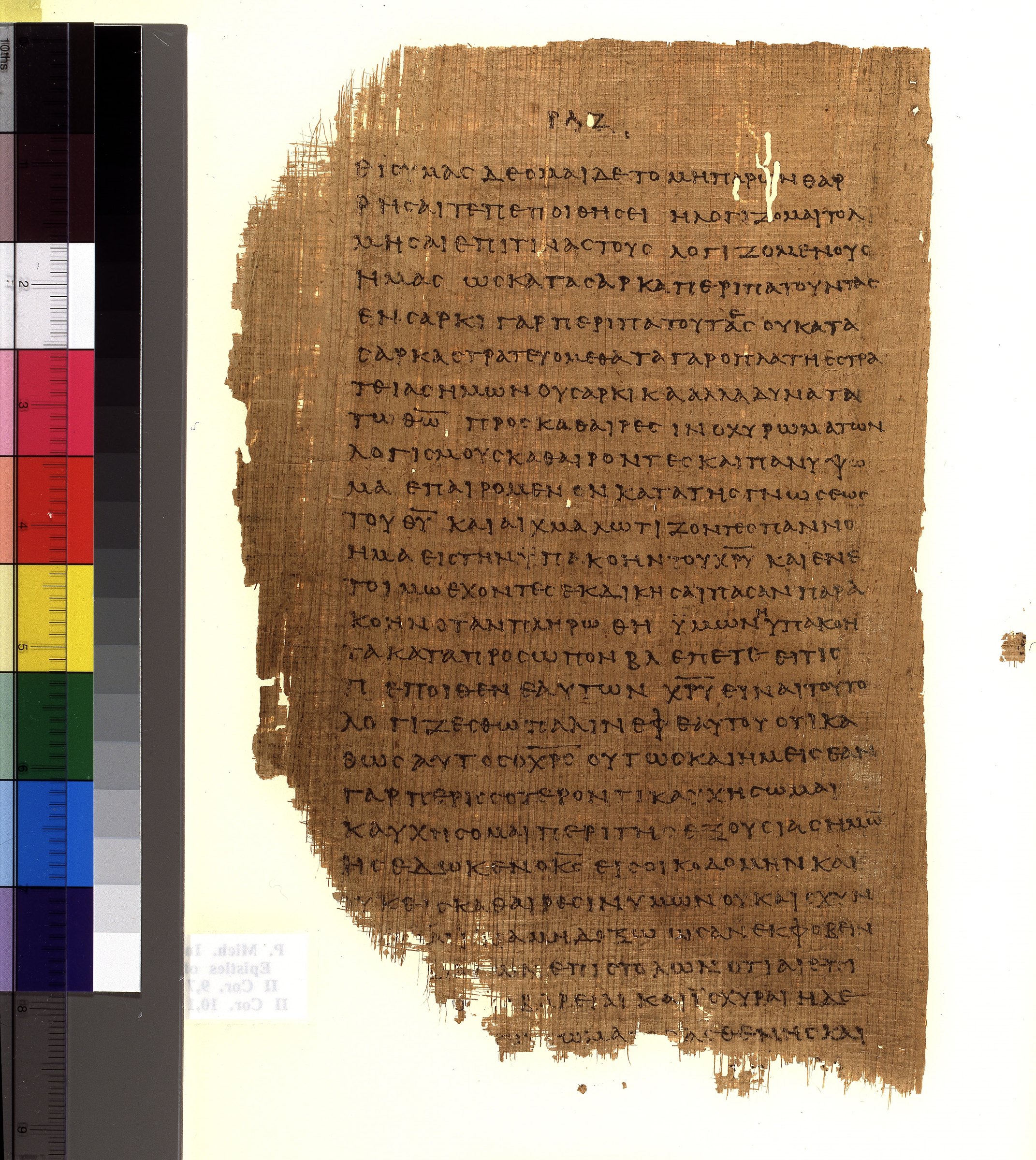
University of Michigan Library photograph 10046x6238_137JP2_UMich.jpg (https://ntmss.info/images/webfriendly/10046/10046x6238_137JP2_UMich.jpg), linked to NTVMR page 1220 (folio 70v) in NTVMR's page index. 10:1 begins on the previous page; 10:11 continues on the next page. Checked on the image: the scribe's page number ρλζ (137) at the head of the page, continuing the sequence of the neighbouring pages; the first line reads ‹εις υμας δεομαι δε το μη παρων θαρ...›, as in the transcription.
10:1 εις υμας 2 δεομαι δε το μη παρω̣ν θαρ
ρησαι τε πεποιθησει η λογιζομαι τολ
μησαι επι τινας τους λογιζομενους
ημας ως κατα σαρκα περιπατουντας
3 εν σαρκι γαρ περιπατουτας ου κατα
σαρκα στρατευομεθα 4 τα γαρ οπλα της στρα
τειας ημων ου σαρκικα αλλα δυνατα
τω θ̅ω̅ προς καθαιρεσιν οχυρωματων
λογισμους καθαιροντες 5 και παν υψω
μα επαιρομενον κατα της γνωσεως
του θ̅υ̅ και αιχμαλωτιζοντες παν νο
ημα εις την υπακοην του χ̅ρ̅υ̅ 6 και εν ε
τοιμω εχοντες εκδικησαι πασαν παρα
κοην οταν πληρωθη υμων υπακοη
7 τα κατα προσωπον βλεπετε ει τις
πεποιθεν εαυτων χ̅ρ̅υ̅ ειναι τουτο
λογιζεσθω παλιν εφ εαυτου οτι κα
θως αυτος ο χ̅ρ̅ς̅ ουτως και ημεις 8 εαν
γαρ περισσοτερον τι καυχησωμαι
καυχησομαι περι της εξουσιας ημων
ης εδωκεν ο κ̅ς̅ εις οικοδομην και
ο̣υκ εις καθαιρεσιν υμων ουκ αισχυν
[θη]σ̣ο̣μ̣αι 9 ινα μη δοξω ως αν εκφοβειν
[υμας] δ̣ι̣α̣ των επιστολων 10 οτι αι επι
[στολαι] μ̣[ε]ν̣ βαρειαι και ισχυραι η δε
[παρουσια] τ̣ο̣υ̣ σ̣ωματ̣ος ασθενης και
[ο λογος εξουθενημενος] 11 τ̣ο̣υ̣[το] λ̣ο̣
[γιζεσθω]
10:1Now I Paul myself beseech you by the meekness and gentleness of Christ, who in presence am base among you, but being absent am bold toward you: 2But I beseech you, that I may not be bold when I am present with that confidence, wherewith I think to be bold against some, which think of us as if we walked according to the flesh. 3For though we walk in the flesh, we do not war after the flesh: 4(For the weapons of our warfare are not carnal, but mighty through God to the pulling down of strong holds;) 5Casting down imaginations, and every high thing that exalteth itself against the knowledge of God, and bringing into captivity every thought to the obedience of Christ; 6And having in a readiness to revenge all disobedience, when your obedience is fulfilled. 7Do ye look on things after the outward appearance? If any man trust to himself that he is Christ’s, let him of himself think this again, that, as he is Christ’s, even so are we Christ’s. 8For though I should boast somewhat more of our authority, which the Lord hath given us for edification, and not for your destruction, I should not be ashamed: 9That I may not seem as if I would terrify you by letters. 10For his letters, say they, are weighty and powerful; but his bodily presence is weak, and his speech contemptible. 11Let such an one think this, that, such as we are in word by letters when we are absent, such will we be also in deed when we are present.
Where on the image
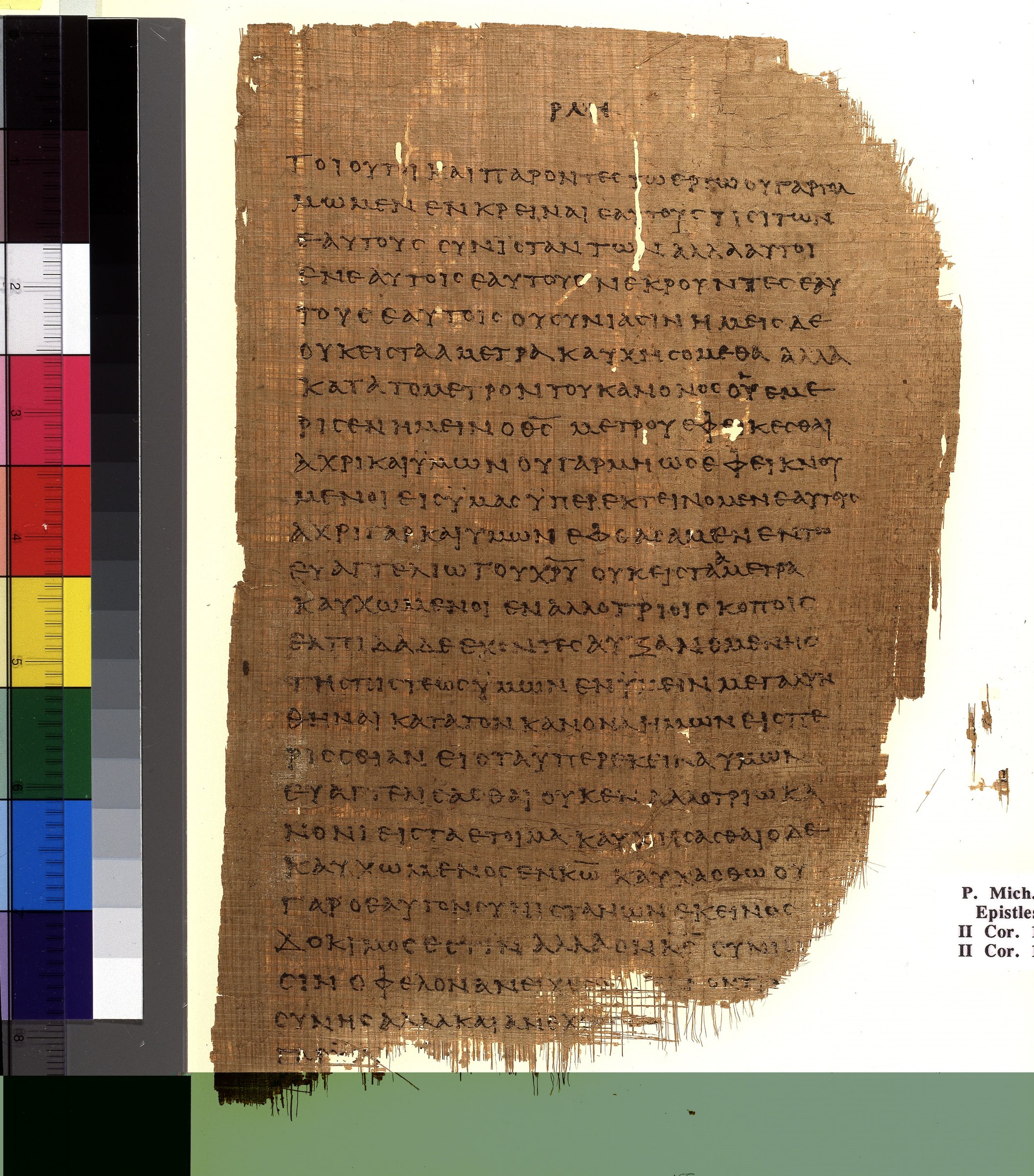
University of Michigan Library photograph 10046x6238_138JP2_UMich.jpg (https://ntmss.info/images/webfriendly/10046/10046x6238_138JP2_UMich.jpg), linked to NTVMR page 1230 (folio 71r) in NTVMR's page index. 10:11 begins on the previous page; 11:2 continues on the next page. Checked on the image: the scribe's page number ρλη (138) at the head of the page, continuing the sequence of the neighbouring pages; the first line reads ‹τοιουτοι και παροντες τω εργω ου γαρ τολ...›, as in the transcription.
10:11 τοιουτοι και παροντες τω εργω 12 ου γαρ τολ
μωμεν ενκρειναι εαυ̣τους τισι των
εαυτους συνισταντων αλλα αυτοι
εν εαυτοις εαυτους νεκρουντες εαυ
τους εαυτοις ου συνιασιν 13 ημεις δε
ουκ εις τα αμετρα καυχησομεθα αλλα
κατα το μετρον του κανονος ου εμε
ρισεν ημειν ο θ̅ς̅ μετρου εφεικεσθαι
αχρι και υμων 14 ου γαρ μη ως εφεικνου
μενοι εις υμας υπερεκτεινομεν εαυτους
αχρι γαρ και υμων εφθασαμεν εν τω
ευαγγελιω του χ̅ρ̅υ̅ 15 ουκ εις τα μετρα
καυχωμενοι εν αλλοτριοις κοποις
ελπιδα δε εχοντες αυξανομενης
της πιστεως υμων εν υμειν μεγαλυν
θηναι κατα τον κανονα ημων εις πε
ρισσειαν 16 εις τα υπερεκεινα υμων
ευαγγελισασθαι ουκ εν αλλοτριω κα
νονι εις τα ετοιμα καυχησασθαι 17 ο δε
καυχωμενος εν κ̅ω̅ καυχασθω 18 ου
γαρ ο εαυτον συνιστανων εκεινος
δοκιμος εστιν αλλα ον κ̅ς̅ συνισ̣τ̣[η]
σιν 11:1 οφελον ανειχε̣σ̣θ̣[ε μι]κ̣ρ̣ον τι̣ α̣[φρο]
συνης αλλα και ανεχε̣σ̣θ̣ε̣ μ̣[ου] 2 [ζηλω]
γαρ υ̣μ̣[ας θ̅υ̅ ζηλω ηρμοσαμην γαρ]
10:11Let such an one think this, that, such as we are in word by letters when we are absent, such will we be also in deed when we are present. 12For we dare not make ourselves of the number, or compare ourselves with some that commend themselves: but they measuring themselves by themselves, and comparing themselves among themselves, are not wise. 13But we will not boast of things without our measure, but according to the measure of the rule which God hath distributed to us, a measure to reach even unto you. 14For we stretch not ourselves beyond our measure, as though we reached not unto you: for we are come as far as to you also in preaching the gospel of Christ: 15Not boasting of things without our measure, that is, of other men’s labours; but having hope, when your faith is increased, that we shall be enlarged by you according to our rule abundantly, 16To preach the gospel in the regions beyond you, and not to boast in another man’s line of things made ready to our hand. 17But he that glorieth, let him glory in the Lord. 18For not he that commendeth himself is approved, but whom the Lord commendeth. 11:1Would to God ye could bear with me a little in my folly: and indeed bear with me. 2For I am jealous over you with godly jealousy: for I have espoused you to one husband, that I may present you as a chaste virgin to Christ.
Notes
- Greek: the NTVMR diplomatic transcription, line by line as on the papyrus. Square brackets enclose letters that are lost or illegible and were supplied by the transcribers; a dot under a letter marks it as uncertain; [...] marks a gap. Nomina sacra and numerals keep the scribe's overline. Spelling is the scribe's (no accents or breathings). Words broken at a line end stay broken as on the papyrus. Corrections are not shown: the text is the first hand.
- English: the King James Version (1611), whole verses, for every verse that has text on the page. A verse that begins on one page and ends on the next is given in full on both. The KJV translates a later form of the Greek text, so its wording does not always match the papyrus; material differences (such as verses the papyrus does not have) are noted in the section.
Cite
Sources
- Source: P46 (P.Mich. inv. 6238, University of Michigan Library): photographs as published in the INTF New Testament Virtual Manuscript Room; Greek from the INTF NTVMR transcription of P46; English from the King James Version (holding institution)
- Critical edition: INTF NTVMR diplomatic transcription (CC BY 4.0)
← previous · → next · v cycle view · l back to library