P46 (Chester Beatty II): 2 Corinthians 2:3-3:3 (fols. 62v-63r)
Introduction
P46 is a papyrus codex of the letters of Paul copied in Egypt around 200, the oldest surviving collection of Paul's letters. 86 of its 104 leaves survive: 56 in the Chester Beatty Library, Dublin (Biblical Papyrus II, published by Frederic Kenyon in 1934-1937) and 30 in the University of Michigan Library, Ann Arbor (P.Mich. inv. 6238, published by Henry Sanders in 1935). The letters run in the order Romans, Hebrews, 1 and 2 Corinthians, Ephesians, Galatians, Philippians, Colossians and 1 Thessalonians; the first seven leaves (Romans 1:1-5:17) and the end of the book are lost. Hebrews standing after Romans, and the doxology of Romans (16:25-27) standing after 15:33, are among its best-known features.
Each section below is one page side: the holding library's photograph, the NTVMR diplomatic transcription line by line, and the King James Version of every verse that has text on the page. The lower lines of many leaves are lost; the transcribers' restorations are in square brackets.
This entry covers fols. 62v-63r (2 Corinthians 2:3-3:3).
How was this verified? (Provenance)
Where on the image
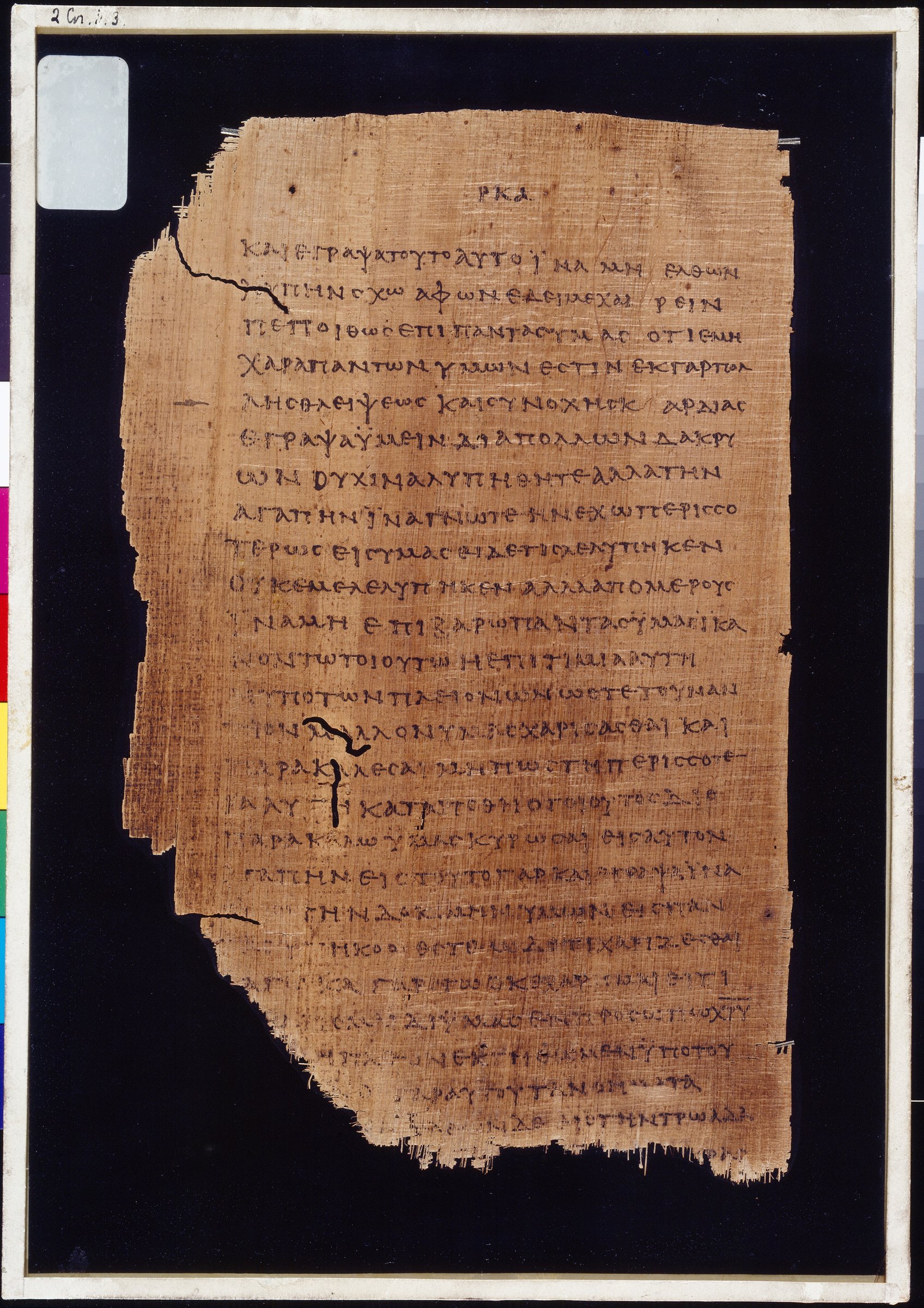
Chester Beatty Library photograph T0005264.jpg (https://ntmss.info/images/webfriendly/10046/T0005264.jpg), linked to NTVMR page 1060 (folio 62v) in NTVMR's page index. 2:12 continues on the next page. Checked on the image: the scribe's page number ρκα (121) at the head of the page, continuing the sequence of the neighbouring pages.
2:3 και εγραψα τουτο αυτο ινα μη ελθων
λυπην σχω αφ ων εδει με χαιρειν
πεποιθως επι παντας υμας οτι εμη
χαρα παντων υμων εστιν 4 εκ γαρ πολ
λης θλειψεως και συνοχης καρδιας
εγραψα υμειν δια πολλων δακρυ
ων ουχ ινα λυπηθητε αλλα την
αγαπην ινα γνωτε ην εχω περισσο
τερως εις υμας 5 ει δε τις λελυπηκεν
ουκ εμε λελυπηκεν αλλα απο μερους
ινα μη επιβαρω παντας υμας 6 ικα
νον τω τοιουτω η επιτιμια αυτη
η̣ υπο των πλειονων 7 ωστε τουναν
τ̣ιον μα̣λλον υμας χαρισασθαι και
π̣αρακα̣λεσαι μη πως τη περισσοτε
ρ̣α λυπ̣η̣ καταποθη ο τοιουτος 8 διο
παρακα̣λω υμας κυρωσαι εις αυτον
α̣γαπην 9 εις τουτο γαρ και εγ̣ραψα ινα
[γν]ω̣ την δοκιμην υμων εις παν
τ̣α̣ υ̣π̣ηκοοι εστε 10 ω δε τι χαριζεσθαι
[κ]αγω̣ κα[ι] γαρ εγω ο κεχαρι̣σμαι ει τι
[κεχ]α̣ρ̣ι̣σμαι δι υμας εν προσωπω χ̅ρ̅υ̅
11 [ινα μ]η πλεονεκτηθωμεν υπο του
[σαταν]α̣ ο[υ] γ̣αρ αυτου τα νοημ̣α̣τα
[αγνοουμ]ε̣ν̣ 12 ελθ̣ω̣ν δε εις την τρωαδα
[εις το ευαγγελιον του χ̅ρ̅υ̅ και θ]υ̣ρ̣ας̣
2:3And I wrote this same unto you, lest, when I came, I should have sorrow from them of whom I ought to rejoice; having confidence in you all, that my joy is the joy of you all. 4For out of much affliction and anguish of heart I wrote unto you with many tears; not that ye should be grieved, but that ye might know the love which I have more abundantly unto you. 5But if any have caused grief, he hath not grieved me, but in part: that I may not overcharge you all. 6Sufficient to such a man is this punishment, which was inflicted of many. 7So that contrariwise ye ought rather to forgive him, and comfort him, lest perhaps such a one should be swallowed up with overmuch sorrow. 8Wherefore I beseech you that ye would confirm your love toward him. 9For to this end also did I write, that I might know the proof of you, whether ye be obedient in all things. 10To whom ye forgive any thing, I forgive also: for if I forgave any thing, to whom I forgave it, for your sakes forgave I it in the person of Christ; 11Lest Satan should get an advantage of us: for we are not ignorant of his devices. 12Furthermore, when I came to Troas to preach Christ’s gospel, and a door was opened unto me of the Lord,
Where on the image
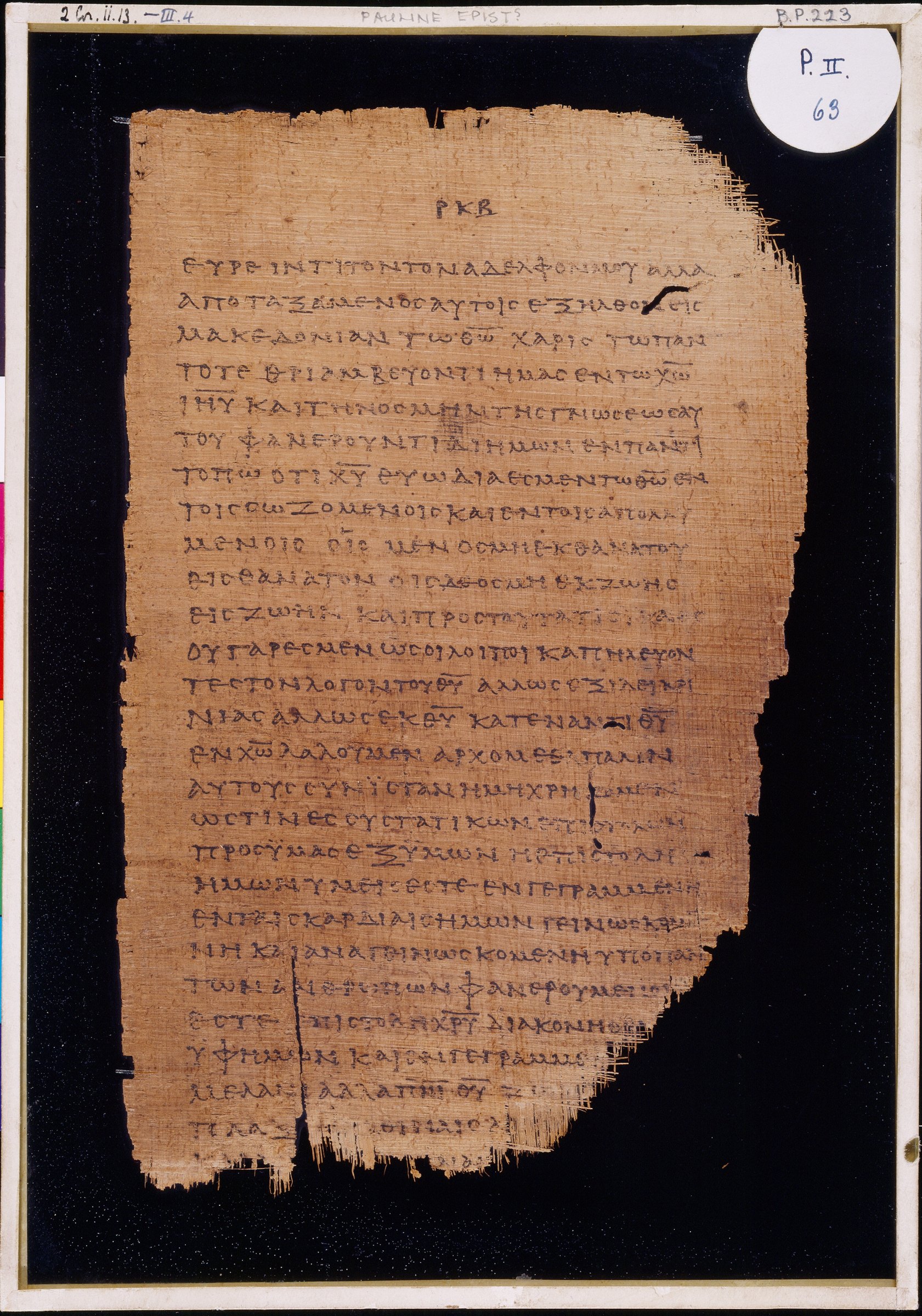
Chester Beatty Library photograph T0005271.jpg (https://ntmss.info/images/webfriendly/10046/T0005271.jpg), linked to NTVMR page 1070 (folio 63r) in NTVMR's page index. 2:13 begins on the previous page. Checked on the image: the scribe's page number ρκβ (122) at the head of the page, continuing the sequence of the neighbouring pages; the disc on the frame reads ‹P. II 63›.
2:13 ευρειν τιτον τον αδελφον μου αλλα
αποταξαμενος αυτοις εξηλθον̣ εις
μακεδονιαν 14 τω θ̅ω̅ χαρις τω παν
τοτε θριαμβευοντι ημας εν τω χ̅ω̅
ι̅η̅υ̅ και την οσμην της γνωσεως αυ
του φανερουντι δι ημων εν παντι
τοπω 15 οτι χ̅υ̅ ευωδια εσμεν τω θ̅ω̅ εν
τοις σωζομενοις και εν τοις απολλυ
μενοις 16 οις μεν οσμη εκ θανατου
εις θανατον οις δε οσμη εκ ζωης
εις ζωην και προς ταυτα τις ικανο̣ς
17 ου γαρ εσμεν ως οι λοιποι καπηλευον
τες τον λογον του θ̅υ̅ αλλ ως εξ ιλεικρι
νιας αλλ ως εκ θ̅υ̅ κατεναντι θ̅υ̅
εν χ̅ω̅ λαλουμεν 3:1 αρχομεθα παλιν
αυτους συνισταν η μη χρηζ̣ομεν
ως τινες συστατικων επιστολων
προς υμας εξ υμων 2 η επιστολη
ημων υμεις εστε ενγεγραμμενη
εν ταις καρδιαις ημων γεινωσκομε̣
νη και αναγεινωσκομενη υπο παν
των ανθρωπων 3 φανερουμενοι [οτι]
εστε επιστολη χ̅ρ̅υ̅ διακονηθε̣[ισα]
υφ ημω̣ν και ενγεγραμμεν̣[η ου]
μελανι αλλα π̅ν̅ι̅ θ̅υ̅ ζω̣[ντος ουκ εν]
πλαξ[ιν λ]ι̣θιναις α[λλ εν πλαξιν]
κ̣α̣ρ̣δ̣[ιαις σαρκι]ναι̣[ς]
2:13I had no rest in my spirit, because I found not Titus my brother: but taking my leave of them, I went from thence into Macedonia. 14Now thanks be unto God, which always causeth us to triumph in Christ, and maketh manifest the savour of his knowledge by us in every place. 15For we are unto God a sweet savour of Christ, in them that are saved, and in them that perish: 16To the one we are the savour of death unto death; and to the other the savour of life unto life. And who is sufficient for these things? 17For we are not as many, which corrupt the word of God: but as of sincerity, but as of God, in the sight of God speak we in Christ. 3:1Do we begin again to commend ourselves? or need we, as some others, epistles of commendation to you, or letters of commendation from you? 2Ye are our epistle written in our hearts, known and read of all men: 3Forasmuch as ye are manifestly declared to be the epistle of Christ ministered by us, written not with ink, but with the Spirit of the living God; not in tables of stone, but in fleshy tables of the heart.
Notes
- Greek: the NTVMR diplomatic transcription, line by line as on the papyrus. Square brackets enclose letters that are lost or illegible and were supplied by the transcribers; a dot under a letter marks it as uncertain; [...] marks a gap. Nomina sacra and numerals keep the scribe's overline. Spelling is the scribe's (no accents or breathings). Words broken at a line end stay broken as on the papyrus. Corrections are not shown: the text is the first hand.
- English: the King James Version (1611), whole verses, for every verse that has text on the page. A verse that begins on one page and ends on the next is given in full on both. The KJV translates a later form of the Greek text, so its wording does not always match the papyrus; material differences (such as verses the papyrus does not have) are noted in the section.
Cite
Sources
- Source: P46 (Chester Beatty Biblical Papyrus II, Chester Beatty Library, Dublin): photographs as published in the INTF New Testament Virtual Manuscript Room; Greek from the INTF NTVMR transcription of P46; English from the King James Version (holding institution)
- Critical edition: INTF NTVMR diplomatic transcription (CC BY 4.0)
← previous · → next · v cycle view · l back to library