P46 (Chester Beatty II): 2 Corinthians 3:5-4:3 (fols. 63v-64r)
Introduction
P46 is a papyrus codex of the letters of Paul copied in Egypt around 200, the oldest surviving collection of Paul's letters. 86 of its 104 leaves survive: 56 in the Chester Beatty Library, Dublin (Biblical Papyrus II, published by Frederic Kenyon in 1934-1937) and 30 in the University of Michigan Library, Ann Arbor (P.Mich. inv. 6238, published by Henry Sanders in 1935). The letters run in the order Romans, Hebrews, 1 and 2 Corinthians, Ephesians, Galatians, Philippians, Colossians and 1 Thessalonians; the first seven leaves (Romans 1:1-5:17) and the end of the book are lost. Hebrews standing after Romans, and the doxology of Romans (16:25-27) standing after 15:33, are among its best-known features.
Each section below is one page side: the holding library's photograph, the NTVMR diplomatic transcription line by line, and the King James Version of every verse that has text on the page. The lower lines of many leaves are lost; the transcribers' restorations are in square brackets.
This entry covers fols. 63v-64r (2 Corinthians 3:5-4:3).
How was this verified? (Provenance)
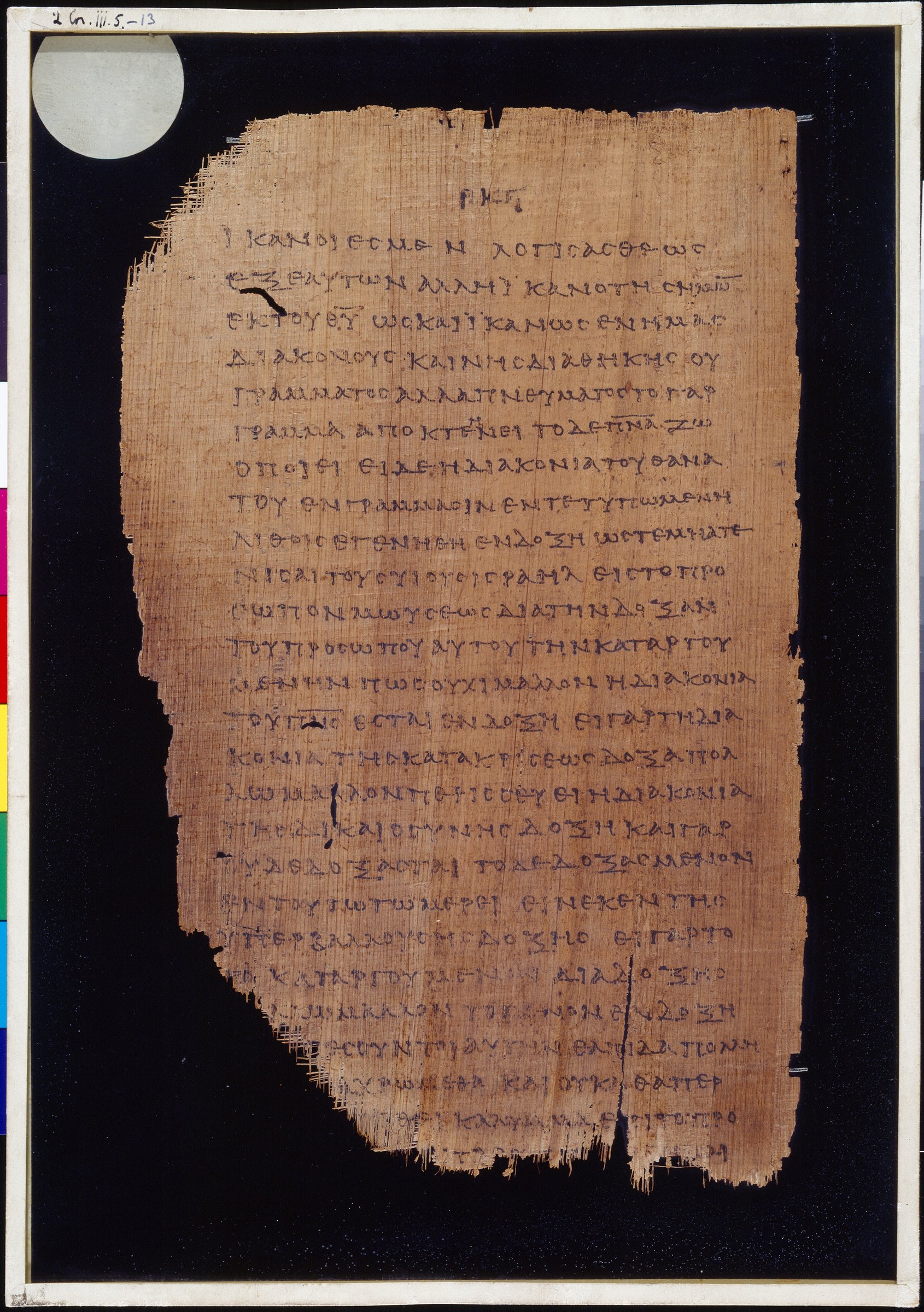
Where on the image
Chester Beatty Library photograph T0005269.jpg (https://ntmss.info/images/webfriendly/10046/T0005269.jpg), linked to NTVMR page 1080 (folio 63v) in NTVMR's page index. 3:5 begins on the previous page; 3:13 continues on the next page. Checked on the image: the scribe's page number ρκγ (123) at the head of the page, continuing the sequence of the neighbouring pages.
3:5 ικανοι εσμεν λογισασθε ως
εξ εαυτων αλλ η ικανοτης ημων
εκ του θ̅υ̅ 6 ως και ικανωσεν ημας
διακονους καινης διαθηκης ου
γραμματος αλλα πνευματος το γαρ
γραμμα αποκτενει το δε π̅ν̅α̅ ζω
οποιει 7 ει δε η διακονια του θανα
του εν γραμμασιν εντετυπωμενη
λιθοις εγενηθη εν δοξη ωστε μη ατε
νισαι τους υιους ισραηλ εις το προ
σωπον μωυσεως δια την δοξαν
του προσωπου αυτου την καταργου
μενην 8 πως ουχι μαλλον η διακονια
του π̅ν̣̣̅ς̅ εσται εν δοξη 9 ει γαρ τη δια
κονια της κατακρισεως δοξα πολ
λω μαλλον περισσευει η διακονια
της δικαιοσυνης δοξη 10 και γαρ
ου δεδοξασται το δεδοξασμενον
εν τουτω τω μερει εινεκεν της
υπερβαλλουσης δοξης 11 ει γαρ το
τ̣ο̣ καταργουμενον δια δοξης
[πο]λλω μαλλον το μ̣ενον εν δοξη
12 [εχοντ]ες ουν τοιαυτη̣ν ελπιδα πολλη
[παρρησι]α̣ χρωμεθα 13 και ου καθαπερ
[μωυσης ετ]ι̣θει καλυμμα επ̣ι το προ
[σωπον αυτου] π̣ρ̣ο̣ς̣ [το μη ατ]ε̣ν̣ι̣σ̣αι
3:5Not that we are sufficient of ourselves to think any thing as of ourselves; but our sufficiency is of God; 6Who also hath made us able ministers of the new testament; not of the letter, but of the spirit: for the letter killeth, but the spirit giveth life. 7But if the ministration of death, written and engraven in stones, was glorious, so that the children of Israel could not stedfastly behold the face of Moses for the glory of his countenance; which glory was to be done away: 8How shall not the ministration of the spirit be rather glorious? 9For if the ministration of condemnation be glory, much more doth the ministration of righteousness exceed in glory. 10For even that which was made glorious had no glory in this respect, by reason of the glory that excelleth. 11For if that which is done away was glorious, much more that which remaineth is glorious. 12Seeing then that we have such hope, we use great plainness of speech: 13And not as Moses, which put a vail over his face, that the children of Israel could not stedfastly look to the end of that which is abolished:
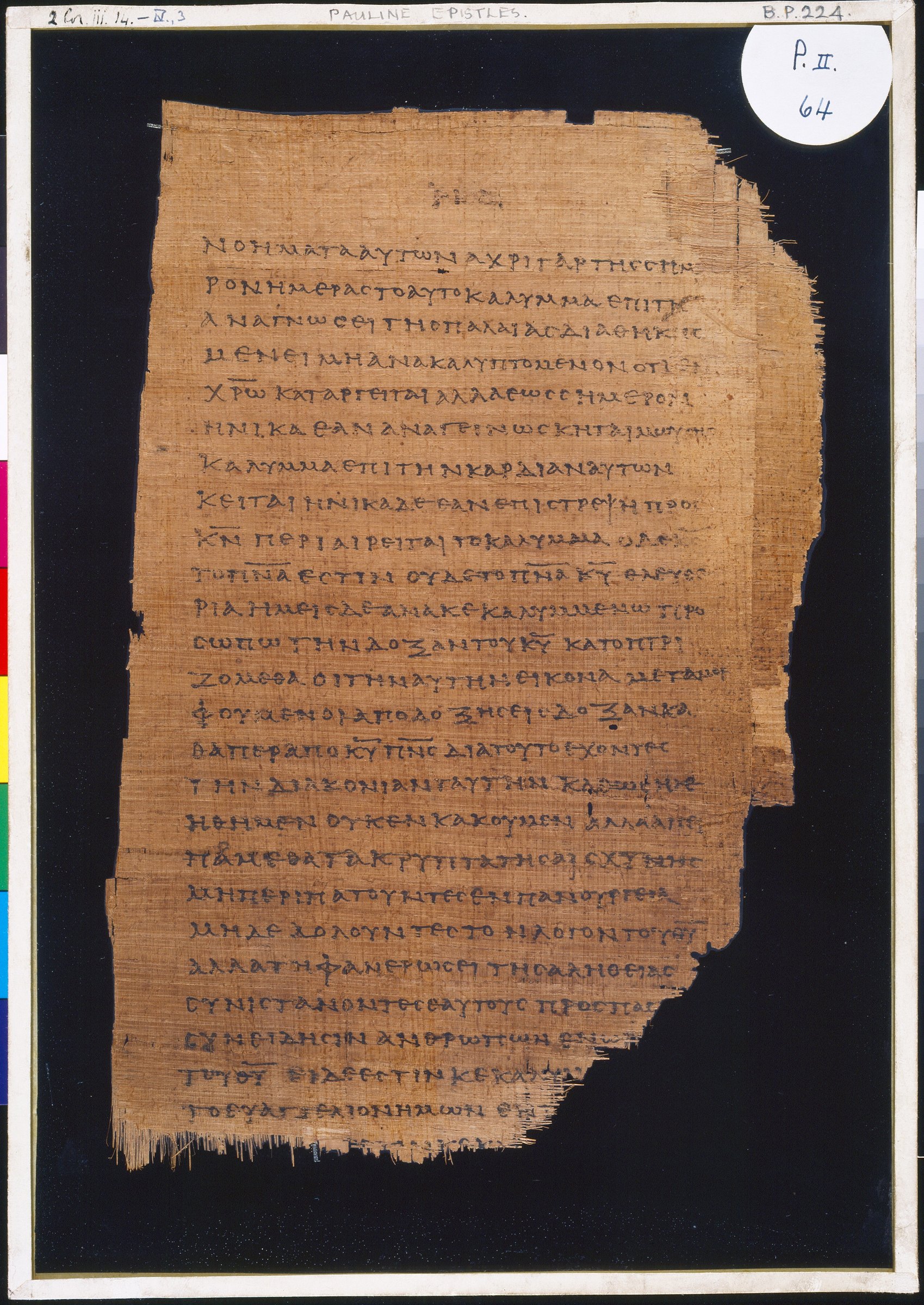
Where on the image
Chester Beatty Library photograph T0005266.jpg (https://ntmss.info/images/webfriendly/10046/T0005266.jpg), linked to NTVMR page 1090 (folio 64r) in NTVMR's page index. 3:14 begins on the previous page. Checked on the image: the scribe's page number ρκδ (124) at the head of the page, continuing the sequence of the neighbouring pages; the disc on the frame reads ‹P. II 64›.
3:14 νοηματα αυτων αχρι γαρ της σημ[ε]
ρον ημερας το αυτο καλυμμα επι τη̣
αναγνωσει της παλαιας διαθηκη̣ς
μενει μη ανακαλυπτομενον οτι εν̣
χ̅ρ̅ω̅ καταργειται 15 αλλα εως σημερον
ηνικα εαν αναγεινωσκηται μωυσ̣ης̣
καλυμμα επι την καρδιαν αυτων
κειται 16 ηνικα δε εαν επιστρεψη προς
κ̅ν̅ περιαιρειται το καλυμμα 17 ο δε κ̅ς̣̣̅
το π̅ν̅α̅ εστιν ου δε το π̅ν̅α̅ κ̅υ̅ ελευθε
ρια 18 ημεις δε ανακεκαλυμμενω προ
σωπω την δοξαν του κ̅υ̅ κατοπτρι
ζομεθα οι την αυτην εικονα μεταμορ
φουμενοι απο δοξης εις δοξαν κα
θαπερ απο κ̅υ̅ π̅ν̅ς̅ 4:1 δια τουτο εχοντες
την διακονιαν ταυτην καθως ηλε
ηθημεν ουκ ενκακουμεν 2 αλλα απει
παμεθα τα κρυπτα της αισχυνης
μη περιπατουντες εν πανουργεια
μηδε δολουντες τον λογον του θ̅υ̅
αλλα τη φανερωσει της αληθειας
συνιστανοντες εαυτους προς πασ[αν]
συνειδησιν ανθρωπων ενωπ̣[ιον]
του θ̅υ̅ 3 ει δε εστιν κεκαλυμ̣[μενον]
το ευαγγελιον ημων εν τ[οις απολ]
[λυμενοις] ε̣σ̣τ̣ι̣ν κεκα̣[λυμμενον]
3:14But their minds were blinded: for until this day remaineth the same vail untaken away in the reading of the old testament; which vail is done away in Christ. 15But even unto this day, when Moses is read, the vail is upon their heart. 16Nevertheless when it shall turn to the Lord, the vail shall be taken away. 17Now the Lord is that Spirit: and where the Spirit of the Lord is, there is liberty. 18But we all, with open face beholding as in a glass the glory of the Lord, are changed into the same image from glory to glory, even as by the Spirit of the Lord. 4:1Therefore seeing we have this ministry, as we have received mercy, we faint not; 2But have renounced the hidden things of dishonesty, not walking in craftiness, nor handling the word of God deceitfully; but by manifestation of the truth commending ourselves to every man’s conscience in the sight of God. 3But if our gospel be hid, it is hid to them that are lost:
Notes
- Greek: the NTVMR diplomatic transcription, line by line as on the papyrus. Square brackets enclose letters that are lost or illegible and were supplied by the transcribers; a dot under a letter marks it as uncertain; [...] marks a gap. Nomina sacra and numerals keep the scribe's overline. Spelling is the scribe's (no accents or breathings). Words broken at a line end stay broken as on the papyrus. Corrections are not shown: the text is the first hand.
- English: the King James Version (1611), whole verses, for every verse that has text on the page. A verse that begins on one page and ends on the next is given in full on both. The KJV translates a later form of the Greek text, so its wording does not always match the papyrus; material differences (such as verses the papyrus does not have) are noted in the section.
Cite
Sources
- Source: P46 (Chester Beatty Biblical Papyrus II, Chester Beatty Library, Dublin): photographs as published in the INTF New Testament Virtual Manuscript Room; Greek from the INTF NTVMR transcription of P46; English from the King James Version (holding institution)
- Critical edition: INTF NTVMR diplomatic transcription (CC BY 4.0)
← previous · → next · v cycle view · l back to library