P46 (Chester Beatty II): 2 Corinthians 4:4-5:4 (fols. 64v-65r)
Introduction
P46 is a papyrus codex of the letters of Paul copied in Egypt around 200, the oldest surviving collection of Paul's letters. 86 of its 104 leaves survive: 56 in the Chester Beatty Library, Dublin (Biblical Papyrus II, published by Frederic Kenyon in 1934-1937) and 30 in the University of Michigan Library, Ann Arbor (P.Mich. inv. 6238, published by Henry Sanders in 1935). The letters run in the order Romans, Hebrews, 1 and 2 Corinthians, Ephesians, Galatians, Philippians, Colossians and 1 Thessalonians; the first seven leaves (Romans 1:1-5:17) and the end of the book are lost. Hebrews standing after Romans, and the doxology of Romans (16:25-27) standing after 15:33, are among its best-known features.
Each section below is one page side: the holding library's photograph, the NTVMR diplomatic transcription line by line, and the King James Version of every verse that has text on the page. The lower lines of many leaves are lost; the transcribers' restorations are in square brackets.
This entry covers fols. 64v-65r (2 Corinthians 4:4-5:4).
How was this verified? (Provenance)
Where on the image
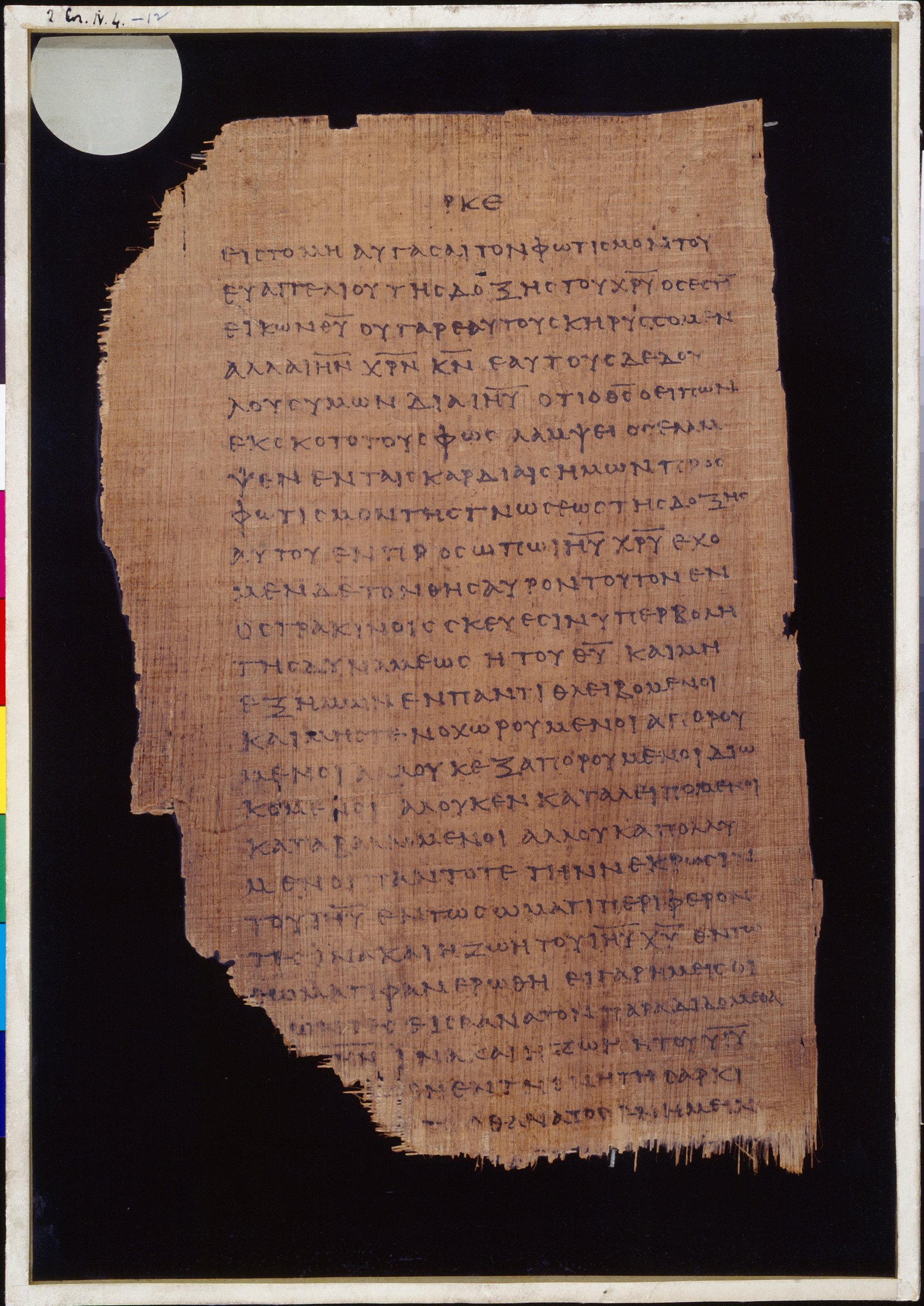
Chester Beatty Library photograph T0005259.jpg (https://ntmss.info/images/webfriendly/10046/T0005259.jpg), linked to NTVMR page 1100 (folio 64v) in NTVMR's page index. 4:4 begins on the previous page. Checked on the image: the scribe's page number ρκε (125) at the head of the page, continuing the sequence of the neighbouring pages.
4:4 εις το μη αυγασαι τον φωτισμον του
ευαγγελιου της δοξης του χ̅ρ̅υ̅ ος εστιν
εικων θ̅υ̅ 5 ου γαρ εαυτους κηρυσσομεν
αλλα ι̅η̅ν̅ χ̅ρ̅ν̅ κ̅ν̅ εαυτους δε δου
λους υμων δια ι̅η̅υ̅ 6 οτι ο θ̅ς̅ ο ειπων
εκ σκοτοτους φως λαμψει ος ελαμ
ψεν εν ταις καρδιαις ημων προς
φωτισμον της γνωσεως της δοξης
αυτου εν προσωπω ι̅η̅υ̅ χ̅ρ̅υ̅ 7 εχο
μεν δε τον θησαυρον τουτον εν
οστρακινοις σκευεσιν υπερβολη
της δυναμεως η του θ̅υ̅ και μη
εξ ημων 8 εν παντι θλειβομενοι
και μη στ̣ενοχωρουμενοι απορου
μενοι αλλ ουκ εξαπορουμενοι 9 διω
κομενοι αλ ουκ ενκαταλειπομενοι
καταβαλλομενοι αλλ ουκ απολλυ
μενοι 10 παντοτε την νεκρωσιν
του ι̅η̅υ̅ εν τω σωματι περιφερον
τες ινα και η ζωη του ι̅η̅υ̅ χ̅υ̅ εν τω
σωματι φανερωθη 11 ει γαρ ημεις οι
[ζ]ωντ̣ε̣ς εις θανατον παραδιδομεθα
[δια ι̅]η̣̣̅ν̅ ινα και η ζωη η του υ̅ι̅υ̅
[φανερ]ω̣θη εν τη θνητη σαρκι
[ημων] 12 [ωσ]τ̣ε̣ ο θανατος εν ημειν
[ενεργειται] η̣ δε̣ ζ̣[ωη εν] υ̣[μειν]
4:4In whom the god of this world hath blinded the minds of them which believe not, lest the light of the glorious gospel of Christ, who is the image of God, should shine unto them. 5For we preach not ourselves, but Christ Jesus the Lord; and ourselves your servants for Jesus’ sake. 6For God, who commanded the light to shine out of darkness, hath shined in our hearts, to give the light of the knowledge of the glory of God in the face of Jesus Christ. 7But we have this treasure in earthen vessels, that the excellency of the power may be of God, and not of us. 8We are troubled on every side, yet not distressed; we are perplexed, but not in despair; 9Persecuted, but not forsaken; cast down, but not destroyed; 10Always bearing about in the body the dying of the Lord Jesus, that the life also of Jesus might be made manifest in our body. 11For we which live are alway delivered unto death for Jesus’ sake, that the life also of Jesus might be made manifest in our mortal flesh. 12So then death worketh in us, but life in you.
Where on the image
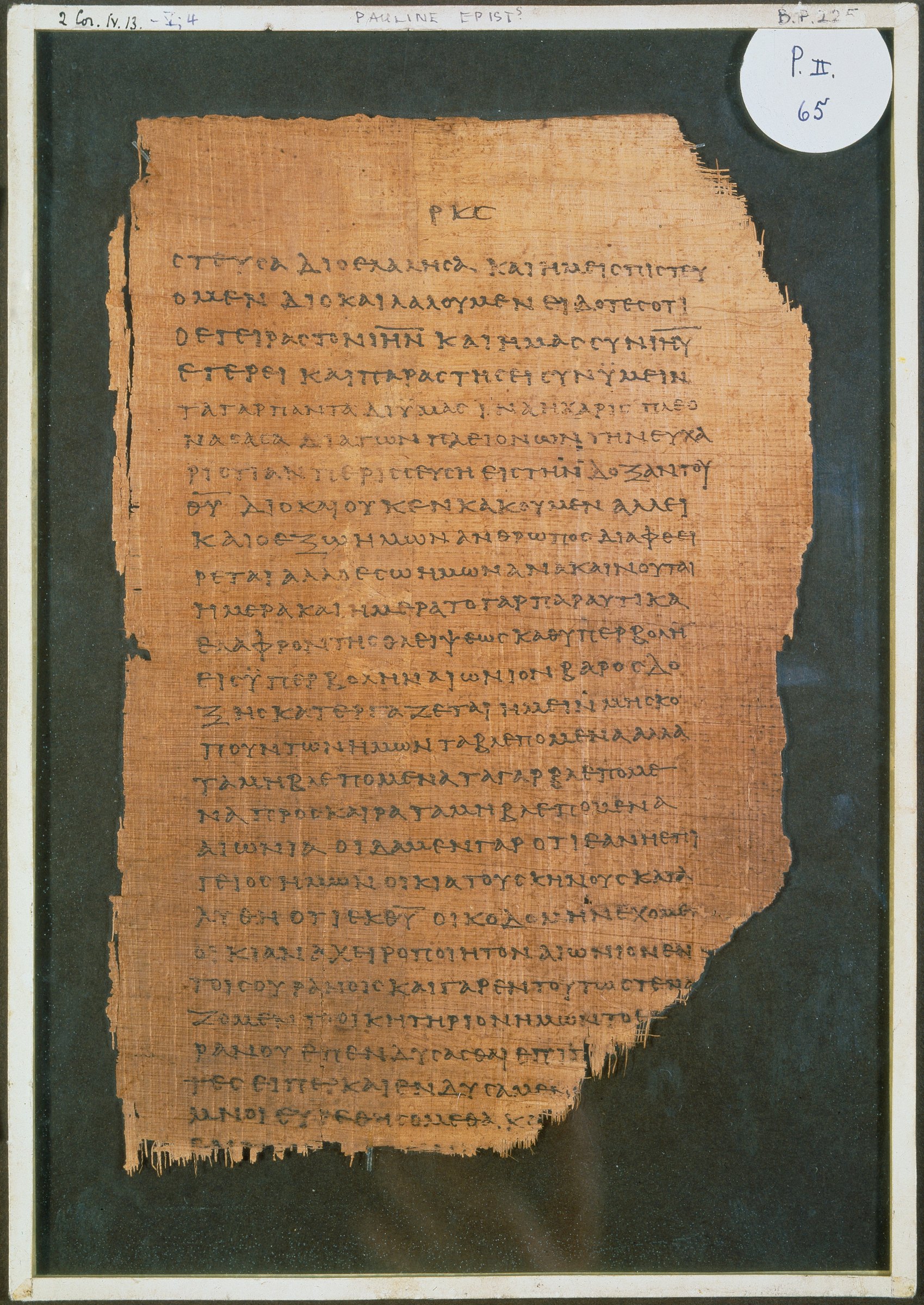
Chester Beatty Library photograph T0005573.jpg (https://ntmss.info/images/webfriendly/10046/T0005573.jpg), linked to NTVMR page 1110 (folio 65r) in NTVMR's page index. 4:13 begins on the previous page; 5:4 continues on the next page. Checked on the image: the scribe's page number ρκς (126) at the head of the page, continuing the sequence of the neighbouring pages; the disc on the frame reads ‹P. II 65›.
4:13 στευσα διο ελαλησα και ημεις πιστευ
ομεν διο και λαλουμεν 14 ειδοτες οτι
ο εγειρας τον ι̅η̅ν̅ και ημας συν ι̅η̅υ̅
εγερει και παραστησει συν υμειν
15 τα γαρ παντα δι υμας ινα η χαρις πλεο
νασασα δια των πλειονων την ευχα
ριστιαν περισσευση εις την δοξαν του
θ̅υ̅ 16 διο και ουκ ενκακουμεν αλλ ει
και ο εξω ημων ανθρωπος διαφθει
ρεται αλλ ο εσω ημων ανακαινουται
ημερα και ημερα 17 το γαρ παραυτικα
ελαφρον της θλειψεως καθ υπερβολην
εις υπερβολην αιωνιον βαρος δο
ξης κατεργαζεται ημειν 18 μη σκο
πουντων ημων τα βλεπομενα αλλα
τα μη βλεπομενα τα γαρ βλεπομε
να προσκαιρα τα μη βλεπομενα
αιωνια 5:1 οιδαμεν γαρ οτι εαν η επι
γειος ημων οικια του σκηνους κατα
λυθη οτι εκ θ̅υ̅ οικοδομην εχομεν̣
οικιαν αχειροποιητον αιωνιον εν
τοις ουρανοις 2 και γαρ εν τουτω στενα
ζομεν το οικητηριον ημων το ε[ξ ου]
ρανου επενδυσασθαι επιπ̣[οθουν]
τες 3 ειπερ και ενδυσαμενο̣[ι ου γυ]
μνοι ευρ̣εθησομεθα 4 κα̣[ι γαρ οι οντες]
εν̣ τ̣[ω σκηνει σ]τ̣ε̣ν̣α̣[ζομεν βαρου]
[μενοι]
4:13We having the same spirit of faith, according as it is written, I believed, and therefore have I spoken; we also believe, and therefore speak; 14Knowing that he which raised up the Lord Jesus shall raise up us also by Jesus, and shall present us with you. 15For all things are for your sakes, that the abundant grace might through the thanksgiving of many redound to the glory of God. 16For which cause we faint not; but though our outward man perish, yet the inward man is renewed day by day. 17For our light affliction, which is but for a moment, worketh for us a far more exceeding and eternal weight of glory; 18While we look not at the things which are seen, but at the things which are not seen: for the things which are seen are temporal; but the things which are not seen are eternal. 5:1For we know that if our earthly house of this tabernacle were dissolved, we have a building of God, an house not made with hands, eternal in the heavens. 2For in this we groan, earnestly desiring to be clothed upon with our house which is from heaven: 3If so be that being clothed we shall not be found naked. 4For we that are in this tabernacle do groan, being burdened: not for that we would be unclothed, but clothed upon, that mortality might be swallowed up of life.
Notes
- Greek: the NTVMR diplomatic transcription, line by line as on the papyrus. Square brackets enclose letters that are lost or illegible and were supplied by the transcribers; a dot under a letter marks it as uncertain; [...] marks a gap. Nomina sacra and numerals keep the scribe's overline. Spelling is the scribe's (no accents or breathings). Words broken at a line end stay broken as on the papyrus. Corrections are not shown: the text is the first hand.
- English: the King James Version (1611), whole verses, for every verse that has text on the page. A verse that begins on one page and ends on the next is given in full on both. The KJV translates a later form of the Greek text, so its wording does not always match the papyrus; material differences (such as verses the papyrus does not have) are noted in the section.
Cite
Sources
- Source: P46 (Chester Beatty Biblical Papyrus II, Chester Beatty Library, Dublin): photographs as published in the INTF New Testament Virtual Manuscript Room; Greek from the INTF NTVMR transcription of P46; English from the King James Version (holding institution)
- Critical edition: INTF NTVMR diplomatic transcription (CC BY 4.0)
← previous · → next · v cycle view · l back to library