P46 (Chester Beatty II): 2 Corinthians 5:5-6:2 (fols. 65v-66r)
Introduction
P46 is a papyrus codex of the letters of Paul copied in Egypt around 200, the oldest surviving collection of Paul's letters. 86 of its 104 leaves survive: 56 in the Chester Beatty Library, Dublin (Biblical Papyrus II, published by Frederic Kenyon in 1934-1937) and 30 in the University of Michigan Library, Ann Arbor (P.Mich. inv. 6238, published by Henry Sanders in 1935). The letters run in the order Romans, Hebrews, 1 and 2 Corinthians, Ephesians, Galatians, Philippians, Colossians and 1 Thessalonians; the first seven leaves (Romans 1:1-5:17) and the end of the book are lost. Hebrews standing after Romans, and the doxology of Romans (16:25-27) standing after 15:33, are among its best-known features.
Each section below is one page side: the holding library's photograph, the NTVMR diplomatic transcription line by line, and the King James Version of every verse that has text on the page. The lower lines of many leaves are lost; the transcribers' restorations are in square brackets.
This entry covers fols. 65v-66r (2 Corinthians 5:5-6:2).
How was this verified? (Provenance)
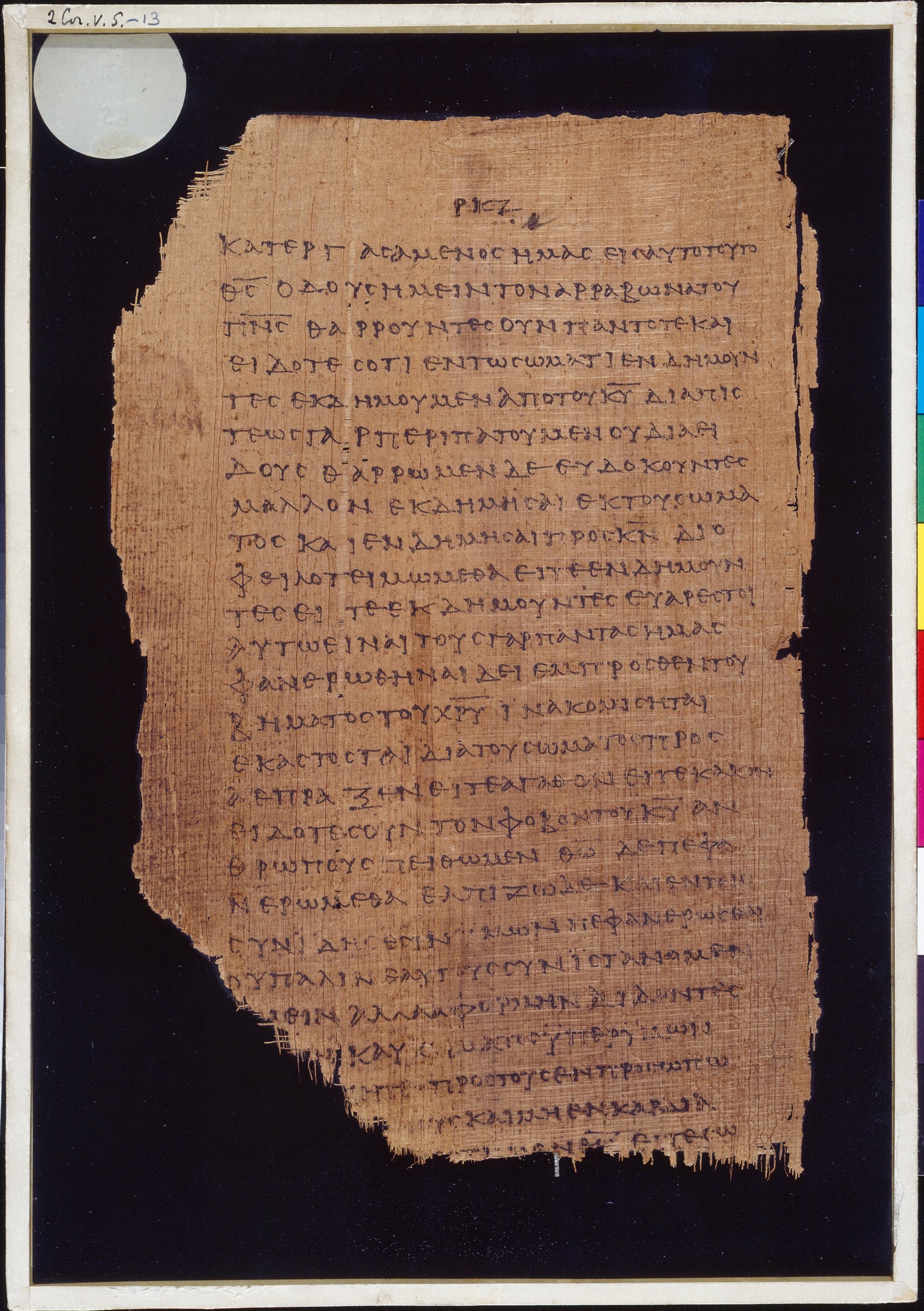
Where on the image
Chester Beatty Library photograph T0005252.jpg (https://ntmss.info/images/webfriendly/10046/T0005252.jpg), linked to NTVMR page 1120 (folio 65v) in NTVMR's page index. 5:5 begins on the previous page; 5:13 continues on the next page. Checked on the image: the scribe's page number ρκζ (127) at the head of the page, continuing the sequence of the neighbouring pages.
5:5 κατεργασαμενος ημας εις αυτο τουτο
θ̅ς̅ ο δους ημειν τον αρραβωνα του
π̅ν̅ς̅ 6 θαρρουντες ουν παντοτε και
ειδοτες οτι εν τω σωματι ενδημουν
τες εκδημουμεν απο του κ̅υ̅ 7 δια πισ
τεως γαρ περιπατουμεν ου δια ει
δους 8 θαρρωμεν δε ευδοκουντες
μαλλον εκδημησαι εκ του σωμα
τος και ενδημησαι προς κ̅ν̅ 9 διο
φειλοτειμωμεθα ειτε ενδημουν
τες ειτε εκδημουντες ευαρεστοι
αυτω ειναι 10 τους γαρ παντας ημας
φανερωθηναι δει εμπροσθεν του
βηματος του χ̅ρ̅υ̅ ινα κομισηται
εκαστος τα ιδια του σωματος προς
α επραξεν ειτε αγαθον ειτε κακον
11 ειδοτες ουν τον φοβον του κ̅υ̅ αν
θρωπους πειθωμεν θ̅ω̅ δε πεφα
νερωμεθα ελπιζω δε και εν ταις
συνιδησεσιν υμων πεφανερωσθαι
12 ου παλιν εαυτους συνιστανομεν
[υ]μ̣ειν αλλα αφορμην διδοντες
[υμει]ν καυχη̣ματος υπερ υμων
[ινα ε]χ̣ητε προς τους εν προσωπω
[καυχωμεν]ο̣υς και μη εν καρδια
13 [ειτε γαρ εξ]ε̣σ̣τ̣η̣μ̣εν θ̅ω̣̣̅ ειτε σω
[φρονουμεν]
5:5Now he that hath wrought us for the selfsame thing is God, who also hath given unto us the earnest of the Spirit. 6Therefore we are always confident, knowing that, whilst we are at home in the body, we are absent from the Lord: 7(For we walk by faith, not by sight:) 8We are confident, I say, and willing rather to be absent from the body, and to be present with the Lord. 9Wherefore we labour, that, whether present or absent, we may be accepted of him. 10For we must all appear before the judgment seat of Christ; that every one may receive the things done in his body, according to that he hath done, whether it be good or bad. 11Knowing therefore the terror of the Lord, we persuade men; but we are made manifest unto God; and I trust also are made manifest in your consciences. 12For we commend not ourselves again unto you, but give you occasion to glory on our behalf, that ye may have somewhat to answer them which glory in appearance, and not in heart. 13For whether we be beside ourselves, it is to God: or whether we be sober, it is for your cause.
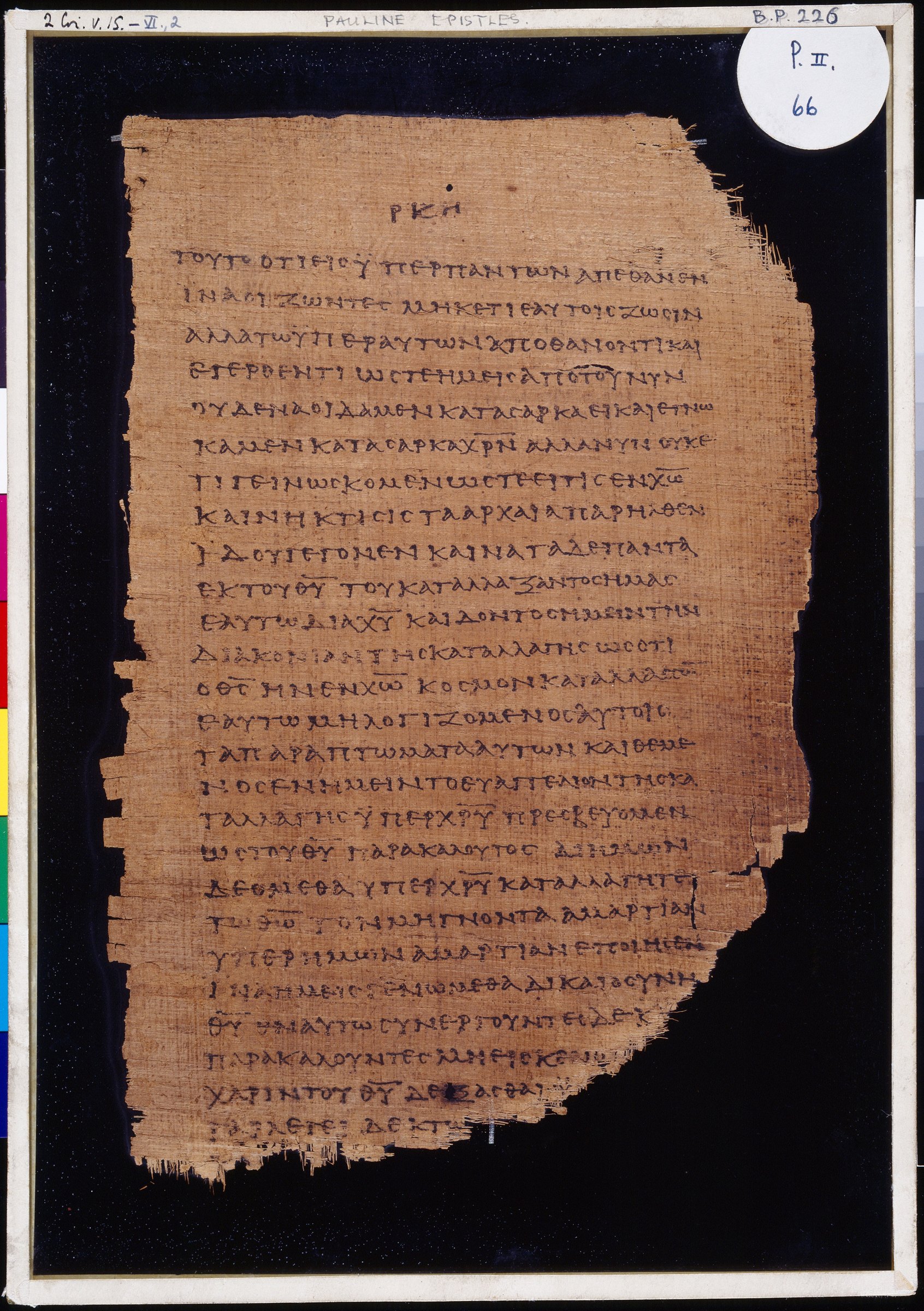
Where on the image
Chester Beatty Library photograph T0005267.jpg (https://ntmss.info/images/webfriendly/10046/T0005267.jpg), linked to NTVMR page 1130 (folio 66r) in NTVMR's page index. 5:14 begins on the previous page; 6:2 continues on the next page. Checked on the image: the scribe's page number ρκη (128) at the head of the page, continuing the sequence of the neighbouring pages; the disc on the frame reads ‹P. II 66›.
5:14 τουτο οτι εις υπερ παντων απεθανεν
15 ινα οι ζωντες μηκετι εαυτοις ζωσιν
αλλα τω υπερ αυτων αποθανοντι και
εγερθεντι 16 ωστε ημεις απο του νυν
ουδενα οιδαμεν κατα σαρκα ει και εγνω
καμεν κατα σαρκα χ̅ρ̅ν̅ αλλα νυν ουκε
τι γεινωσκομεν 17 ωστε ει τις εν χ̅ω̅
καινη κτισις τα αρχαια παρηλθεν
ιδου γεγονεν καινα 18 τα δε παντα
εκ του θ̅υ̅ του καταλλαξαντος ημας
εαυτω δια χ̅υ̅ και δοντος ημειν την
διακονιαν της καταλλαγης 19 ως οτι
ο θ̅ς̅ ην εν χ̅ω̅ κοσμον καταλλασσων
εαυτω μη λογιζομενος αυτοις
τα παραπτωματα αυτων και θεμε
νος εν ημειν το ευαγγελιον της κα
ταλλαγης 20 υπερ χ̅ρ̅υ̅ πρεσβευομεν
ως του θ̅υ̅ παρακαλουτος δι ημων
δεομεθα υπερ χ̅ρ̅υ̅ καταλλαγητε
τω θ̅ω̅ 21 τον μη γνοντα αμαρτιαν
υπερ ημων αμαρτιαν εποιησεν
ινα ημεις γενωμεθα δικαιοσυνη
θ̅υ̅ εν αυτω 6:1 συνεργουντες δε κα̣[ι]
παρακαλουντες μη εις κενον̣ [την]
χαριν του θ̅υ̅ δεξασθαι υ[μας] 2 [καιρω]
γαρ λεγει δεκτω [επηκουσα σου]
κ̣α̣[ι εν ημερα σωτηριας εβοηθησα]
5:14For the love of Christ constraineth us; because we thus judge, that if one died for all, then were all dead: 15And that he died for all, that they which live should not henceforth live unto themselves, but unto him which died for them, and rose again. 16Wherefore henceforth know we no man after the flesh: yea, though we have known Christ after the flesh, yet now henceforth know we him no more. 17Therefore if any man be in Christ, he is a new creature: old things are passed away; behold, all things are become new. 18And all things are of God, who hath reconciled us to himself by Jesus Christ, and hath given to us the ministry of reconciliation; 19To wit, that God was in Christ, reconciling the world unto himself, not imputing their trespasses unto them; and hath committed unto us the word of reconciliation. 20Now then we are ambassadors for Christ, as though God did beseech you by us: we pray you in Christ’s stead, be ye reconciled to God. 21For he hath made him to be sin for us, who knew no sin; that we might be made the righteousness of God in him. 6:1We then, as workers together with him, beseech you also that ye receive not the grace of God in vain. 2(For he saith, I have heard thee in a time accepted, and in the day of salvation have I succoured thee: behold, now is the accepted time; behold, now is the day of salvation.)
Notes
- Greek: the NTVMR diplomatic transcription, line by line as on the papyrus. Square brackets enclose letters that are lost or illegible and were supplied by the transcribers; a dot under a letter marks it as uncertain; [...] marks a gap. Nomina sacra and numerals keep the scribe's overline. Spelling is the scribe's (no accents or breathings). Words broken at a line end stay broken as on the papyrus. Corrections are not shown: the text is the first hand.
- English: the King James Version (1611), whole verses, for every verse that has text on the page. A verse that begins on one page and ends on the next is given in full on both. The KJV translates a later form of the Greek text, so its wording does not always match the papyrus; material differences (such as verses the papyrus does not have) are noted in the section.
Cite
Sources
- Source: P46 (Chester Beatty Biblical Papyrus II, Chester Beatty Library, Dublin): photographs as published in the INTF New Testament Virtual Manuscript Room; Greek from the INTF NTVMR transcription of P46; English from the King James Version (holding institution)
- Critical edition: INTF NTVMR diplomatic transcription (CC BY 4.0)
← previous · → next · v cycle view · l back to library