P46 (P.Mich. inv. 6238): Hebrews 7:2-8:8 (fols. 27r-28v)
Introduction
P46 is a papyrus codex of the letters of Paul copied in Egypt around 200, the oldest surviving collection of Paul's letters. 86 of its 104 leaves survive: 56 in the Chester Beatty Library, Dublin (Biblical Papyrus II, published by Frederic Kenyon in 1934-1937) and 30 in the University of Michigan Library, Ann Arbor (P.Mich. inv. 6238, published by Henry Sanders in 1935). The letters run in the order Romans, Hebrews, 1 and 2 Corinthians, Ephesians, Galatians, Philippians, Colossians and 1 Thessalonians; the first seven leaves (Romans 1:1-5:17) and the end of the book are lost. Hebrews standing after Romans, and the doxology of Romans (16:25-27) standing after 15:33, are among its best-known features.
Each section below is one page side: the holding library's photograph, the NTVMR diplomatic transcription line by line, and the King James Version of every verse that has text on the page. The lower lines of many leaves are lost; the transcribers' restorations are in square brackets.
This entry covers fols. 27r-28v (Hebrews 7:2-8:8).
How was this verified? (Provenance)
Where on the image
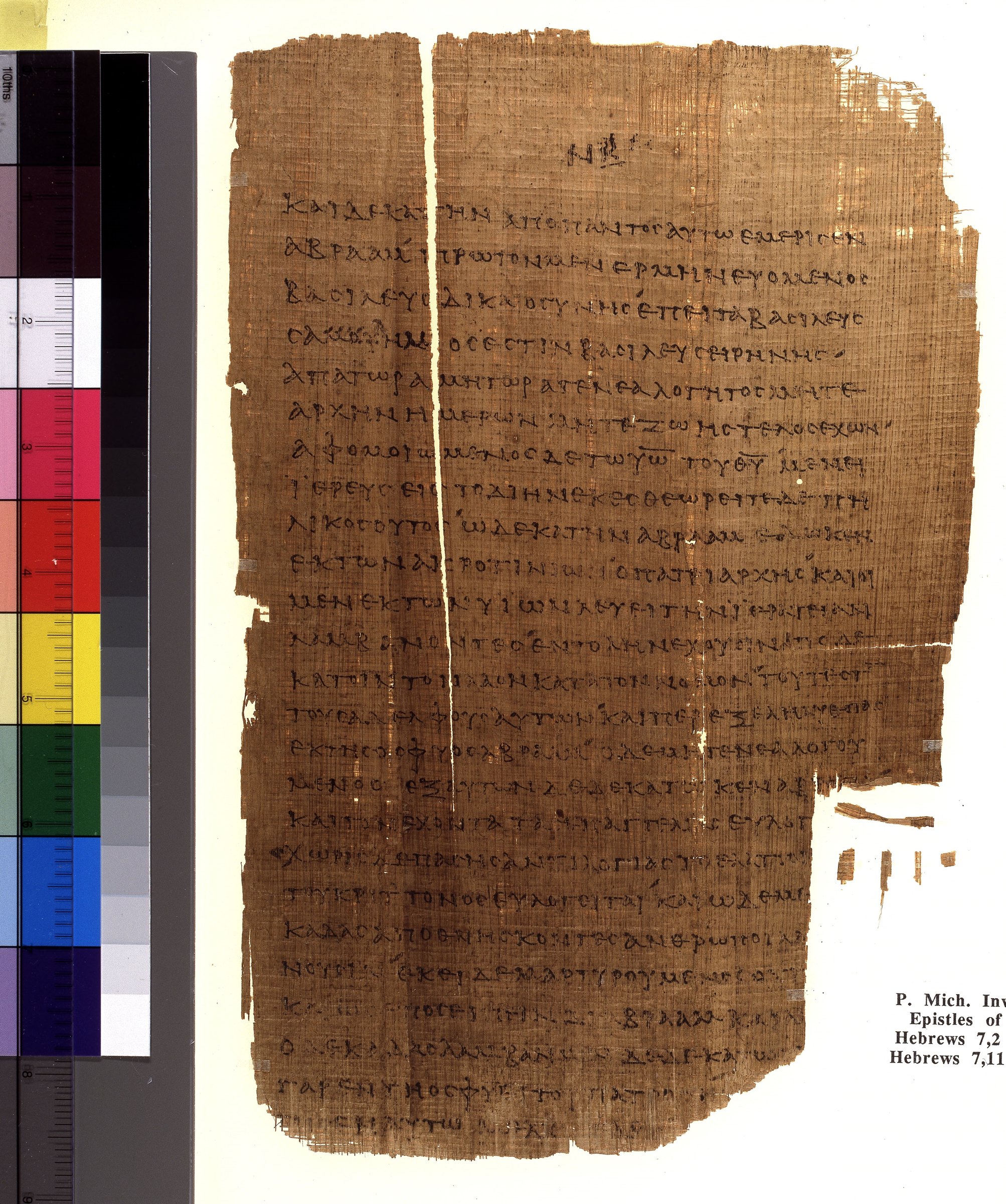
University of Michigan Library photograph 10046x6238_52JP2_UMich.jpg (https://ntmss.info/images/webfriendly/10046/10046x6238_52JP2_UMich.jpg), linked to NTVMR page 350 (folio 27r) in NTVMR's page index. 7:2 begins on the previous page. Checked on the image: the scribe's page number νβ (52) at the head of the page, matching NTVMR folio 27r.
7:2 και δεκατην απο παντος αυτω εμερισεν
αβρααμ πρωτον μεν ερμηνευομενος
βασιλευς δικαιοσυνης επειτα βασιλευς
σαμουηλ ος εστιν βασιλευς ειρηνης
3 απατωρ αμητωρ αγενεαλογητος μητε
αρχην ημερων μητε ζωης τελος εχων
αφομοιωμενος δε τω υ̅ω̅ του θ̅υ̅ μενει
ιερευς εις το διηνεκες 4 θεωρειτε δε πη
λικος ουτος ω δεκατην αβρααμ εδωκεν
εκ των ακροτινιων ο πατριαρχης 5 και οι
μεν εκ των υιων λευει την ιερατειαν
λαμβανοντες εντολην εχουσιν α̣ποδε
κατοιν τον λαον κατα τον νομον τουτ εστι̣ν
τους αδελφους αυτων καιπερ εξεληλυθο̣τας
εκ της οσφυος αβρααμ 6 ο δε μη γενεαλογου
μενος εξ αυτων δεδεκατωκεν αβρα̣α̣μ̣
και τον εχοντα τας επαγγελιας ευλογ[ηκεν]
7 χωρις δε πασης αντιλογιας το ελαττον̣ [υπο]
του κριττονος ευλογειται 8 και ωδε με[ν δε]
καδας αποθνησκοντες ανθρωποι λα̣[μβα]
νουσιν εκει δε μαρτυρουμενος οτι [ζη]
9 και̣ ως ε̣πος ειπειν δι αβρααμ και λε̣[υει]
ο δεκαδας λαμβανω̣ν δεδεκατωτ̣[αι] 10 [ετι]
γαρ εν τη οσφυε̣ι̣ του̣ πατρ̣ο̣ς η̣[ν οτε συνην]
τη̣σ̣εν αυτω μ̣ελχ[ισ]ε̣δ̣ε̣[κ]
7:2To whom also Abraham gave a tenth part of all; first being by interpretation King of righteousness, and after that also King of Salem, which is, King of peace; 3Without father, without mother, without descent, having neither beginning of days, nor end of life; but made like unto the Son of God; abideth a priest continually. 4Now consider how great this man was, unto whom even the patriarch Abraham gave the tenth of the spoils. 5And verily they that are of the sons of Levi, who receive the office of the priesthood, have a commandment to take tithes of the people according to the law, that is, of their brethren, though they come out of the loins of Abraham: 6But he whose descent is not counted from them received tithes of Abraham, and blessed him that had the promises. 7And without all contradiction the less is blessed of the better. 8And here men that die receive tithes; but there he receiveth them, of whom it is witnessed that he liveth. 9And as I may so say, Levi also, who receiveth tithes, payed tithes in Abraham. 10For he was yet in the loins of his father, when Melchisedec met him.
Where on the image
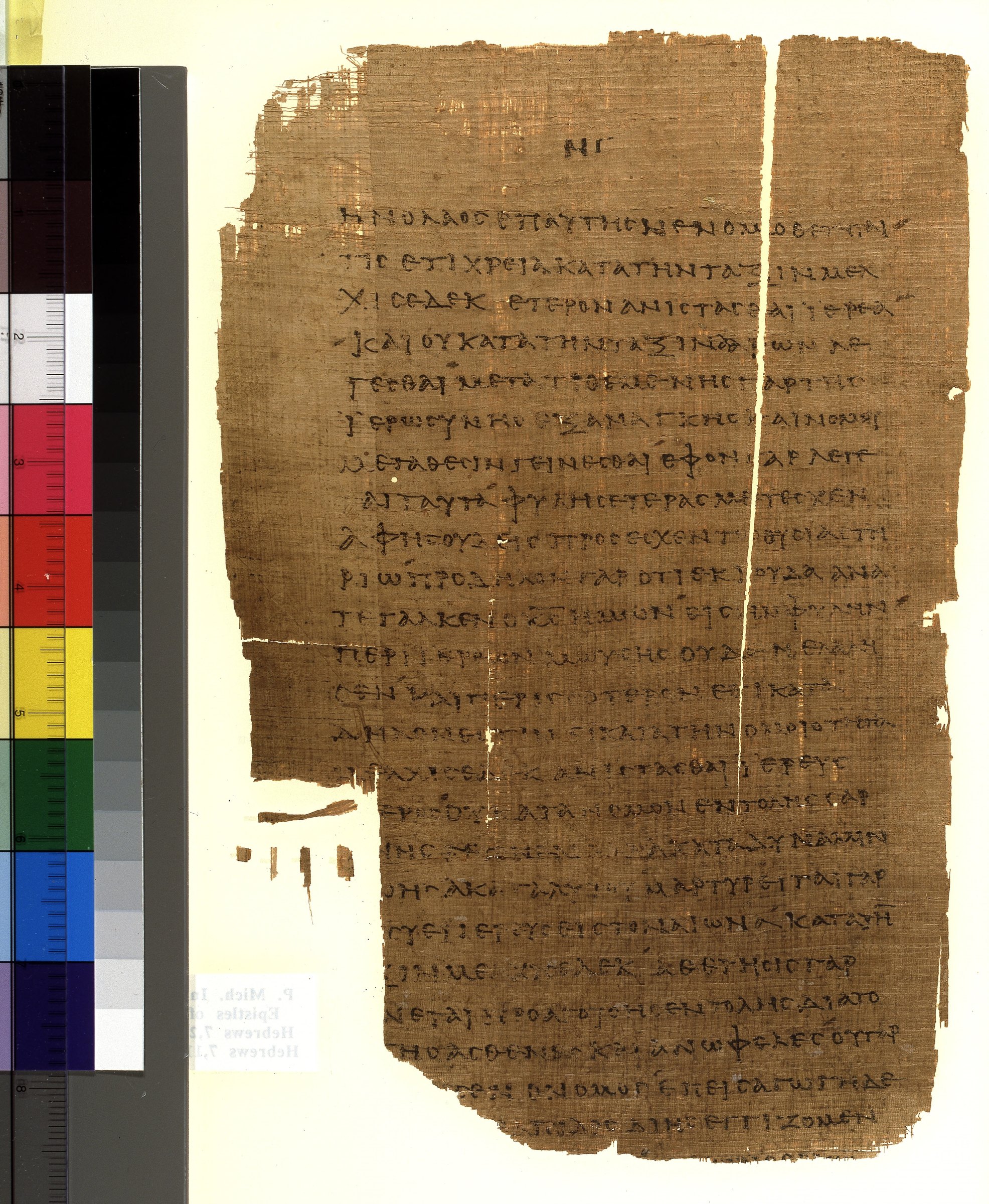
University of Michigan Library photograph 10046x6238_53JP2_UMich.jpg (https://ntmss.info/images/webfriendly/10046/10046x6238_53JP2_UMich.jpg), linked to NTVMR page 360 (folio 27v) in NTVMR's page index. 7:11 begins on the previous page; 7:20 continues on the next page. Checked on the image: the scribe's page number νγ (53) at the head of the page, matching NTVMR folio 27v.
7:11 ην ο λαος επ αυτης νενομοθετηται
τις ετι χρεια κατα την ταξιν μελ
χισεδεκ ετερον ανιστασθαι ιερεα
και ου κατα την ταξιν αρων λε
γεσθαι 12 μετατιθεμενης γαρ της
ιερωσυνης εξ αναγκης και νομου
μεταθεσιν γεινεσθαι 13 εφ ον γ̣αρ λεγε
τ̣αι ταυτα φυλης ετερας μετεσχεν
αφ ης ουδεις προσεσχεν τω θυσιαστη
ριω 14 προδηλον γαρ οτι εκ ιουδα ανα
τεταλκεν ο κ̅ς̅ ημων εις ην φυλην
περι ιε̣ρεων μωυσης ουδεν ελαλη
σεν 15 και περισσοτερο̣ν ετι κατα
δηλον εσ̣τιν ει κατα την ομοιοτητα
μ̣ελχισεδε̣κ ανιστασθαι ιερευς
[ετ]ερος 16 ου κ̣ατα νομον εντολης σαρ
[κι]ν̣ης γ̣ε̣γ̣ο̣νεν α̣λλ̣α κατα δυναμιν
[ζ]ω̣ης̣ ακατ̣αλυτο̣υ 17 μαρτυρειται γαρ
[οτι] συ ει ιερευς εις τον αιωνα κατα την
[τα]ξ̣ιν μελ̣χισεδεκ 18 αθετησις γαρ
[γι]νεται προαγουσης εντολης δια το
[αυ]τ̣ης ασθενες και ανωφελες 19 ου γαρ
[ετελειω]σεν ο νομος επεισαγωγη δε
[κρειττονος] ε̣λ̣πιδος δι ης εγγιζομεν
[τω θ̅ω̅] 20 [και καθ οσον ου χ]ω̣ρ̣ι̣ς̣ ο̣ρ̣κ̣ω̣
7:11If therefore perfection were by the Levitical priesthood, (for under it the people received the law,) what further need was there that another priest should rise after the order of Melchisedec, and not be called after the order of Aaron? 12For the priesthood being changed, there is made of necessity a change also of the law. 13For he of whom these things are spoken pertaineth to another tribe, of which no man gave attendance at the altar. 14For it is evident that our Lord sprang out of Juda; of which tribe Moses spake nothing concerning priesthood. 15And it is yet far more evident: for that after the similitude of Melchisedec there ariseth another priest, 16Who is made, not after the law of a carnal commandment, but after the power of an endless life. 17For he testifieth, Thou art a priest for ever after the order of Melchisedec. 18For there is verily a disannulling of the commandment going before for the weakness and unprofitableness thereof. 19For the law made nothing perfect, but the bringing in of a better hope did; by the which we draw nigh unto God. 20And in asmuch as not without an oath he was made priest:
Where on the image
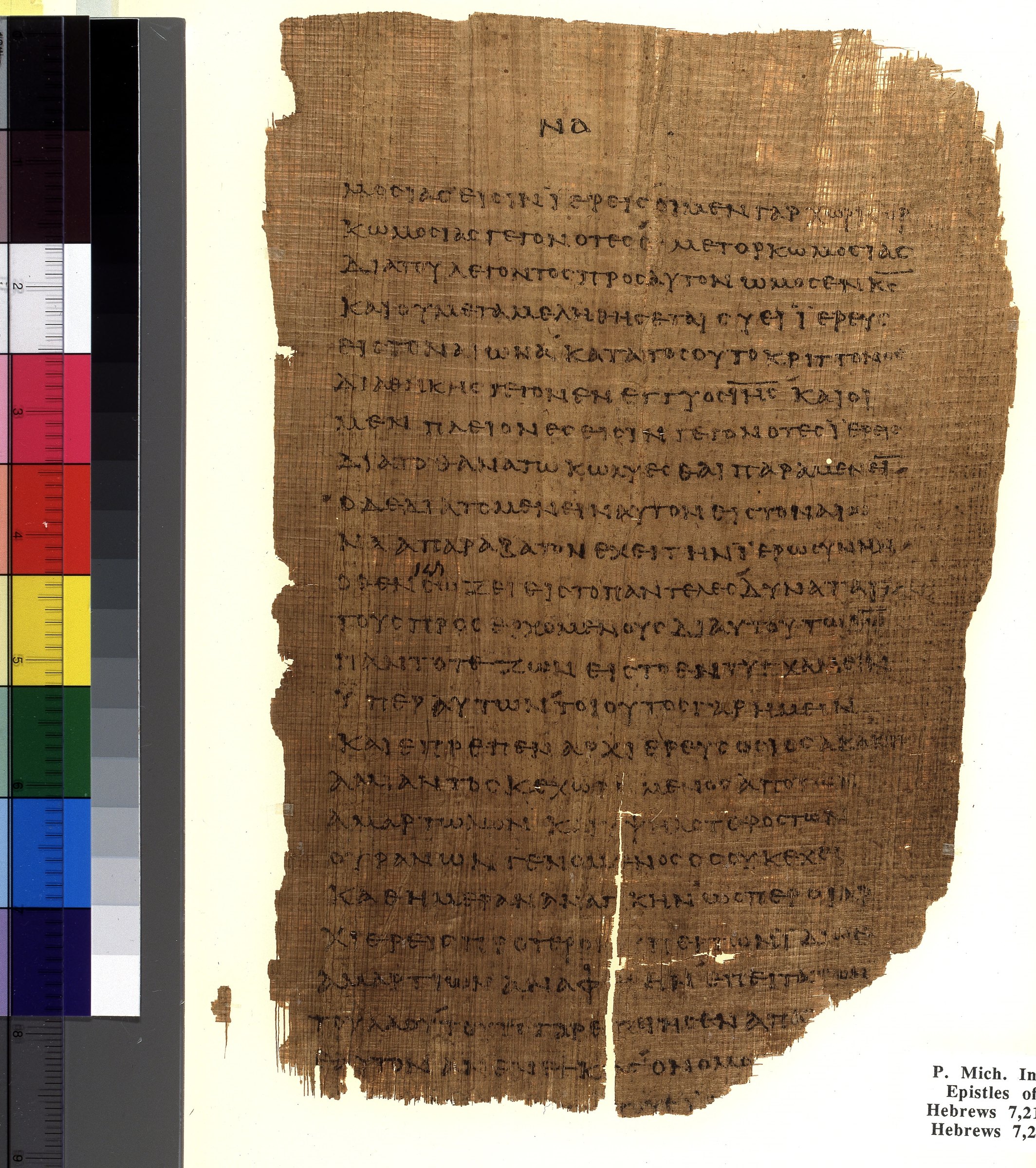
University of Michigan Library photograph 10046x6238_54JP2_UMich.jpg (https://ntmss.info/images/webfriendly/10046/10046x6238_54JP2_UMich.jpg), linked to NTVMR page 370 (folio 28r) in NTVMR's page index. 7:20 begins on the previous page; 7:28 continues on the next page. Checked on the image: the scribe's page number νδ (54) at the head of the page, matching NTVMR folio 28r.
7:20 μοσιας εισιν ιερεις οι μεν γαρ χωρις ορ
κωμοσιας γεγονοτες 21 ο μετ ορκωμοσιας
δια του λεγοντος προς αυτον ωμοσεν κ̅ς̅
και ου μεταμεληθησεται συ ει ιερευς
εις τον αιωνα 22 κατα τοσουτο κριττονος
διαθηκης γεγονεν εγγυος ι̅η̅ς̅ 23 και οι
μεν πλειονες εισιν γεγονοτες ιερεις
δια το θανατω κωλυεσθαι παραμενειν
24 ο δε δια το μενειν αυτον εις τον αιω
να απαραβατον εχει την ιερωσυνην
25 οθεν σωζει εις το παντελες δυναται
τους προσερχομενους δι αυτου τω θ̣̣̅ω̣̣̅
παντοτε ζων εις το εντυγχανειν
υπερ αυτων 26 τοιουτος γαρ ημειν
και επρεπεν αρχιερευς οσιος ακακο̣ς̣
αμιαντος κεχωρ̣ι̣σ̣μενος απο τ̣ω̣ν̣
αμαρτωλων και υψηλοτερος των
ουρανων γενομενος 27 ος ουκ εχει̣
καθ ημεραν αναγκην ωσπερ οι αρ
χιερεις προτερον̣ υ̣περ των ιδι̣ω̣ν̣
αμαρτιων αναφε̣ρ̣ειν επειτα τ̣ω̣ν
του λαου τουτο γαρ επο̣ιησεν απαξ̣
εαυτον ανενεγκα̣ς 28 ο νομο[ς γαρ κα]
[θιστησιν ανθρω]π̣ο̣υς ι̣ε̣[ρεις εχοντας]
7:20And in asmuch as not without an oath he was made priest: 21(For those priests were made without an oath; but this with an oath by him that said unto him, The Lord sware and will not repent, Thou art a priest for ever after the order of Melchisedec:) 22By so much was Jesus made a surety of a better testament. 23And they truly were many priests, because they were not suffered to continue by reason of death: 24But this man, because he continueth ever, hath an unchangeable priesthood. 25Wherefore he is able also to save them to the uttermost that come unto God by him, seeing he ever liveth to make intercession for them. 26For such an high priest became us, who is holy, harmless, undefiled, separate from sinners, and made higher than the heavens; 27Who needeth not daily, as those high priests, to offer up sacrifice, first for his own sins, and then for the people’s: for this he did once, when he offered up himself. 28For the law maketh men high priests which have infirmity; but the word of the oath, which was since the law, maketh the Son, who is consecrated for evermore.
Where on the image
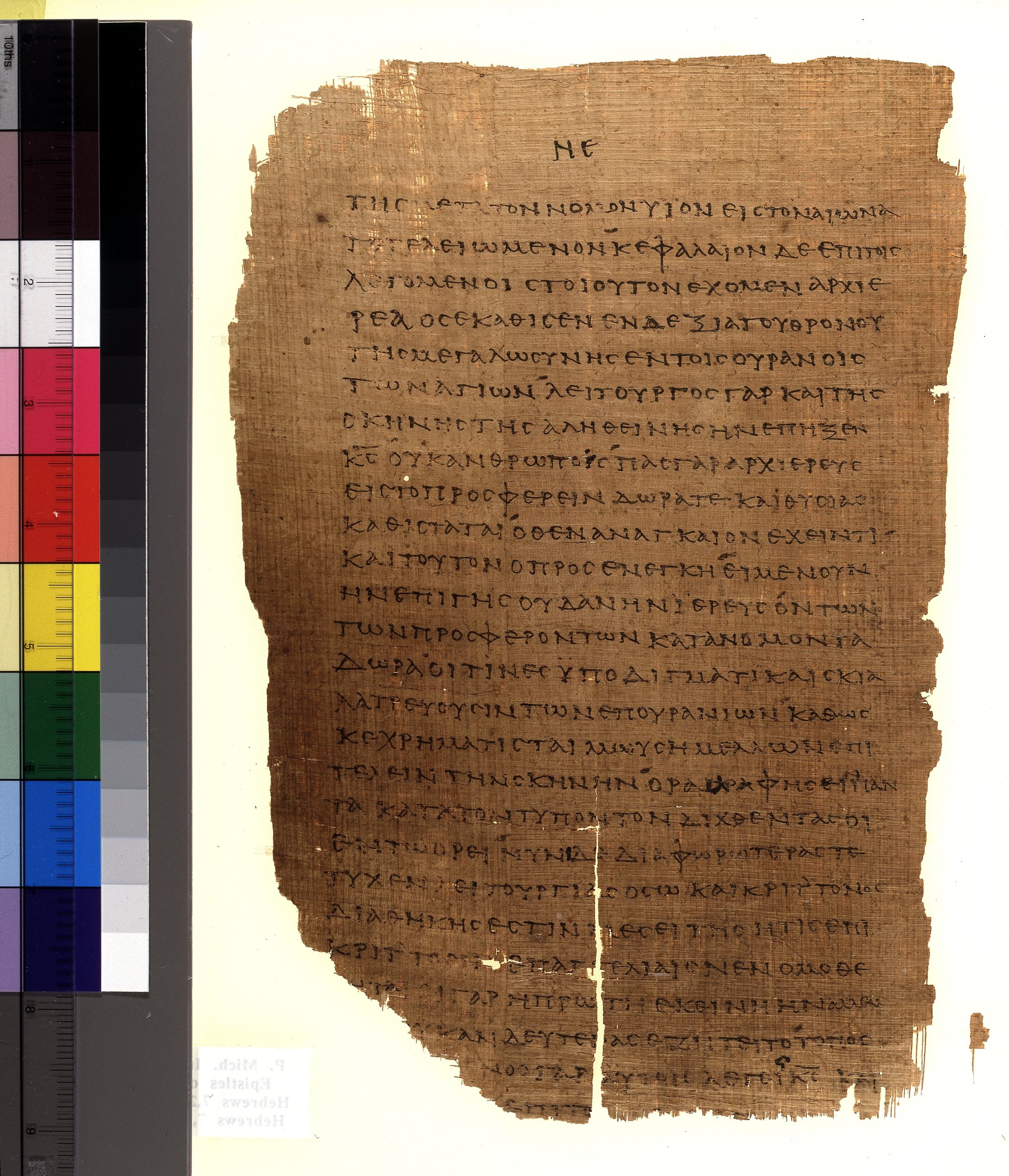
University of Michigan Library photograph 10046x6238_55JP2_UMich.jpg (https://ntmss.info/images/webfriendly/10046/10046x6238_55JP2_UMich.jpg), linked to NTVMR page 380 (folio 28v) in NTVMR's page index. 7:28 begins on the previous page; 8:8 continues on the next page. Checked on the image: the scribe's page number νε (55) at the head of the page, matching NTVMR folio 28v.
7:28 της μετα τον νομον υιον εις τον αιωνα
τετελειωμενον 8:1 κεφαλαιον δε επι τοις
λεγομενοις τοιουτον εχομεν αρχιε
ρεα ος εκαθισεν εν δεξια του θρονου
της μεγαλωσυνης εν τοις ουρανοις
2 των αγιων λειτουργος γαρ και της
σκηνης της αληθεινης ην επηξεν
κ̅ς̅ ουκ ανθρωποις 3 πας γαρ αρχιερευς
εις το προσφερειν δωρα τε και θυσιας
καθισταται οθεν αναγκαιον εχειν τι
και τουτον ο προσενεγκη 4 ει μεν ουν
ην επι γης ουδ αν ην ιερευς οντων
των προσφεροντων κατα νομον τα
δωρα 5 οιτινες υποδιγματι και σκια
λατρευουσιν των επουρανιων καθως
κεχρηματισται μωυση μελλων επι
τελειν την σκηνην ορα γραφησει παν
τα κατα τον τυπον τον διχθεντα σοι
εν τω ορει 6 νυν δε διαφωρωτερας τε
τυχεν λειτουργιας οσω και κριττονος
διαθηκης εστιν μ̣εσειτης ητις επι
κριττοσιν̣ επαγγελιαις νενομοθε
[τ]ηται 7 ει γαρ η πρωτη εκεινη ην αμεμ
[πτος ο]υκ αν δευτερ̣ας εζητειτο τοπος
8 [μεμφομ]ε̣νος γαρ αυτοις λεγει κ̅ς̅ και
[συντελεσω] επι το[ν οικον ι]σ̣[ραηλ και]
7:28For the law maketh men high priests which have infirmity; but the word of the oath, which was since the law, maketh the Son, who is consecrated for evermore. 8:1Now of the things which we have spoken this is the sum: We have such an high priest, who is set on the right hand of the throne of the Majesty in the heavens; 2A minister of the sanctuary, and of the true tabernacle, which the Lord pitched, and not man. 3For every high priest is ordained to offer gifts and sacrifices: wherefore it is of necessity that this man have somewhat also to offer. 4For if he were on earth, he should not be a priest, seeing that there are priests that offer gifts according to the law: 5Who serve unto the example and shadow of heavenly things, as Moses was admonished of God when he was about to make the tabernacle: for, See, saith he, that thou make all things according to the pattern shewed to thee in the mount. 6But now hath he obtained a more excellent ministry, by how much also he is the mediator of a better covenant, which was established upon better promises. 7For if that first covenant had been faultless, then should no place have been sought for the second. 8For finding fault with them, he saith, Behold, the days come, saith the Lord, when I will make a new covenant with the house of Israel and with the house of Judah:
Notes
- Greek: the NTVMR diplomatic transcription, line by line as on the papyrus. Square brackets enclose letters that are lost or illegible and were supplied by the transcribers; a dot under a letter marks it as uncertain; [...] marks a gap. Nomina sacra and numerals keep the scribe's overline. Spelling is the scribe's (no accents or breathings). Words broken at a line end stay broken as on the papyrus. Corrections are not shown: the text is the first hand.
- English: the King James Version (1611), whole verses, for every verse that has text on the page. A verse that begins on one page and ends on the next is given in full on both. The KJV translates a later form of the Greek text, so its wording does not always match the papyrus; material differences (such as verses the papyrus does not have) are noted in the section.
Cite
Sources
- Source: P46 (P.Mich. inv. 6238, University of Michigan Library): photographs as published in the INTF New Testament Virtual Manuscript Room; Greek from the INTF NTVMR transcription of P46; English from the King James Version (holding institution)
- Critical edition: INTF NTVMR diplomatic transcription (CC BY 4.0)
← previous · → next · v cycle view · l back to library