P46 (P.Mich. inv. 6238): Romans 12:10-13:1 (fol. 16v)
Introduction
P46 is a papyrus codex of the letters of Paul copied in Egypt around 200, the oldest surviving collection of Paul's letters. 86 of its 104 leaves survive: 56 in the Chester Beatty Library, Dublin (Biblical Papyrus II, published by Frederic Kenyon in 1934-1937) and 30 in the University of Michigan Library, Ann Arbor (P.Mich. inv. 6238, published by Henry Sanders in 1935). The letters run in the order Romans, Hebrews, 1 and 2 Corinthians, Ephesians, Galatians, Philippians, Colossians and 1 Thessalonians; the first seven leaves (Romans 1:1-5:17) and the end of the book are lost. Hebrews standing after Romans, and the doxology of Romans (16:25-27) standing after 15:33, are among its best-known features.
Each section below is one page side: the holding library's photograph, the NTVMR diplomatic transcription line by line, and the King James Version of every verse that has text on the page. The lower lines of many leaves are lost; the transcribers' restorations are in square brackets.
This entry covers fol. 16v (Romans 12:10-13:1).
How was this verified? (Provenance)
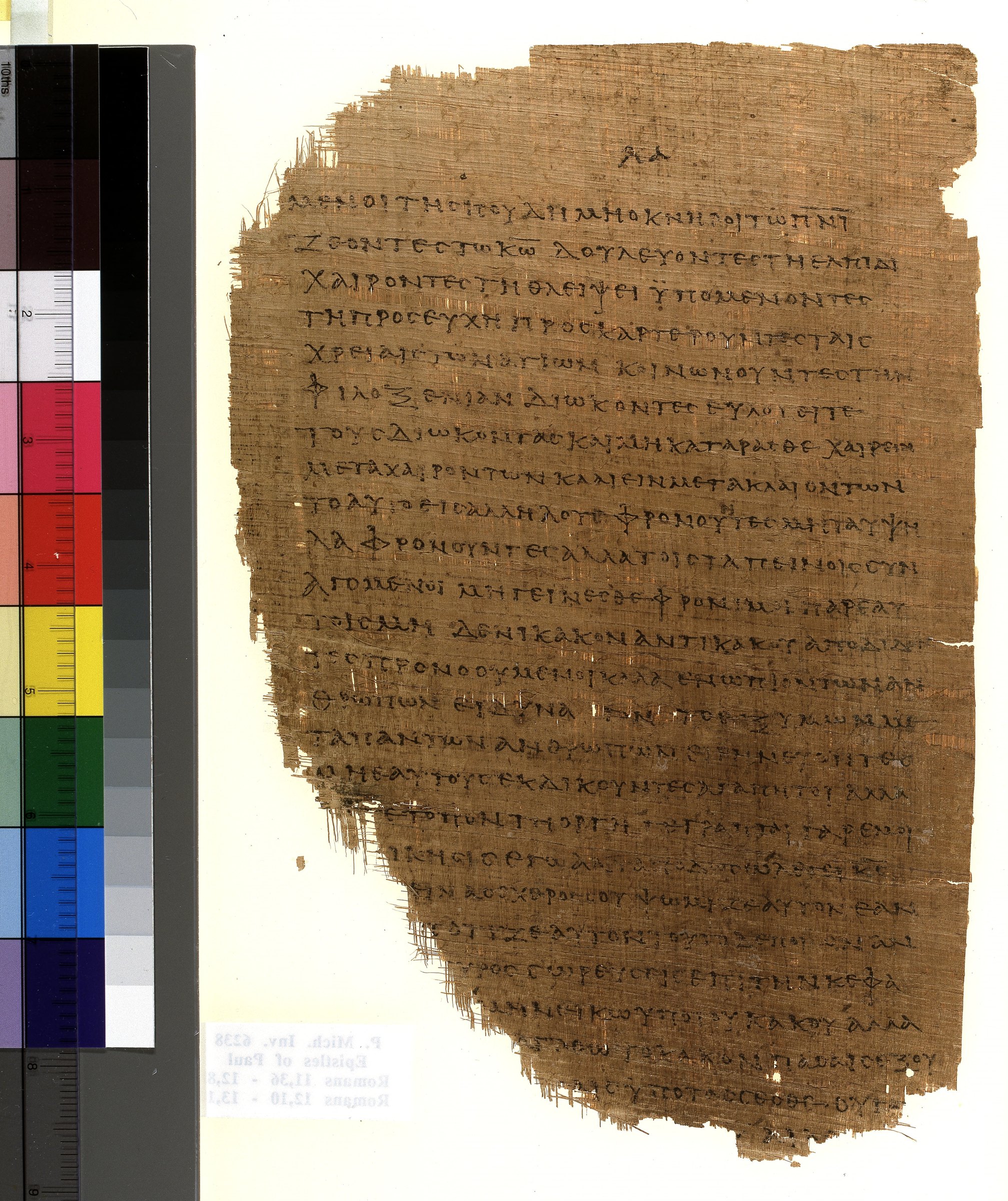
Where on the image
University of Michigan Library photograph 10046x6238_31JP2_UMich.jpg (https://ntmss.info/images/webfriendly/10046/10046x6238_31JP2_UMich.jpg), linked to NTVMR page 140 (folio 16v) in NTVMR's page index. 12:10 begins on the previous page; 13:1 continues on the next page. Checked on the image: the scribe's page number λα (31) at the head of the page, matching NTVMR folio 16v.
12:10 μενοι 11 τη σπουδη μη οκνηροι τω π̅ν̅ι̅
ζεοντες τω κ̅ω̅ δουλευοντες 12 τη ελπιδι
χαιροντες τη θλειψει υπομενοντες
τη προσευχη προσκαρτερουντες 13 ταις
χρειαις των αγιων κοινωνουντες την
φιλοξενιαν διωκοντες 14 ευλογειτε
τους διωκοντας και μη καταρασθε 15 χαιρειν
μετα χαιροντων κλαιειν μετα κλαιοντων
16 το αυτο εις αλληλους φρονουτες μη τα υψη
λα φρονουντες αλλα τοις ταπεινοις συν
αγομενοι μη γεινεσθε φρονιμοι παρ εαυ
τοις 17 μηδενι κακον αντι κακου αποδιδον
τες προνοουμενοι καλα ενωπιον των αν
θρωπων 18 ει δυνατον το εξ υμων με
τα παντων ανθρωπων ειρηνευοντες
19 μη εαυτους εκδικουντες αγαπητοι αλλα
δ̣ο̣τ̣ε τοπον τη οργη γεγραπται γαρ εμοι
ε̣κ̣δ̣ικησις εγω ανταποδωσω λεγει κ̅ς̅
20 [εαν π]εινα ο εχθρος̣ σου ψωμιζε αυτον εαν
[διψα] ποτιζε αυτον τουτο δε ποιων αν
[θρακας] π̣υρος σωρευσεις επι την κεφα
[λην αυτου] 21 μη νεικω υπο του κακου αλλα
[νεικα εν τω] α̣γαθω το κακον 13:1 πασαις εξου
[σιαις υπερεχου]σ̣αις υποτασσεσθε ου γα̣[ρ]
[εστιν εξουσια ει μη υπο θ̅]υ̣̣̅ αι δ̣ε̣ [ουσαι]
12:10Be kindly affectioned one to another with brotherly love; in honour preferring one another; 11Not slothful in business; fervent in spirit; serving the Lord; 12Rejoicing in hope; patient in tribulation; continuing instant in prayer; 13Distributing to the necessity of saints; given to hospitality. 14Bless them which persecute you: bless, and curse not. 15Rejoice with them that do rejoice, and weep with them that weep. 16Be of the same mind one toward another. Mind not high things, but condescend to men of low estate. Be not wise in your own conceits. 17Recompense to no man evil for evil. Provide things honest in the sight of all men. 18If it be possible, as much as lieth in you, live peaceably with all men. 19Dearly beloved, avenge not yourselves, but rather give place unto wrath: for it is written, Vengeance is mine; I will repay, saith the Lord. 20Therefore if thine enemy hunger, feed him; if he thirst, give him drink: for in so doing thou shalt heap coals of fire on his head. 21Be not overcome of evil, but overcome evil with good. 13:1Let every soul be subject unto the higher powers. For there is no power but of God: the powers that be are ordained of God.
Notes
- Greek: the NTVMR diplomatic transcription, line by line as on the papyrus. Square brackets enclose letters that are lost or illegible and were supplied by the transcribers; a dot under a letter marks it as uncertain; [...] marks a gap. Nomina sacra and numerals keep the scribe's overline. Spelling is the scribe's (no accents or breathings). Words broken at a line end stay broken as on the papyrus. Corrections are not shown: the text is the first hand.
- English: the King James Version (1611), whole verses, for every verse that has text on the page. A verse that begins on one page and ends on the next is given in full on both. The KJV translates a later form of the Greek text, so its wording does not always match the papyrus; material differences (such as verses the papyrus does not have) are noted in the section.
Cite
Sources
- Source: P46 (P.Mich. inv. 6238, University of Michigan Library): photographs as published in the INTF New Testament Virtual Manuscript Room; Greek from the INTF NTVMR transcription of P46; English from the King James Version (holding institution)
- Critical edition: INTF NTVMR diplomatic transcription (CC BY 4.0)
← previous · → next · v cycle view · l back to library