P66 (Papyrus Bodmer II): John 10:1-11:6 (pages 67-74)
Introduction
P66 is a papyrus codex of the Gospel of John copied in Egypt around 200, the most complete early copy of John. Most of it is Papyrus Bodmer II in the Fondation Martin Bodmer, Cologny (Geneva); small pieces are in the Chester Beatty Library, Dublin, and the Institut für Altertumskunde, Cologne. The first five quires (John 1:1-14:26) survive as a bound book of numbered pages; later leaves, from John 14:29 to 21:9, are damaged and kept between glass. The scribe made many corrections, some of them his own; only the first hand is shown here.
Each section below is one page: the photograph, the NTVMR diplomatic transcription line by line, and the King James Version of every verse on the page. Pages of the bound book are shown on the photographic plates published by Victor Martin and J. W. B. Barns in 1962 (scanned by the Bodmer Lab), the glass-mounted leaves on colour photographs. Lost: John 6:12-34 (pages 35-38) and parts of chapters 14-21; the transcription ends at 21:9. Where P66 lacks a verse that the KJV has (John 5:4, the account of the adulteress at 7:53-8:11, 16:15), the section says so.
This entry covers pages 67-74 (John 10:1-11:6).
How was this verified? (Provenance)
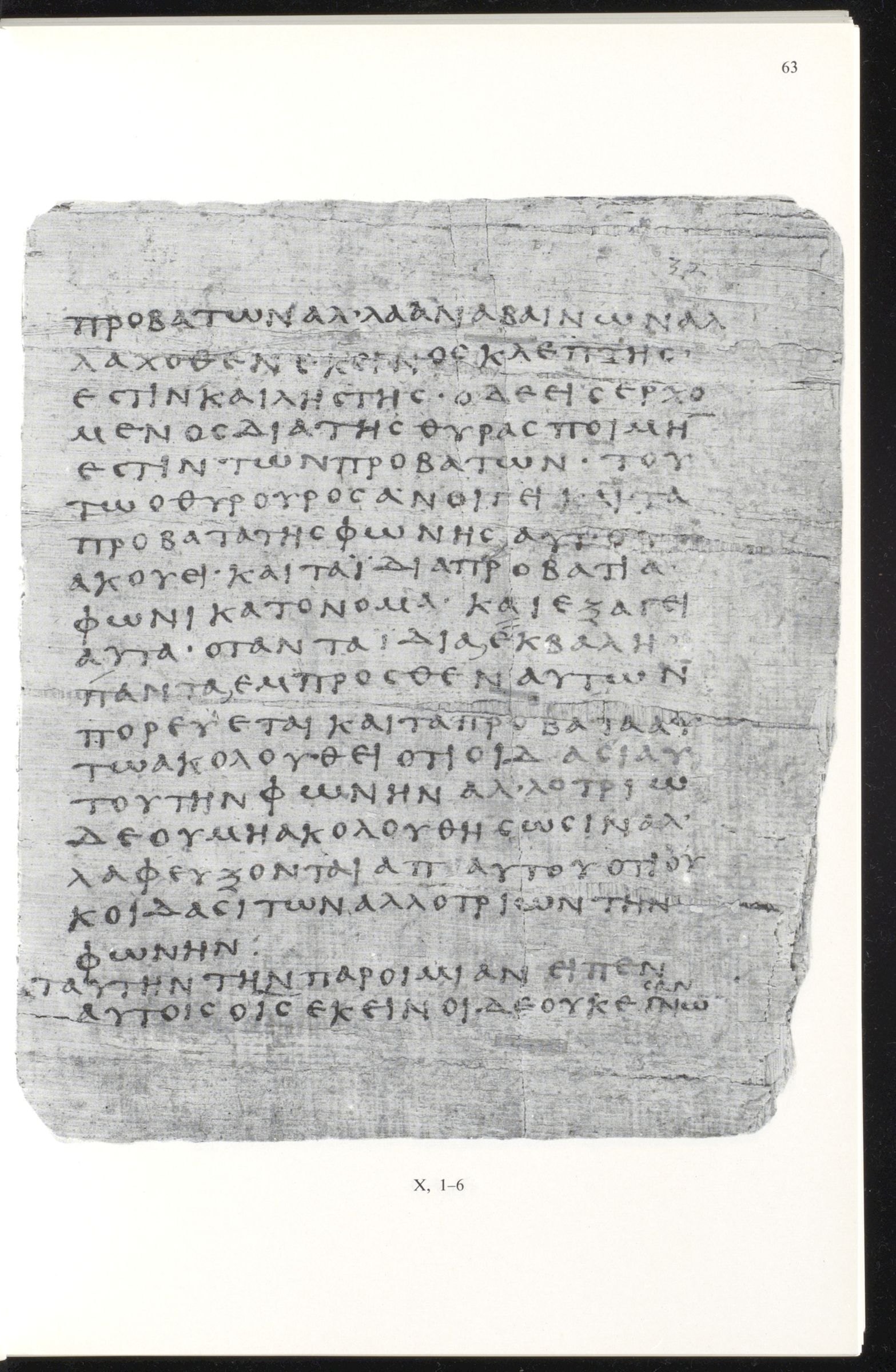
Where on the image
Fondation Martin Bodmer, Papyrus Bodmer II, Bodmer Lab image 1072205287_071 (https://bodmerlab.unige.ch/fr/constellations/papyri/mirador/1072205287), photographic plate of the 1962 Martin-Barns edition, shown whole. NTVMR page 630 (page 67) is linked to this image in NTVMR's page index. 10:1 begins on the previous page; 10:6 continues on the next page. Checked on the image: the printed caption reads ‹X, 1-6›; the last line of writing, ‹αυτοις ο ι̅ς̅ εκεινοι δε ουκ εγνων› (line 20 of the transcription), is legible at the foot of the page.
10:1 προβατων αλλα αναβαινων αλ
λαχοθεν εκεινος κλεπτης
εστιν και ληστης· 2 ο δε εισερχο
μενος δια της θυρας ποιμην
εστιν των προβατων· 3 του
τω ο θυρουρος ανοιγει και τα
προβατα της φωνης αυτου
ακουει· και τα ιδια προβατια
φωνι κατ ονομα· και εξαγει
αυτα· 4 οταν τα ιδια εκβαλη
παντα εμπροσθεν αυτων
πορευεται και τα προβατα αυ
τω ακολουθει οτι οιδασι αυ
του την φωνην 5 αλλοτριω
δε ου μη ακολουθησωσιν αλ
λα φευξονται απο̣ αυτου οτι ου
κ οιδασι των αλλοτριων την
φωνην.
6 ταυτην την παροιμιαν ειπεν
αυτοις ο ι̅ς̅ εκεινοι δε ουκ εγνων
10:1Verily, verily, I say unto you, He that entereth not by the door into the sheepfold, but climbeth up some other way, the same is a thief and a robber. 2But he that entereth in by the door is the shepherd of the sheep. 3To him the porter openeth; and the sheep hear his voice: and he calleth his own sheep by name, and leadeth them out. 4And when he putteth forth his own sheep, he goeth before them, and the sheep follow him: for they know his voice. 5And a stranger will they not follow, but will flee from him: for they know not the voice of strangers. 6This parable spake Jesus unto them: but they understood not what things they were which he spake unto them.
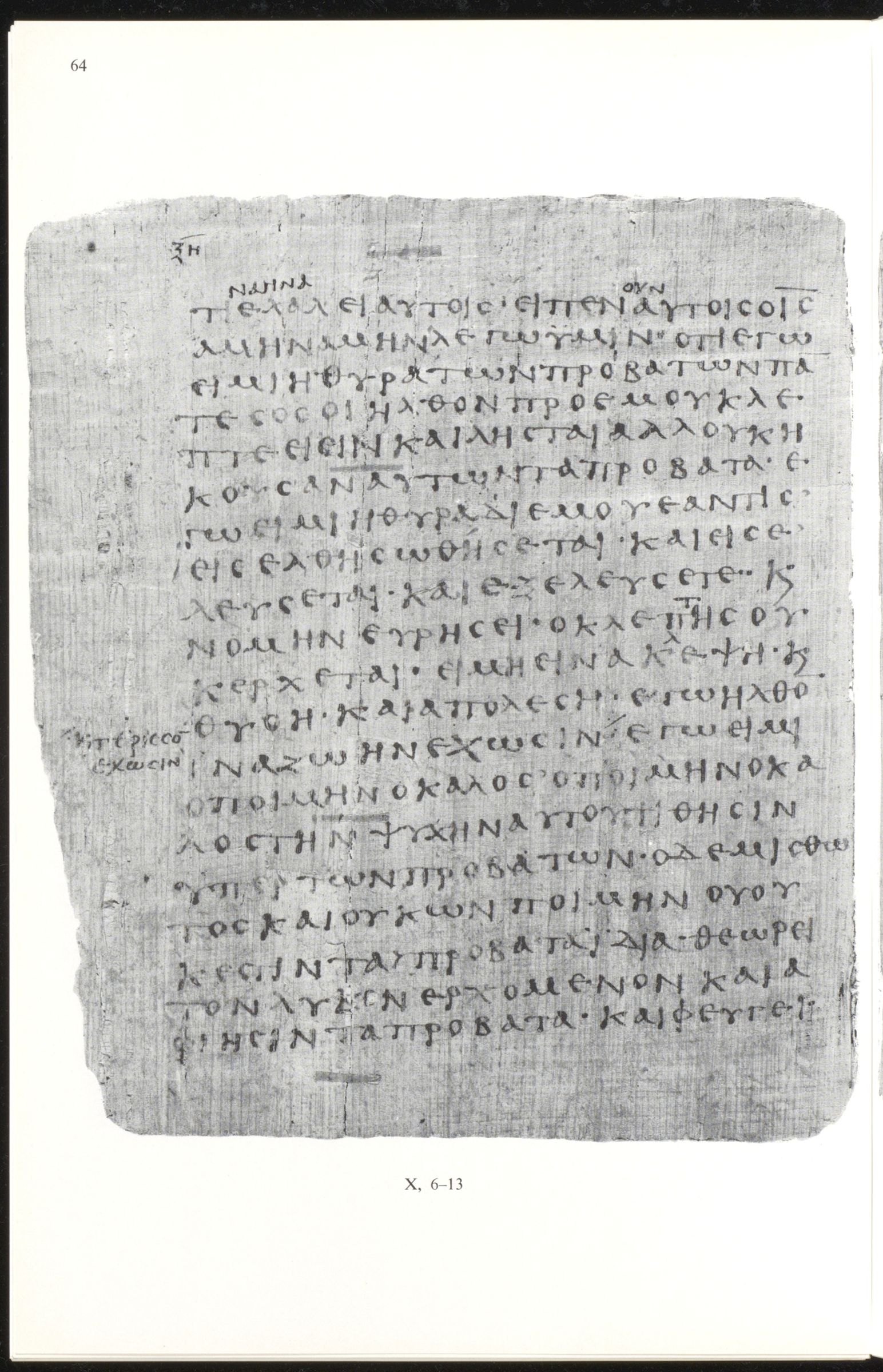
Where on the image
Fondation Martin Bodmer, Papyrus Bodmer II, Bodmer Lab image 1072205287_072 (https://bodmerlab.unige.ch/fr/constellations/papyri/mirador/1072205287), photographic plate of the 1962 Martin-Barns edition, shown whole. NTVMR page 640 (page 68) is linked to this image in NTVMR's page index. 10:6 begins on the previous page; 10:12 continues on the next page. Checked on the image: the printed caption reads ‹X, 6-13›; the last line of writing, ‹φιησιν τα προβατα· και φευγει·› (line 20 of the transcription), is legible at the foot of the page.
10:6 τι ελαλει αυτοις· 7 ειπεν αυτοις ο ι̅ς̅
αμην αμην λεγω υμιν οτι εγω
ειμι η θυρα των προβατων 8 παν
τες οσοι ηλθον προ εμου κλε
πτε ειε̣ιν και λησται αλλ ουκ η
κουσαν αυτων τα προβατα· 9 ε
γω ειμι η θυρα δι εμου εαν τις
εισελθη σωθησεται· και εισε
λευσεται· και εξελευσετε· και
νομην ευρησει· 10 ο κλεπης ου
κ ερχεται· ει μη εινα κεψη· και
θυση· και απολεση· εγω ηλθον
ινα ζωην εχωσιν 11 εγω ειμι
ο ποιμην ο καλος ο ποιμην ο κα
λος την ψυχην αυτου τιθησιν
υπερ των προβατων· 12 ο δε μισθω
τος και ουκ ων ποιμην ου ου
κ εστιν τα προβατα ιδια θεωρει
τον λυδον ερχομενον και α
φιησιν τα προβατα· και φευγει·
10:6This parable spake Jesus unto them: but they understood not what things they were which he spake unto them. 7Then said Jesus unto them again, Verily, verily, I say unto you, I am the door of the sheep. 8All that ever came before me are thieves and robbers: but the sheep did not hear them. 9I am the door: by me if any man enter in, he shall be saved, and shall go in and out, and find pasture. 10The thief cometh not, but for to steal, and to kill, and to destroy: I am come that they might have life, and that they might have it more abundantly. 11I am the good shepherd: the good shepherd giveth his life for the sheep. 12But he that is an hireling, and not the shepherd, whose own the sheep are not, seeth the wolf coming, and leaveth the sheep, and fleeth: and the wolf catcheth them, and scattereth the sheep.
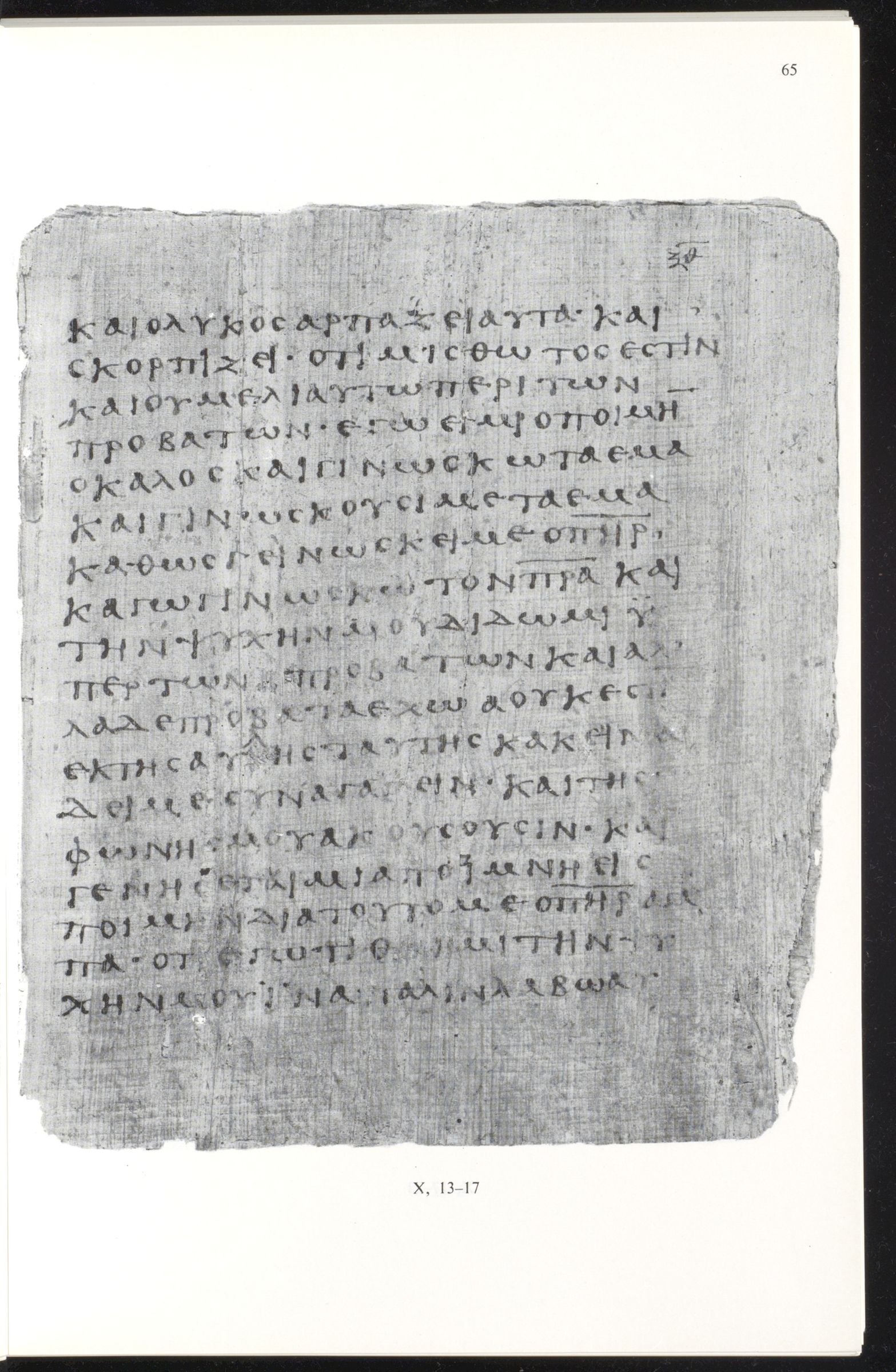
Where on the image
Fondation Martin Bodmer, Papyrus Bodmer II, Bodmer Lab image 1072205287_073 (https://bodmerlab.unige.ch/fr/constellations/papyri/mirador/1072205287), photographic plate of the 1962 Martin-Barns edition, shown whole. NTVMR page 650 (page 69) is linked to this image in NTVMR's page index. 10:12 begins on the previous page; 10:17 continues on the next page. Checked on the image: the printed caption reads ‹X, 13-17›.
10:12 και ο λυκος αρπαζει αυτα· και
σκορπιζει· 13 οτι μισθωτος εστιν
και ου μελι αυτω περι των
προβατων· 14 εγω ειμι ο ποιμην
ο καλος και γινωσκω τα εμα
και γινωσκουσι με τα εμα
15 καθως γεινωσκει με ο π̅η̅ρ̅
καγω γινωσκω τον π̅ρ̅α̅ και
την ψυχην μου διδωμι υ
περ των κ̣α̣ προβατων 16 και αλ
λα δε προβατα εχω α ουκ εστιν
εκ της αυχ̣ης ταυτης κακεινα
δει με συναγαγειν· και της
φωνης μου ακουσουσιν· και
γενησεται μια ποιμνη εις
ποιμην 17 δια τουτο με ο π̅η̅ρ̅ αγα
πα· οτι̣ εγω τιθημι την ψυ
χην μου ινα παλιν λαβω αυ
10:12But he that is an hireling, and not the shepherd, whose own the sheep are not, seeth the wolf coming, and leaveth the sheep, and fleeth: and the wolf catcheth them, and scattereth the sheep. 13The hireling fleeth, because he is an hireling, and careth not for the sheep. 14I am the good shepherd, and know my sheep, and am known of mine. 15As the Father knoweth me, even so know I the Father: and I lay down my life for the sheep. 16And other sheep I have, which are not of this fold: them also I must bring, and they shall hear my voice; and there shall be one fold, and one shepherd. 17Therefore doth my Father love me, because I lay down my life, that I might take it again.
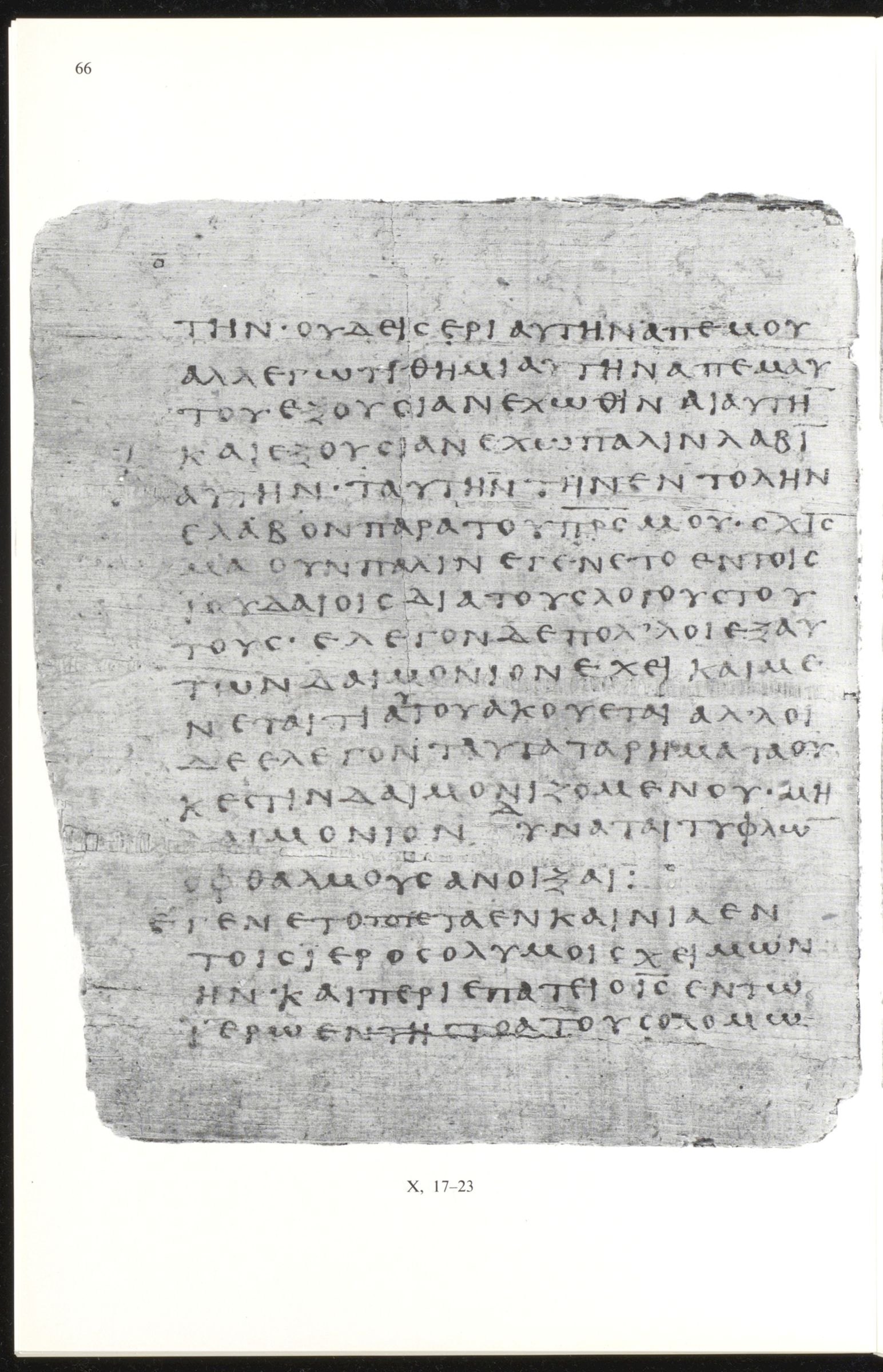
Where on the image
Fondation Martin Bodmer, Papyrus Bodmer II, Bodmer Lab image 1072205287_074 (https://bodmerlab.unige.ch/fr/constellations/papyri/mirador/1072205287), photographic plate of the 1962 Martin-Barns edition, shown whole. NTVMR page 660 (page 70) is linked to this image in NTVMR's page index. 10:17 begins on the previous page; 10:23 continues on the next page. Checked on the image: the printed caption reads ‹X, 17-23›; the last line of writing, ‹ιερω εν τη στοα του σολομω› (line 19 of the transcription), is legible at the foot of the page.
10:17 την· 18 ουδεις ερι αυτην απ εμου
αλλ εγω τιθημι αυτην απ εμαυ
του εξουσιαν εχω θιναι αυτην
και εξουσιαν εχω παλιν λαβιν
αυτην· ταυτην την εντολην
ελαβον παρα του π̅ρ̅ς̅ μου· 19 σχισ
μα ουν παλιν εγενετο εν τοις
ιουδαιοις δια τους λογους του
τους· 20 ελεγον δε πολλοι εξ αυ
των δαιμονιον εχει και με
νεται τι ατου ακουεται 21 αλλοι
δε ελεγον ταυτα τα ρηματα ου
κ εστιν δαιμονιζομενου· μη
δ̣αιμονιον τ̣υναται τυφλων
οφθαλμους ανοιξαι·
22 εγενετο δ̣ε̣ τα ενκαινια εν
τοις ιεροσολυμοις χειμων
ην· 23 και περιεπατει ο ι̅ς̅ εν τω
ιερω εν τη στοα του σολομω
10:17Therefore doth my Father love me, because I lay down my life, that I might take it again. 18No man taketh it from me, but I lay it down of myself. I have power to lay it down, and I have power to take it again. This commandment have I received of my Father. 19¶ There was a division therefore again among the Jews for these sayings. 20And many of them said, He hath a devil, and is mad; why hear ye him? 21Others said, These are not the words of him that hath a devil. Can a devil open the eyes of the blind? 22¶ And it was at Jerusalem the feast of the dedication, and it was winter. 23And Jesus walked in the temple in Solomon’s porch.
Where on the image
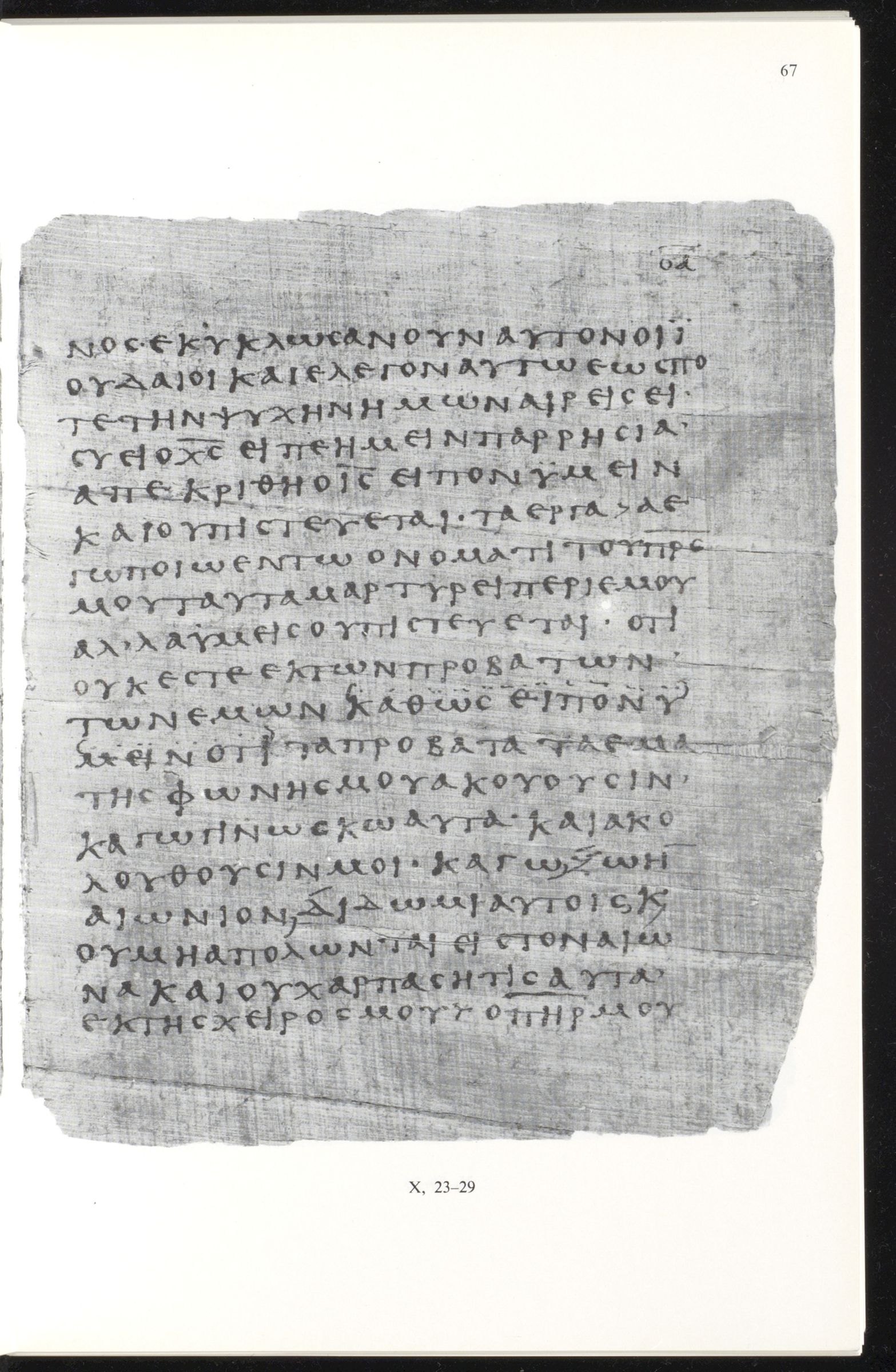
Fondation Martin Bodmer, Papyrus Bodmer II, Bodmer Lab image 1072205287_075 (https://bodmerlab.unige.ch/fr/constellations/papyri/mirador/1072205287), photographic plate of the 1962 Martin-Barns edition, shown whole. NTVMR page 670 (page 71) is linked to this image in NTVMR's page index. 10:23 begins on the previous page; 10:29 continues on the next page. Checked on the image: the printed caption reads ‹X, 23-29›; the last line of writing, ‹εκ της χειρος μου ο π̅η̅ρ̅ μου› (line 19 of the transcription), is legible at the foot of the page.
10:23 νος 24 εκυκλωσαν ουν αυτον οι ι
ουδαιοι και ελεγον αυτω εως πο
τε την ψυχην ημων αιρεις ει
συ ει ο χ̅ς̅ ειπε ημειν παρρησια
25 απεκριθη ο ι̅ς̅ ειπον υμειν
και ου πιστευεται· τα εργα α ε
γω ποιω εν τω ονοματι του π̅ρ̅ς̅
μου ταυτα μαρτυρει περι εμου
26 αλλα υμεις ου πιστευεται· οτι
ουκ εστε εκ των προβατων
των εμων καθως ειπον υ
μειν οτι 27 τα προβατα τα εμα
της φωνης μου ακουουσιν
καγω γινωσκω αυτα· και ακο
λουθουσιν μοι· 28 καγω ζωην
αιωνιον διδωμι αυτοις και
ου μη απολωνται εις τον αιω
να και ουχ αρπαση τις αυτα
εκ της χειρος μου 29 ο π̅η̅ρ̅ μου
10:23And Jesus walked in the temple in Solomon’s porch. 24Then came the Jews round about him, and said unto him, How long dost thou make us to doubt? If thou be the Christ, tell us plainly. 25Jesus answered them, I told you, and ye believed not: the works that I do in my Father’s name, they bear witness of me. 26But ye believe not, because ye are not of my sheep, as I said unto you. 27My sheep hear my voice, and I know them, and they follow me: 28And I give unto them eternal life; and they shall never perish, neither shall any man pluck them out of my hand. 29My Father, which gave them me, is greater than all; and no man is able to pluck them out of my Father’s hand.
Where on the image
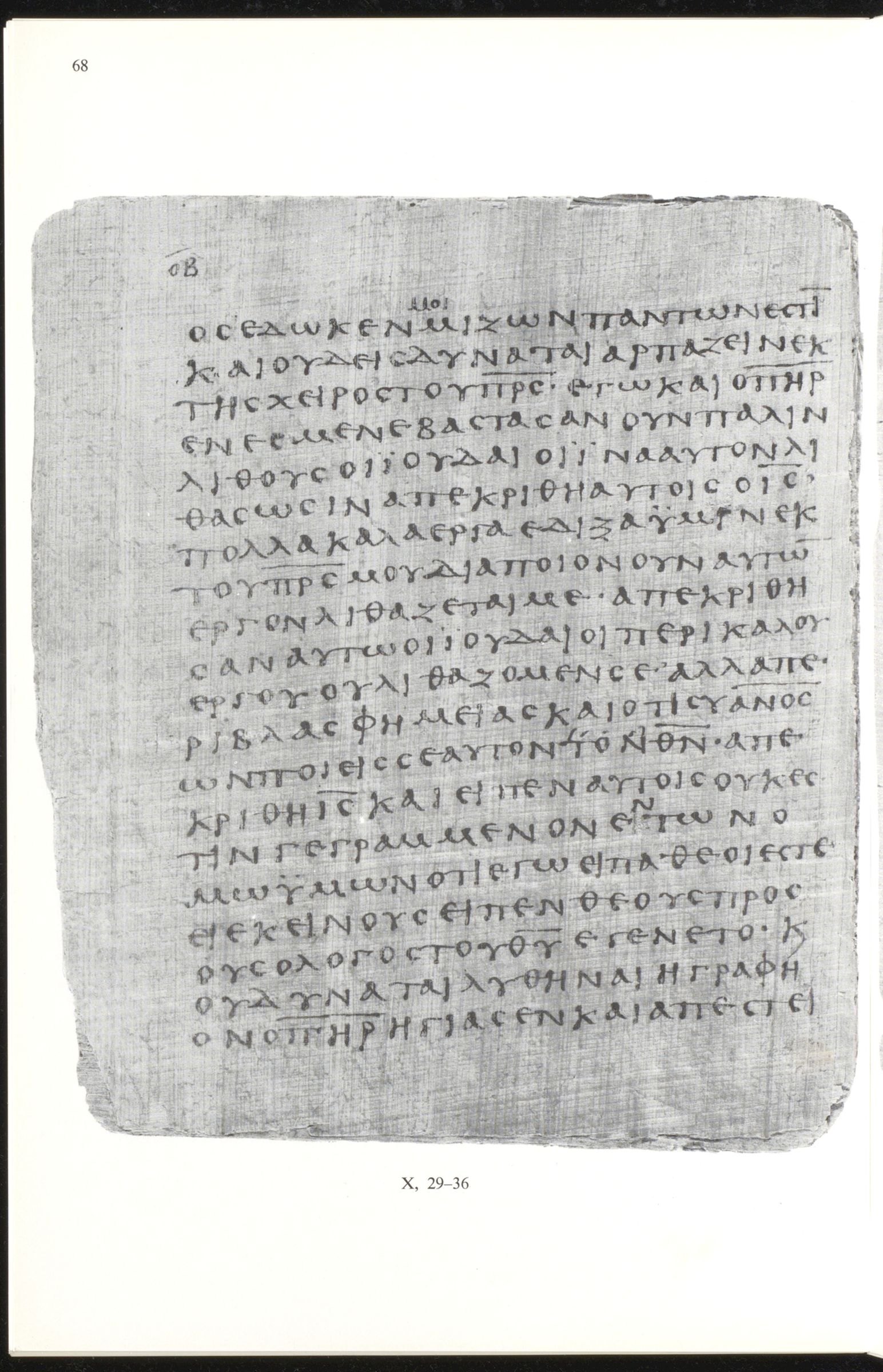
Fondation Martin Bodmer, Papyrus Bodmer II, Bodmer Lab image 1072205287_076 (https://bodmerlab.unige.ch/fr/constellations/papyri/mirador/1072205287), photographic plate of the 1962 Martin-Barns edition, shown whole. NTVMR page 680 (page 72) is linked to this image in NTVMR's page index. 10:29 begins on the previous page; 10:36 continues on the next page. Checked on the image: the printed caption reads ‹X, 29-36›; the last line of writing, ‹ον ο π̅η̅ρ̅ ηγιασεν και απεστει› (line 20 of the transcription), is legible at the foot of the page.
10:29 ος εδωκεν μιζων παντων εστιν
και ουδεις δυναται αρπαζειν εκ
της χειρος του π̅ρ̅ς̅· 30 εγω και ο π̅η̅ρ̅
εν εσμεν 31 εβαστασαν ουν παλιν
λιθους οι ιουδαιοι ινα αυτον λι
θασωσιν 32 απεκριθη αυτοις ο ι̅ς̅
πολλα καλα εργα εδιξα υμυ̣ν εκ
του π̅ρ̅ς̅ μου δια ποιον ουν αυτων
εργον λιθαζεται με· 33 απεκριθη
σαν αυτω οι ιουδαιοι περι καλου
εργου ου λιθαζομεν σε αλλα πε
ρι βλασφημειας και οτι συ α̅ν̅ο̅ς̅
ων ποιεις σεαυτον τον θ̅ν̅· 34 απε
κριθη ι̅ς̅ και ειπεν αυτοις ουκ εσ
τιν γεγραμμενον εκ̣ τω νο
μω υμων οτι εγω ειπα θεοι εστε
35 ει εκεινους ειπεν θεους προς
ους ο λογος του θ̅υ̅ εγενετο· και
ου δυναται λυθηναι η γραφη
36 ον ο π̅η̅ρ̅ ηγιασεν και απεστει
10:29My Father, which gave them me, is greater than all; and no man is able to pluck them out of my Father’s hand. 30I and my Father are one. 31Then the Jews took up stones again to stone him. 32Jesus answered them, Many good works have I shewed you from my Father; for which of those works do ye stone me? 33The Jews answered him, saying, For a good work we stone thee not; but for blasphemy; and because that thou, being a man, makest thyself God. 34Jesus answered them, Is it not written in your law, I said, Ye are gods? 35If he called them gods, unto whom the word of God came, and the scripture can not be broken; 36Say ye of him, whom the Father hath sanctified, and sent into the world, Thou blasphemest; because I said, I am the Son of God?
Where on the image
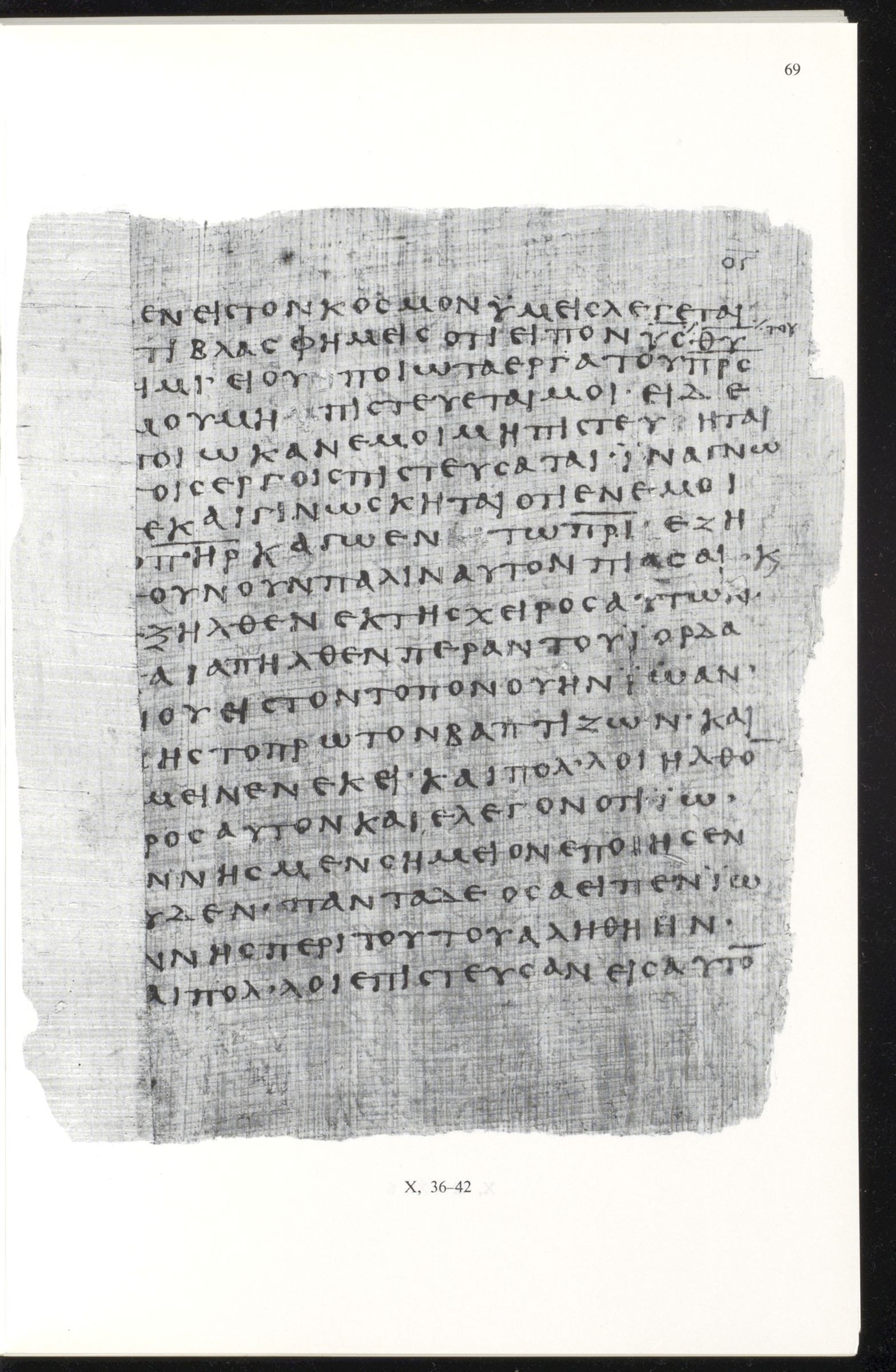
Fondation Martin Bodmer, Papyrus Bodmer II, Bodmer Lab image 1072205287_077 (https://bodmerlab.unige.ch/fr/constellations/papyri/mirador/1072205287), photographic plate of the 1962 Martin-Barns edition, shown whole. NTVMR page 690 (page 73) is linked to this image in NTVMR's page index. 10:36 begins on the previous page; 10:42 continues on the next page. Checked on the image: the printed caption reads ‹X, 36-42›; the last line of writing, ‹αι πολλοι επιστευσαν εις αυτον› (line 19 of the transcription), is legible at the foot of the page.
10:36 λ̣εν εις τον κοσμον υμεις λεγεται
[ο]τι βλασφημεις οτι ειπον υ̅ς̅ θ̅υ̅
ε̣ιμι 37 ει ουν ποιω τα εργα του π̅ρ̅ς̅
μου μη μ̣ πιστευεται μοι· 38 ει δε
π̣οιω καν εμοι μη πιστευσηται
τ̣οις εργοις πιστευσαται· ινα γνω
τ̣ε και γινωσκηται οτι εν εμοι
ο̣ π̅η̅ρ̅ καγω εν α̣υ̣τω π̅ρ̅ι̅· 39 εζη
τ̣ουν ουν παλιν αυτον πιασαι και
ε̣ξηλθεν εκ της χειρος αυτων·
40 κ̣αι απηλθεν περαν του ιορδα
ν̣ου εις τον τοπον ου ην ιωαν
ν̣ης το πρωτον βαπτιζων· και
[ε]μεινεν εκει· 41 και πολλοι ηλθον
[π]ρος αυτον και ελεγον οτι ιω
[α]ννης μεν σημειον εποιησεν
[ο]υδεν· παντα δε οσα ειπεν ιω
[α]ννης περι τουτου αληθη ειν·
42 [κ]αι πολλοι επιστευσαν εις αυτον
10:36Say ye of him, whom the Father hath sanctified, and sent into the world, Thou blasphemest; because I said, I am the Son of God? 37If I do not the works of my Father, believe me not. 38But if I do, though ye believe not me, believe the works: that ye may know, and believe, that the Father is in me, and I in him. 39Therefore they sought again to take him: but he escaped out of their hand, 40And went away again beyond Jordan into the place where John at first baptized; and there he abode. 41And many resorted unto him, and said, John did no miracle: but all things that John spake of this man were true. 42And many believed on him there.
Where on the image
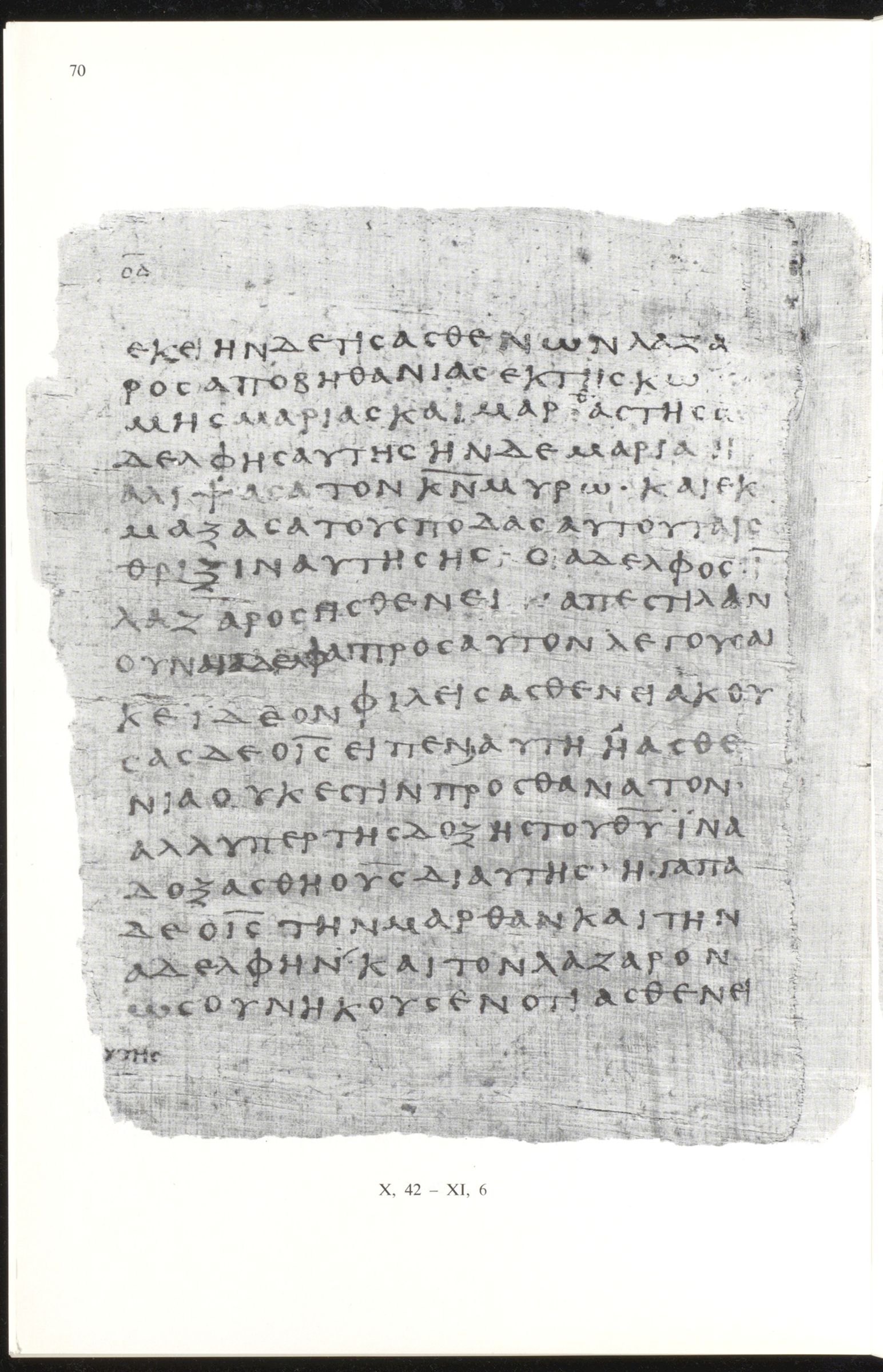
Fondation Martin Bodmer, Papyrus Bodmer II, Bodmer Lab image 1072205287_078 (https://bodmerlab.unige.ch/fr/constellations/papyri/mirador/1072205287), photographic plate of the 1962 Martin-Barns edition, shown whole. NTVMR page 700 (page 74) is linked to this image in NTVMR's page index. 10:42 begins on the previous page; 11:6 continues on the next page. Checked on the image: the printed caption reads ‹X, 42 - XI, 6›; the last line of writing, ‹ως ουν ηκουσεν οτι ασθενει› (line 17 of the transcription), is legible at the foot of the page.
10:42 εκει 11:1 ην δε τις ασθενων λαζα
ρος απο βηθανιας εκ της κω
μης μαριας και μαρι̣ας της α
δελφης αυτο̣υ̣ 2 ην δε μαρια η
αλιψασα τον κ̅ν̅ μυρω· και εκ
μαξασα τους ποδας αυτου ταις
θριξιν αυτης ης και αδελφος ην
λαζαρος α̣σθενω̣ν· 3 απεστιλεν
ουν μ̣α̣ρθ̣α προς αυτον λεγουσα
κ̅ε̅ ιδε ον φιλεις ασθενει 4 ακου
σας δε ο ι̅ς̅ ειπεν αυτη η ασθε
νια ουκ εστιν προς θανατον
αλλ υπερ της δοξης του θ̅υ̅ ινα
δοξασθη ο υ̅ς̅ δι αυτης 5 ηγαπα
δε ο ι̅ς̅ την μαρθαν και την
αδελφην και τον λαζαρον
6 ως ουν ηκουσεν οτι ασθενει
10:42And many believed on him there. 11:1Now a certain man was sick, named Lazarus, of Bethany, the town of Mary and her sister Martha. 2(It was that Mary which anointed the Lord with ointment, and wiped his feet with her hair, whose brother Lazarus was sick.) 3Therefore his sisters sent unto him, saying, Lord, behold, he whom thou lovest is sick. 4When Jesus heard that, he said, This sickness is not unto death, but for the glory of God, that the Son of God might be glorified thereby. 5Now Jesus loved Martha, and her sister, and Lazarus. 6When he had heard therefore that he was sick, he abode two days still in the same place where he was.
Notes
- Greek: the NTVMR diplomatic transcription, line by line as on the papyrus. Square brackets enclose letters that are lost or illegible and were supplied by the transcribers; a dot under a letter marks it as uncertain; [...] marks a gap. Nomina sacra and numerals keep the scribe's overline. Spelling is the scribe's (no accents or breathings). Words broken at a line end stay broken as on the papyrus. Corrections are not shown: the text is the first hand.
- English: the King James Version (1611), whole verses, for every verse that has text on the page. A verse that begins on one page and ends on the next is given in full on both. The KJV translates a later form of the Greek text, so its wording does not always match the papyrus; material differences (such as verses the papyrus does not have) are noted in the section.
Cite
Sources
- Source: Papyrus Bodmer II (P66), Fondation Martin Bodmer: images from the Bodmer Lab, University of Geneva; Greek from the INTF NTVMR transcription of P66; English from the King James Version (holding institution)
- Critical edition: INTF NTVMR diplomatic transcription (CC BY 4.0)
← previous · → next · v cycle view · l back to library