P66 (Papyrus Bodmer II): John 9:6-10:1 (pages 61-66)
Introduction
P66 is a papyrus codex of the Gospel of John copied in Egypt around 200, the most complete early copy of John. Most of it is Papyrus Bodmer II in the Fondation Martin Bodmer, Cologny (Geneva); small pieces are in the Chester Beatty Library, Dublin, and the Institut für Altertumskunde, Cologne. The first five quires (John 1:1-14:26) survive as a bound book of numbered pages; later leaves, from John 14:29 to 21:9, are damaged and kept between glass. The scribe made many corrections, some of them his own; only the first hand is shown here.
Each section below is one page: the photograph, the NTVMR diplomatic transcription line by line, and the King James Version of every verse on the page. Pages of the bound book are shown on the photographic plates published by Victor Martin and J. W. B. Barns in 1962 (scanned by the Bodmer Lab), the glass-mounted leaves on colour photographs. Lost: John 6:12-34 (pages 35-38) and parts of chapters 14-21; the transcription ends at 21:9. Where P66 lacks a verse that the KJV has (John 5:4, the account of the adulteress at 7:53-8:11, 16:15), the section says so.
This entry covers pages 61-66 (John 9:6-10:1).
How was this verified? (Provenance)
Where on the image
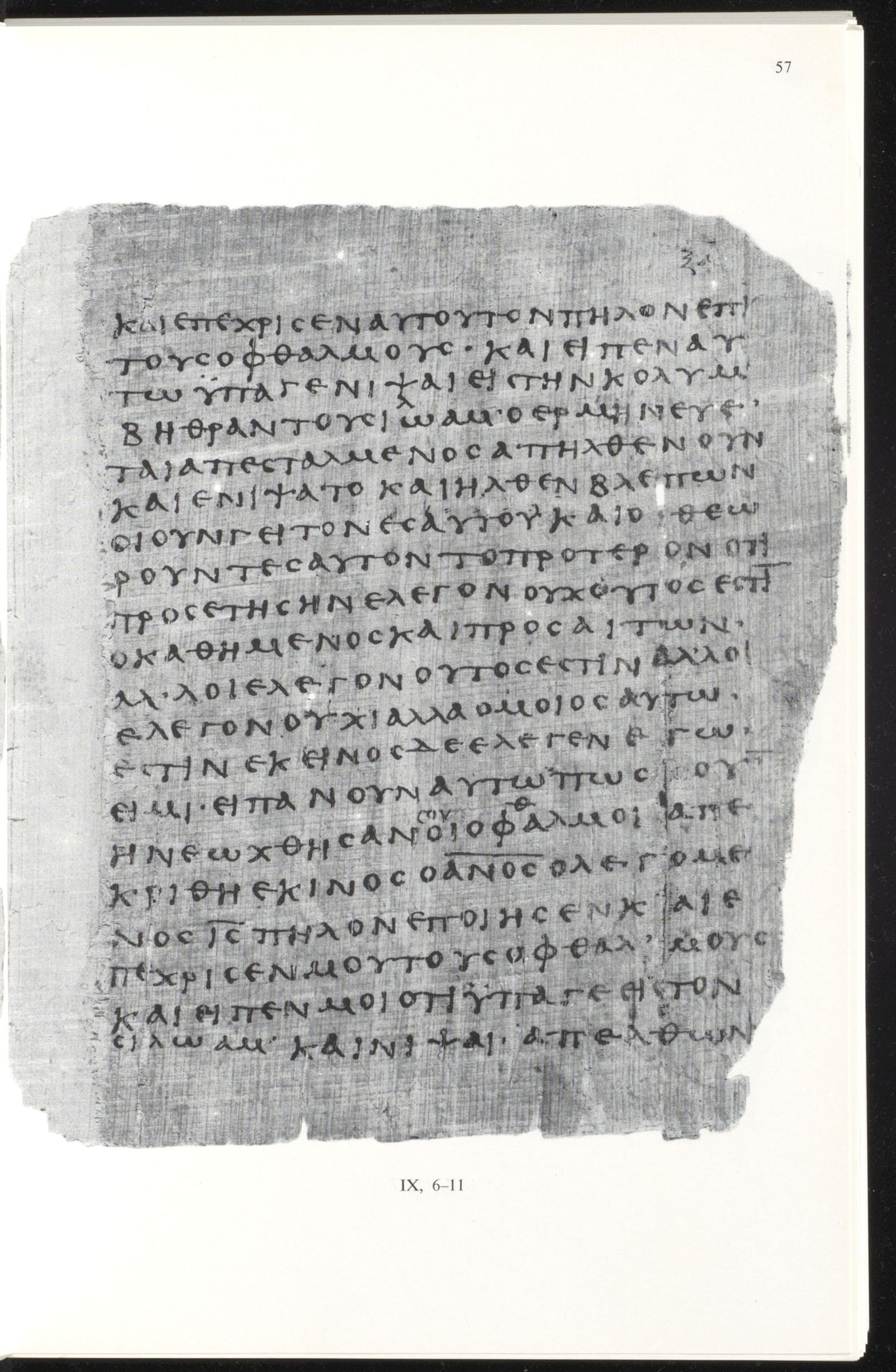
Fondation Martin Bodmer, Papyrus Bodmer II, Bodmer Lab image 1072205287_065 (https://bodmerlab.unige.ch/fr/constellations/papyri/mirador/1072205287), photographic plate of the 1962 Martin-Barns edition, shown whole. NTVMR page 570 (page 61) is linked to this image in NTVMR's page index. 9:6 begins on the previous page; 9:11 continues on the next page. Checked on the image: the printed caption reads ‹IX, 6-11›; the last line of writing, ‹σιλωαμ και νιψαι· απελθων› (line 20 of the transcription), is legible at the foot of the page.
9:6 και επεχρισεν αυτου τον πηλον επι
τους οφθαλμους· 7 και ειπεν αυ
τω υπαγε νιψαι εις την κολυμ
βηθραν του σιωαμ ο ερμηνευε
ται απεσταλμενος απηλθεν ουν
και ενιψατο και ηλθεν βλεπων
8 οι ουν γειτονες αυτου και οι̣ θεω
ρουντες αυτον το προτερον οτι
προσετης ην ελεγον ουχ ουτος εστιν
ο καθημενος και προσαιτων
9 αλλοι ελεγον ουτος εστιν αλλοι
ελεγον ουχι αλλα ομοιος αυτω
εστιν εκεινος δε ελεγεν εγω
ειμι· 10 ειπαν ουν αυτω πως σου
ηνεωχθησαν οι οφαλμοι 11 απε
κριθη εκινος ο α̅ν̅ο̅ς̅ ο λεγομε
νος ι̅ς̅ πηλον εποιησεν και ε
πεχρισεν μου τους οφθαλμους
και ειπεν μοι οτι υπαγε εις τον
σιλωαμ και νιψαι· απελθων
9:6When he had thus spoken, he spat on the ground, and made clay of the spittle, and he anointed the eyes of the blind man with the clay, 7And said unto him, Go, wash in the pool of Siloam, (which is by interpretation, Sent.) He went his way therefore, and washed, and came seeing. 8¶ The neighbours therefore, and they which before had seen him that he was blind, said, Is not this he that sat and begged? 9Some said, This is he: others said, He is like him: but he said, I am he. 10Therefore said they unto him, How were thine eyes opened? 11He answered and said, A man that is called Jesus made clay, and anointed mine eyes, and said unto me, Go to the pool of Siloam, and wash: and I went and washed, and I received sight.
Where on the image
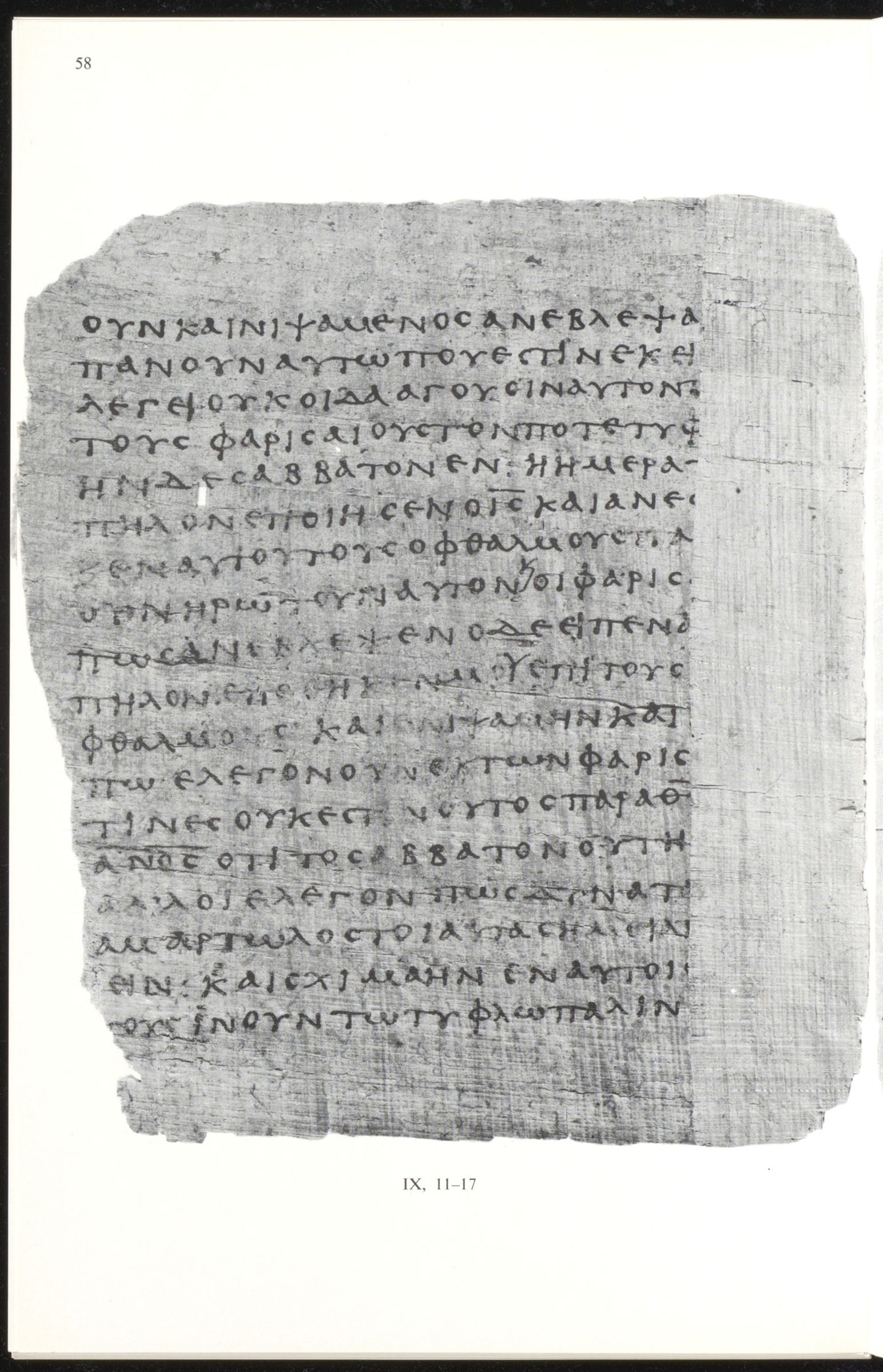
Fondation Martin Bodmer, Papyrus Bodmer II, Bodmer Lab image 1072205287_066 (https://bodmerlab.unige.ch/fr/constellations/papyri/mirador/1072205287), photographic plate of the 1962 Martin-Barns edition, shown whole. NTVMR page 580 (page 62) is linked to this image in NTVMR's page index. 9:11 begins on the previous page; 9:17 continues on the next page. Checked on the image: the printed caption reads ‹IX, 11-17›; the last line of writing, ‹γ̣ουσιν ουν τω τυφλω παλιν› (line 18 of the transcription), is legible at the foot of the page.
9:11 ουν και νιψαμενος ανεβλεψα 12 [ει]
παν ουν αυτω που εστιν εκει[νος]
λεγει ουκ οιδα 13 αγουσιν αυτον π̣[ρος]
τους φαρισαιους τον ποτε τυφ[λον]
14 ην δε σαββατον εν τ̣η ημερα τ̣[ον]
πηλον εποιησεν ο ι̅ς̅ και ανεω̣
ξεν αυτου τους οφθαλμους 15 πα[λιν]
ουν ηρωτουν αυτον οι φαρισ[αιοι]
πως ανεβλεψεν ο δε ειπεν α[υτοις]
πηλον επεθηκεν μοι επι τους [ο]
φθαλμους και ενιψαμην και [βλε]
πω 16 ελεγον ουν εκ των φαρισ[αιων]
τινες ουκ εστιν ουτος παρα θ̅υ̣̣̅ [ο]
α̅ν̅ο̅ς̅ οτι το σαββατον ου τη[ρει]
αλλοι ελεγον πως δυνατα̣[ι α̅ν̅ο̅ς̅]
αμαρτωλος τοιαυτα σημεια π̣[οι]
ειν· και σχιμα ην εν αυτοις̣ 17 [λε]
γ̣ουσιν ουν τω τυφλω παλιν [τι συ]
9:11He answered and said, A man that is called Jesus made clay, and anointed mine eyes, and said unto me, Go to the pool of Siloam, and wash: and I went and washed, and I received sight. 12Then said they unto him, Where is he? He said, I know not. 13¶ They brought to the Pharisees him that aforetime was blind. 14And it was the sabbath day when Jesus made the clay, and opened his eyes. 15Then again the Pharisees also asked him how he had received his sight. He said unto them, He put clay upon mine eyes, and I washed, and do see. 16Therefore said some of the Pharisees, This man is not of God, because he keepeth not the sabbath day. Others said, How can a man that is a sinner do such miracles? And there was a division among them. 17They say unto the blind man again, What sayest thou of him, that he hath opened thine eyes? He said, He is a prophet.
Where on the image
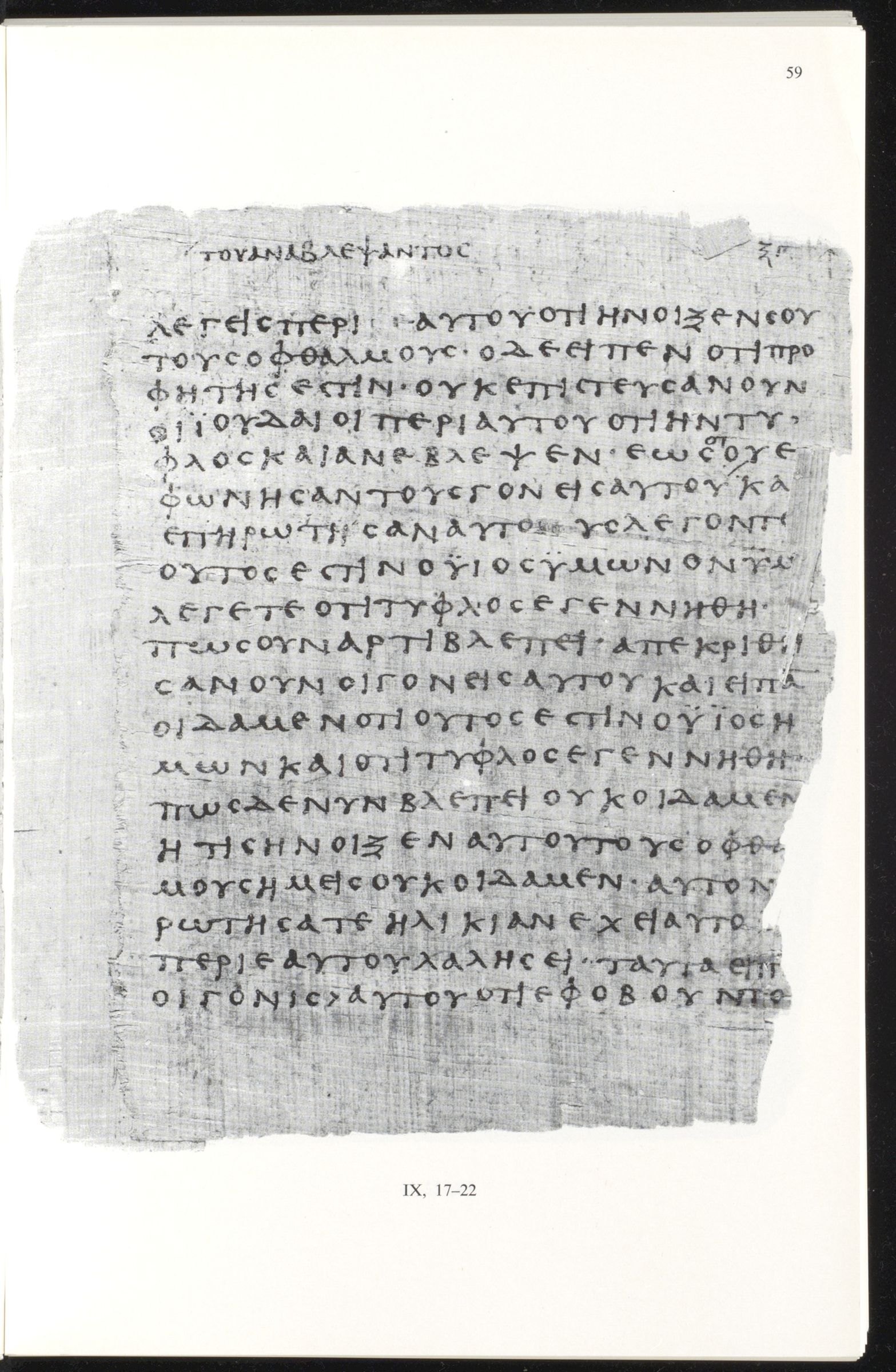
Fondation Martin Bodmer, Papyrus Bodmer II, Bodmer Lab image 1072205287_067 (https://bodmerlab.unige.ch/fr/constellations/papyri/mirador/1072205287), photographic plate of the 1962 Martin-Barns edition, shown whole. NTVMR page 590 (page 63) is linked to this image in NTVMR's page index. 9:17 begins on the previous page; 9:22 continues on the next page. Checked on the image: the printed caption reads ‹IX, 17-22›; the last line of writing, ‹οι γονις αυτου οτι εφοβουντο› (line 19 of the transcription), is legible at the foot of the page.
9:17 λεγεις περι σ̣εαυτου οτι ηνοιξεν σου
τους οφθαλμους· ο δε ειπεν οτι προ
φητης εστιν· 18 ουκ επιστευσαν ουν
οι ιουδαιοι περι αυτου οτι ην τυ
φλος και ανεβλεψεν· εως ου ε
φωνησαν τους γονεις αυτου 19 κα[ι]
επηρωτησαν αυτους λεγοντε̣[ς]
ουτος εστιν ο υιος υμων ον υμ[εις]
λεγετε οτι τυφλος εγεννηθη·
πως ουν αρτι βλεπει· 20 απεκριθη
σαν ουν οι γονεις αυτου και ειπαν
οιδαμεν οτι ουτος εστιν ο υιος η
μων και οτι τυφλος εγεννηθη·
21 πως δε νυν βλεπει ουκ οιδαμεν
η τις ηνοιξεν αυτου τους οφθα̣[λ]
μους ημεις ουκ οιδαμεν· αυτον [ε]
ρωτησατε ηλικιαν εχει αυτος̣
περι εαυτου λαλησει· 22 ταυτα ειπ[αν]
οι γονις αυτου οτι εφοβουντο
9:17They say unto the blind man again, What sayest thou of him, that he hath opened thine eyes? He said, He is a prophet. 18But the Jews did not believe concerning him, that he had been blind, and received his sight, until they called the parents of him that had received his sight. 19And they asked them, saying, Is this your son, who ye say was born blind? how then doth he now see? 20His parents answered them and said, We know that this is our son, and that he was born blind: 21But by what means he now seeth, we know not; or who hath opened his eyes, we know not: he is of age; ask him: he shall speak for himself. 22These words spake his parents, because they feared the Jews: for the Jews had agreed already, that if any man did confess that he was Christ, he should be put out of the synagogue.
Where on the image
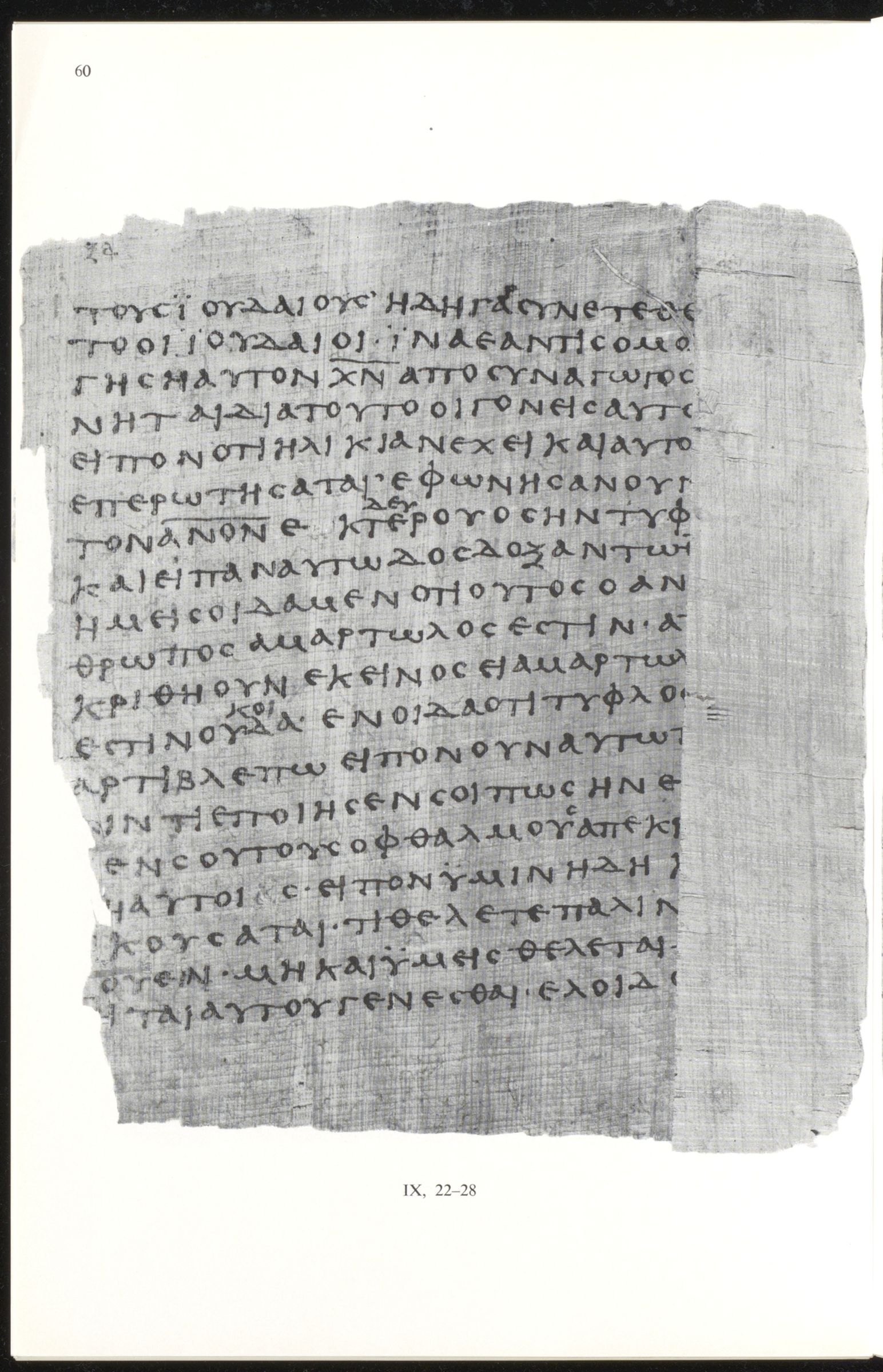
Fondation Martin Bodmer, Papyrus Bodmer II, Bodmer Lab image 1072205287_068 (https://bodmerlab.unige.ch/fr/constellations/papyri/mirador/1072205287), photographic plate of the 1962 Martin-Barns edition, shown whole. NTVMR page 600 (page 64) is linked to this image in NTVMR's page index. 9:22 begins on the previous page; 9:28 continues on the next page. Checked on the image: the printed caption reads ‹IX, 22-28›; the last line of writing, ‹ηται αυτου γενεσθαι· ελοιδο̣› (line 19 of the transcription), is legible at the foot of the page.
9:22 τους ιουδαιους ηδη γα συνετεθε[ιν]
το οι ιουδαιοι· ινα εαν τις ομο[λο]
γηση αυτον χ̅ν̅ αποσυναγωγος [γε]
νηται 23 δια τουτο οι γονεις αυτο[υ]
ειπον οτι ηλικιαν εχει και αυτο[ν]
επερωτησαται 24 εφωνησαν ουν̣
τον α̅ν̅ο̅ν̅ εκ τερου ος ην τυφ[λος]
και ειπαν αυτω δος δοξαν τω θ̣̣̅[ω̅]
ημεις οιδαμεν οτι ουτος ο αν
θρωπος αμαρτωλος εστιν· 25 απ̣[ε]
κριθη ουν εκεινος ει αμαρτωλ[ος]
εστιν ουδα· εν οιδα οτι τυφλος̣ [ων]
αρτι βλεπω 26 ειπον ουν αυτω π̣[α]
λ̣ιν τι εποιησεν σοι πως ηνε[ω]
[ξ]εν σου τους οφθαλμου 27 απεκρ̣[ι]
[θ]η αυτοια̣ς· ειπον υμιν ηδη κ̣[αι]
[η]κουσαται· τι θελετε παλιν [α]
[κ]ουειν· μη και υμεις θελεται μ̣[α]
[θ]ηται αυτου γενεσθαι· 28 ελοιδο̣[ρη]
9:22These words spake his parents, because they feared the Jews: for the Jews had agreed already, that if any man did confess that he was Christ, he should be put out of the synagogue. 23Therefore said his parents, He is of age; ask him. 24Then again called they the man that was blind, and said unto him, Give God the praise: we know that this man is a sinner. 25He answered and said, Whether he be a sinner or no, I know not: one thing I know, that, whereas I was blind, now I see. 26Then said they to him again, What did he to thee? how opened he thine eyes? 27He answered them, I have told you already, and ye did not hear: wherefore would ye hear it again? will ye also be his disciples? 28Then they reviled him, and said, Thou art his disciple; but we are Moses’ disciples.
Where on the image
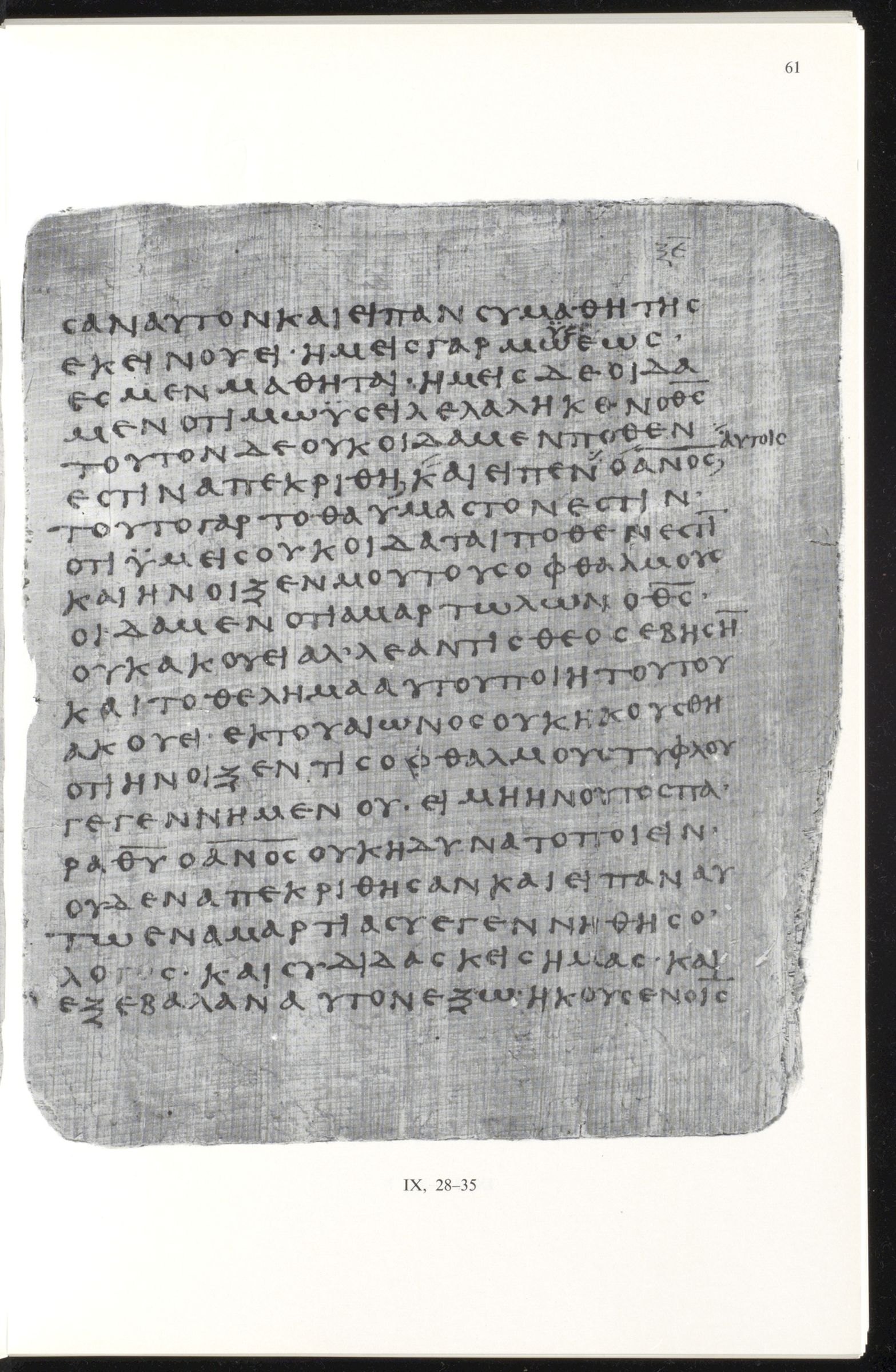
Fondation Martin Bodmer, Papyrus Bodmer II, Bodmer Lab image 1072205287_069 (https://bodmerlab.unige.ch/fr/constellations/papyri/mirador/1072205287), photographic plate of the 1962 Martin-Barns edition, shown whole. NTVMR page 610 (page 65) is linked to this image in NTVMR's page index. 9:28 begins on the previous page; 9:35 continues on the next page. Checked on the image: the printed caption reads ‹IX, 28-35›; the last line of writing, ‹εξεβαλαν αυτον εξω· ηκουσεν ο ι̅ς̅› (line 20 of the transcription), is legible at the foot of the page.
9:28 σαν αυτον και ειπαν συ μαθητης
εκεινου ει· ημεις γαρ μωεως
εσμεν μαθηται· 29 ημεις δε οιδα
μεν οτι μωυσει λελαληκεν ο θ̅ς̅
τουτον δε ουκ οιδαμεν ποθεν
εστιν 30 απεκριθη και ειπεν ο α̅ν̅ο̅ς̅
τουτο γαρ το θαυμαστον εστιν
οτι υμεις ουκ οιδαται ποθεν εστιν
και ηνοιξεν μου τους οφθαλμους
31 οιδαμεν οτι αμαρτωλων ο θ̅ς̅
ουκ ακουει αλλ εαν τις θεοσεβης ην
και το θελημα αυτου ποιη τουτου
ακουει· 32 εκ του αιωνος ουκ ηκουσθη
οτι ηνοιξεν τις οφθαλμους τυφλου
γεγεννημενου· 33 ει μη ην ουτος πα
ρα θ̅υ̅ ο α̅ν̅ο̅ς̅ ουκ ηδυνατο ποιειν
ουδεν 34 απεκριθησαν και ειπαν αυ
τω εν αμαρτια συ εγεννηθης ο
λογος· και συ διδασκεις ημας· και
εξεβαλαν αυτον εξω· 35 ηκουσεν ο ι̅ς̅
9:28Then they reviled him, and said, Thou art his disciple; but we are Moses’ disciples. 29We know that God spake unto Moses: as for this fellow, we know not from whence he is. 30The man answered and said unto them, Why herein is a marvellous thing, that ye know not from whence he is, and yet he hath opened mine eyes. 31Now we know that God heareth not sinners: but if any man be a worshipper of God, and doeth his will, him he heareth. 32Since the world began was it not heard that any man opened the eyes of one that was born blind. 33If this man were not of God, he could do nothing. 34They answered and said unto him, Thou wast altogether born in sins, and dost thou teach us? And they cast him out. 35Jesus heard that they had cast him out; and when he had found him, he said unto him, Dost thou believe on the Son of God?
Where on the image
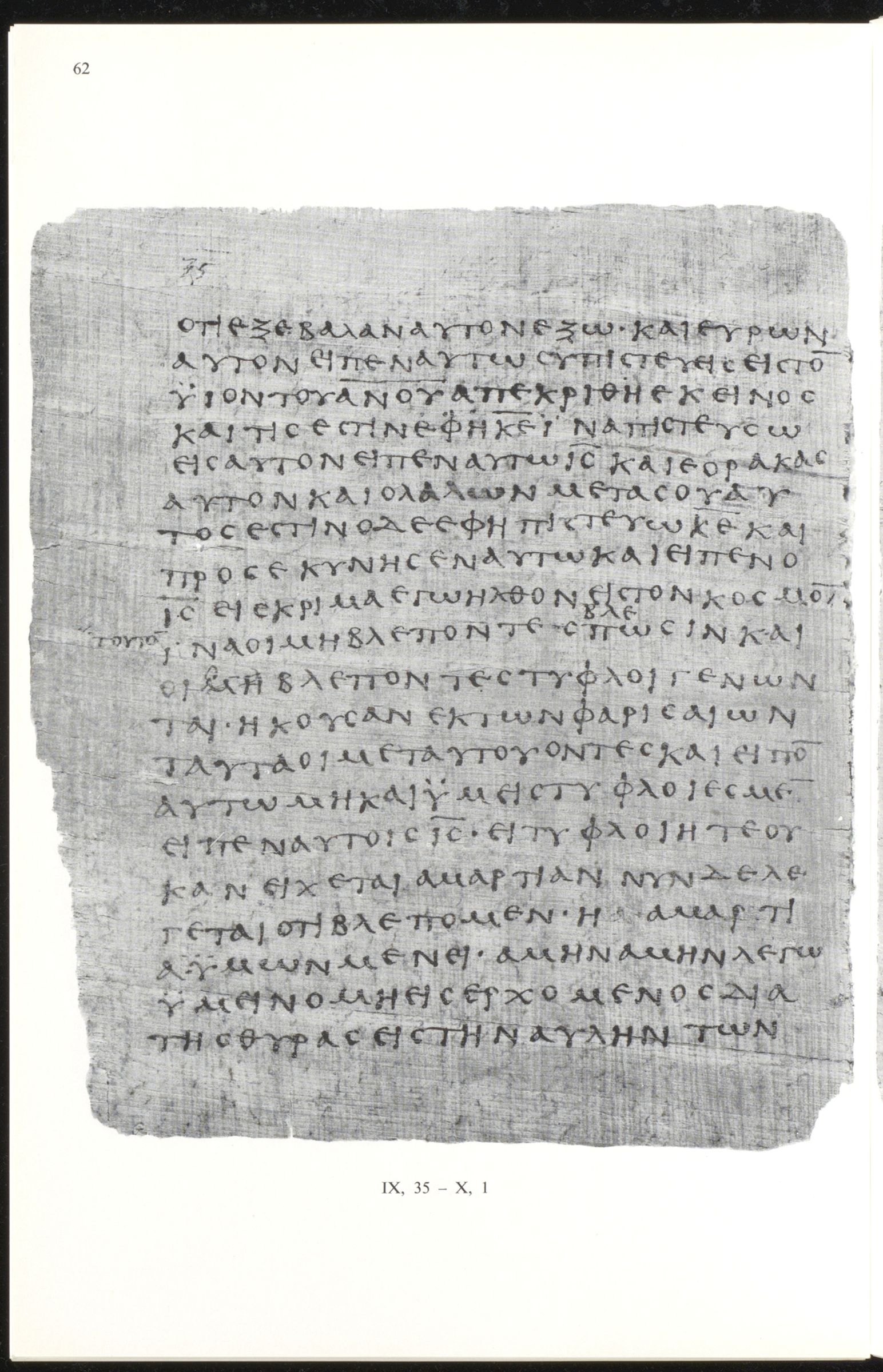
Fondation Martin Bodmer, Papyrus Bodmer II, Bodmer Lab image 1072205287_070 (https://bodmerlab.unige.ch/fr/constellations/papyri/mirador/1072205287), photographic plate of the 1962 Martin-Barns edition, shown whole. NTVMR page 620 (page 66) is linked to this image in NTVMR's page index. 9:35 begins on the previous page; 10:1 continues on the next page. Checked on the image: the printed caption reads ‹IX, 35 - X, 1›; the last line of writing, ‹της θυρας εις την αυλην των› (line 20 of the transcription), is legible at the foot of the page.
9:35 οτι εξεβαλαν αυτον εξω· και ευρων
αυτον ειπεν αυτω συ πιστευεις εις τον
υιον του α̅ν̅ο̅υ̅ 36 απεκριθη εκεινος
και τις εστιν εφη κ̅ε̅ ινα πιστευσω
εις αυτον 37 ειπεν αυτω ι̅ς̅ και εορακας
αυτον και ο λαλων μετα σου αυ
τος εστιν 38 ο δε εφη πιστευω κ̅ε̅ και
προσεκυνησεν αυτω 39 και ειπεν ο
ι̅ς̅ εις κριμα εγω ηλθον εις τον κοσμον
ινα οι μη βλεποντες πωσιν και
οι μη βλεποντες τυφλοι γενων
ται· 40 ηκουσαν εκ των φαρισαιων
ταυτα οι μετ αυτου οντες και ειπον
αυτω μη και υμεις τυφλοι εσμεν
41 ειπεν αυτοις ι̅ς̅· ει τυφλοι ητε ου
κ αν ειχεται αμαρτιαν νυν δε λε
γεται οτι βλεπομεν· η ααμαμ̣τι
α υμων μενει· 10:1 αμην αμην λεγω
υμειν ο μη εισερχομενος δια
της θυρας εις την αυλην των
9:35Jesus heard that they had cast him out; and when he had found him, he said unto him, Dost thou believe on the Son of God? 36He answered and said, Who is he, Lord, that I might believe on him? 37And Jesus said unto him, Thou hast both seen him, and it is he that talketh with thee. 38And he said, Lord, I believe. And he worshipped him. 39¶ And Jesus said, For judgment I am come into this world, that they which see not might see; and that they which see might be made blind. 40And some of the Pharisees which were with him heard these words, and said unto him, Are we blind also? 41Jesus said unto them, If ye were blind, ye should have no sin: but now ye say, We see; therefore your sin remaineth. 10:1Verily, verily, I say unto you, He that entereth not by the door into the sheepfold, but climbeth up some other way, the same is a thief and a robber.
Notes
- Greek: the NTVMR diplomatic transcription, line by line as on the papyrus. Square brackets enclose letters that are lost or illegible and were supplied by the transcribers; a dot under a letter marks it as uncertain; [...] marks a gap. Nomina sacra and numerals keep the scribe's overline. Spelling is the scribe's (no accents or breathings). Words broken at a line end stay broken as on the papyrus. Corrections are not shown: the text is the first hand.
- English: the King James Version (1611), whole verses, for every verse that has text on the page. A verse that begins on one page and ends on the next is given in full on both. The KJV translates a later form of the Greek text, so its wording does not always match the papyrus; material differences (such as verses the papyrus does not have) are noted in the section.
Cite
Sources
- Source: Papyrus Bodmer II (P66), Fondation Martin Bodmer: images from the Bodmer Lab, University of Geneva; Greek from the INTF NTVMR transcription of P66; English from the King James Version (holding institution)
- Critical edition: INTF NTVMR diplomatic transcription (CC BY 4.0)
← previous · → next · v cycle view · l back to library