P66 (Papyrus Bodmer II): John 11:6-12:3 (pages 75-84)
Introduction
P66 is a papyrus codex of the Gospel of John copied in Egypt around 200, the most complete early copy of John. Most of it is Papyrus Bodmer II in the Fondation Martin Bodmer, Cologny (Geneva); small pieces are in the Chester Beatty Library, Dublin, and the Institut für Altertumskunde, Cologne. The first five quires (John 1:1-14:26) survive as a bound book of numbered pages; later leaves, from John 14:29 to 21:9, are damaged and kept between glass. The scribe made many corrections, some of them his own; only the first hand is shown here.
Each section below is one page: the photograph, the NTVMR diplomatic transcription line by line, and the King James Version of every verse on the page. Pages of the bound book are shown on the photographic plates published by Victor Martin and J. W. B. Barns in 1962 (scanned by the Bodmer Lab), the glass-mounted leaves on colour photographs. Lost: John 6:12-34 (pages 35-38) and parts of chapters 14-21; the transcription ends at 21:9. Where P66 lacks a verse that the KJV has (John 5:4, the account of the adulteress at 7:53-8:11, 16:15), the section says so.
This entry covers pages 75-84 (John 11:6-12:3).
How was this verified? (Provenance)
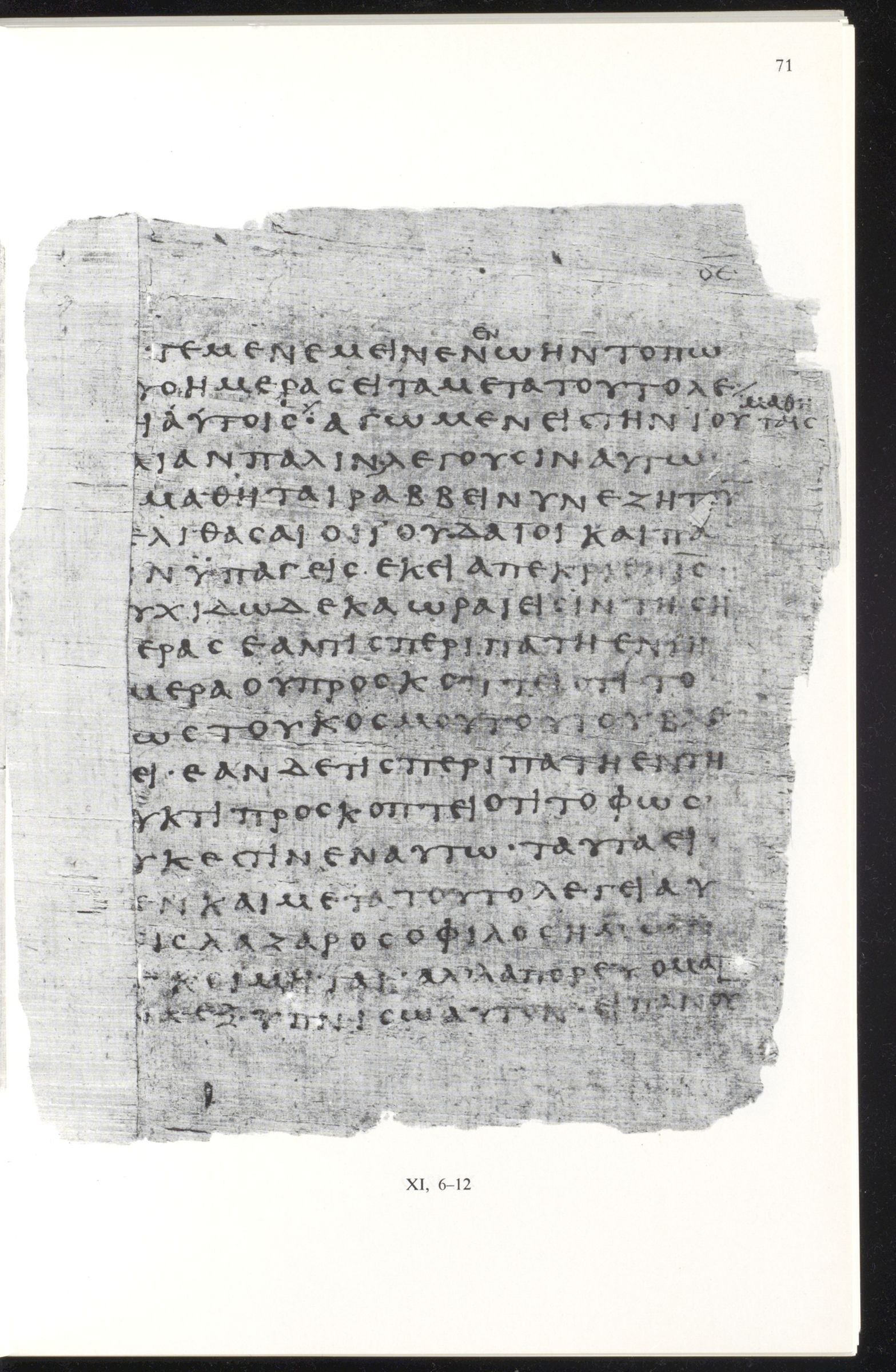
Where on the image
Fondation Martin Bodmer, Papyrus Bodmer II, Bodmer Lab image 1072205287_079 (https://bodmerlab.unige.ch/fr/constellations/papyri/mirador/1072205287), photographic plate of the 1962 Martin-Barns edition, shown whole. NTVMR page 710 (page 75) is linked to this image in NTVMR's page index. 11:6 begins on the previous page; 11:12 continues on the next page. Checked on the image: the printed caption reads ‹XI, 6-12›; the last line of writing, ‹να εξυπνισω αυτον· ειπαν ουν› (line 18 of the transcription), is legible at the foot of the page.
11:6 [το]τε μεν εμεινεν ω ην τοπω
[δ]υο ημερας 7 ειτα μετα τουτο λε
[γ]ε̣ι αυτοις· αγωμεν εις την ιου
[δ]α̣ιαν παλιν· 8 λεγουσιν αυτω
[οι] μαθηται ραββει νυν εζητο̣υν
[σ]ε λιθασαι οι ιουδαιοι και πα
[λ]ι̣ν υπαγεις εκει 9 απεκριθη ι̅ς̅·
[ο]υχι δωδεκα ωραι εισιν της η
[μ]ερας εαν τις περιπατη εν τ̣η
[η]μερα ου προσκοπτει οτι το
[φ]ως του κοσμου τουτου βλε
[π]ει· 10 εαν δε τις περιπατη εν τη
[ν]υκτι προσκοπτει οτι το φως
[ο]υκ εστιν εν αυτω· 11 ταυτα ει
[π]εν και μετα τουτο λεγει αυ
[τ]οις λαζαρος ο φιλος ημων
[κ]ε̣κοιμηται· αλλα πορευομαι
[ι]να εξυπνισω αυτον· 12 ειπαν ουν
11:6When he had heard therefore that he was sick, he abode two days still in the same place where he was. 7Then after that saith he to his disciples, Let us go into Judæa again. 8His disciples say unto him, Master, the Jews of late sought to stone thee; and goest thou thither again? 9Jesus answered, Are there not twelve hours in the day? If any man walk in the day, he stumbleth not, because he seeth the light of this world. 10But if a man walk in the night, he stumbleth, because there is no light in him. 11These things said he: and after that he saith unto them, Our friend Lazarus sleepeth; but I go, that I may awake him out of sleep. 12Then said his disciples, Lord, if he sleep, he shall do well.
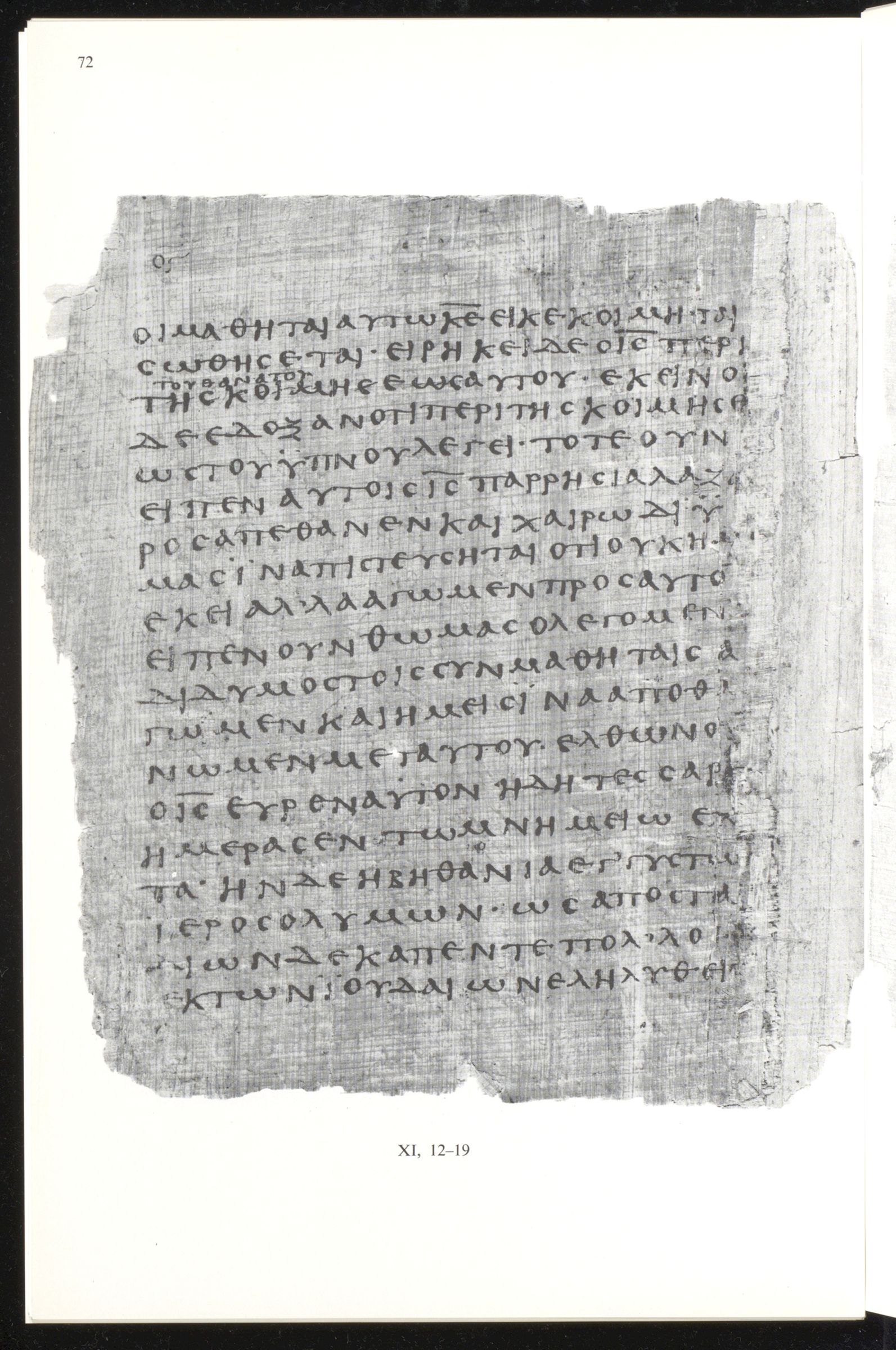
Where on the image
Fondation Martin Bodmer, Papyrus Bodmer II, Bodmer Lab image 1072205287_080 (https://bodmerlab.unige.ch/fr/constellations/papyri/mirador/1072205287), photographic plate of the 1962 Martin-Barns edition, shown whole. NTVMR page 720 (page 76) is linked to this image in NTVMR's page index. 11:12 begins on the previous page; 11:19 continues on the next page. Checked on the image: the printed caption reads ‹XI, 12-19›; the last line of writing, ‹εκ των ιουδαιων εληλυθεισ̣› (line 19 of the transcription), is legible at the foot of the page.
11:12 οι μαθηται αυτω κ̅ε̅ ει κεκοιμηται
σωθησεται· 13 ειρηκει δε ο ι̅ς̅ περι
της κοιμησεως αυτου· εκεινοι
δε εδοξαν οτι περι της κοιμησε
ως του υπνου λεγει· 14 τοτε ουν
ειπεν αυτοις ι̅ς̅ παρρησια λαζα
ρος απεθανεν 15 και χαιρω δι υ
μας ινα πιστευσηται οτι ουκ ημη̣[ν]
εκει αλλα αγωμεν προς αυτον
16 ειπεν ουν θωμας ο λεγομενο̣[ς]
διδυμος τοις συνμαθηταις α
γωμεν και ημεις ινα αποθα
νωμεν μετ αυτου· 17 ελθων ουν
ο ι̅ς̅ ευρον αυτον ηδη τεσσαρε̣[ς]
ημερας εν τω μνημειω εχ[ον]
τα· 18 ην δε η βηθανια εγγυς των̣
ιεροσολυμων· ως απο στα
διων δεκαπεντε 19 πολλοι δ̣[ε]
εκ των ιουδαιων εληλυθεισ̣[αν]
11:12Then said his disciples, Lord, if he sleep, he shall do well. 13Howbeit Jesus spake of his death: but they thought that he had spoken of taking of rest in sleep. 14Then said Jesus unto them plainly, Lazarus is dead. 15And I am glad for your sakes that I was not there, to the intent ye may believe; nevertheless let us go unto him. 16Then said Thomas, which is called Didymus, unto his fellowdisciples, Let us also go, that we may die with him. 17Then when Jesus came, he found that he had lain in the grave four days already. 18Now Bethany was nigh unto Jerusalem, about fifteen furlongs off: 19And many of the Jews came to Martha and Mary, to comfort them concerning their brother.
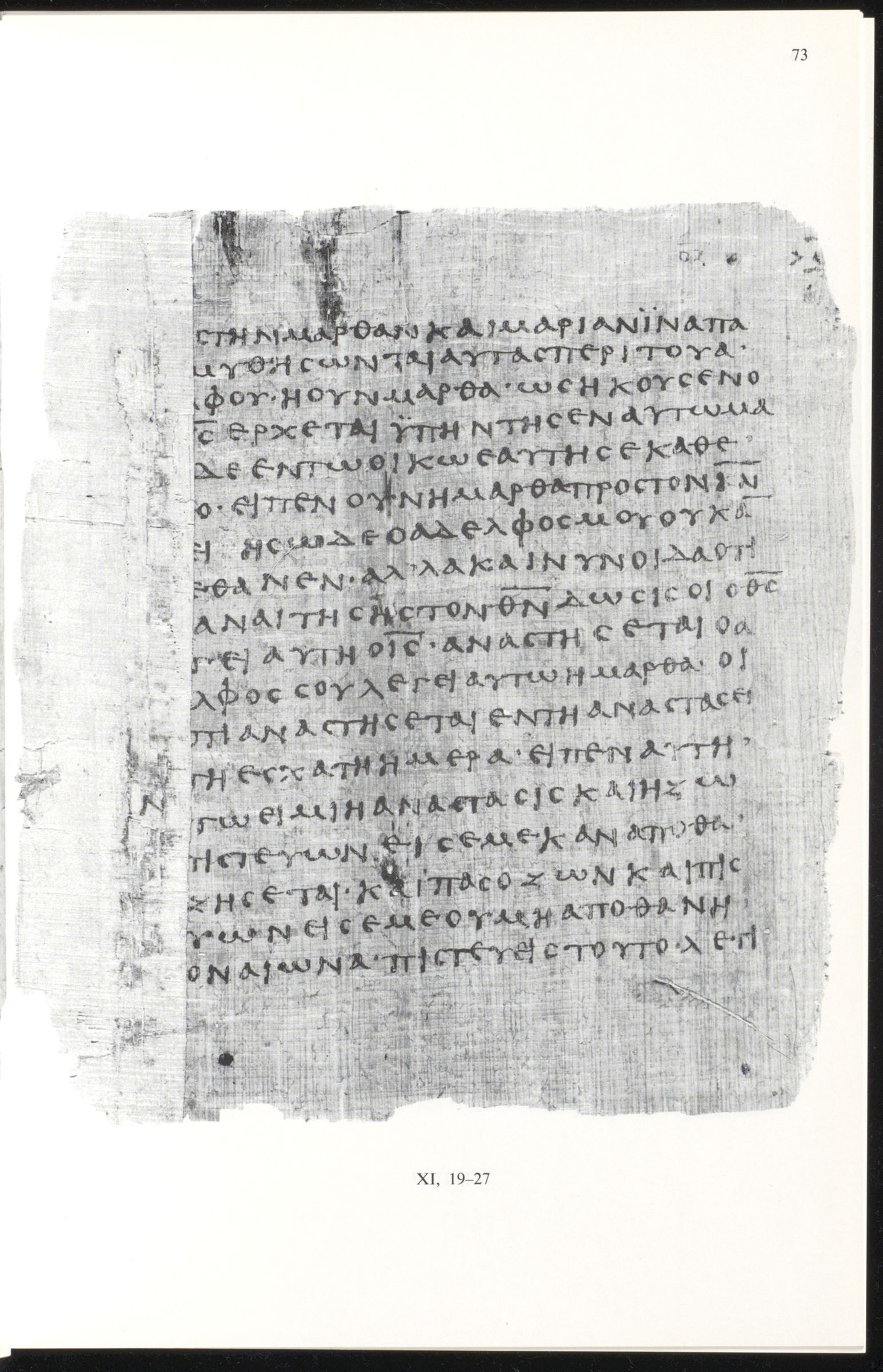
Where on the image
Fondation Martin Bodmer, Papyrus Bodmer II, Bodmer Lab image 1072205287_081 (https://bodmerlab.unige.ch/fr/constellations/papyri/mirador/1072205287), photographic plate of the 1962 Martin-Barns edition, shown whole. NTVMR page 730 (page 77) is linked to this image in NTVMR's page index. 11:19 begins on the previous page; 11:27 continues on the next page. Checked on the image: the printed caption reads ‹XI, 19-27›; the last line of writing, ‹ον αιωνα· πιστευεις τουτο λεγι› (line 18 of the transcription), is legible at the foot of the page.
11:19 [προ]ς την μαρθαν και μαριαν ινα πα
[ρα]μυθησωνται αυτας περι του α
[δε]λ̣φου· 20 η ουν μαρθα· ως ηκουσεν ο
[τι] ι̣̣̅ς̅ ερχεται υπηντησεν αυτω μα
[ρια] δε εν τω οικω εαυτης εκαθε
[ζετ]ο· 21 ειπεν ουν η μαρθα προς τον κ̅ν̅
[κ̅ε̅] εις̣ ης ωδε ο αδελφος μου ουκ αν
[απ]εθανεν· 22 αλλα και νυν οιδα οτι
[οσα] αν αιτησης τον θ̅ν̅ δωσι σοι ο θ̅ς̅
23 [λε]γει αυτη ο ι̅ς̅· αναστησεται ο α
[δε]λφος σου 24 λεγει αυτω η μαρθα· οι
[δα] ο̣τι αναστησεται εν τη αναστασει
[εν] τη εσχατη ημερα· 25 ειπεν αυτη
[ι̅ς̅ ε]γω ειμι η αναστασις και η ζω
[η ο] π̣ιστευων εις εμε καν αποθα
[νη] ζησεται· 26 και πας ο ζων και πισ
[τε]υων εις εμε ου μη αποθανη
[εις τ]ον αιωνα· πιστευεις τουτο 27 λεγι
11:19And many of the Jews came to Martha and Mary, to comfort them concerning their brother. 20Then Martha, as soon as she heard that Jesus was coming, went and met him: but Mary sat still in the house. 21Then said Martha unto Jesus, Lord, if thou hadst been here, my brother had not died. 22But I know, that even now, whatsoever thou wilt ask of God, God will give it thee. 23Jesus saith unto her, Thy brother shall rise again. 24Martha saith unto him, I know that he shall rise again in the resurrection at the last day. 25Jesus said unto her, I am the resurrection, and the life: he that believeth in me, though he were dead, yet shall he live: 26And whosoever liveth and believeth in me shall never die. Believest thou this? 27She saith unto him, Yea, Lord: I believe that thou art the Christ, the Son of God, which should come into the world.
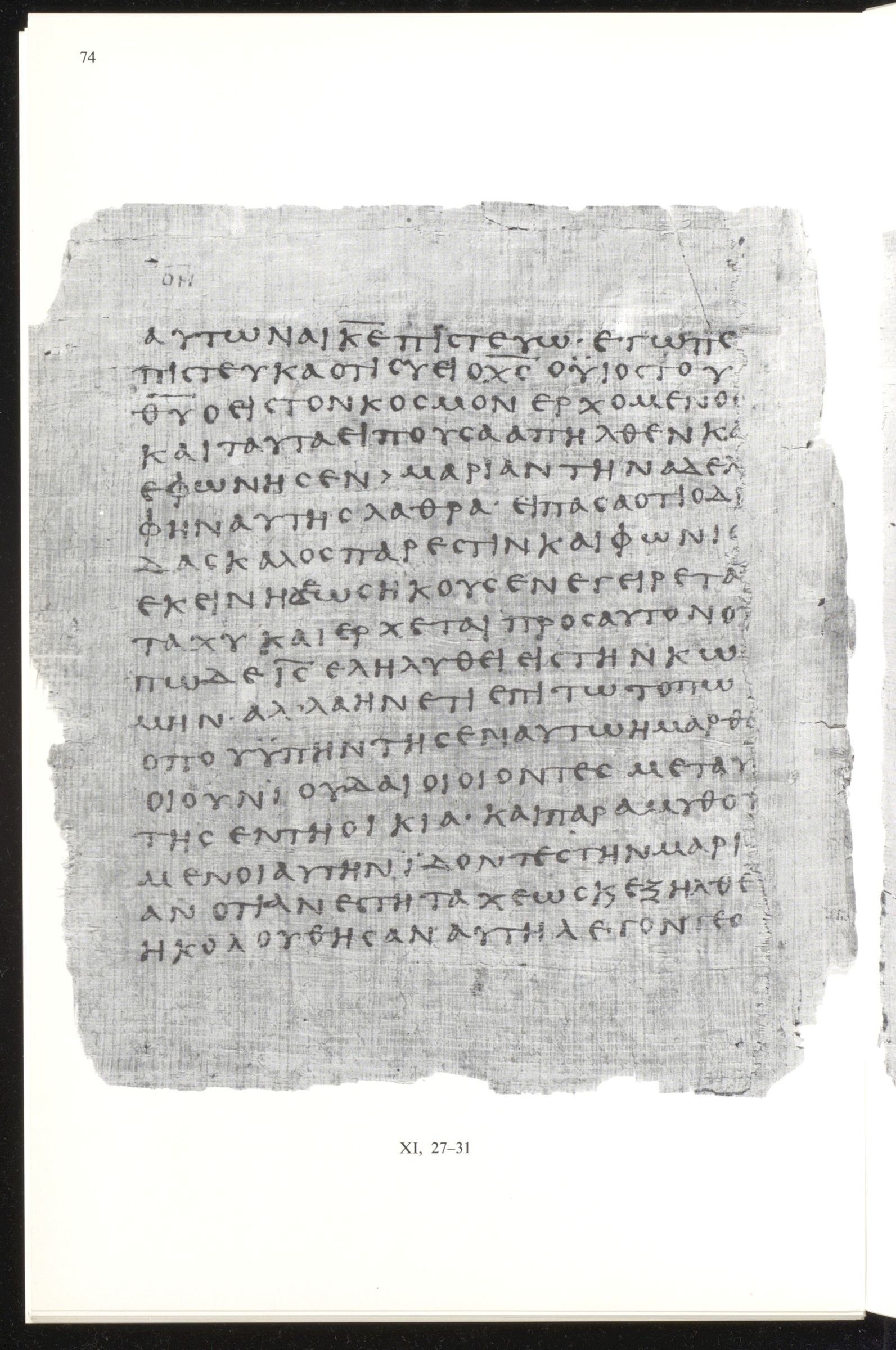
Where on the image
Fondation Martin Bodmer, Papyrus Bodmer II, Bodmer Lab image 1072205287_082 (https://bodmerlab.unige.ch/fr/constellations/papyri/mirador/1072205287), photographic plate of the 1962 Martin-Barns edition, shown whole. NTVMR page 740 (page 78) is linked to this image in NTVMR's page index. 11:27 begins on the previous page; 11:31 continues on the next page. Checked on the image: the printed caption reads ‹XI, 27-31›; the last line of writing, ‹ηκολουθησαν αυτη λεγοντες› (line 17 of the transcription), is legible at the foot of the page.
11:27 αυτω ναι κ̅ε̅ πιστευω· εγω πε
πιστευκα οτι συ ει ο χ̅ς̅ ο υιος του
θ̅υ̅ ο εις τον κοσμον ερχομενος̣
28 και ταυτα ειπουσα απηλθεν κα[ι]
εφωνησεν μαριαν την αδελ
φην αυτης λαθρα· ειπασα οτι ο δι
δασκαλος παρεστιν και φωνι σ[ε]
29 εκεινης ως ηκουσεν εγειρετα[ι]
ταχυ και ερχεται προς αυτον 30 ου̣
πω δε ι̅ς̅ εληλυθει εις την κω
μην· αλλα ην ετι επι τω τοπω
οπου υπηντησεν αυτω η μαρθα̣
31 οι ουν ιουδαιοι οι οντες μετ αυ
της εν τη οικια· και παραμυθου
μενοι αυτην ιδοντες την μαρι
αν οτι ανεστη ταχεως και εξηλθεν
ηκολουθησαν αυτη λεγοντες
11:27She saith unto him, Yea, Lord: I believe that thou art the Christ, the Son of God, which should come into the world. 28And when she had so said, she went her way, and called Mary her sister secretly, saying, The Master is come, and calleth for thee. 29As soon as she heard that, she arose quickly, and came unto him. 30Now Jesus was not yet come into the town, but was in that place where Martha met him. 31The Jews then which were with her in the house, and comforted her, when they saw Mary, that she rose up hastily and went out, followed her, saying, She goeth unto the grave to weep there.
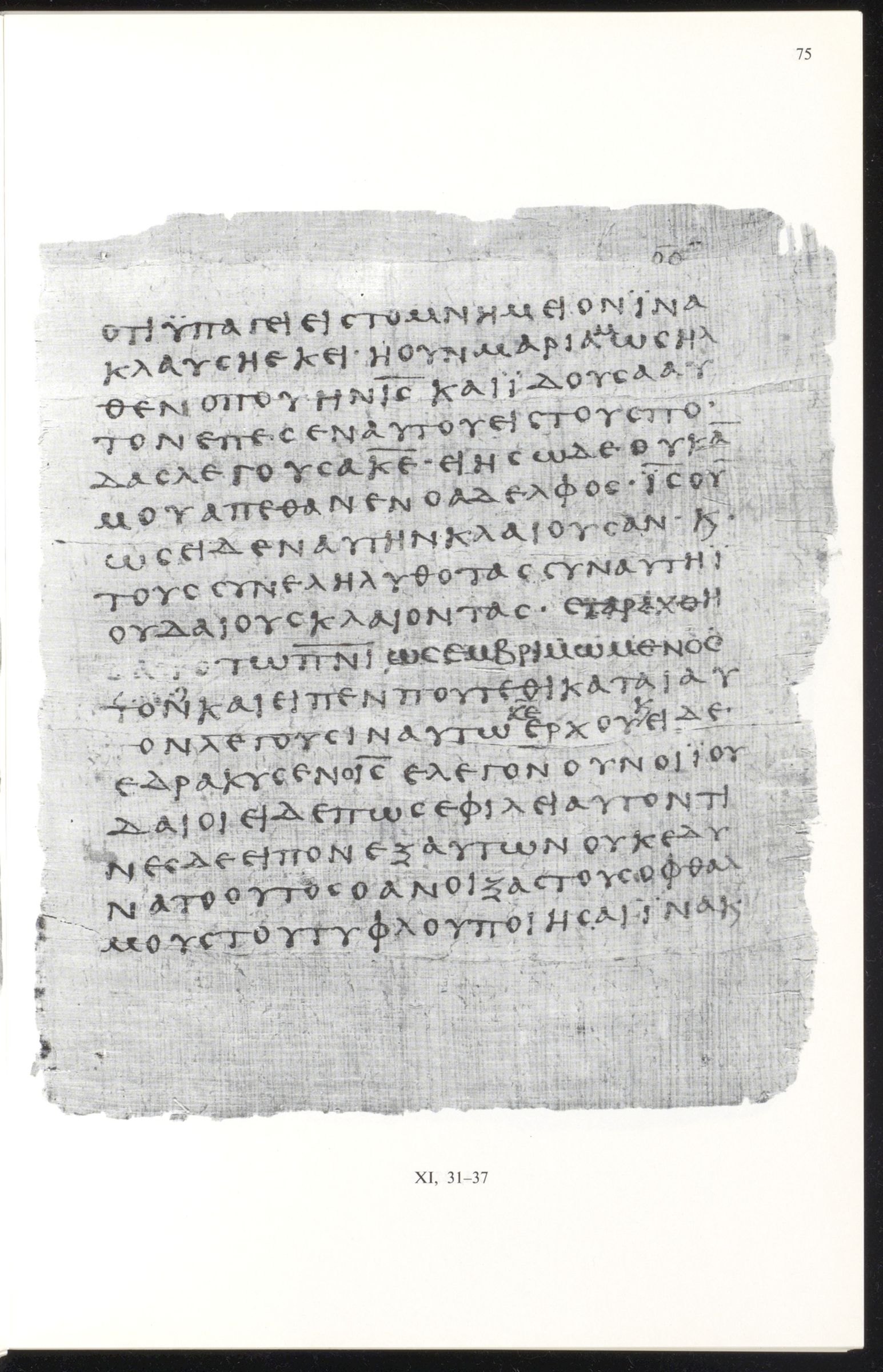
Where on the image
Fondation Martin Bodmer, Papyrus Bodmer II, Bodmer Lab image 1072205287_083 (https://bodmerlab.unige.ch/fr/constellations/papyri/mirador/1072205287), photographic plate of the 1962 Martin-Barns edition, shown whole. NTVMR page 750 (page 79) is linked to this image in NTVMR's page index. 11:31 begins on the previous page; 11:37 continues on the next page. Checked on the image: the printed caption reads ‹XI, 31-37›.
11:31 οτι υπαγει εις το μνημειον ινα
κλαυση εκει· 32 η ουν μαρια ως ηλ
θεν οπου ην ι̅ς̅ και ιδουσα αυ
τον επεσεν αυτου εις τους πο
δας λεγουσα κ̅ε̅· ει ης ωδε ουκ αν
μου απεθανεν ο αδελφος· 33 ι̅ς̅ ουν
ως ειδεν αυτην κλαιουσαν· και
τους συνεληλυθοτας συν αυτη ι
ουδαιους κλαιοντας· εβρει̣μ̣η
σατο τω π̅ν̅ι̅ κ̣α̣ι̣ ε̣[ταραξ]ε̣ν̣ [ε]α̣υ̣
τον 34 και ειπεν που τεθικαται αυ
τον λεγουσιν αυτω ερχου ειδε·
35 εδρακυσεν ι̅ς̅ 36 ελεγον ουν οι ιου
δαιοι ειδε πως εφιλει αυτον 37 τι
νες δε ειπον εξ αυτων ουκ εδυ
νατο ουτος ο ανοιξας τους οφθαλ
μους του τυφλου ποιησαι ινα και
11:31The Jews then which were with her in the house, and comforted her, when they saw Mary, that she rose up hastily and went out, followed her, saying, She goeth unto the grave to weep there. 32Then when Mary was come where Jesus was, and saw him, she fell down at his feet, saying unto him, Lord, if thou hadst been here, my brother had not died. 33When Jesus therefore saw her weeping, and the Jews also weeping which came with her, he groaned in the spirit, and was troubled, 34And said, Where have ye laid him? They said unto him, Lord, come and see. 35Jesus wept. 36Then said the Jews, Behold how he loved him! 37And some of them said, Could not this man, which opened the eyes of the blind, have caused that even this man should not have died?
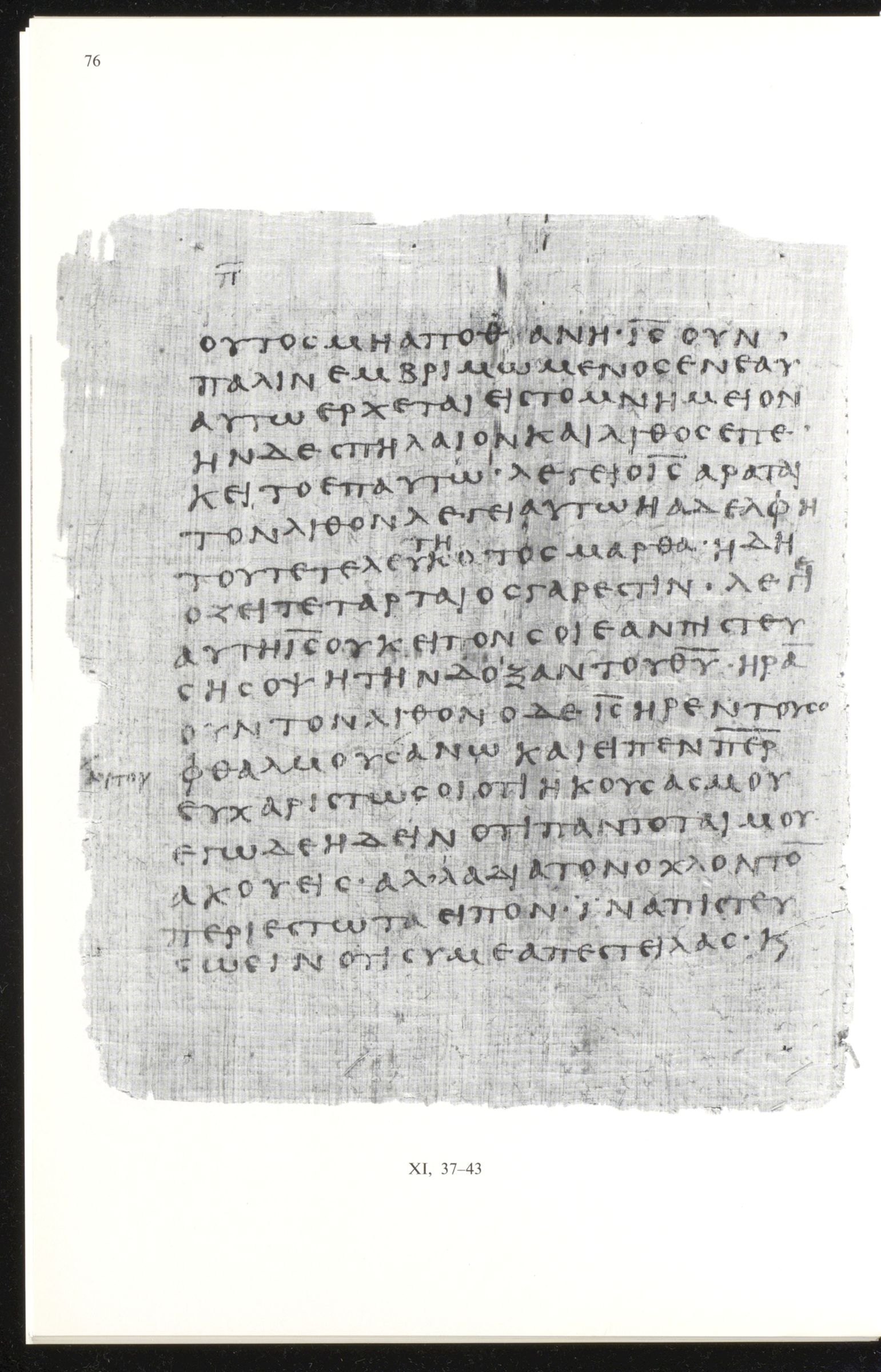
Where on the image
Fondation Martin Bodmer, Papyrus Bodmer II, Bodmer Lab image 1072205287_084 (https://bodmerlab.unige.ch/fr/constellations/papyri/mirador/1072205287), photographic plate of the 1962 Martin-Barns edition, shown whole. NTVMR page 760 (page 80) is linked to this image in NTVMR's page index. 11:37 begins on the previous page; 11:43 continues on the next page. Checked on the image: the printed caption reads ‹XI, 37-43›; the last line of writing, ‹σωσιν οτι συ με απεστειλας· και› (line 17 of the transcription), is legible at the foot of the page.
11:37 ουτος μη αποθανη· 38 ι̅ς̅ ουν
παλιν εμβριμωμενος εν εαυ
αυτω ερχεται εις το μνημειον
ην δε σπηλαιον και λιθος επε
κειτο επ αυτω· 39 λεγει ο ι̅ς̅ αραται
τον λιθον λεγει αυτω η αδελφη
του τετελευκω̣τος μαρθα· ηδη
οζει τεταρταιος γαρ εστιν· 40 λεγι
αυτη ι̅ς̅ ουκ ειπον σοι εαν πιστευ
σης οψη την δοξαν του θ̅υ̅· 41 ηραν
ουν τον λιθον ο δε ι̅ς̅ ηρεν τους ο
φθαλμους ανω και ειπεν π̅ε̅ρ̅
ευχαριστω σοι οτι ηκουσας μου
42 εγω δε ηδειν οτι παντοται μου
ακουεις· αλλα δια τον οχλον τον
περιεστωτα ειπον· ινα πιστευ
σωσιν οτι συ με απεστειλας· 43 και
11:37And some of them said, Could not this man, which opened the eyes of the blind, have caused that even this man should not have died? 38Jesus therefore again groaning in himself cometh to the grave. It was a cave, and a stone lay upon it. 39Jesus said, Take ye away the stone. Martha, the sister of him that was dead, saith unto him, Lord, by this time he stinketh: for he hath been dead four days. 40Jesus saith unto her, Said I not unto thee, that, if thou wouldest believe, thou shouldest see the glory of God? 41Then they took away the stone from the place where the dead was laid. And Jesus lifted up his eyes, and said, Father, I thank thee that thou hast heard me. 42And I knew that thou hearest me always: but because of the people which stand by I said it, that they may believe that thou hast sent me. 43And when he thus had spoken, he cried with a loud voice, Lazarus, come forth.
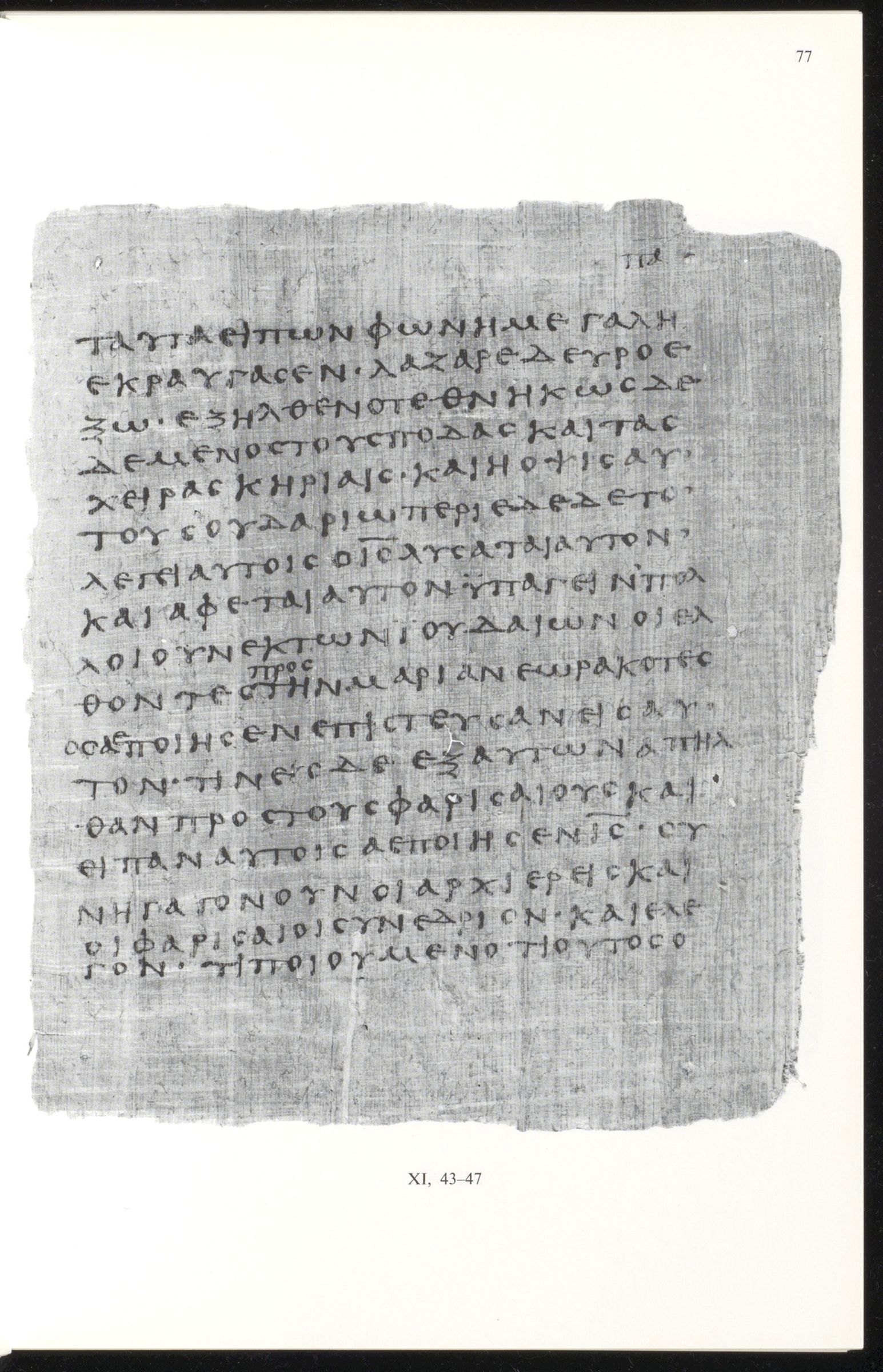
Where on the image
Fondation Martin Bodmer, Papyrus Bodmer II, Bodmer Lab image 1072205287_085 (https://bodmerlab.unige.ch/fr/constellations/papyri/mirador/1072205287), photographic plate of the 1962 Martin-Barns edition, shown whole. NTVMR page 770 (page 81) is linked to this image in NTVMR's page index. 11:43 begins on the previous page; 11:47 continues on the next page. Checked on the image: the printed caption reads ‹XI, 43-47›.
11:43 ταυτα ειπων φωνη μεγαλη
εκραυγασεν· λαζαρε δευρο ε
ξω· 44 εξηλθεν ο τεθνηκως δε
δεμενος τους ποδας και τας
χειρας κηριαις· και η οψις αυ
του σουδαριω περιεδεδετο
λεγει αυτοις ο ι̅ς̅ λυσαται αυτον
και αφεται αυτον υπαγειν 45 πολ
λοι ουν εκ των ιουδαιων οι ελ
θοντες την μαριαν εωρακοτες
α̣ εποιησεν επιστευσαν εις αυ
τον· 46 τινες δε εξ αυτων απηλ
θαν προς τους φαρισαιους και
ειπαν αυτοις α εποιησεν ι̅ς̅· 47 συ
νηγαγον ουν οι αρχιερεις και
οι φαρισαιοι συνεδριον· και ελε
γον· τι ποιουμεν οτι ουτος ο
11:43And when he thus had spoken, he cried with a loud voice, Lazarus, come forth. 44And he that was dead came forth, bound hand and foot with graveclothes: and his face was bound about with a napkin. Jesus saith unto them, Loose him, and let him go. 45Then many of the Jews which came to Mary, and had seen the things which Jesus did, believed on him. 46But some of them went their ways to the Pharisees, and told them what things Jesus had done. 47¶ Then gathered the chief priests and the Pharisees a council, and said, What do we? for this man doeth many miracles.
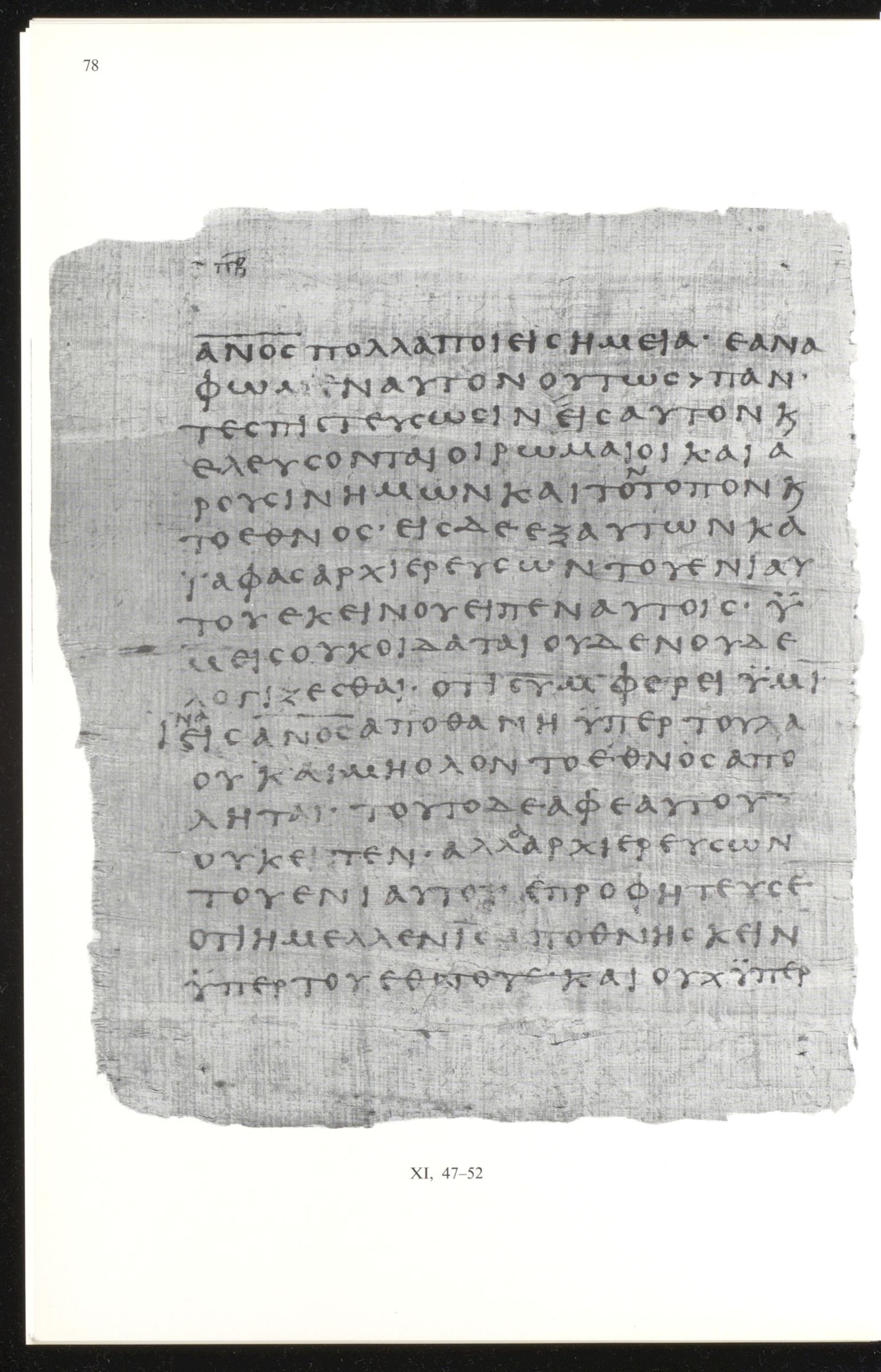
Where on the image
Fondation Martin Bodmer, Papyrus Bodmer II, Bodmer Lab image 1072205287_086 (https://bodmerlab.unige.ch/fr/constellations/papyri/mirador/1072205287), photographic plate of the 1962 Martin-Barns edition, shown whole. NTVMR page 780 (page 82) is linked to this image in NTVMR's page index. 11:47 begins on the previous page; 11:52 continues on the next page. Checked on the image: the printed caption reads ‹XI, 47-52›; the last line of writing, ‹υπερ του εθνους· και ουχ υπερ› (line 17 of the transcription), is legible at the foot of the page.
11:47 α̅ν̅ο̅ς̅ πολλα ποιει σημεια· 48 εαν α
φωμεν αυτον ουτως παν
τες πιστευσωσιν εις αυτον και
ελευσονται οι ρωμαιοι και α
ρουσιν ημων και το τοπον και
το εθνος 49 εις δε εξ αυτων κα
ιαφας αρχιερευς ων του ενιαυ
του εκεινου ειπεν αυτοις· υ
μεις ουκ οιδαται ουδεν 50 ουδε
λογιζεσθαι· οτι συμφερει υμιν
εις α̅ν̅ο̅ς̅ αποθανη υπερ του λα
ου και μη ολον το εθνος απο
ληται· 51 τουτο δε αφ εαυτου·
ουκ ειπεν· αλλ αρχιερευς ων
του ενιαυτου επροφητευσεν
οτι ημελλεν ι̅ς̅ αποθνησκειν
υπερ του εθνους· 52 και ουχ υπερ
11:47¶ Then gathered the chief priests and the Pharisees a council, and said, What do we? for this man doeth many miracles. 48If we let him thus alone, all men will believe on him: and the Romans shall come and take away both our place and nation. 49And one of them, named Caiaphas, being the high priest that same year, said unto them, Ye know nothing at all, 50Nor consider that it is expedient for us, that one man should die for the people, and that the whole nation perish not. 51And this spake he not of himself: but being high priest that year, he prophesied that Jesus should die for that nation; 52And not for that nation only, but that also he should gather together in one the children of God that were scattered abroad.
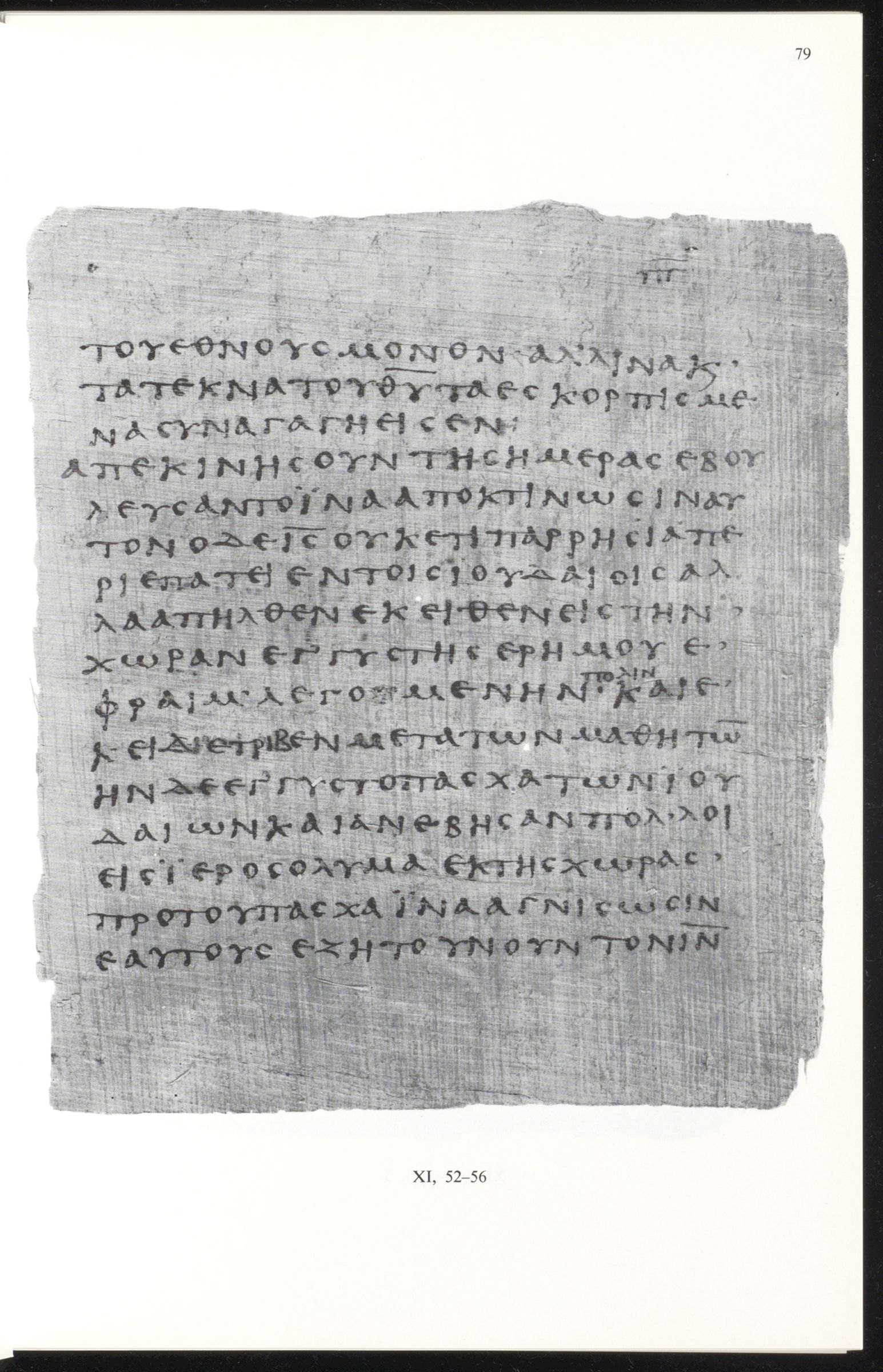
Where on the image
Fondation Martin Bodmer, Papyrus Bodmer II, Bodmer Lab image 1072205287_087 (https://bodmerlab.unige.ch/fr/constellations/papyri/mirador/1072205287), photographic plate of the 1962 Martin-Barns edition, shown whole. NTVMR page 790 (page 83) is linked to this image in NTVMR's page index. 11:52 begins on the previous page; 11:56 continues on the next page. Checked on the image: the printed caption reads ‹XI, 52-56›.
11:52 του εθνους μονον· αλλ ινα και
τα τεκνα του θ̅υ̅ τα εσκορπισμε
να συναγαγη εις εν·
53 απ εκινης ουν της ημερας εβου
λευσαντο ινα αποκτινωσιν αυ
τον 54 ο δε ι̅ς̅ ουκετι παρρησια πε
ριεπατει εν τοις ιουδαιοις αλ
λα απηλθεν εκειθεν εις την
χωραν εγγυς της ερημου ε
φραιμ λεγου̣μενην · και ε
κει εμ̣ι̣ν̣εν μετα των μαθητων
55 ην δε εγγυς το πασχα των ιου
δαιων και ανεβησαν πολλοι
εις ιεροσολυμα εκ της χωρας
προ του πασχα ινα αγνισωσιν
εαυτους 56 εζητουν ουν τον ι̅ν̅
11:52And not for that nation only, but that also he should gather together in one the children of God that were scattered abroad. 53Then from that day forth they took counsel together for to put him to death. 54Jesus therefore walked no more openly among the Jews; but went thence unto a country near to the wilderness, into a city called Ephraim, and there continued with his disciples. 55¶ And the Jews’ passover was nigh at hand: and many went out of the country up to Jerusalem before the passover, to purify themselves. 56Then sought they for Jesus, and spake among themselves, as they stood in the temple, What think ye, that he will not come to the feast?
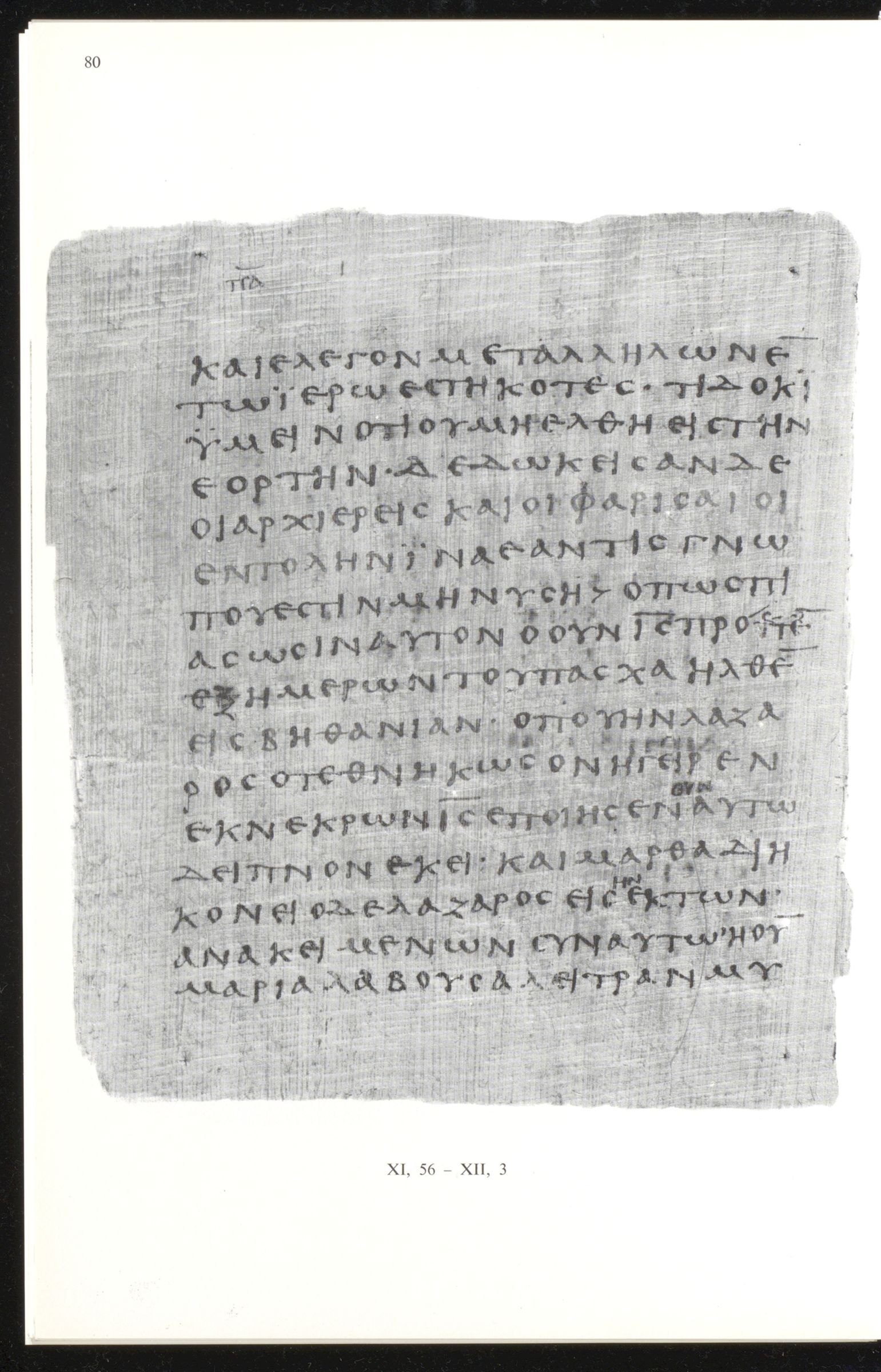
Where on the image
Fondation Martin Bodmer, Papyrus Bodmer II, Bodmer Lab image 1072205287_088 (https://bodmerlab.unige.ch/fr/constellations/papyri/mirador/1072205287), photographic plate of the 1962 Martin-Barns edition, shown whole. NTVMR page 800 (page 84) is linked to this image in NTVMR's page index. 11:56 begins on the previous page; 12:3 continues on the next page. Checked on the image: the printed caption reads ‹XI, 56 - XII, 3›; the last line of writing, ‹μαρια λαβουσα λειτραν μυ› (line 16 of the transcription), is legible at the foot of the page.
11:56 και ελεγον μετ αλληλων εν
τω ιερω εστηκοτες· τι δοκι
υμειν οτι ου μη ελθη εις την
εορτην· 57 δεδωκεισαν δε
οι αρχιερεις και οι φαρισαιοι
εντολην ινα εαν τις γνω
που εστιν μηνυση οπως πι
ασωσιν αυτον 12:1 ο ουν ι̅ς̅ προ πεν
τε ημερων του πασχα ηλθεν
εις βηθανιαν· οπου ην λαζα
ρος ο τεθνηκως ον ηγειρεν
εκ νεκρων ι̅ς̅ 2 εποιησεν αυτω
δειπνον εκει· και μαρθα διη
κονει ο δε λαζαρος εις εκ των
ανακειμενων συν αυτω 3 η ουν
μαρια λαβουσα λειτραν μυ
11:56Then sought they for Jesus, and spake among themselves, as they stood in the temple, What think ye, that he will not come to the feast? 57Now both the chief priests and the Pharisees had given a commandment, that, if any man knew where he were, he should shew it, that they might take him. 12:1Then Jesus six days before the passover came to Bethany, where Lazarus was which had been dead, whom he raised from the dead. 2There they made him a supper; and Martha served: but Lazarus was one of them that sat at the table with him. 3Then took Mary a pound of ointment of spikenard, very costly, and anointed the feet of Jesus, and wiped his feet with her hair: and the house was filled with the odour of the ointment.
Notes
- Greek: the NTVMR diplomatic transcription, line by line as on the papyrus. Square brackets enclose letters that are lost or illegible and were supplied by the transcribers; a dot under a letter marks it as uncertain; [...] marks a gap. Nomina sacra and numerals keep the scribe's overline. Spelling is the scribe's (no accents or breathings). Words broken at a line end stay broken as on the papyrus. Corrections are not shown: the text is the first hand.
- English: the King James Version (1611), whole verses, for every verse that has text on the page. A verse that begins on one page and ends on the next is given in full on both. The KJV translates a later form of the Greek text, so its wording does not always match the papyrus; material differences (such as verses the papyrus does not have) are noted in the section.
Cite
Sources
- Source: Papyrus Bodmer II (P66), Fondation Martin Bodmer: images from the Bodmer Lab, University of Geneva; Greek from the INTF NTVMR transcription of P66; English from the King James Version (holding institution)
- Critical edition: INTF NTVMR diplomatic transcription (CC BY 4.0)
← previous · → next · v cycle view · l back to library