P66 (Papyrus Bodmer II): John 3:2-4:6 (pages 12-17)
Introduction
P66 is a papyrus codex of the Gospel of John copied in Egypt around 200, the most complete early copy of John. Most of it is Papyrus Bodmer II in the Fondation Martin Bodmer, Cologny (Geneva); small pieces are in the Chester Beatty Library, Dublin, and the Institut für Altertumskunde, Cologne. The first five quires (John 1:1-14:26) survive as a bound book of numbered pages; later leaves, from John 14:29 to 21:9, are damaged and kept between glass. The scribe made many corrections, some of them his own; only the first hand is shown here.
Each section below is one page: the photograph, the NTVMR diplomatic transcription line by line, and the King James Version of every verse on the page. Pages of the bound book are shown on the photographic plates published by Victor Martin and J. W. B. Barns in 1962 (scanned by the Bodmer Lab), the glass-mounted leaves on colour photographs. Lost: John 6:12-34 (pages 35-38) and parts of chapters 14-21; the transcription ends at 21:9. Where P66 lacks a verse that the KJV has (John 5:4, the account of the adulteress at 7:53-8:11, 16:15), the section says so.
This entry covers pages 12-17 (John 3:2-4:6).
How was this verified? (Provenance)
Where on the image
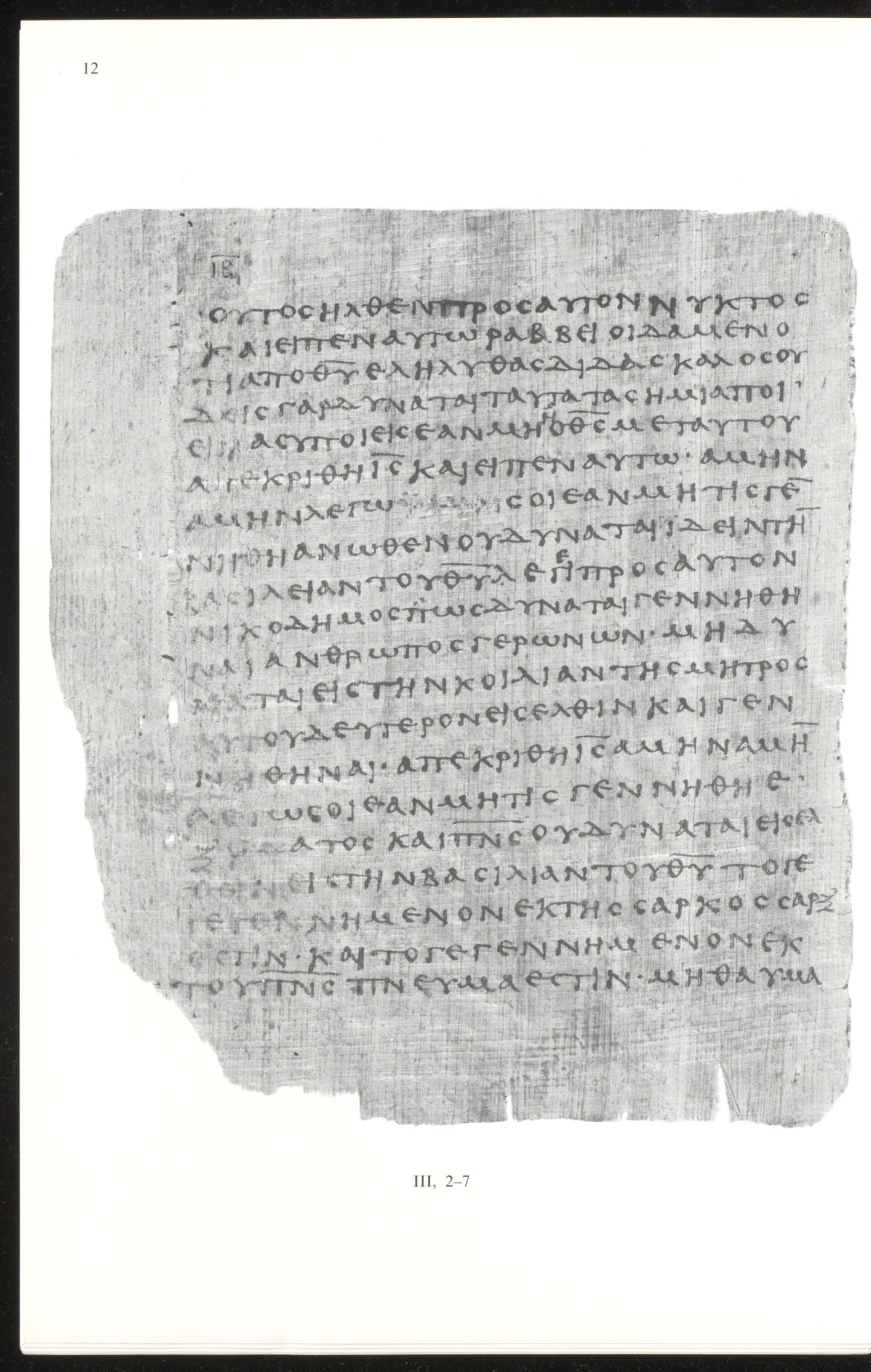
Fondation Martin Bodmer, Papyrus Bodmer II, Bodmer Lab image 1072205287_020 (https://bodmerlab.unige.ch/fr/constellations/papyri/mirador/1072205287), photographic plate of the 1962 Martin-Barns edition, shown whole. NTVMR page 120 (page 12) is linked to this image in NTVMR's page index. 3:2 begins on the previous page; 3:7 continues on the next page. Checked on the image: the printed caption reads ‹III, 2-7›; the last line of writing, ‹του π̅ν̅ς̅ πνευμα εστιν· μη θαυμα› (line 20 of the transcription), is legible at the foot of the page.
3:2 ουτος ηλθεν προς αυτον νυκτος
και ειπεν αυτω ραμβει οιδαμεν ο
τι απο θ̅υ̅ εληλυθας διδασκαλος ου
δεις γαρ δυναται ταυτα τα σημια ποι
ειν α συ ποιεις εαν μη ο θ̅ς̅ μετ αυτου
3 απεκριθη ι̅ς̅ και ειπεν αυτω· αμην
αμην λεγω υμιν σοι εαν μη τις γεν
νηθη ανωθεν ου δυναται ιδειν την
βασιλειαν του θ̅υ̅ 4 λεγι προς αυτον
νικοδημος πως δυναται γεννηθη
ναι ανθρωπος γερων ων· μη δυ
ναται εις την κοιλιαν της μητρος
αυτου δευτερον εισελθιν και γεν
νηθηναι· 5 απεκριθη ι̅ς̅ αμην αμην
λεγω σοι εαν μη τις γεννηθη ε
ξ υδατος και π̅ν̅ς̅ ου δυναται εισελ
θειν εις την βασιλιαν του θ̅υ̅ 6 το γε
γεγεννημενον εκ της σαρκος σαρξ
εστιν· και το γεγεννημενον εκ
του π̅ν̅ς̅ πνευμα εστιν· 7 μη θαυμα
3:2The same came to Jesus by night, and said unto him, Rabbi, we know that thou art a teacher come from God: for no man can do these miracles that thou doest, except God be with him. 3Jesus answered and said unto him, Verily, verily, I say unto thee, Except a man be born again, he can not see the kingdom of God. 4Nicodemus saith unto him, How can a man be born when he is old? can he enter the second time into his mother’s womb, and be born? 5Jesus answered, Verily, verily, I say unto thee, Except a man be born of water and of the Spirit, he can not enter into the kingdom of God. 6That which is born of the flesh is flesh; and that which is born of the Spirit is spirit. 7Marvel not that I said unto thee, Ye must be born again.
Where on the image
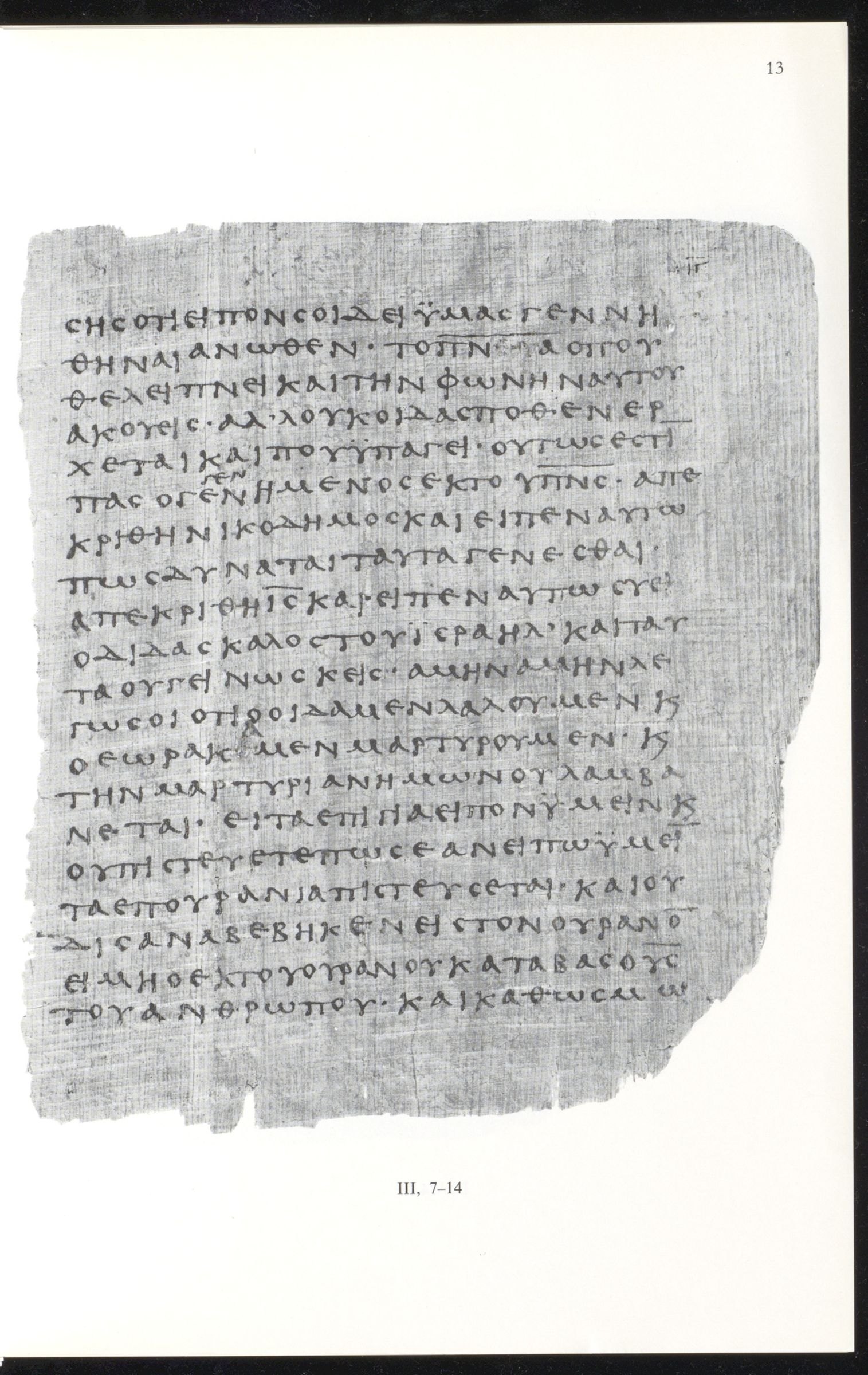
Fondation Martin Bodmer, Papyrus Bodmer II, Bodmer Lab image 1072205287_021 (https://bodmerlab.unige.ch/fr/constellations/papyri/mirador/1072205287), photographic plate of the 1962 Martin-Barns edition, shown whole. NTVMR page 130 (page 13) is linked to this image in NTVMR's page index. 3:7 begins on the previous page; 3:14 continues on the next page. Checked on the image: the printed caption reads ‹III, 7-14›; the last line of writing, ‹του ανθρωπου· και καθως μω› (line 20 of the transcription), is legible at the foot of the page.
3:7 σης οτι ειπον σοι δει υμας γεννη
θηναι ανωθεν· 8 το πνευα οπου
θελει πνει και την φωνην αυτου
ακουεις· αλλ ουκ οιδας ποθεν ερ
χεται και που υπαγει· ουτως εστιν
πας ο γενημενος εκ του π̅ν̅ς̅· 9 απε
κριθη νικοδημος και ειπεν αυτω
πως δυναται ταυτα γενεσθαι·
10 απεκριθη ι̅ς̅ και ειπεν αυτω συ ει
ο διδασκαλος του ισραηλ και ταυ
τα ου γεινωσκεις· 11 αμην αμην λε
γω σοι οτι ο οιδαμεν λαλουμεν και
ο εωρακεμεν μαρτυρουμεν· και
την μαρτυριαν ημων ου λαμβα
νεται· 12 ει τα επιγια ειπον υμειν και
ου πιστευετε πως εαν ειπω υμειν
τα επουρανια πιστευσεται· 13 και ου
δις αναβεβηκεν εις τον ουρανον
ει μη ο εκ του ουρανου καταβας ο υ̅ς̅
του ανθρωπου· 14 και καθως μω
3:7Marvel not that I said unto thee, Ye must be born again. 8The wind bloweth where it listeth, and thou hearest the sound thereof, but canst not tell whence it cometh, and whither it goeth: so is every one that is born of the Spirit. 9Nicodemus answered and said unto him, How can these things be? 10Jesus answered and said unto him, Art thou a master of Israel, and knowest not these things? 11Verily, verily, I say unto thee, We speak that we do know, and testify that we have seen; and ye receive not our witness. 12If I have told you earthly things, and ye believe not, how shall ye believe, if I tell you of heavenly things? 13And no man hath ascended up to heaven, but he that came down from heaven, even the Son of man which is in heaven. 14¶ And as Moses lifted up the serpent in the wilderness, even so must the Son of man be lifted up:
Where on the image
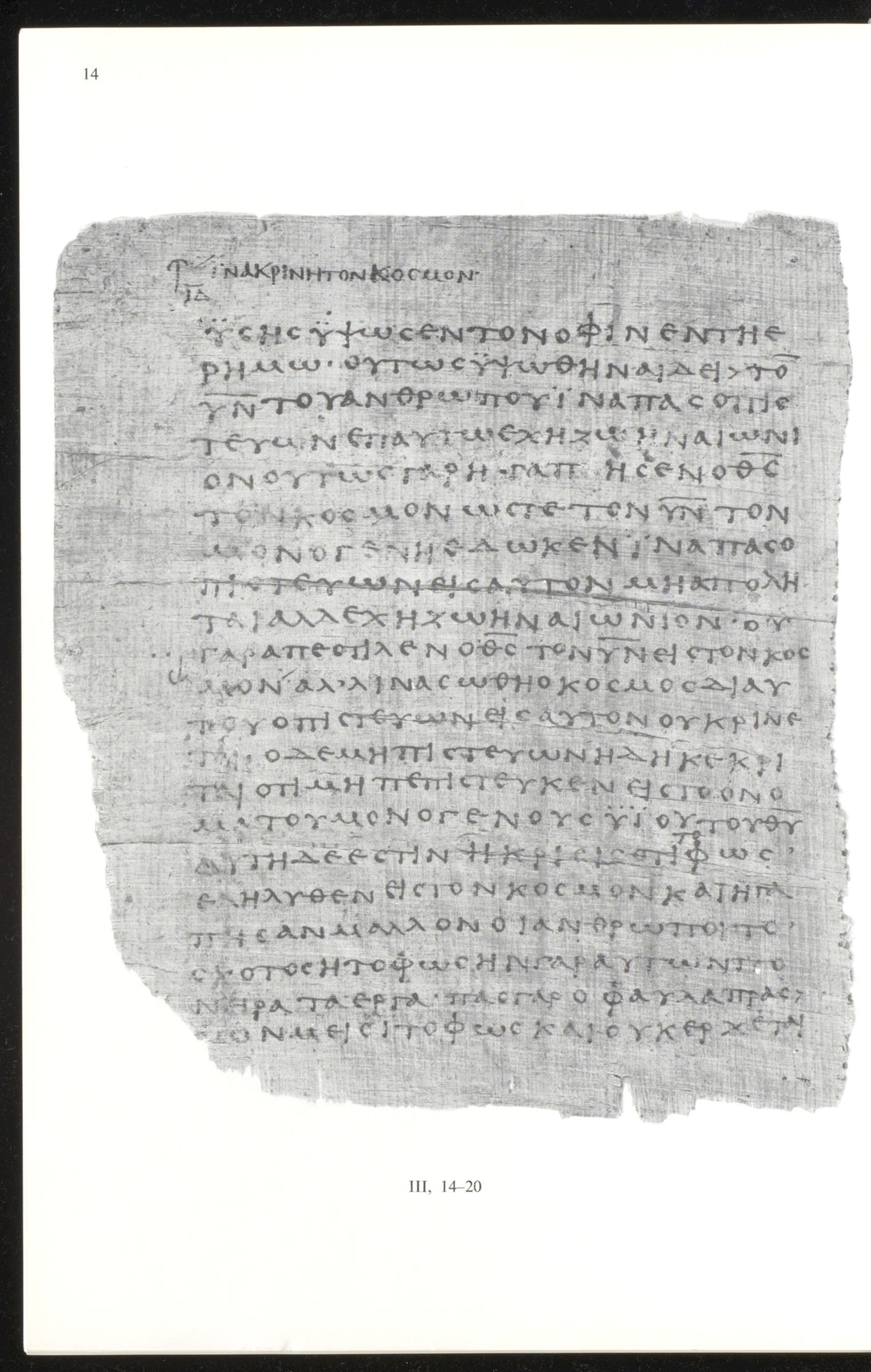
Fondation Martin Bodmer, Papyrus Bodmer II, Bodmer Lab image 1072205287_022 (https://bodmerlab.unige.ch/fr/constellations/papyri/mirador/1072205287), photographic plate of the 1962 Martin-Barns edition, shown whole. NTVMR page 140 (page 14) is linked to this image in NTVMR's page index. 3:14 begins on the previous page; 3:20 continues on the next page. Checked on the image: the printed caption reads ‹III, 14-20›; the last line of writing, ‹σ̣ω̣ν μεισι το φως και ουκ ερχεται› (line 21 of the transcription), is legible at the foot of the page.
3:14 υσης υψωσεν τον οφιν εν τη ε
ρημω· ουτως υψωθηναι δει τον
υ̅ν̅ του ανθρωπου 15 ινα πας ο πισ
τευων επ αυτω εχη ζωην αιωνι
ον 16 ουτως γαρ η α̣γαπη ησεν ο θ̅ς̅
τον κοσμον ωστε τον υ̅ν̅ τον
μονογενη εδωκεν ινα πας ο
πιστευων εις αυτον μη απολη
ται αλλ εχη ζωην αιωνιον· 17 ου
γαρ απεστιλεν ο θ̅ς̅ τον υ̅ν̅ εις τον κοσ
μον αλλ ινα σωθη ο κοσμος δι αυ
του 18 ο πιστευων εις αυτον ου κρινε
ται· ο δε μη πιστευων ηδη κεκρι
ται οτι μη πεπιστευκεν εις το ονο
μα του μονογενους υιου του θ̅υ̅
19 αυτη δε εστιν η κρισις οτι φως
εληλυθεν εις τον κοσμον και ηγα
πησαν μαλλον οι ανθρωποι το
σκοτος η το φως ην γαρ αυτων πο
νηρα τα εργα· 20 πας γαρ ο φαυλα πρασ
σ̣ω̣ν μεισι το φως και ουκ ερχεται
3:14¶ And as Moses lifted up the serpent in the wilderness, even so must the Son of man be lifted up: 15That whosoever believeth in him should not perish, but have eternal life. 16¶ For God so loved the world, that he gave his only begotten Son, that whosoever believeth in him should not perish, but have everlasting life. 17For God sent not his Son into the world to condemn the world; but that the world through him might be saved. 18¶ He that believeth on him is not condemned: but he that believeth not is condemned already, because he hath not believed in the name of the only begotten Son of God. 19And this is the condemnation, that light is come into the world, and men loved darkness rather than light, because their deeds were evil. 20For every one that doeth evil hateth the light, neither cometh to the light, lest his deeds should be reproved.
Where on the image
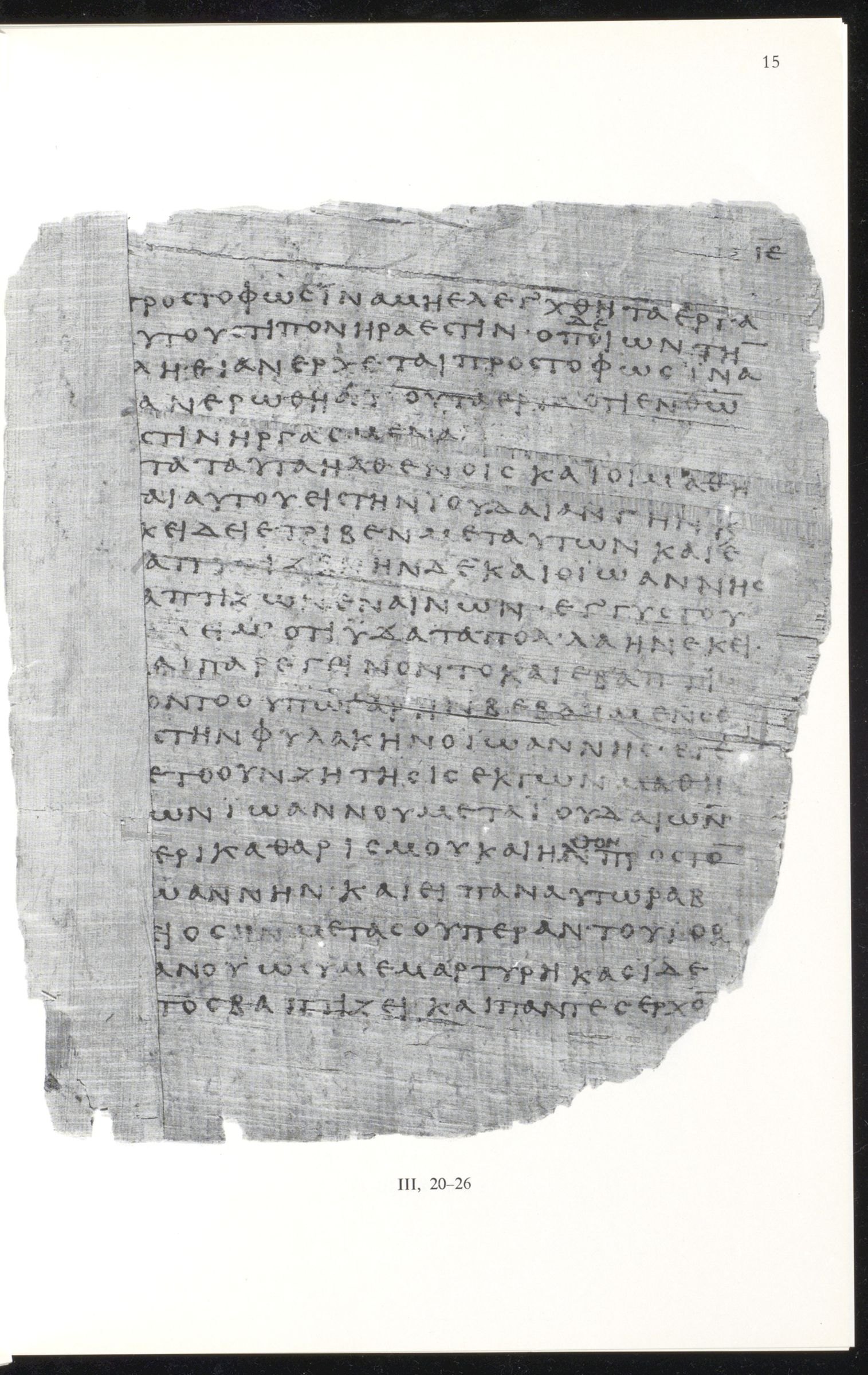
Fondation Martin Bodmer, Papyrus Bodmer II, Bodmer Lab image 1072205287_023 (https://bodmerlab.unige.ch/fr/constellations/papyri/mirador/1072205287), photographic plate of the 1962 Martin-Barns edition, shown whole. NTVMR page 150 (page 15) is linked to this image in NTVMR's page index. 3:20 begins on the previous page; 3:26 continues on the next page. Checked on the image: the printed caption reads ‹III, 20-26›; the last line of writing, ‹τος βαπτιζει και παντες ερχον› (line 21 of the transcription), is legible at the foot of the page.
3:20 π̣ρος το φως ινα μη ελεγχθη τα εργα
α̣υτου οτι πονηρα εστιν· 21 ο ποιων την
[α]ληθιαν ερχεται προς το φως ινα
[φ]ανερωθη αυτου τα εργα οτι εν θ̅ω̅
[ε]στιν ηργασμενα.
22 [με]τα ταυτα ηλθεν ο ι̅ς̅ και οι μαθη
τ̣αι αυτου εις την ιουδαιαν γην και
[ε]κει δειετριβεν μετ αυτων και ε[β]
απτειζεν 23 ην δε και ο ιωαννης
[β]απτιζων εν αινων· εγγυς του
[σ]αλειμ οτι υδατα πολλα ην εκει·
[κ]αι παρεγεινοντο και εβαπτι
[ζ]οντο 24 ουπω γαρ ην βεβλημενος
[ει]ς την φυλακην ο ιωαννης· 25 εγε
[ν]ετο ουν ζητησις εκ των μαθη
[τ]ων ιωαννου μετα ιουδαιων
[π]ερι καθαρισμου 26 και ην προς τον
[ι]ωαννην· και ειπαν αυτω ραβ
[β]ει ος ην μετα σου περαν· του ιορ
[δ]ανου ω συ μεμαρτυρηκας ιδε
[ου]τος βαπτιζει και παντες ερχον
3:20For every one that doeth evil hateth the light, neither cometh to the light, lest his deeds should be reproved. 21But he that doeth truth cometh to the light, that his deeds may be made manifest, that they are wrought in God. 22¶ After these things came Jesus and his disciples into the land of Judæa; and there he tarried with them, and baptized. 23¶ And John also was baptizing in Ænon near to Salim, because there was much water there: and they came, and were baptized. 24For John was not yet cast into prison. 25¶ Then there arose a question between some of John’s disciples and the Jews about purifying. 26And they came unto John, and said unto him, Rabbi, he that was with thee beyond Jordan, to whom thou barest witness, behold, the same baptizeth, and all men come to him.
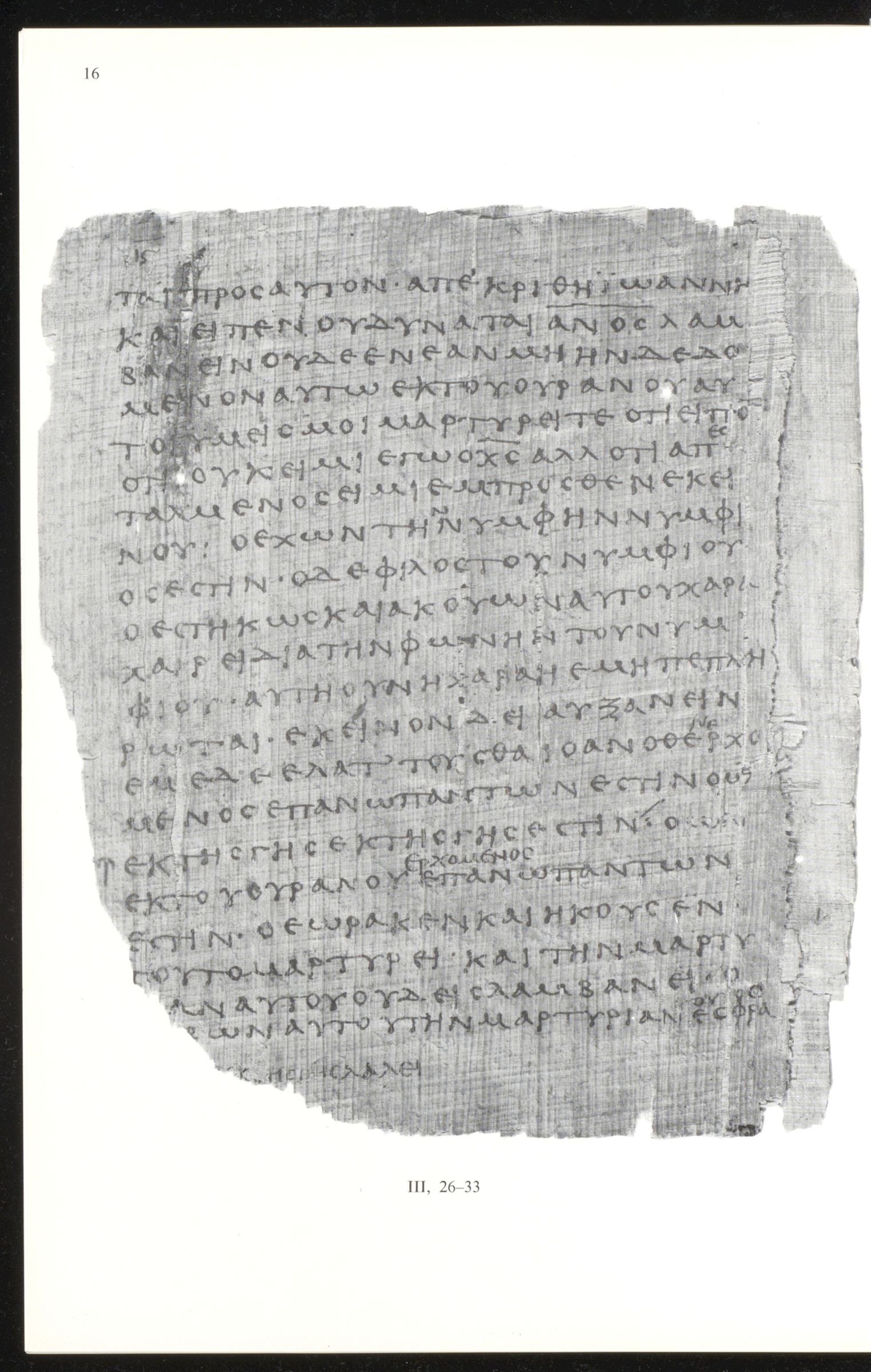
Where on the image
Fondation Martin Bodmer, Papyrus Bodmer II, Bodmer Lab image 1072205287_024 (https://bodmerlab.unige.ch/fr/constellations/papyri/mirador/1072205287), photographic plate of the 1962 Martin-Barns edition, shown whole. NTVMR page 160 (page 16) is linked to this image in NTVMR's page index. 3:26 begins on the previous page; 3:33 continues on the next page. Checked on the image: the printed caption reads ‹III, 26-33›; the last line of writing, ‹β̣ων αυτου την μαρτυριαν εσφρα› (line 21 of the transcription), is legible at the foot of the page.
3:26 ται προς αυτον· 27 απεκριθη ιωαννη[ς]
και ειπεν ου δυναται α̅ν̅ο̅ς̅ λαμ
βανειν ουδε εν εαν μη ην δεδο
μενον αυτω εκ του ουρανου 28 αυ
τοι υμεις μοι μαρτυρειτε οτι ειπον
οτι ουκ ειμι εγω ο χ̅ς̅ αλλ οτι απ
ταλμενος ειμι εμπροσθεν εκει
νου· 29 ο εχων τη νυμφην νυμφι
ος εστιν· ο δε φιλος του νυμφιου
ο εστηκως και ακουων αυτου χαρα
χαιρει δια την φωνην του νυμ
φιου· αυτη ουν η χαρα η εμη πεπλη
ρωται· 30 εκεινον δει αυξανειν
εμε δε ελαττουσθαι 31 ο ανοθ ερχο
μενος επανω παντων εστιν ο ων
εκ της γης εκ της γης εστιν· ο ων
εκ του ουρανου επανω παντων
εστιν· 32 ο εωρακεν και ηκουσεν
τουτο μαρτυρει· και την μαρτυ
[ρι]αν αυτου ουδεις λαμβανει· 33 ο
[λα]β̣ων αυτου την μαρτυριαν εσφρα
3:26And they came unto John, and said unto him, Rabbi, he that was with thee beyond Jordan, to whom thou barest witness, behold, the same baptizeth, and all men come to him. 27John answered and said, A man can receive nothing, except it be given him from heaven. 28Ye yourselves bear me witness, that I said, I am not the Christ, but that I am sent before him. 29He that hath the bride is the bridegroom: but the friend of the bridegroom, which standeth and heareth him, rejoiceth greatly because of the bridegroom’s voice: this my joy therefore is fulfilled. 30He must increase, but I must decrease. 31He that cometh from above is above all: he that is of the earth is earthly, and speaketh of the earth: he that cometh from heaven is above all. 32And what he hath seen and heard, that he testifieth; and no man receiveth his testimony. 33He that hath received his testimony hath set to his seal that God is true.
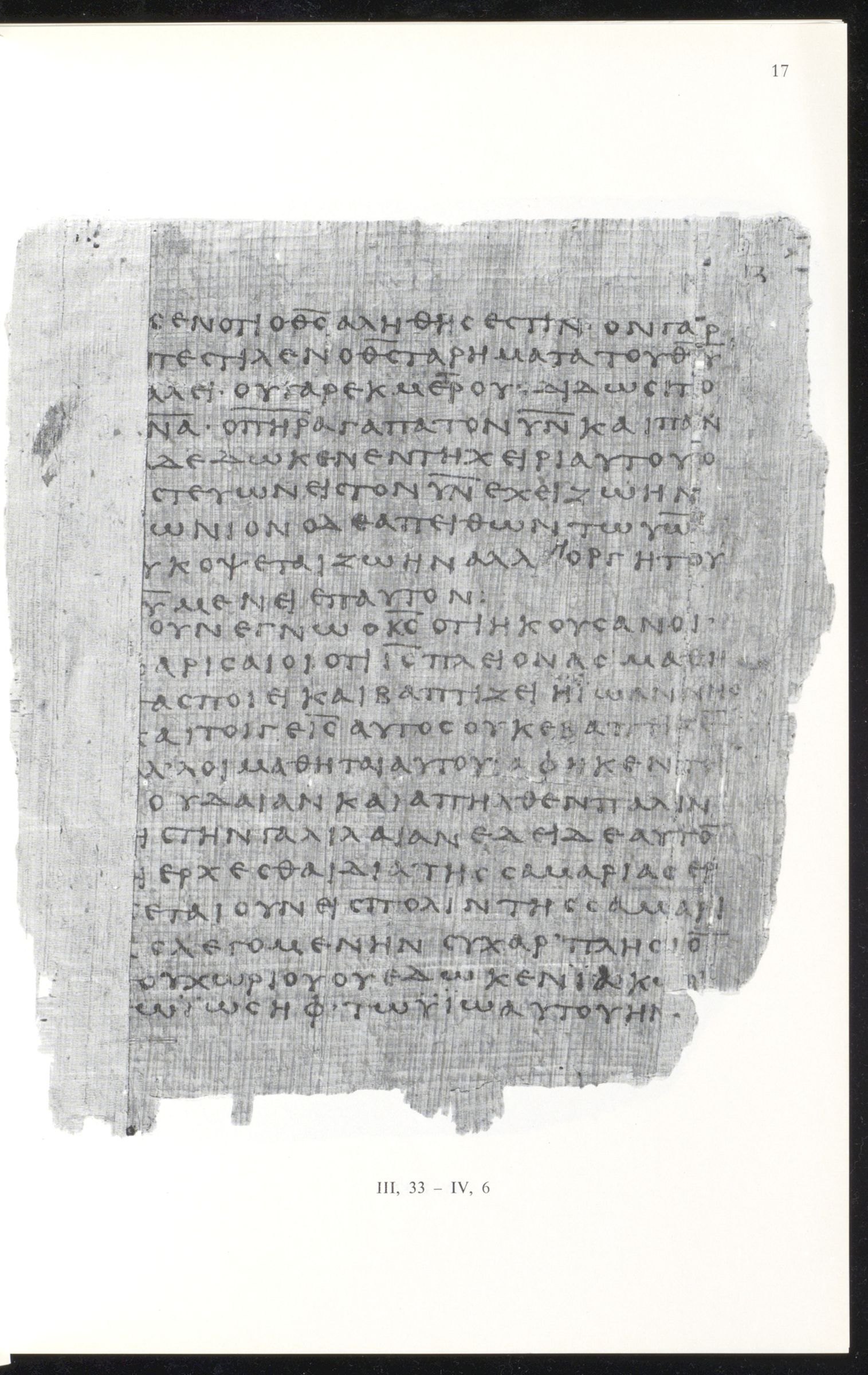
Where on the image
Fondation Martin Bodmer, Papyrus Bodmer II, Bodmer Lab image 1072205287_025 (https://bodmerlab.unige.ch/fr/constellations/papyri/mirador/1072205287), photographic plate of the 1962 Martin-Barns edition, shown whole. NTVMR page 170 (page 17) is linked to this image in NTVMR's page index. 3:33 begins on the previous page; 4:6 continues on the next page. Checked on the image: the printed caption reads ‹III, 33 - IV, 6›; the last line of writing, ‹τ̣ω ιωσηφ τω υιω αυτου ην› (line 21 of the transcription), is legible at the foot of the page.
3:33 [γι]σεν οτι ο θ̅ς̅ αληθης εστιν· 34 ον γαρ
[α]πεστιλεν ο θ̅ς̅ τα ρηματα του θ̅υ̅
[λ]αλει· ου γαρ εκ μερους̣ διδωσι το
[π̅]ν̅α̅· 35 ο π̅η̅ρ̅ αγαπα τον υ̅ν̅ και παν
[τ]α̣ δεδωκεν εν τη χειρι αυτου 36 ο
[πι]στευων εις τον υ̅ν̅ εχει ζωην
[αι]ωνιον ο δε απειθων τω υ̅ω̅
[ο]υκ οψεται ζωην αλλ[α] οργη του
[θ̅]υ̅ μενει επ αυτον·
4:1 [ως] ουν εγνω ο ι̣̣̅ς̅ οτι ηκουσαν οι
φ̣αρισαιοι οτι ι̅ς̅ πλειονας μαθη
τ̣ας ποιει και βαπτιζει η ιωαννης
2 κ̣αιτοιγε ι̅ς̅ αυτος ουκ εβαπτιζεν
α̣λλ οι μαθηται αυτου· 3 αφηκεν την
[ι]ουδαιαν και απηλθεν παλιν
ε̣ις την γαλιλαιαν 4 εδει δε αυτον
δ̣ιερχεσθαι δια της σαμαριας 5 ερ
χ̣εται ουν εις πολιν της σαμαρι
α̣ς λεγομενην συχαρ· πλησιον
τ̣ου χωριου ου εδωκεν ιωκω̣β̣
τ̣ω ιωσηφ τω υιω αυτου 6 ην [δε]
3:33He that hath received his testimony hath set to his seal that God is true. 34For he whom God hath sent speaketh the words of God: for God giveth not the Spirit by measure unto him. 35The Father loveth the Son, and hath given all things into his hand. 36He that believeth on the Son hath everlasting life: and he that believeth not the Son shall not see life; but the wrath of God abideth on him. 4:1When therefore the Lord knew how the Pharisees had heard that Jesus made and baptized more disciples than John, 2(Though Jesus himself baptized not, but his disciples,) 3He left Judæa, and departed again into Galilee. 4And he must needs go through Samaria. 5Then cometh he to a city of Samaria, which is called Sychar, near to the parcel of ground that Jacob gave to his son Joseph. 6Now Jacob’s well was there. Jesus therefore, being wearied with his journey, sat thus on the well: and it was about the sixth hour.
Notes
- Greek: the NTVMR diplomatic transcription, line by line as on the papyrus. Square brackets enclose letters that are lost or illegible and were supplied by the transcribers; a dot under a letter marks it as uncertain; [...] marks a gap. Nomina sacra and numerals keep the scribe's overline. Spelling is the scribe's (no accents or breathings). Words broken at a line end stay broken as on the papyrus. Corrections are not shown: the text is the first hand.
- English: the King James Version (1611), whole verses, for every verse that has text on the page. A verse that begins on one page and ends on the next is given in full on both. The KJV translates a later form of the Greek text, so its wording does not always match the papyrus; material differences (such as verses the papyrus does not have) are noted in the section.
Cite
Sources
- Source: Papyrus Bodmer II (P66), Fondation Martin Bodmer: images from the Bodmer Lab, University of Geneva; Greek from the INTF NTVMR transcription of P66; English from the King James Version (holding institution)
- Critical edition: INTF NTVMR diplomatic transcription (CC BY 4.0)
← previous · → next · v cycle view · l back to library