P66 (Papyrus Bodmer II): John 4:6-5:2 (pages 18-25)
Introduction
P66 is a papyrus codex of the Gospel of John copied in Egypt around 200, the most complete early copy of John. Most of it is Papyrus Bodmer II in the Fondation Martin Bodmer, Cologny (Geneva); small pieces are in the Chester Beatty Library, Dublin, and the Institut für Altertumskunde, Cologne. The first five quires (John 1:1-14:26) survive as a bound book of numbered pages; later leaves, from John 14:29 to 21:9, are damaged and kept between glass. The scribe made many corrections, some of them his own; only the first hand is shown here.
Each section below is one page: the photograph, the NTVMR diplomatic transcription line by line, and the King James Version of every verse on the page. Pages of the bound book are shown on the photographic plates published by Victor Martin and J. W. B. Barns in 1962 (scanned by the Bodmer Lab), the glass-mounted leaves on colour photographs. Lost: John 6:12-34 (pages 35-38) and parts of chapters 14-21; the transcription ends at 21:9. Where P66 lacks a verse that the KJV has (John 5:4, the account of the adulteress at 7:53-8:11, 16:15), the section says so.
This entry covers pages 18-25 (John 4:6-5:2).
How was this verified? (Provenance)
Where on the image
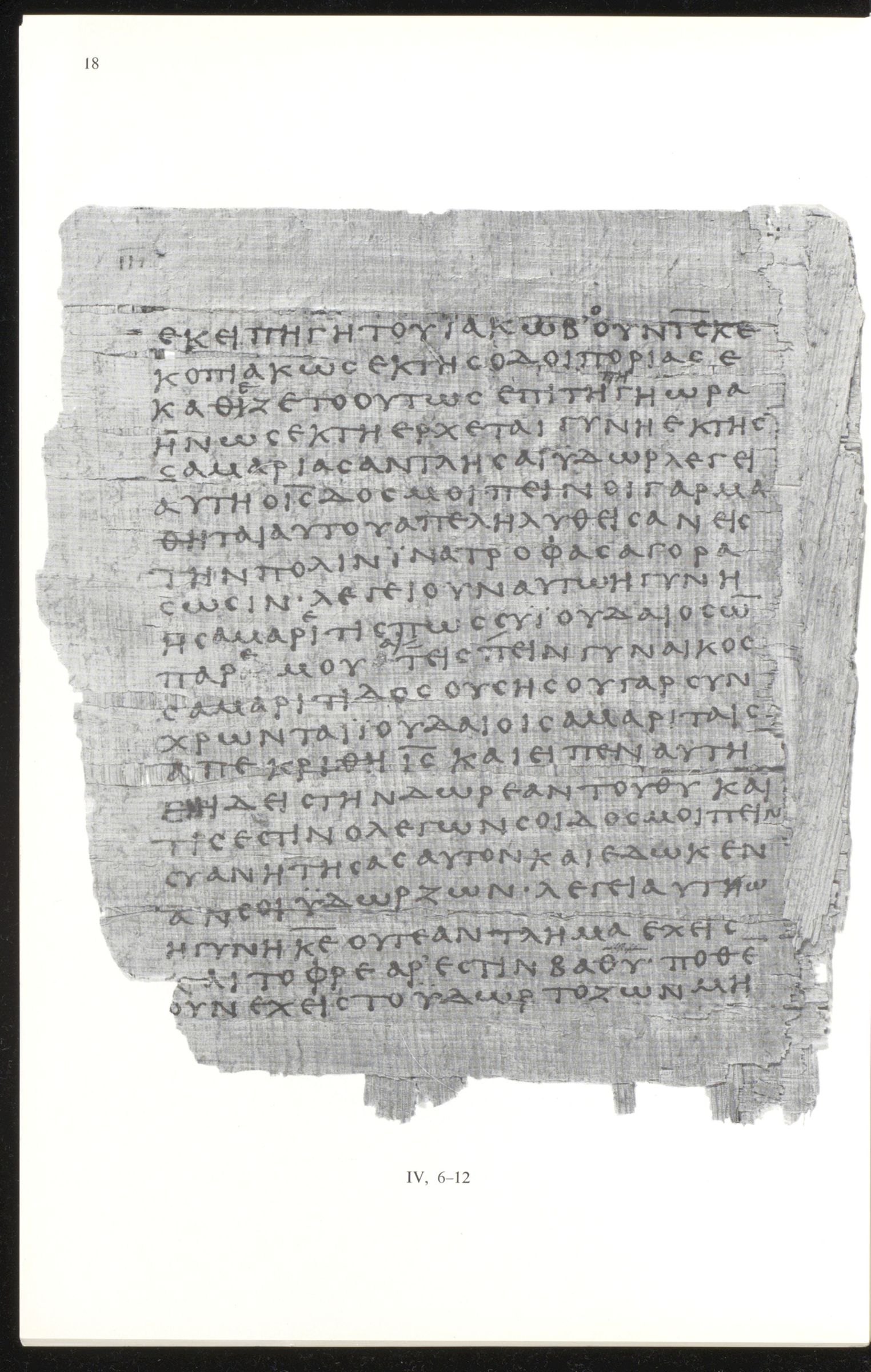
Fondation Martin Bodmer, Papyrus Bodmer II, Bodmer Lab image 1072205287_026 (https://bodmerlab.unige.ch/fr/constellations/papyri/mirador/1072205287), photographic plate of the 1962 Martin-Barns edition, shown whole. NTVMR page 180 (page 18) is linked to this image in NTVMR's page index. 4:6 begins on the previous page; 4:12 continues on the next page. Checked on the image: the printed caption reads ‹IV, 6-12›; the last line of writing, ‹ουν εχεις το υδωρ το ζων μη› (line 21 of the transcription), is legible at the foot of the page.
4:6 εκει πηγη του ιακωβ ουν ι̅ς̅ κε
κοπιακως εκ της οδοιποριας ε
καθιζετο ουτως επι τη γη ωρα
ην ως εκτη 7 ερχεται γυνη εκ της
σαμαριας αντλησαι υδωρ λεγει
αυτη ο ι̅ς̅ δος μοι πειν 8 οι γαρ μα
θηται αυτου απεληλυθεισαν εις
την πολιν ινα τροφας αγορα
σωσιν· 9 λεγει ουν αυτω η γυνη
η σαμαριτις πως συ ιουδαιος ων
παρα̣ μου ε̣τεις πειν γυναικος
σαμαριτιδος ουσης ου γαρ συν
χρωνται ιουδαιοι σαμαριταις
10 απεκριθη ι̅ς̅ και ειπεν αυτη
η ειδεις την δωρεαν του θ̅υ̅ και
τις εστιν ο λεγων σοι δος μοι πειν
συ αν ητησας αυτον και εδωκεν
αν σοι υδωρ ζων· 11 λεγει αυτη
η γυνη κ̅ε̅ ουτε αντλημα εχεις
κ̣αι το φρεαρ εστιν βα θ̅υ̅· ποθεν
ουν εχεις το υδωρ το ζων 12 μη
4:6Now Jacob’s well was there. Jesus therefore, being wearied with his journey, sat thus on the well: and it was about the sixth hour. 7There cometh a woman of Samaria to draw water: Jesus saith unto her, Give me to drink. 8(For his disciples were gone away unto the city to buy meat.) 9Then saith the woman of Samaria unto him, How is it that thou, being a Jew, askest drink of me, which am a woman of Samaria? for the Jews have no dealings with the Samaritans. 10Jesus answered and said unto her, If thou knewest the gift of God, and who it is that saith to thee, Give me to drink; thou wouldest have asked of him, and he would have given thee living water. 11The woman saith unto him, Sir, thou hast nothing to draw with, and the well is deep: from whence then hast thou that living water? 12Art thou greater than our father Jacob, which gave us the well, and drank thereof himself, and his children, and his cattle?
Where on the image
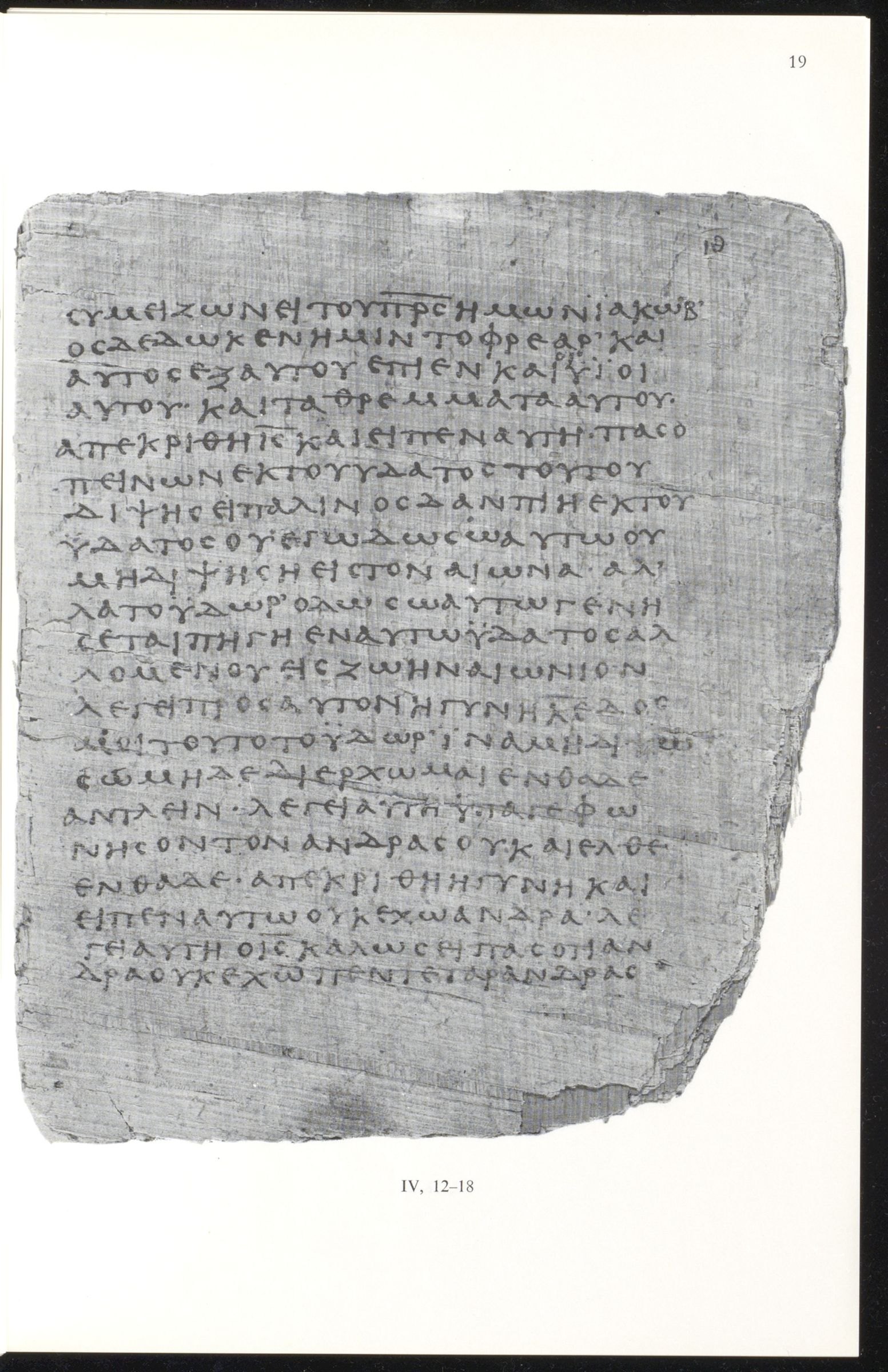
Fondation Martin Bodmer, Papyrus Bodmer II, Bodmer Lab image 1072205287_027 (https://bodmerlab.unige.ch/fr/constellations/papyri/mirador/1072205287), photographic plate of the 1962 Martin-Barns edition, shown whole. NTVMR page 190 (page 19) is linked to this image in NTVMR's page index. 4:12 begins on the previous page; 4:18 continues on the next page. Checked on the image: the printed caption reads ‹IV, 12-18›.
4:12 συ μειζων ει του π̅ρ̅ς̅ ημων ιακωβ·
ος δεδωκεν ημιν το φρεαρ και
αυτος εξ αυτου επιεν και υιοι
αυτου· και τα θρεμματα αυτου·
13 απεκριθη ι̅ς̅ και ειπεν αυτη· πας ο
πεινων εκ του υδατος τουτου
διψησει παλιν 14 ος δ αν πιη εκ του
υδατος ου εγω δωσω αυτω ου
μη διψηση εις τον αιωνα. αλ
λα το υδωρ ο δωσω αυτω γενη
σεται πηγη εν αυτω υδατος αλ
λομενου εις ζωην αιωνιον
15 λεγει προς αυτον η γυνη κ̅ε̅ δος
μοι τουτο το υδωρ ινα μη διψη
σω μηδε διερχωμαι ενθαδε
αντλειν· 16 λεγει αυτη υπαγε φω
νησον τον ανδρα σου και ελθε
ενθαδε· 17 απεκριθη η γυνη και
ειπεν αυτω ουκ εχω ανδρα· λε
γει αυτη ο ι̅ς̅ καλως ειπας οτι αν
δρα ουκ εχω 18 πεντε γαρ ανδρας
4:12Art thou greater than our father Jacob, which gave us the well, and drank thereof himself, and his children, and his cattle? 13Jesus answered and said unto her, Whosoever drinketh of this water shall thirst again: 14But whosoever drinketh of the water that I shall give him shall never thirst; but the water that I shall give him shall be in him a well of water springing up into everlasting life. 15The woman saith unto him, Sir, give me this water, that I thirst not, neither come hither to draw. 16Jesus saith unto her, Go, call thy husband, and come hither. 17The woman answered and said, I have no husband. Jesus said unto her, Thou hast well said, I have no husband: 18For thou hast had five husbands; and he whom thou now hast is not thy husband: in that saidst thou truly.
Where on the image
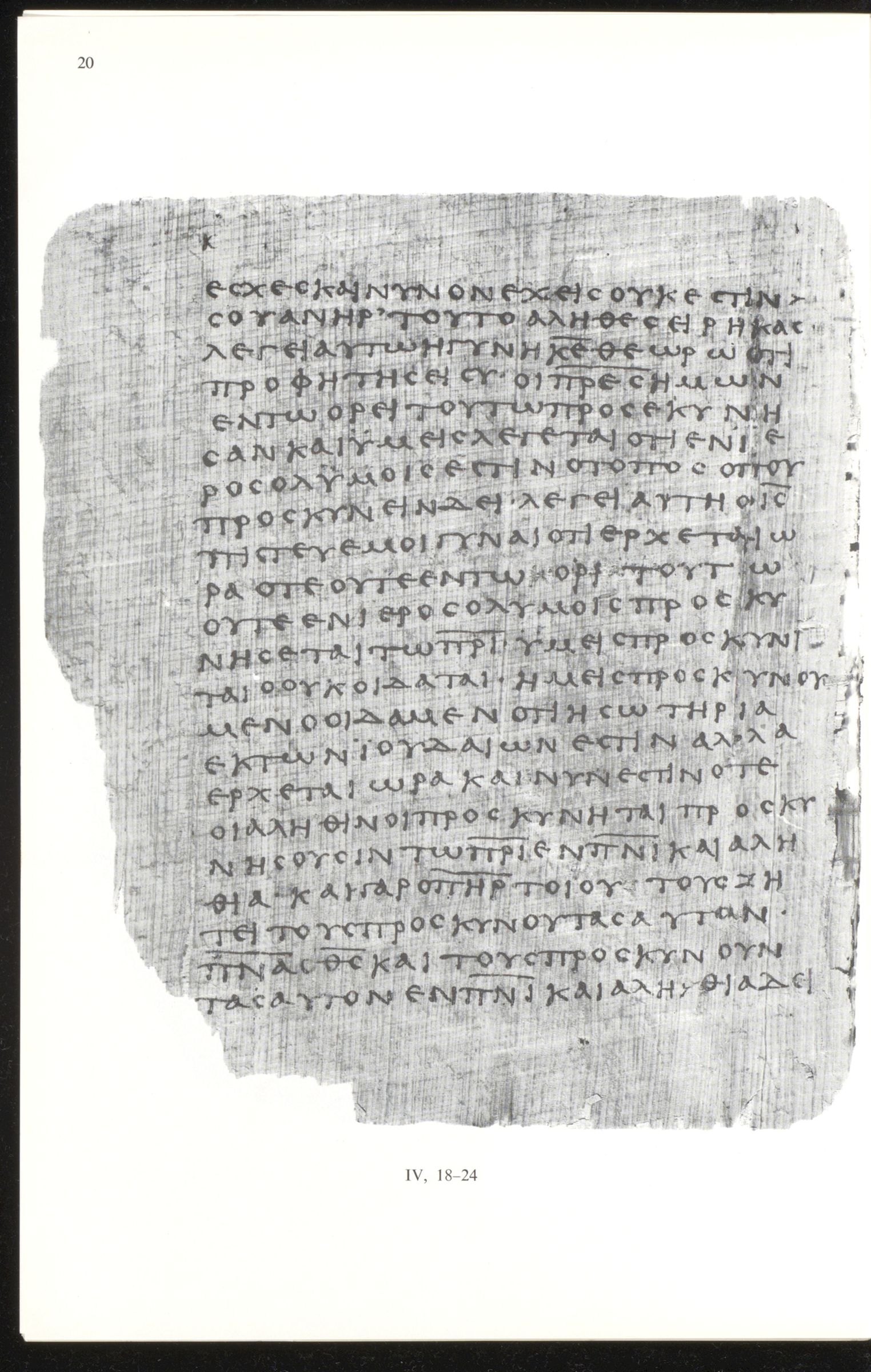
Fondation Martin Bodmer, Papyrus Bodmer II, Bodmer Lab image 1072205287_028 (https://bodmerlab.unige.ch/fr/constellations/papyri/mirador/1072205287), photographic plate of the 1962 Martin-Barns edition, shown whole. NTVMR page 200 (page 20) is linked to this image in NTVMR's page index. 4:18 begins on the previous page; 4:24 continues on the next page. Checked on the image: the printed caption reads ‹IV, 18-24›; the last line of writing, ‹τας αυτον εν π̅ν̅ι̅ και αληθια δει› (line 22 of the transcription), is legible at the foot of the page.
4:18 εσχες και νυν ον εχεις ουκ εστιν
σου ανηρ τουτο αληθες ειρηκας
19 λεγει αυτω η γυνη κ̅ε̅ θεωρω οτι
προφητης ει συ· 20 οι π̅ρ̅ε̅ς̅ ημων
εν τω ορει τουτω προσεκυνη
σαν και υμεις λεγεται οτι εν ιε
ροσολυμοις εστιν ο τοπος οπου
προσκυνειν δει· 21 λεγει αυτη ο ι̅ς̅
πιστευε μοι γυναι οτι ερχεται ω
ρα οτε ουτε εν τω κοσ̣μ̣ω̣ τουτω
ουτε εν ιεροσολυμοις προσκυ
νησεται τω π̅ρ̅ι̅· 22 υμεις προσκυνι
ται ο ουκ οιδαται· ημεις προσκυνου
μεν ο οιδαμεν οτι η σωτηρια
εκ των ιουδαιων εστιν 23 αλλα
ερχεται ωρα και νυν εστιν οτε
οι αληθινοι προσκυνηται προσκυ
νησουσιν τω π̅ρ̅ι̅ εν π̅ν̅ι̅ και αλη
θια· και γαρ ο π̅η̅ρ̅ τοιου[.]τους ζη
τει τους προσκυνουτας αυτω·
24 π̅ν̅α̅ ο θ̅ς̅ και τους προσκυνουν
τας αυτον εν π̅ν̅ι̅ και αληθια δει
4:18For thou hast had five husbands; and he whom thou now hast is not thy husband: in that saidst thou truly. 19The woman saith unto him, Sir, I perceive that thou art a prophet. 20Our fathers worshipped in this mountain; and ye say, that in Jerusalem is the place where men ought to worship. 21Jesus saith unto her, Woman, believe me, the hour cometh, when ye shall neither in this mountain, nor yet at Jerusalem, worship the Father. 22Ye worship ye know not what: we know what we worship: for salvation is of the Jews. 23But the hour cometh, and now is, when the true worshippers shall worship the Father in spirit and in truth: for the Father seeketh such to worship him. 24God is a Spirit: and they that worship him must worship him in spirit and in truth.
Where on the image
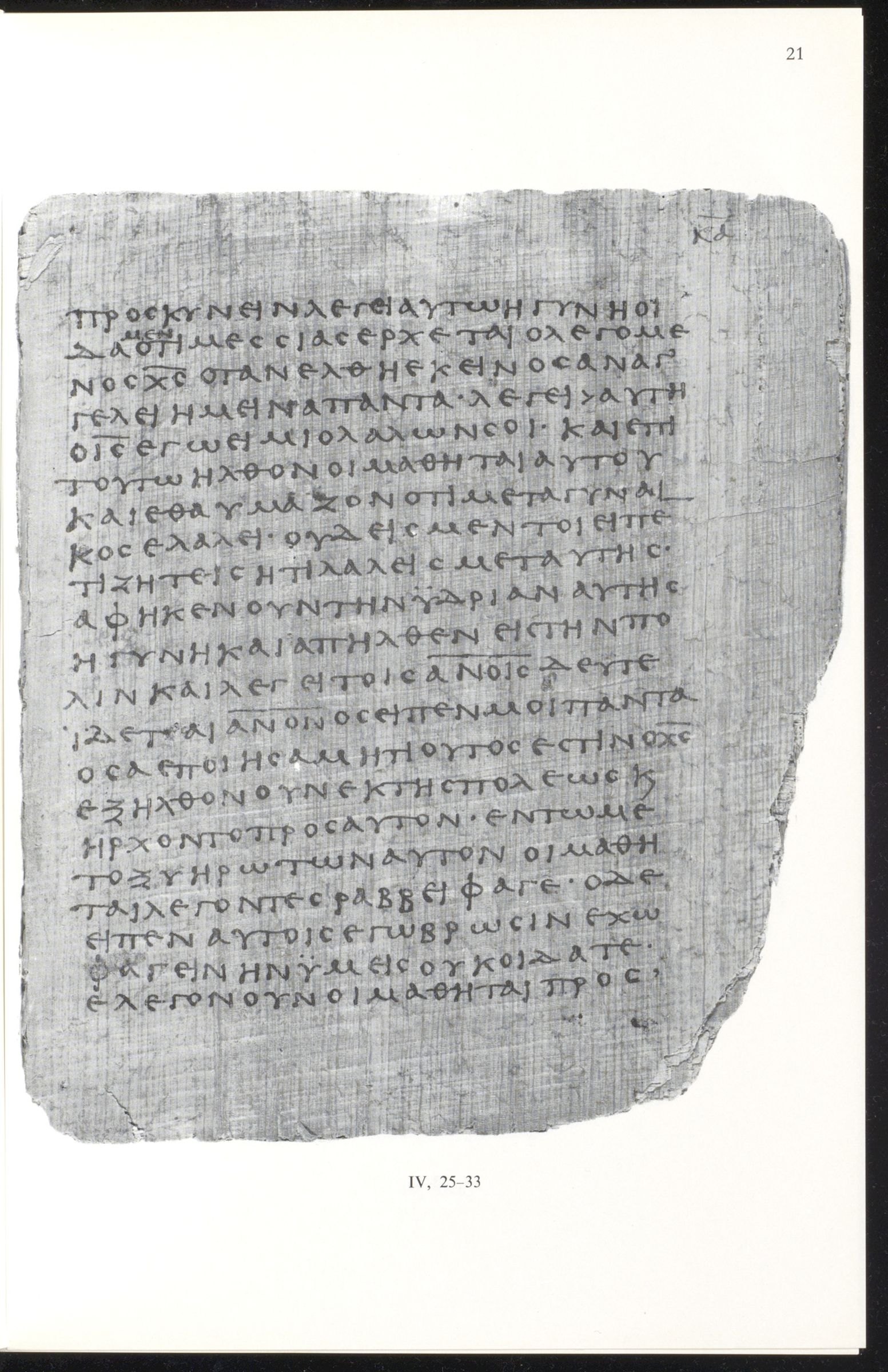
Fondation Martin Bodmer, Papyrus Bodmer II, Bodmer Lab image 1072205287_029 (https://bodmerlab.unige.ch/fr/constellations/papyri/mirador/1072205287), photographic plate of the 1962 Martin-Barns edition, shown whole. NTVMR page 210 (page 21) is linked to this image in NTVMR's page index. 4:24 begins on the previous page; 4:33 continues on the next page. Checked on the image: the printed caption reads ‹IV, 25-33›; the last line of writing, ‹ελεγον ουν οι μαθηται προς› (line 21 of the transcription), is legible at the foot of the page.
4:24 προσκυνειν 25 λεγει αυτω η γυνη οι
δα οτι μεσσιας ερχεται ο λεγομε
νος χ̅ς̅ οταν ελθη εκεινος αναγ
γελει ημειν απαντα· 26 λεγει αυτη
ο ι̅ς̅ εγω ειμι ο λαλων σοι· 27 και επι
τουτω ηλθον οι μαθηται αυτου
και εθαυμαζον οτι μετα γυναι
κος ελαλει· ουδεις μεντοι ειπεν
τι ζητεις η τι λαλεις μετ αυτης·
28 αφηκεν ουν την υδριαν αυτης
η γυνη και απηλθεν εις την πο
λιν και λεγει τοις α̅ν̅ο̅ι̅ς̅ 29 δευτε
ιδετε̣ α̅ν̅ο̅ν̅ ος ειπεν μοι παντα
οσα εποιησα μητι ουτος εστιν ο χ̅ς̅
30 εξηλθον ουν εκ της πολεως και
ηρχοντο προς αυτον· 31 εν τω με
τοξυ ηρωτων αυτον οι μαθη
ται λεγοντες ραββει φαγε· 32 ο δε
ειπεν αυτοις εγω βρωσιν εχω
φαγειν ην υμεις ουκ οιδατε·
33 ελεγον ουν οι μαθηται προς
4:24God is a Spirit: and they that worship him must worship him in spirit and in truth. 25The woman saith unto him, I know that Messias cometh, which is called Christ: when he is come, he will tell us all things. 26Jesus saith unto her, I that speak unto thee am he. 27¶ And upon this came his disciples, and marvelled that he talked with the woman: yet no man said, What seekest thou? or, Why talkest thou with her? 28The woman then left her waterpot, and went her way into the city, and saith to the men, 29Come, see a man, which told me all things that ever I did: is not this the Christ? 30Then they went out of the city, and came unto him. 31¶ In the mean while his disciples prayed him, saying, Master, eat. 32But he said unto them, I have meat to eat that ye know not of. 33Therefore said the disciples one to another, Hath any man brought him ought to eat?
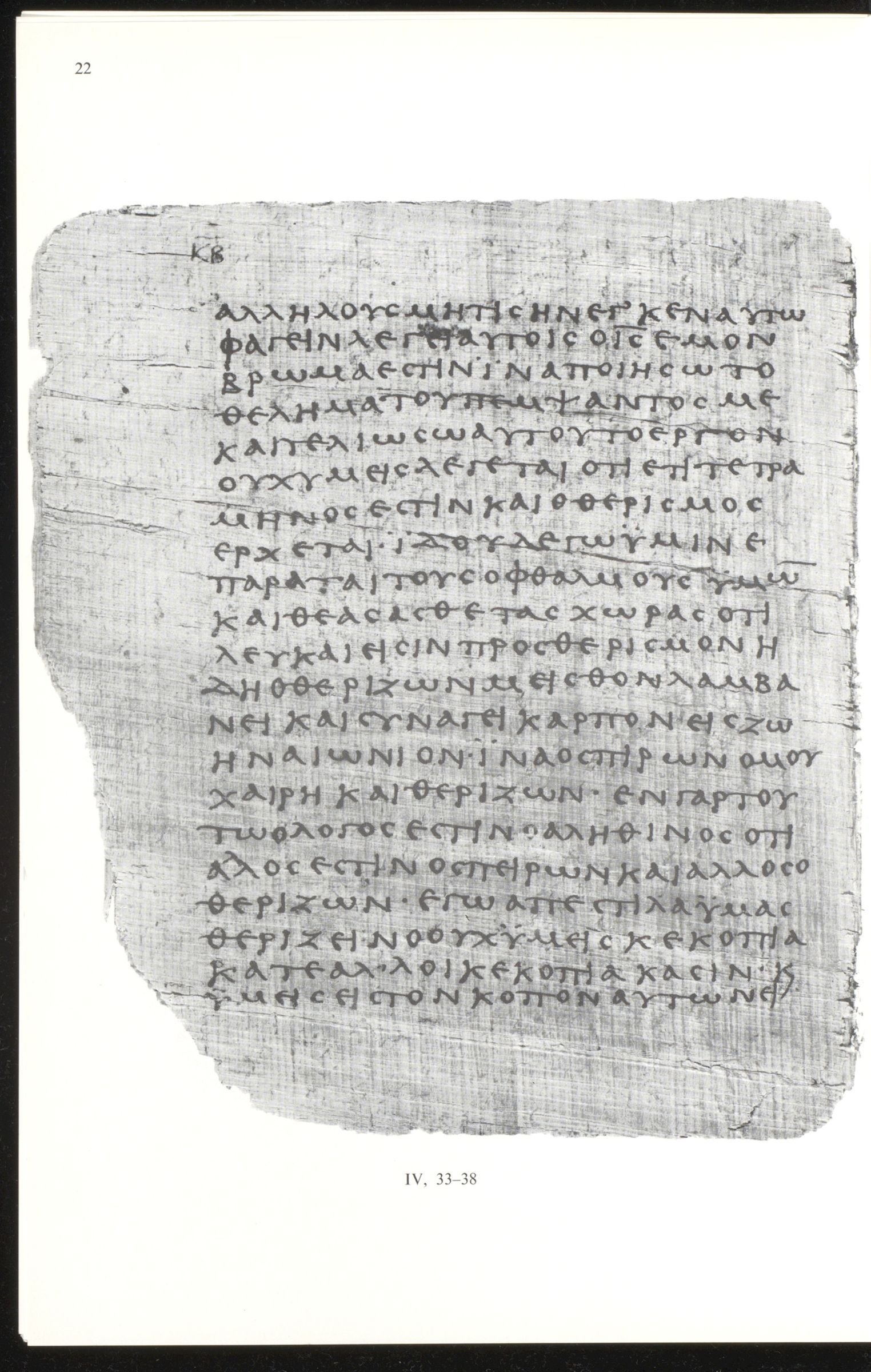
Where on the image
Fondation Martin Bodmer, Papyrus Bodmer II, Bodmer Lab image 1072205287_030 (https://bodmerlab.unige.ch/fr/constellations/papyri/mirador/1072205287), photographic plate of the 1962 Martin-Barns edition, shown whole. NTVMR page 220 (page 22) is linked to this image in NTVMR's page index. 4:33 begins on the previous page; 4:38 continues on the next page. Checked on the image: the printed caption reads ‹IV, 33-38›; the last line of writing, ‹υμεις εις τον κοπον αυτων ει› (line 21 of the transcription), is legible at the foot of the page.
4:33 αλληλους μη τις ηνεγκεν αυτω
φαγειν 34 λεγει αυτοις ο ι̅ς̅ εμον
βρωμα εστιν ινα ποιησω το
θελημα του πεμψαντος με
και τελιωσω αυτου το εργον
35 ουχ υμεις λεγεται οτι ετι τετρα
μηνος εστιν και ο θερισμος
ερχεται· ιδου λεγω υμιν ε
παραται τους οφθαλμους υμων
και θεασασθε τας χωρας οτι
λευκαι εισιν προς θερισμον η
δη 36 ο θεριζων μεισθον λαμβα
νει και συναγει καρπον εις ζω
ην αιωνιον· ινα ο σπιρων ομου
χαιρη και θεριζων· 37 εν γαρ του
τω ο λογος εστιν ο αληθινος οτι
αλος εστιν ο σπειρων και αλλος ο
θεριζων· 38 εγω απεστιλα υμας
θεριζειν ο ουχ υμεις κεκοπια
κατε αλλοι κεκοπιακασιν· και
υμεις εις τον κοπον αυτων ει
4:33Therefore said the disciples one to another, Hath any man brought him ought to eat? 34Jesus saith unto them, My meat is to do the will of him that sent me, and to finish his work. 35Say not ye, There are yet four months, and then cometh harvest? behold, I say unto you, Lift up your eyes, and look on the fields; for they are white already to harvest. 36And he that reapeth receiveth wages, and gathereth fruit unto life eternal: that both he that soweth and he that reapeth may rejoice together. 37And herein is that saying true, One soweth, and another reapeth. 38I sent you to reap that whereon ye bestowed no labour: other men laboured, and ye are entered into their labours.
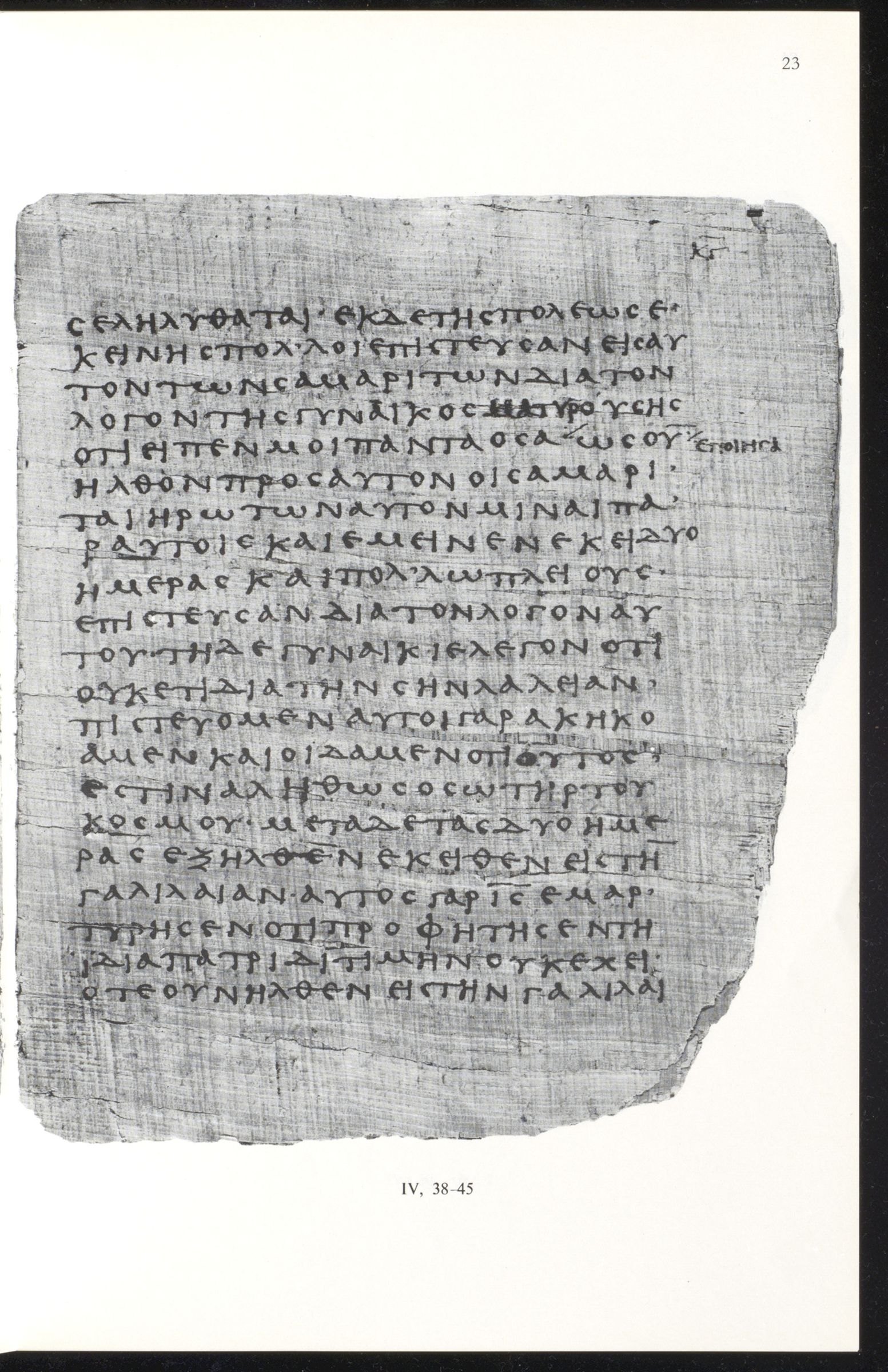
Where on the image
Fondation Martin Bodmer, Papyrus Bodmer II, Bodmer Lab image 1072205287_031 (https://bodmerlab.unige.ch/fr/constellations/papyri/mirador/1072205287), photographic plate of the 1962 Martin-Barns edition, shown whole. NTVMR page 230 (page 23) is linked to this image in NTVMR's page index. 4:38 begins on the previous page; 4:45 continues on the next page. Checked on the image: the printed caption reads ‹IV, 38-45›; the last line of writing, ‹οτε ουν ηλθεν εις την γαλιλαι› (line 21 of the transcription), is legible at the foot of the page.
4:38 σεληλυθαται· 39 εκ δε της πολεως ε
κεινης πολλοι επιστευσαν εις αυ
τον των σαμαριτων δια τον
λογον της γυναικος ματυρουσης
οτι ειπεν μοι παντα οσα 40 ως ουν
ηλθον προς αυτον οι σαμαρι
ται ηρωτων αυτον μιναι πα
ρ αυτοις και εμεινεν εκει δυο
ημερας 41 και πολλω πλειους·
επιστευσαν δια τον λογον αυ
του· 42 τη δε γυναικι ελεγον οτι
ουκετι δια την σην λαλειαν
πιστευομεν αυτοι γαρ ακηκο
αμεν και οιδαμεν οτι α̣υτος
εστιν αληθως ο σωτηρ του
κοσμου· 43 μετα δε τας δυο ημε
ρας εξηλθεν εκειθεν εις την
γαλιλαιαν· 44 αυτος γαρ ι̅ς̅ εμαρ
τυρησεν οτι προφητης εν τη
ιδια πατριδι τιμην ουκ εχει·
45 οτε ουν ηλθεν εις την γαλιλαι
4:38I sent you to reap that whereon ye bestowed no labour: other men laboured, and ye are entered into their labours. 39¶ And many of the Samaritans of that city believed on him for the saying of the woman, which testified, He told me all that ever I did. 40So when the Samaritans were come unto him, they besought him that he would tarry with them: and he abode there two days. 41And many more believed because of his own word; 42And said unto the woman, Now we believe, not because of thy saying: for we have heard him ourselves, and know that this is indeed the Christ, the Saviour of the world. 43¶ Now after two days he departed thence, and went into Galilee. 44For Jesus himself testified, that a prophet hath no honour in his own country. 45Then when he was come into Galilee, the Galilæans received him, having seen all the things that he did at Jerusalem at the feast: for they also went unto the feast.
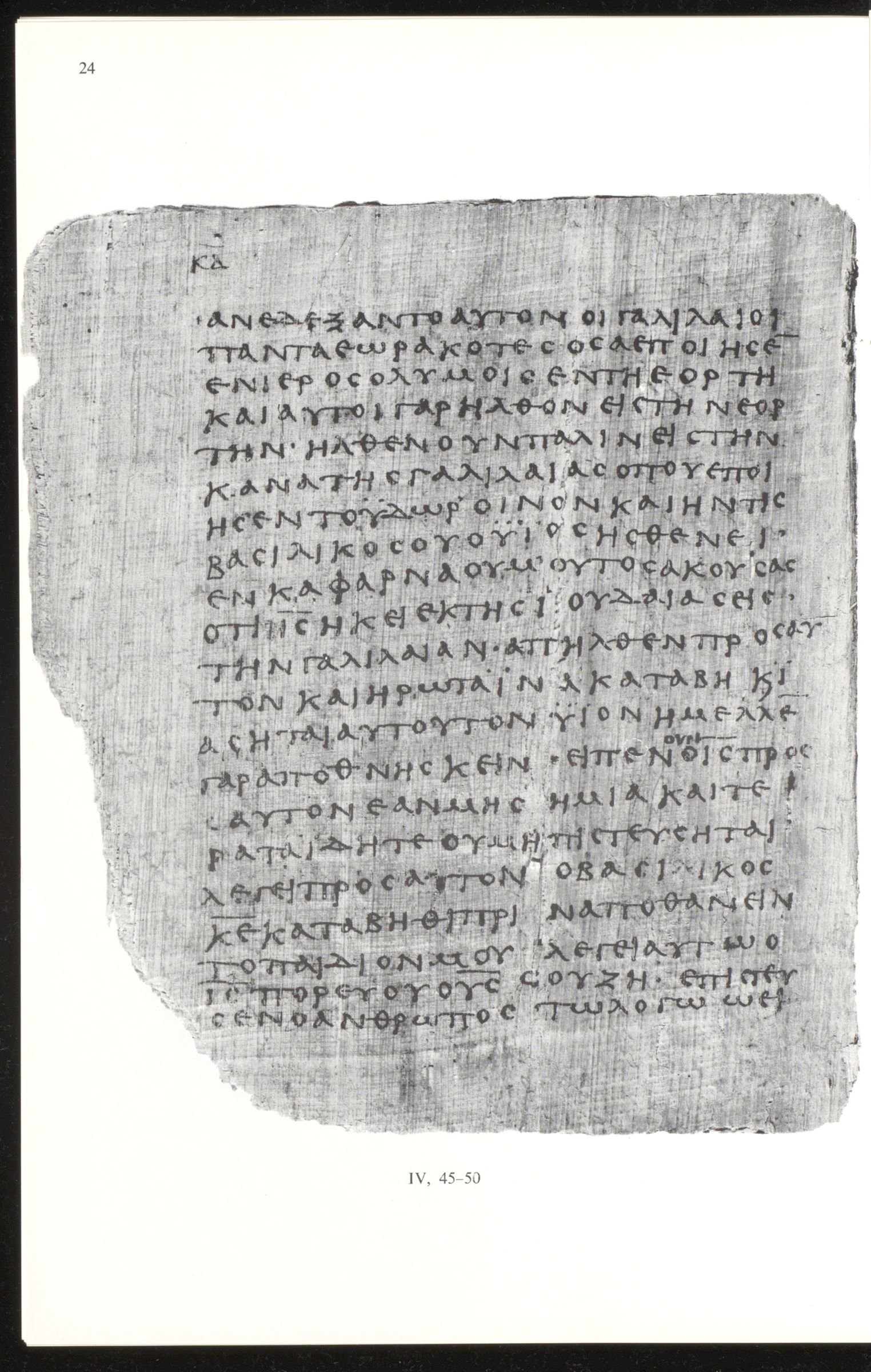
Where on the image
Fondation Martin Bodmer, Papyrus Bodmer II, Bodmer Lab image 1072205287_032 (https://bodmerlab.unige.ch/fr/constellations/papyri/mirador/1072205287), photographic plate of the 1962 Martin-Barns edition, shown whole. NTVMR page 240 (page 24) is linked to this image in NTVMR's page index. 4:45 begins on the previous page; 4:50 continues on the next page. Checked on the image: the printed caption reads ‹IV, 45-50›; the last line of writing, ‹σεν ο ανθρωπος τω λογω ω ει› (line 21 of the transcription), is legible at the foot of the page.
4:45 αν εδεξαντο αυτον οι γαλιλαιοι
παντα εωρακοτες οσα εποιησεν
εν ιεροσολυμοις εν τη εορτη
και αυτοι γαρ ηλθον εις την εορ
την· 46 ηλθεν ουν παλιν εις την
κανα της γαλιλαιας οπου εποι
ησεν το υδωρ οινον και ην τις
βασιλικος ου ο υιος ησθενει
εν καφαρναουμ· 47 ουτος ακουσας
οτι ο ι̅ς̅ ηκει εκ της ιουδαιας εις
την γαλιλαιαν· απηλθεν προς αυ
τον και ηρωτα ινα καταβη και ι
ασηται αυτου τον υιον ημελλεν
γαρ αποθνησκειν· 48 ειπεν ο ι̅ς̅ προ
ς αυτον εαν μη σημια και τε
ρατα ιδητε ου μη πιστευσηται·
49 λεγει προς αυτον ο βασιλικος
κ̅ε̅ καταβηθι πριν αποθανειν
το παιδιον μου· 50 λεγει αυτω ο
ι̅ς̅ πορευου ο υ̅ς̅ σου ζη· επιστευ
σεν ο ανθρωπος τω λογω ω ει
4:45Then when he was come into Galilee, the Galilæans received him, having seen all the things that he did at Jerusalem at the feast: for they also went unto the feast. 46So Jesus came again into Cana of Galilee, where he made the water wine. And there was a certain nobleman, whose son was sick at Capernaum. 47When he heard that Jesus was come out of Judæa into Galilee, he went unto him, and besought him that he would come down, and heal his son: for he was at the point of death. 48Then said Jesus unto him, Except ye see signs and wonders, ye will not believe. 49The nobleman saith unto him, Sir, come down ere my child die. 50Jesus saith unto him, Go thy way; thy son liveth. And the man believed the word that Jesus had spoken unto him, and he went his way.
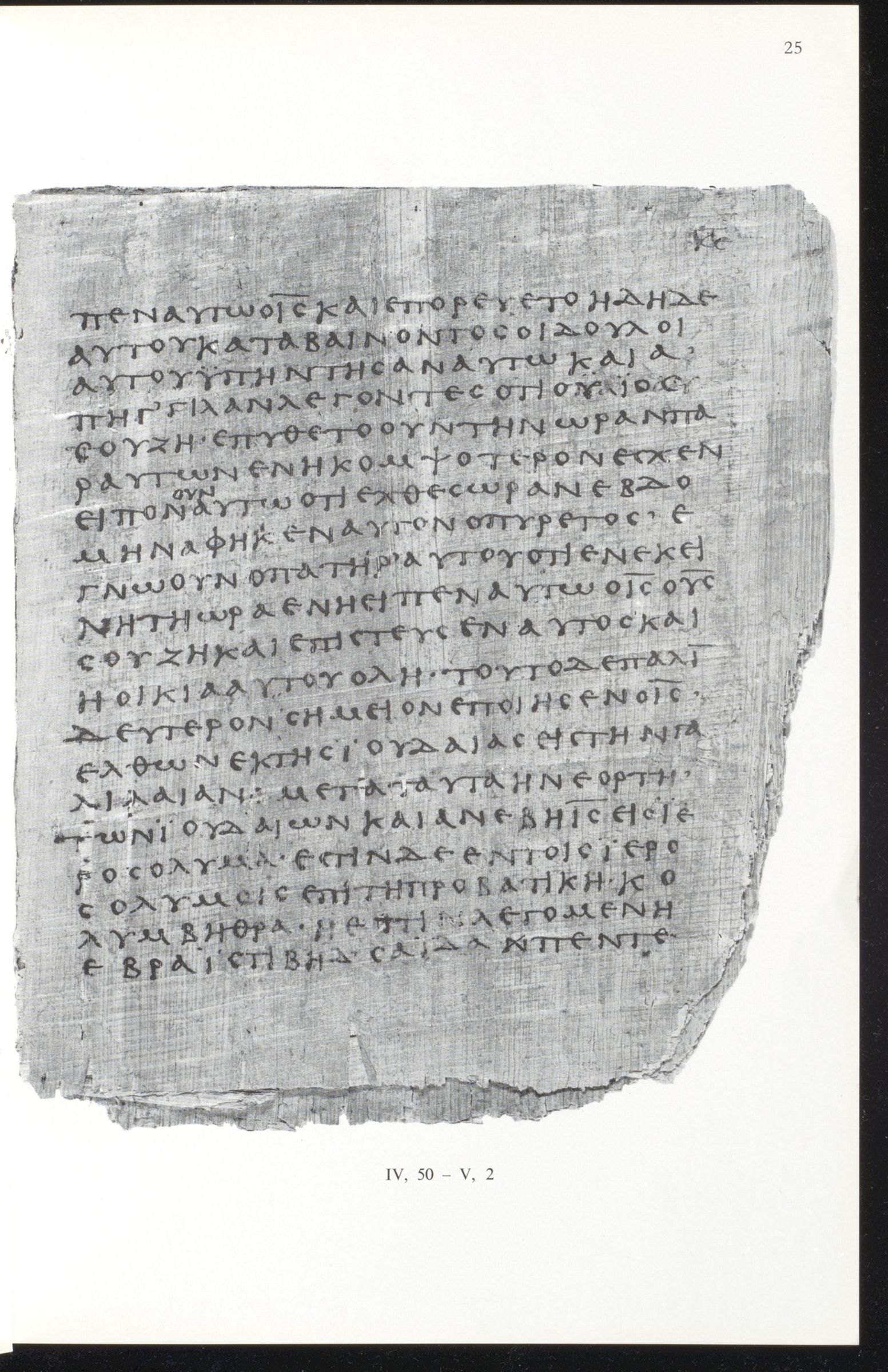
Where on the image
Fondation Martin Bodmer, Papyrus Bodmer II, Bodmer Lab image 1072205287_033 (https://bodmerlab.unige.ch/fr/constellations/papyri/mirador/1072205287), photographic plate of the 1962 Martin-Barns edition, shown whole. NTVMR page 250 (page 25) is linked to this image in NTVMR's page index. 4:50 begins on the previous page; 5:2 continues on the next page. Checked on the image: the printed caption reads ‹IV, 50 - V, 2›.
4:50 πεν αυτω ο ι̅ς̅ και επορευετο 51 ηδη δε
αυτου καταβαινοντος οι δουλοι
αυτου υπηντησαν αυτω και α
πηγγιλαν λεγοντες οτι ο παις αυ
του ζη· 52 επυθετο ουν την ωραν πα
ρ αυτων εν η κομψοτερον εσχεν
ειπον αυτω οτι εχθες ωραν εβδο
μην αφηκεν αυτον ο πυρετος 53 ε
γνω ουν ο πατηρ αυτου οτι εν εκει
νη τη ωρα εν η ειπεν αυτω ο ι̅ς̅ ο υ̅ς̅
σου ζη και επιστευσεν αυτος και
η οικια αυτου ολη· 54 τουτο δε παλιν
δευτερον σημειον εποιησεν ο ι̅ς̅
ελθων εκ της ιουδαιας εις την γα
λιλαιαν· 5:1 μετα ταυτα ην εορτη
των ιουδαιων και ανεβη ι̅ς̅ εις ιε
ροσολυμα· 2 εστιν δε εν τοις ιερο
σολυμοις επι τη προβατικη· κο
λυμβηθρα· η εστιν λεγομενη
εβραιστι βηδσαιδαν πεντε
4:50Jesus saith unto him, Go thy way; thy son liveth. And the man believed the word that Jesus had spoken unto him, and he went his way. 51And as he was now going down, his servants met him, and told him, saying, Thy son liveth. 52Then enquired he of them the hour when he began to amend. And they said unto him, Yesterday at the seventh hour the fever left him. 53So the father knew that it was at the same hour, in the which Jesus said unto him, Thy son liveth: and himself believed, and his whole house. 54This is again the second miracle that Jesus did, when he was come out of Judæa into Galilee. 5:1After this there was a feast of the Jews; and Jesus went up to Jerusalem. 2Now there is at Jerusalem by the sheep market a pool, which is called in the Hebrew tongue Bethesda, having five porches.
Notes
- Greek: the NTVMR diplomatic transcription, line by line as on the papyrus. Square brackets enclose letters that are lost or illegible and were supplied by the transcribers; a dot under a letter marks it as uncertain; [...] marks a gap. Nomina sacra and numerals keep the scribe's overline. Spelling is the scribe's (no accents or breathings). Words broken at a line end stay broken as on the papyrus. Corrections are not shown: the text is the first hand.
- English: the King James Version (1611), whole verses, for every verse that has text on the page. A verse that begins on one page and ends on the next is given in full on both. The KJV translates a later form of the Greek text, so its wording does not always match the papyrus; material differences (such as verses the papyrus does not have) are noted in the section.
Cite
Sources
- Source: Papyrus Bodmer II (P66), Fondation Martin Bodmer: images from the Bodmer Lab, University of Geneva; Greek from the INTF NTVMR transcription of P66; English from the King James Version (holding institution)
- Critical edition: INTF NTVMR diplomatic transcription (CC BY 4.0)
← previous · → next · v cycle view · l back to library