P66 (Papyrus Bodmer II): John 5:2-6:5 (pages 26-33)
Introduction
P66 is a papyrus codex of the Gospel of John copied in Egypt around 200, the most complete early copy of John. Most of it is Papyrus Bodmer II in the Fondation Martin Bodmer, Cologny (Geneva); small pieces are in the Chester Beatty Library, Dublin, and the Institut für Altertumskunde, Cologne. The first five quires (John 1:1-14:26) survive as a bound book of numbered pages; later leaves, from John 14:29 to 21:9, are damaged and kept between glass. The scribe made many corrections, some of them his own; only the first hand is shown here.
Each section below is one page: the photograph, the NTVMR diplomatic transcription line by line, and the King James Version of every verse on the page. Pages of the bound book are shown on the photographic plates published by Victor Martin and J. W. B. Barns in 1962 (scanned by the Bodmer Lab), the glass-mounted leaves on colour photographs. Lost: John 6:12-34 (pages 35-38) and parts of chapters 14-21; the transcription ends at 21:9. Where P66 lacks a verse that the KJV has (John 5:4, the account of the adulteress at 7:53-8:11, 16:15), the section says so.
This entry covers pages 26-33 (John 5:2-6:5).
How was this verified? (Provenance)
Where on the image
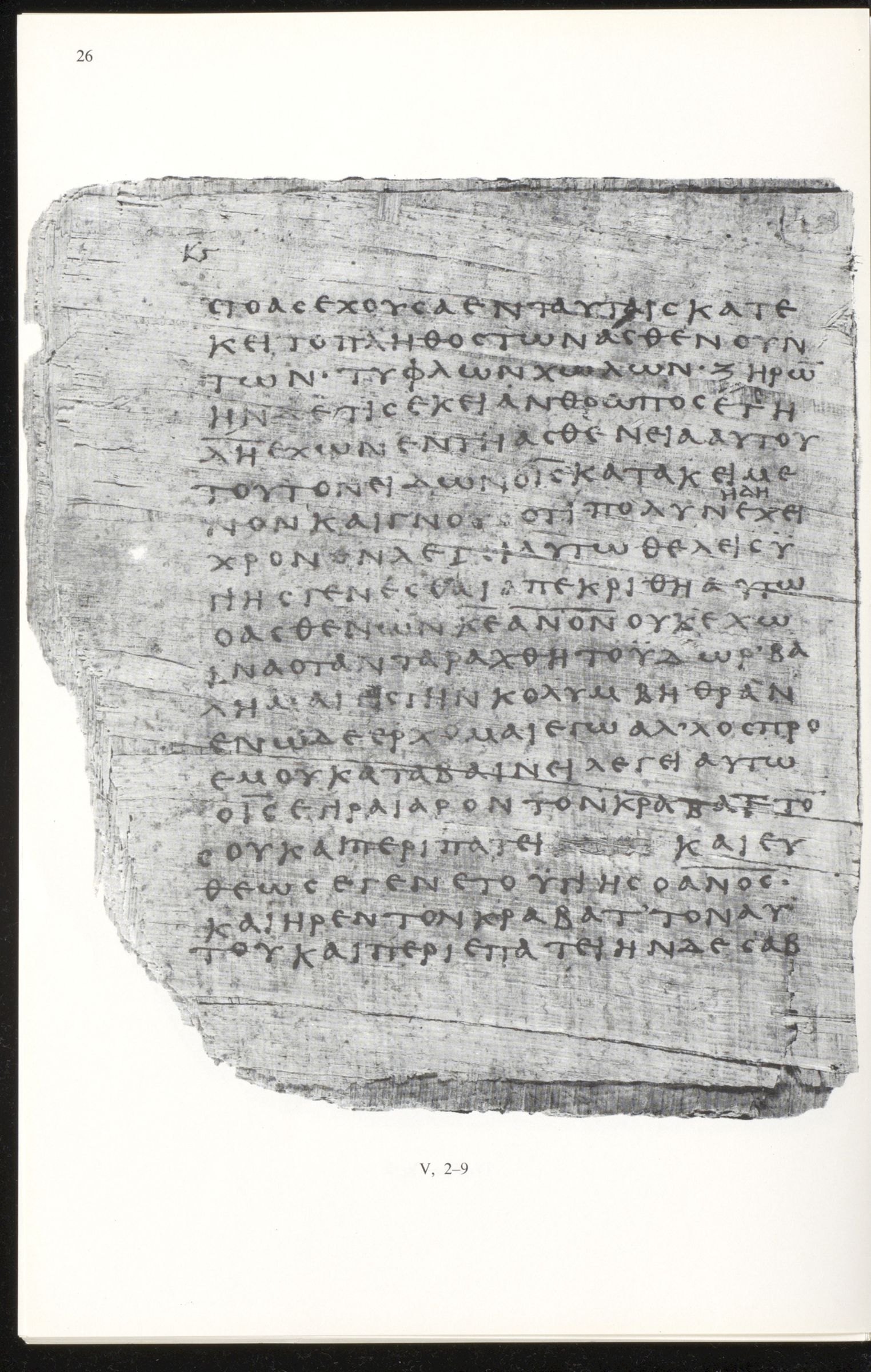
Fondation Martin Bodmer, Papyrus Bodmer II, Bodmer Lab image 1072205287_034 (https://bodmerlab.unige.ch/fr/constellations/papyri/mirador/1072205287), photographic plate of the 1962 Martin-Barns edition, shown whole. NTVMR page 260 (page 26) is linked to this image in NTVMR's page index. 5:2 begins on the previous page; 5:9 continues on the next page. Not written in this papyrus: John 5:4. The NTVMR transcription marks this verse as empty at this point of the text, so the English leaves it out. Checked on the image: the printed caption reads ‹V, 2-9›.
5:2 στοας εχουσα 3 εν ταυταις κατε
κειτο πληθος των ασθενουν
των· τυφλων χωλων· ξηρων
5 ην δε τις εκει ανθρωπος ετη
λ̅η̅ εχων εν τη ασθενεια αυτου
6 τουτον ειδων ο ι̅ς̅ κατακειμε
νον και γνους οτι πολυν εχει
χρονον λεγει αυτω θελεις υ
γιης γενεσθαι 7 απεκριθη αυτω
ο ασθενων κ̅ε̅ α̅ν̅ο̅ν̅ ουκ εχω
ινα οταν ταραχθη το υδωρ βα
λη μαι εις την κολυμβηθραν
εν ω δε ερχομαι εγω αλλος προ
εμου καταβαινει 8 λεγει αυτω
ο ι̅ς̅ εγιραι αρον τον κραβαττον
σου και περιπατει [...] 9 και ευ
θεως εγενετο υγιης ο α̅ν̅ο̅ς̅·
και ηρεν τον κραβαττον αυ
του και περιεπατει ην δε σαβ
5:2Now there is at Jerusalem by the sheep market a pool, which is called in the Hebrew tongue Bethesda, having five porches. 3In these lay a great multitude of impotent folk, of blind, halt, withered, waiting for the moving of the water. 5And a certain man was there, which had an infirmity thirty and eight years. 6When Jesus saw him lie, and knew that he had been now a long time in that case, he saith unto him, Wilt thou be made whole? 7The impotent man answered him, Sir, I have no man, when the water is troubled, to put me into the pool: but while I am coming, another steppeth down before me. 8Jesus saith unto him, Rise, take up thy bed, and walk. 9And immediately the man was made whole, and took up his bed, and walked: and on the same day was the sabbath.
Where on the image
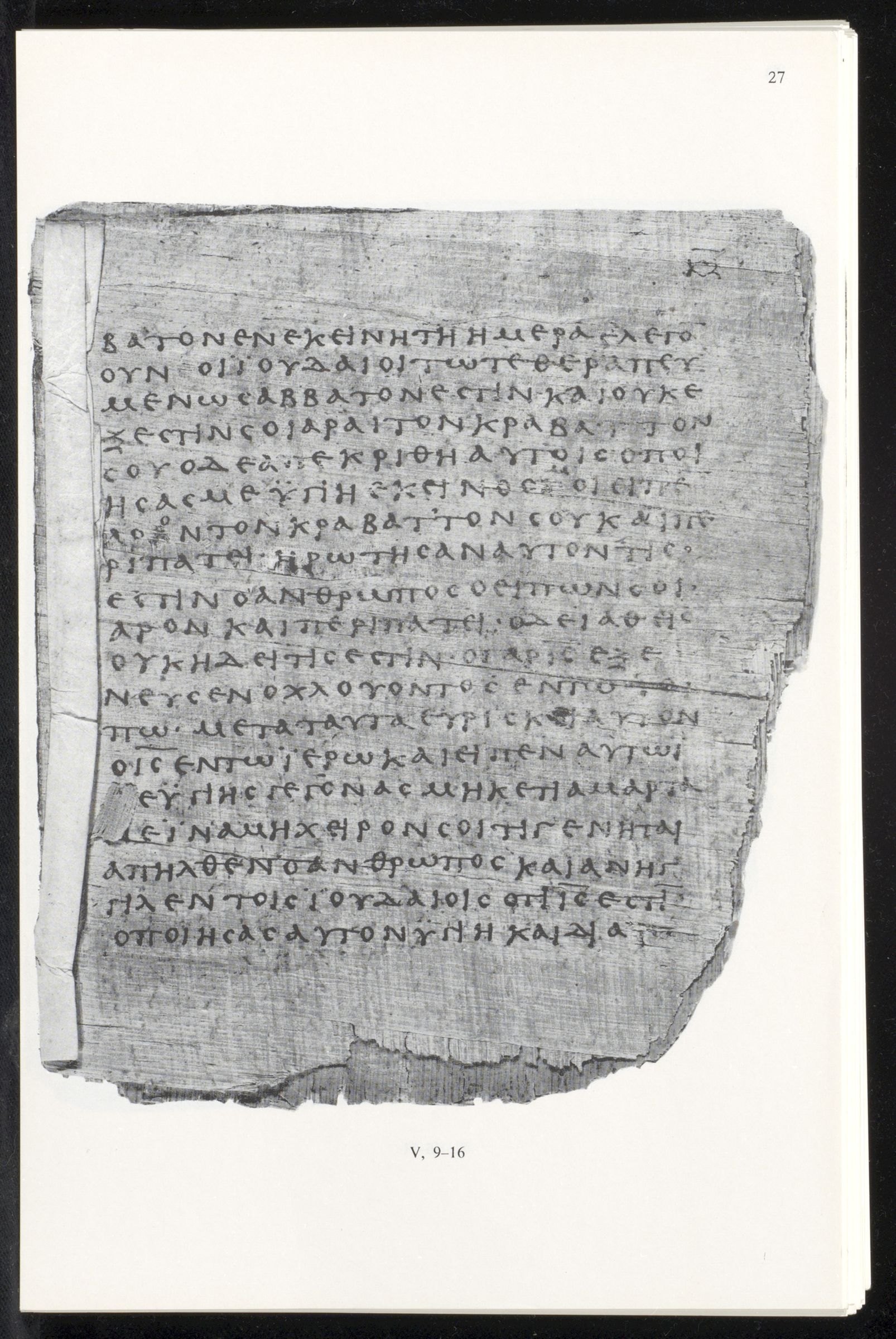
Fondation Martin Bodmer, Papyrus Bodmer II, Bodmer Lab image 1072205287_035 (https://bodmerlab.unige.ch/fr/constellations/papyri/mirador/1072205287), photographic plate of the 1962 Martin-Barns edition, shown whole. NTVMR page 270 (page 27) is linked to this image in NTVMR's page index. 5:9 begins on the previous page; 5:16 continues on the next page. Checked on the image: the printed caption reads ‹V, 9-16›.
5:9 βατον εν εκεινη τη ημερα 10 ελεγον
ουν σοι ιουδαιοι τω τεθεραπευ
μενω σαββατον εστιν και ουκ ε
ξεστιν σοι αραι τον κραβαττον
σου 11 ο δε απεκριθη αυτοις ο ποι
ησας με υγιη εκεινος [.]οι ειπεν
αραν τον κραβαττον σου και πε
ριπατει· 12 ηρωτησαν αυτον τις
εστιν ο ανθρωπος ο ειπων σοι
αρον και περιπατει· 13 ο δε ιαθεις
ουκ ηδει τις εστιν· ο γαρ ι̅ς̅ εξε
νευσεν οχλου οντος εν τω τ̣ο
πω· 14 μετα ταυτα ευρισκο̣ι αυτον
ο ι̅ς̅ εν τω ιερω και ειπεν αυτω ι
[δ]ε υγιης γεγονας μηκετι αμαρτα
ν̣ε ινα μη χειρον σοι τι γενηται
15 απηλθεν ο ανθρωπος και ανηγ
γιλεν τοις ιουδαιοις οτι ι̅ς̅ εστιν
ο ποιησας αυτον υγιη 16 και δια τ̣ο̣
5:9And immediately the man was made whole, and took up his bed, and walked: and on the same day was the sabbath. 10¶ The Jews therefore said unto him that was cured, It is the sabbath day: it is not lawful for thee to carry thy bed. 11He answered them, He that made me whole, the same said unto me, Take up thy bed, and walk. 12Then asked they him, What man is that which said unto thee, Take up thy bed, and walk? 13And he that was healed wist not who it was: for Jesus had conveyed himself away, a multitude being in that place. 14Afterward Jesus findeth him in the temple, and said unto him, Behold, thou art made whole: sin no more, lest a worse thing come unto thee. 15The man departed, and told the Jews that it was Jesus, which had made him whole. 16And therefore did the Jews persecute Jesus, and sought to slay him, because he had done these things on the sabbath day.
Where on the image
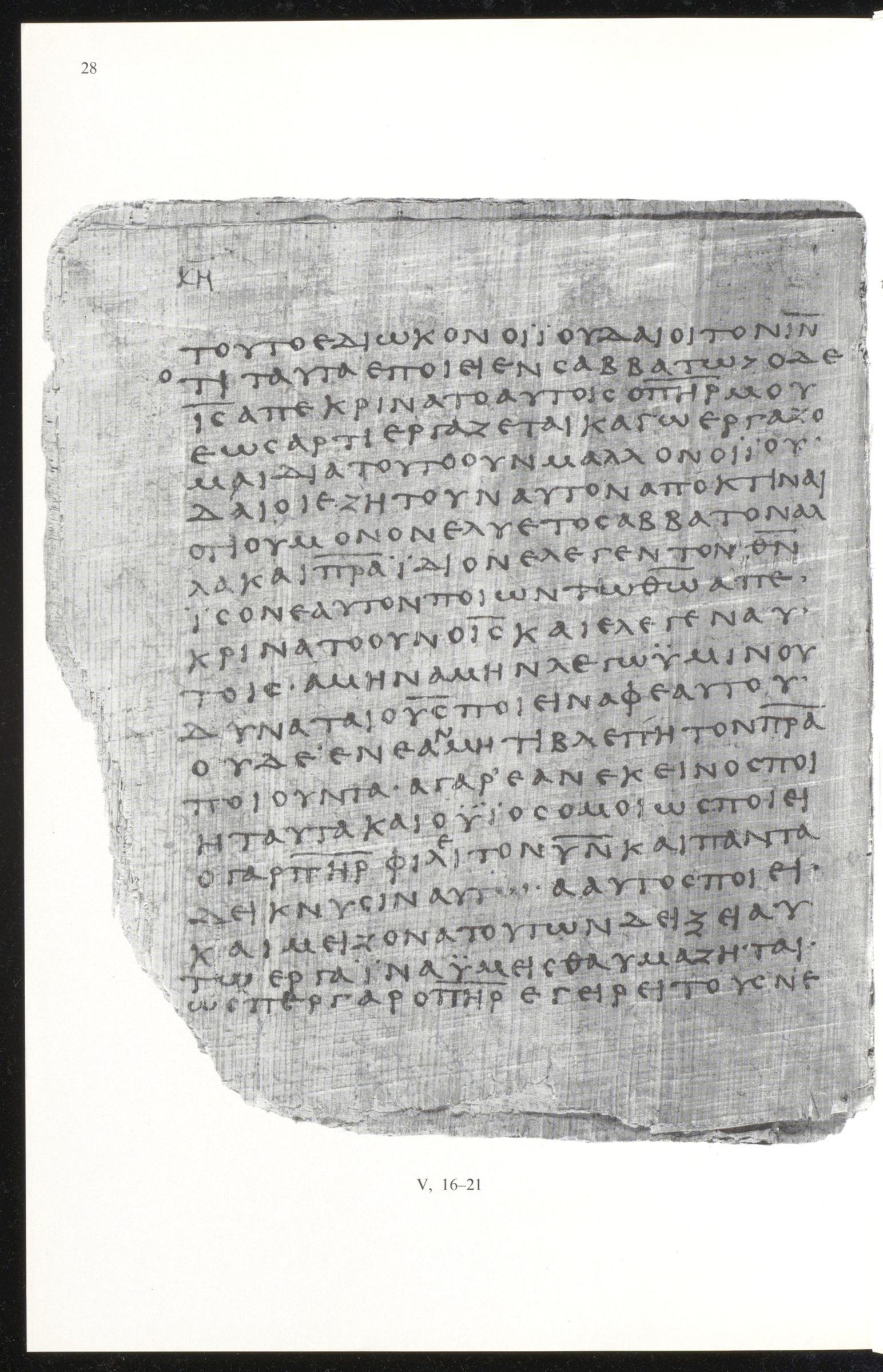
Fondation Martin Bodmer, Papyrus Bodmer II, Bodmer Lab image 1072205287_036 (https://bodmerlab.unige.ch/fr/constellations/papyri/mirador/1072205287), photographic plate of the 1962 Martin-Barns edition, shown whole. NTVMR page 280 (page 28) is linked to this image in NTVMR's page index. 5:16 begins on the previous page; 5:21 continues on the next page. Checked on the image: the printed caption reads ‹V, 16-21›; the last line of writing, ‹ωσπερ γαρ ο π̅η̅ρ̅ εγειρει τους νε› (line 20 of the transcription), is legible at the foot of the page.
5:16 τουτο εδιωκον οι ιουδαιοι τον ι̅ν̅
το ταυτα εποιει εν σαββατω 17 ο δε
ι̅ς̅ απεκρινατο αυτοις ο π̅η̅ρ̅ μου
εως αρτι εργαζεται καγω εργαζο
μαι 18 δια τουτο ουν μαλλον οι ιου
δαιοι εζητουν αυτον αποκτιναι
οτι ου μονον ελυε το σαββατον αλ
λα και π̅ρ̅α̅· ιδιον ελεγεν τον θ̅ν̅
ισον εαυτον ποιων τω θ̅ω̅ 19 απε
κρινατο ουν ο ι̅ς̅ και ελεγεν αυ
τοις· αμην αμην λεγω υμιν ου
δυναται ο υ̅ς̅ ποιειν αφ εαυτου·
ουδε εν εα μη τι βλεπη τον π̅ρ̅α̅
ποιουντα· α γαρ εαν εκεινος ποι
η ταυτα και ο υιος ομοιως ποιει
20 ο γαρ π̅η̅ρ̅ φιλι τον υ̅ν̅ και παντα
δεικνυσιν αυτω· α αυτος ποιει·
και μειζονα τουτων δειξει αυ
τω εργα ινα υμεις θαυμαζηται·
21 ωσπερ γαρ ο π̅η̅ρ̅ εγειρει τους νε
5:16And therefore did the Jews persecute Jesus, and sought to slay him, because he had done these things on the sabbath day. 17¶ But Jesus answered them, My Father worketh hitherto, and I work. 18Therefore the Jews sought the more to kill him, because he not only had broken the sabbath, but said also that God was his Father, making himself equal with God. 19Then answered Jesus and said unto them, Verily, verily, I say unto you, The Son can do nothing of himself, but what he seeth the Father do: for what things soever he doeth, these also doeth the Son likewise. 20For the Father loveth the Son, and sheweth him all things that himself doeth: and he will shew him greater works than these, that ye may marvel. 21For as the Father raiseth up the dead, and quickeneth them; even so the Son quickeneth whom he will.
Where on the image
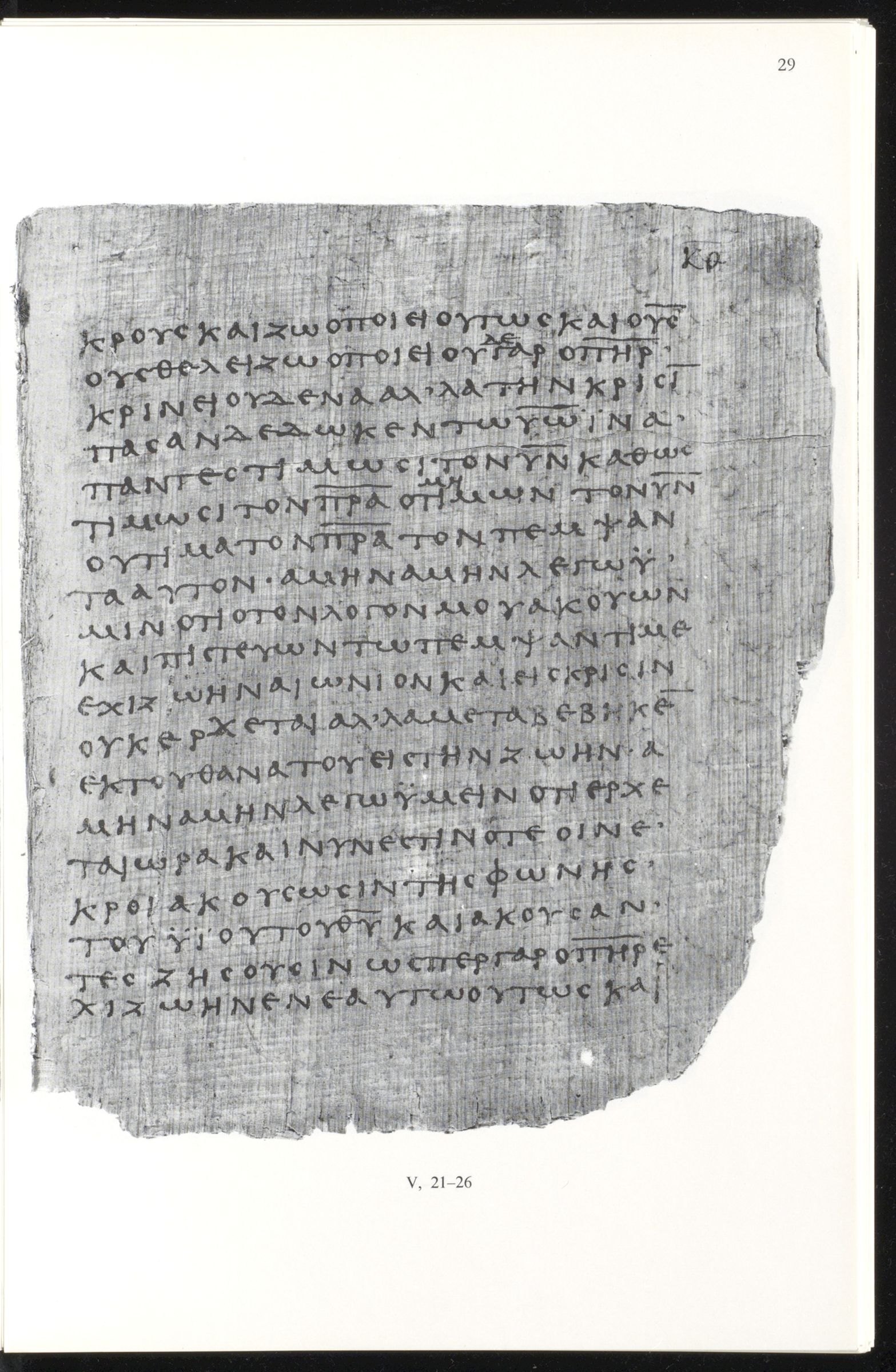
Fondation Martin Bodmer, Papyrus Bodmer II, Bodmer Lab image 1072205287_037 (https://bodmerlab.unige.ch/fr/constellations/papyri/mirador/1072205287), photographic plate of the 1962 Martin-Barns edition, shown whole. NTVMR page 290 (page 29) is linked to this image in NTVMR's page index. 5:21 begins on the previous page; 5:26 continues on the next page. Checked on the image: the printed caption reads ‹V, 21-26›; the last line of writing, ‹χι ζωην εν εαυτω ουτως και› (line 19 of the transcription), is legible at the foot of the page.
5:21 κρους και ζωοποιει ουτως και ο υ̅ς̅
ους θελει ζωοποιει 22 ου γαρ ο π̅η̅ρ̅
κρινει ουδενα αλλα την κρισιν
πασαν δεδωκεν τω υ̅ω̅ 23 ινα
παντες τιμωσι τον υ̅ν̅ καθως
τιμωσι τον π̅ρ̅α̅ ο τιμων τον υ̅ν̅
ου τιμα τον π̅ρ̅α̅ τον πεμψαν
τα αυτον· 24 αμην αμην λεγω υ
μιν οτι ο τον λογον μου ακουων
και πιστευων τω πεμψαντι με
εχι ζωην αιωνιον και εις κρισιν
ουκ ερχεται αλλα μεταβεβηκεν
εκ του θανατου εις την ζωην· 25 α
μην αμην λεγω υμειν οτι ερχε
ται ωρα και νυν εστιν οτε οι νε
κροι ακουσωσιν της φωνης
του υιου του θ̅υ̅ και ακουσαν
τες ζησουσιν 26 ωσπερ γαρ ο π̅η̅ρ̅ ε
χι ζωην εν εαυτω ουτως και
5:21For as the Father raiseth up the dead, and quickeneth them; even so the Son quickeneth whom he will. 22For the Father judgeth no man, but hath committed all judgment unto the Son: 23That all men should honour the Son, even as they honour the Father. He that honoureth not the Son honoureth not the Father which hath sent him. 24Verily, verily, I say unto you, He that heareth my word, and believeth on him that sent me, hath everlasting life, and shall not come into condemnation; but is passed from death unto life. 25Verily, verily, I say unto you, The hour is coming, and now is, when the dead shall hear the voice of the Son of God: and they that hear shall live. 26For as the Father hath life in himself; so hath he given to the Son to have life in himself;
Where on the image
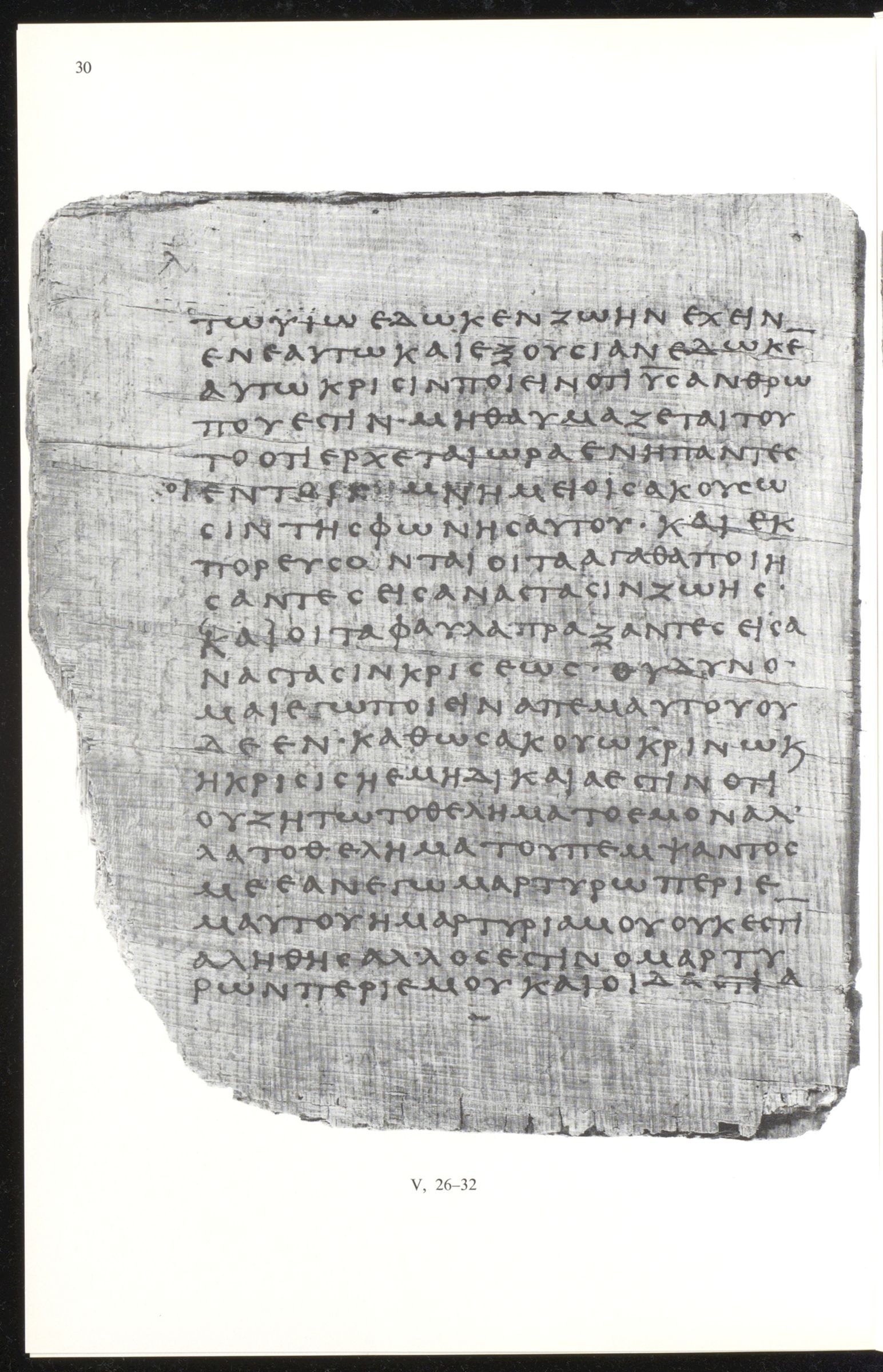
Fondation Martin Bodmer, Papyrus Bodmer II, Bodmer Lab image 1072205287_038 (https://bodmerlab.unige.ch/fr/constellations/papyri/mirador/1072205287), photographic plate of the 1962 Martin-Barns edition, shown whole. NTVMR page 300 (page 30) is linked to this image in NTVMR's page index. 5:26 begins on the previous page; 5:32 continues on the next page. Checked on the image: the printed caption reads ‹V, 26-32›; the last line of writing, ‹ρων περι εμου και οιδα οτι α› (line 20 of the transcription), is legible at the foot of the page.
5:26 τω υιω εδωκεν ζωην εχειν
εν εαυτω 27 και εξουσιαν εδωκεν
αυτω κρισιν ποιειν οτι υ̅ς̅ ανθρω
που εστιν· 28 μη θαυμαζεται του
το οτι ερχεται ωρα εν η παντες
εν τη̣ ερημω ακουσω
σιν της φωνης αυτου· 29 και εκ
πορευσωνται οι τα αγαθα ποιη
σαντες εις αναστασιν ζωης·
και οι τα φαυλα πραξαντες εις α
ναστασιν κρισεως· 30 ου δυνο
μαι εγω ποιειν απ εμαυτου ου
δε εν· καθως ακουω κρινω και
η κρισις η εμη δικαια εστιν οτι
ου ζητω το θελημα το εμον αλ
λα το θελημα του πεμψαντος
με 31 εαν εγω μαρτυρω περι ε
μαυτου η μαρτυρια μου ουκ εστιν
αληθης 32 αλλος εστιν ο μαρτυ
ρων περι εμου και οιδα οτι α
5:26For as the Father hath life in himself; so hath he given to the Son to have life in himself; 27And hath given him authority to execute judgment also, because he is the Son of man. 28Marvel not at this: for the hour is coming, in the which all that are in the graves shall hear his voice, 29And shall come forth; they that have done good, unto the resurrection of life; and they that have done evil, unto the resurrection of damnation. 30I can of mine own self do nothing: as I hear, I judge: and my judgment is just; because I seek not mine own will, but the will of the Father which hath sent me. 31If I bear witness of myself, my witness is not true. 32¶ There is another that beareth witness of me; and I know that the witness which he witnesseth of me is true.
Where on the image
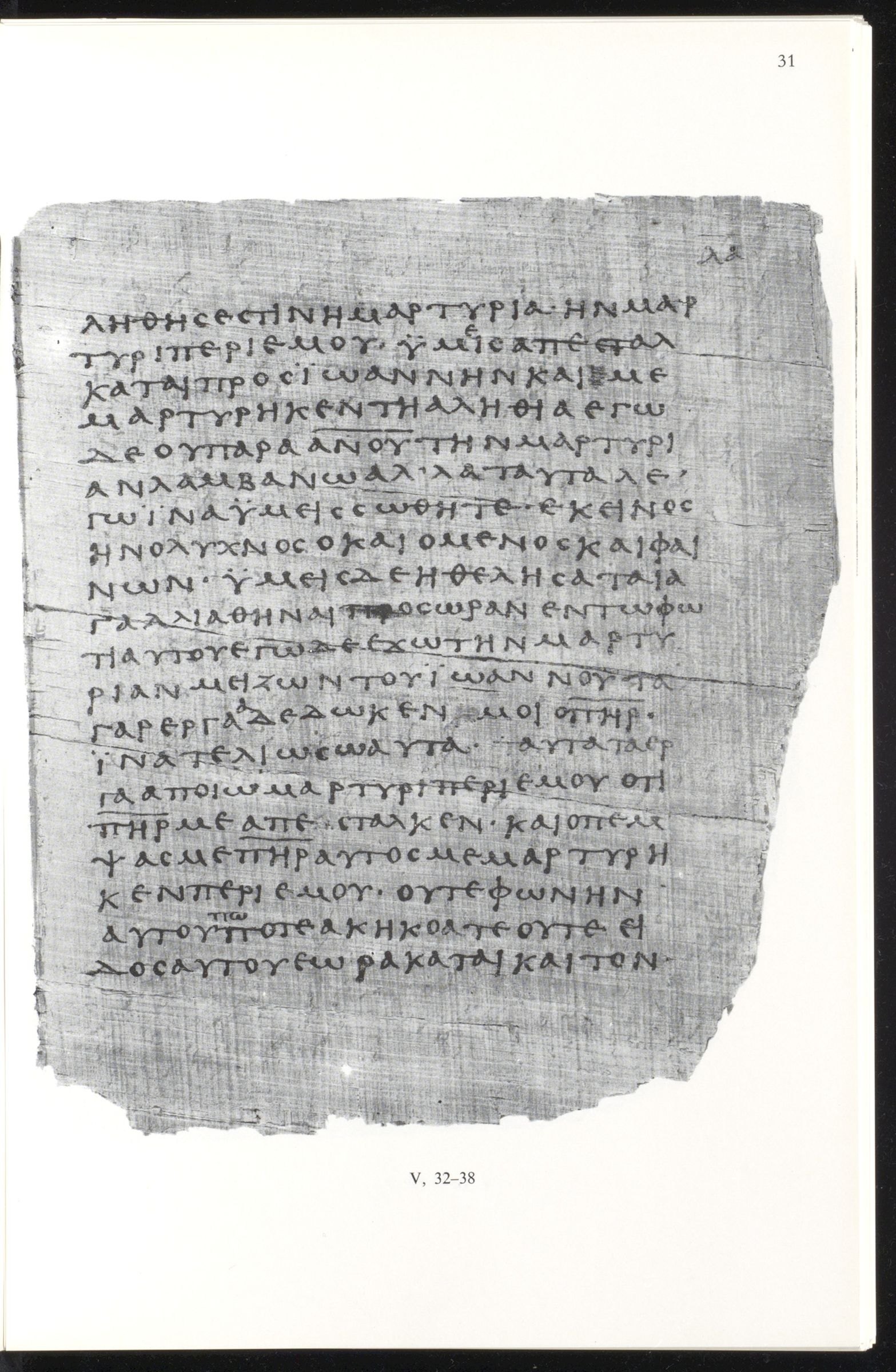
Fondation Martin Bodmer, Papyrus Bodmer II, Bodmer Lab image 1072205287_039 (https://bodmerlab.unige.ch/fr/constellations/papyri/mirador/1072205287), photographic plate of the 1962 Martin-Barns edition, shown whole. NTVMR page 310 (page 31) is linked to this image in NTVMR's page index. 5:32 begins on the previous page; 5:38 continues on the next page. Checked on the image: the printed caption reads ‹V, 32-38›.
5:32 ληθης εστιν η μαρτυρια· ην μαρ
τυρι περι εμου· 33 υμις απεσταλ
καται προς ιωαννην καιι με
μαρτυρηκεν τη αληθια 34 εγω
δε ου παρα α̅ν̅ο̅υ̅ την μαρτυρι
αν λαμβανω αλλα ταυτα λε
γω ινα υμεις σωθητε· 35 εκεινος
ην ο λυχνος ο καιομενος και φαι
νων· υμεις δε ηθελησαται α
γαλλιαθηναι προς ωραν εν τω φω
τι αυτου 36 εγω δε εχω την μαρτυ
ριαν μειζων του ιωαννου τα
γαρ εργα δεδωκεν κ̣ μοι ο π̅η̅ρ̅·
ινα τελιωσω αυτα· ταυτα τα ερ
γα α ποιω μαρτυρι περι εμου οτι
π̅η̅ρ̅ με απεσταλκεν· 37 και ο πεμ
ψας με π̅η̅ρ̅ αυτος μεμαρτυρη
κεν περι εμου· ουτε φωνην
αυτου ποτε ακηκοατε ουτε ει
δος αυτου εωρακαται 38 και τον
5:32¶ There is another that beareth witness of me; and I know that the witness which he witnesseth of me is true. 33Ye sent unto John, and he bare witness unto the truth. 34But I receive not testimony from man: but these things I say, that ye might be saved. 35He was a burning and a shining light: and ye were willing for a season to rejoice in his light. 36¶ But I have greater witness than that of John: for the works which the Father hath given me to finish, the same works that I do, bear witness of me, that the Father hath sent me. 37And the Father himself, which hath sent me, hath borne witness of me. Ye have neither heard his voice at any time, nor seen his shape. 38And ye have not his word abiding in you: for whom he hath sent, him ye believe not.
Where on the image
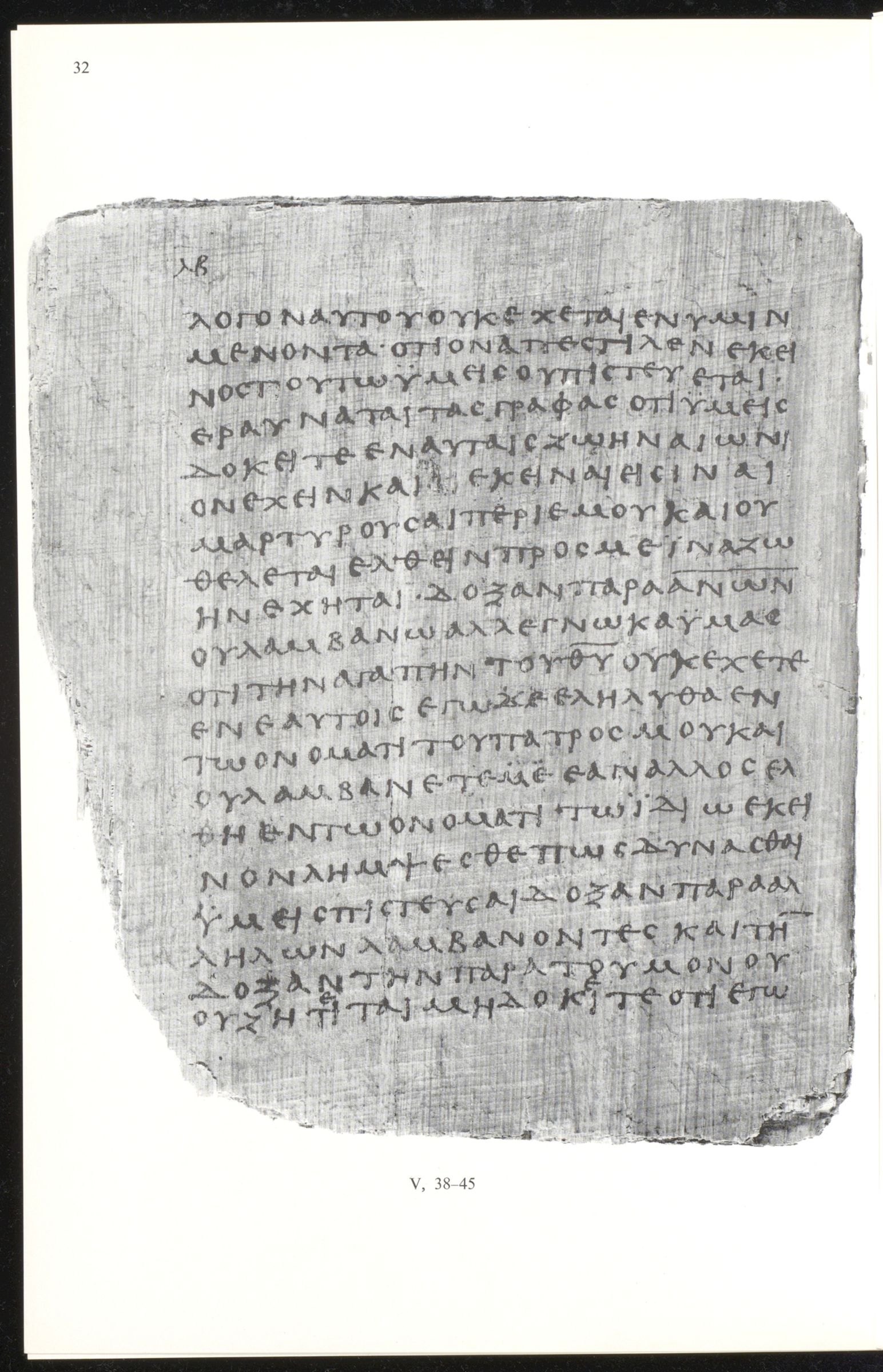
Fondation Martin Bodmer, Papyrus Bodmer II, Bodmer Lab image 1072205287_040 (https://bodmerlab.unige.ch/fr/constellations/papyri/mirador/1072205287), photographic plate of the 1962 Martin-Barns edition, shown whole. NTVMR page 320 (page 32) is linked to this image in NTVMR's page index. 5:38 begins on the previous page; 5:45 continues on the next page. Checked on the image: the printed caption reads ‹V, 38-45›; the last line of writing, ‹ου ζητιται μη δοκιτε οτι εγω› (line 20 of the transcription), is legible at the foot of the page.
5:38 λογον αυτου ουκ εχεται εν υμιν
μενοντα· οτι ον απεστιλεν εκει
νος τουτω υμεις ου πιστευεται·
39 εραυναται τας γραφας οτι υμεις
δοκειτε εν αυταις ζωην αιωνι
ον εχειν και α̣ι̣ εκειναι εισιν αι
μαρτυρουσαι περι εμου 40 και ου
θελεται ελθειν προς με ινα ζω
ην εχηται· 41 δοξαν παρα α̅ν̅ω̅ν̅
ου λαμβανω 42 αλλ εγνωκα υμας
οτι την αγαπην του θ̅υ̅ ουκ εχετε
εν εαυτοις 43 εγω δε εληλυθα εν
τω ονοματι του πατρος μου και
ου λαμβανετε με εαν αλλος ελ
θη εν τω ονοματι τω ιδιω εκει
νον λημψεσθε 44 πως δυνασθαι
υμεις πιστευσαι δοξαν παρα αλ
ληλων λαμβανοντες και την
δοξαν την παρα του μονου
ου ζητιται 45 μη δοκιτε οτι εγω
5:38And ye have not his word abiding in you: for whom he hath sent, him ye believe not. 39¶ Search the scriptures; for in them ye think ye have eternal life: and they are they which testify of me. 40And ye will not come to me, that ye might have life. 41I receive not honour from men. 42But I know you, that ye have not the love of God in you. 43I am come in my Father’s name, and ye receive me not: if another shall come in his own name, him ye will receive. 44How can ye believe, which receive honour one of another, and seek not the honour that cometh from God only? 45Do not think that I will accuse you to the Father: there is one that accuseth you, even Moses, in whom ye trust.
Where on the image
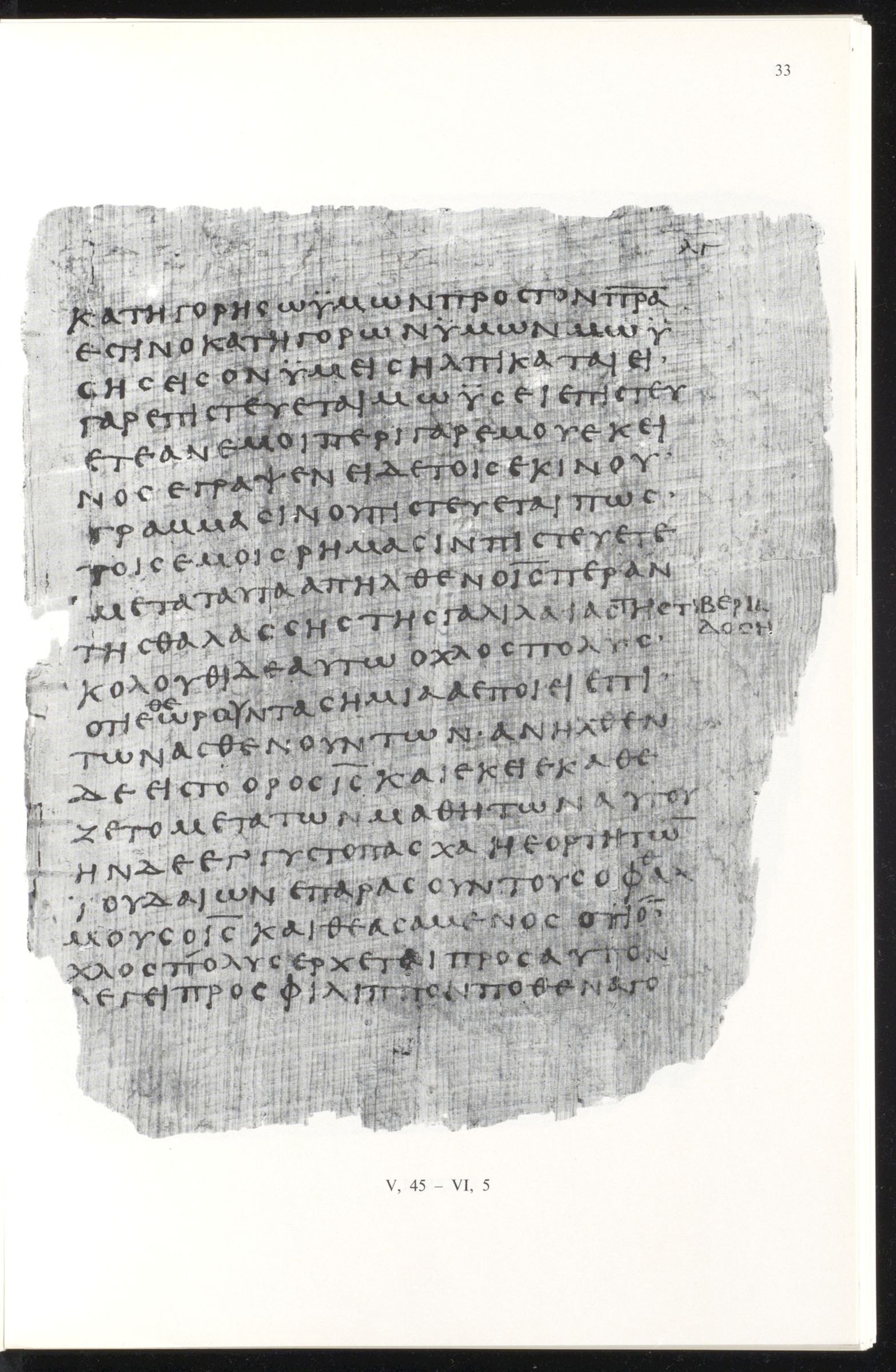
Fondation Martin Bodmer, Papyrus Bodmer II, Bodmer Lab image 1072205287_041 (https://bodmerlab.unige.ch/fr/constellations/papyri/mirador/1072205287), photographic plate of the 1962 Martin-Barns edition, shown whole. NTVMR page 330 (page 33) is linked to this image in NTVMR's page index. 5:45 begins on the previous page; 6:5 continues on the next page. Checked on the image: the printed caption reads ‹V, 45 - VI, 5›; the last line of writing, ‹λεγει προς φιλιππον ποθεν αγο› (line 20 of the transcription), is legible at the foot of the page.
5:45 κατηγορησω υμων προς τον π̅ρ̅α̅
εστιν ο κατηγορων υμων μωυ
σης εις ον υμεις ηλπικαται 46 ει
γαρ επιστευεται μωυσει επιστευ
ετε αν εμοι περι γαρ εμου εκει
νος εγραψεν 47 ει δε τοις εκινου
γραμμασιν ου πιστευεται πως
τοις εμοις ρημασιν πιστευετε
6:1 μετα ταυτα απηλθεν ο ι̅ς̅ περαν
της θαλασσης της γαλιλαιας 2 η
κολουθι δε αυτω οχλος πολυς·
οτι εωρων τα σημια α εποιει επι
των ασθενουντων· 3 ανηλθεν
δε εις το ορος ι̅ς̅ και εκει εκαθε
ζετο μετα των μαθητων αυτου
4 ην δε εγγυς το πασχα η εορτη των
ιουδαιων 5 επαρας ουν τους οφαλ
μους ο ι̅ς̅ και θεασαμενος οτι ο
χλος πολυς ερχετε̣ι προς αυτον
λεγει προς φιλιππον ποθεν αγο
5:45Do not think that I will accuse you to the Father: there is one that accuseth you, even Moses, in whom ye trust. 46For had ye believed Moses, ye would have believed me: for he wrote of me. 47But if ye believe not his writings, how shall ye believe my words? 6:1After these things Jesus went over the sea of Galilee, which is the sea of Tiberias. 2And a great multitude followed him, because they saw his miracles which he did on them that were diseased. 3And Jesus went up into a mountain, and there he sat with his disciples. 4And the passover, a feast of the Jews, was nigh. 5¶ When Jesus then lifted up his eyes, and saw a great company come unto him, he saith unto Philip, Whence shall we buy bread, that these may eat?
Notes
- Greek: the NTVMR diplomatic transcription, line by line as on the papyrus. Square brackets enclose letters that are lost or illegible and were supplied by the transcribers; a dot under a letter marks it as uncertain; [...] marks a gap. Nomina sacra and numerals keep the scribe's overline. Spelling is the scribe's (no accents or breathings). Words broken at a line end stay broken as on the papyrus. Corrections are not shown: the text is the first hand.
- English: the King James Version (1611), whole verses, for every verse that has text on the page. A verse that begins on one page and ends on the next is given in full on both. The KJV translates a later form of the Greek text, so its wording does not always match the papyrus; material differences (such as verses the papyrus does not have) are noted in the section.
Cite
Sources
- Source: Papyrus Bodmer II (P66), Fondation Martin Bodmer: images from the Bodmer Lab, University of Geneva; Greek from the INTF NTVMR transcription of P66; English from the King James Version (holding institution)
- Critical edition: INTF NTVMR diplomatic transcription (CC BY 4.0)
← previous · → next · v cycle view · l back to library