P66 (Papyrus Bodmer II): John 6:5-7:6 (pages 34-44)
Introduction
P66 is a papyrus codex of the Gospel of John copied in Egypt around 200, the most complete early copy of John. Most of it is Papyrus Bodmer II in the Fondation Martin Bodmer, Cologny (Geneva); small pieces are in the Chester Beatty Library, Dublin, and the Institut für Altertumskunde, Cologne. The first five quires (John 1:1-14:26) survive as a bound book of numbered pages; later leaves, from John 14:29 to 21:9, are damaged and kept between glass. The scribe made many corrections, some of them his own; only the first hand is shown here.
Each section below is one page: the photograph, the NTVMR diplomatic transcription line by line, and the King James Version of every verse on the page. Pages of the bound book are shown on the photographic plates published by Victor Martin and J. W. B. Barns in 1962 (scanned by the Bodmer Lab), the glass-mounted leaves on colour photographs. Lost: John 6:12-34 (pages 35-38) and parts of chapters 14-21; the transcription ends at 21:9. Where P66 lacks a verse that the KJV has (John 5:4, the account of the adulteress at 7:53-8:11, 16:15), the section says so.
This entry covers pages 34-44 (John 6:5-7:6).
How was this verified? (Provenance)
Where on the image
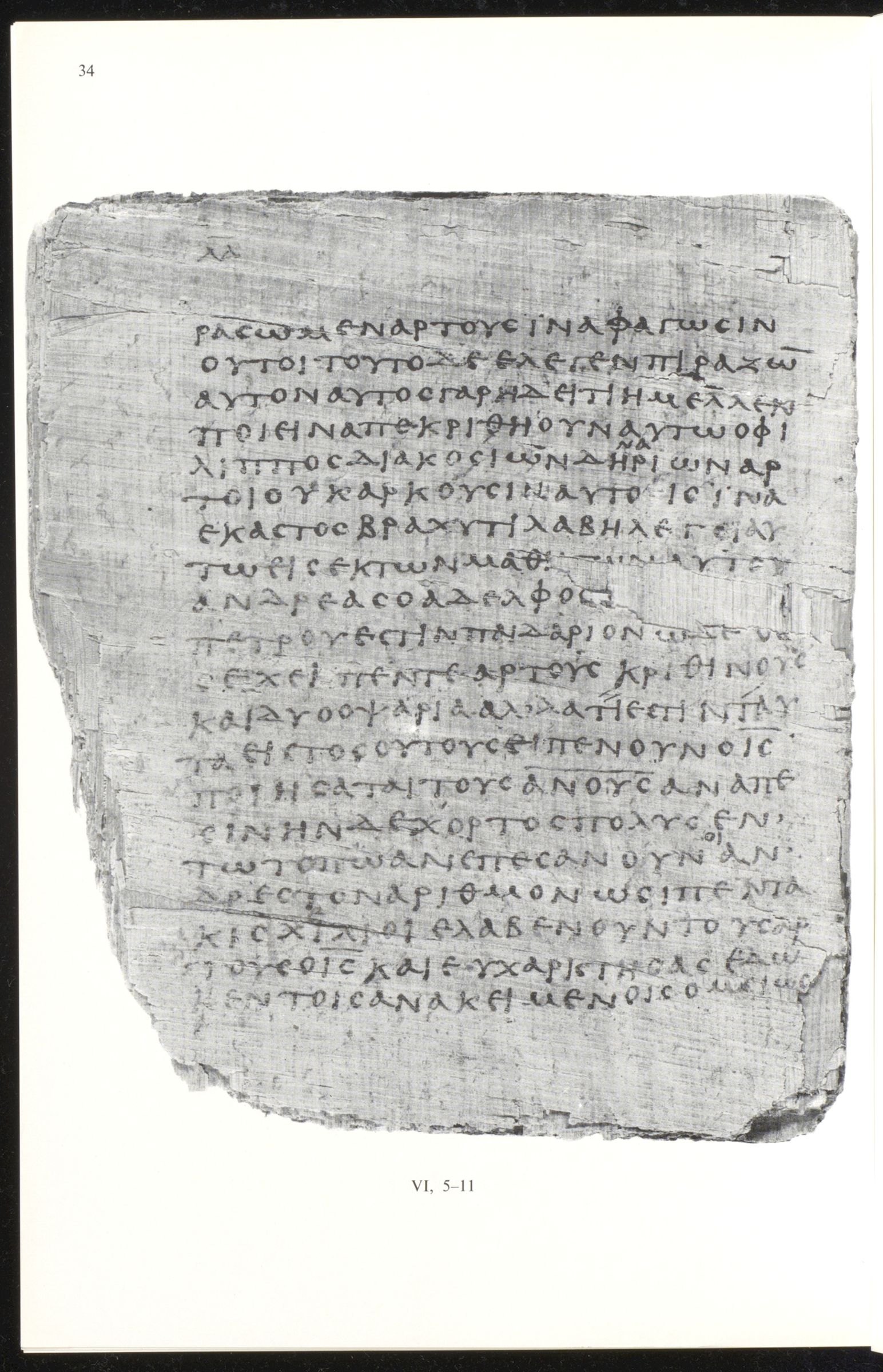
Fondation Martin Bodmer, Papyrus Bodmer II, Bodmer Lab image 1072205287_042 (https://bodmerlab.unige.ch/fr/constellations/papyri/mirador/1072205287), photographic plate of the 1962 Martin-Barns edition, shown whole. NTVMR page 340 (page 34) is linked to this image in NTVMR's page index. 6:5 begins on the previous page; 6:11 continues on the next page. Checked on the image: the printed caption reads ‹VI, 5-11›; the last line of writing, ‹κεν τοις ανακειμενοις ομοιως› (line 20 of the transcription), is legible at the foot of the page.
6:5 ρασωμεν αρτους ινα φαγωσιν
ουτοι 6 τουτο δε ελεγεν πιραζων
αυτον αυτος γαρ ηδει τι ημελλεν
ποιειν 7 απεκριθη ουν αυτω ο φι
λιππος διακοσιων δηριων αρ
τοι ουκ αρκουσιν αυτο[.]ις ινα
εκαστος βραχυ τι λαβη 8 λεγει αυ
τω εις εκ των μαθητων αυτου
ανδρεας ο αδελφος σ̣[ιμωνος]
πετρου 9 εστιν παιδαριον ωδε ο
ς εχει πεντε αρτους κριθινους
και δυο οψαρια αλλα τι εστιν ταυ
τα εις τοσουτους 10 ειπεν ουν ο ι̅ς̅·
ποιησαται τους α̅ν̅ο̅υ̅ς̅ αναπε
σιν ην δε χορτος πολυς εν
τω τοπω ανεπεσαν ουν αν
δρες τον αριθμον ωσι πεντα
κισχιλιοι 11 ελαβεν ουν τους αρ
τους ο ι̅ς̅ και ευχαριστησας εδω
κεν τοις ανακειμενοις ομοιως
6:5¶ When Jesus then lifted up his eyes, and saw a great company come unto him, he saith unto Philip, Whence shall we buy bread, that these may eat? 6And this he said to prove him: for he himself knew what he would do. 7Philip answered him, Two hundred pennyworth of bread is not sufficient for them, that every one of them may take a little. 8One of his disciples, Andrew, Simon Peter’s brother, saith unto him, 9There is a lad here, which hath five barley loaves, and two small fishes: but what are they among so many? 10And Jesus said, Make the men sit down. Now there was much grass in the place. So the men sat down, in number about five thousand. 11And Jesus took the loaves; and when he had given thanks, he distributed to the disciples, and the disciples to them that were set down; and likewise of the fishes as much as they would.
Where on the image
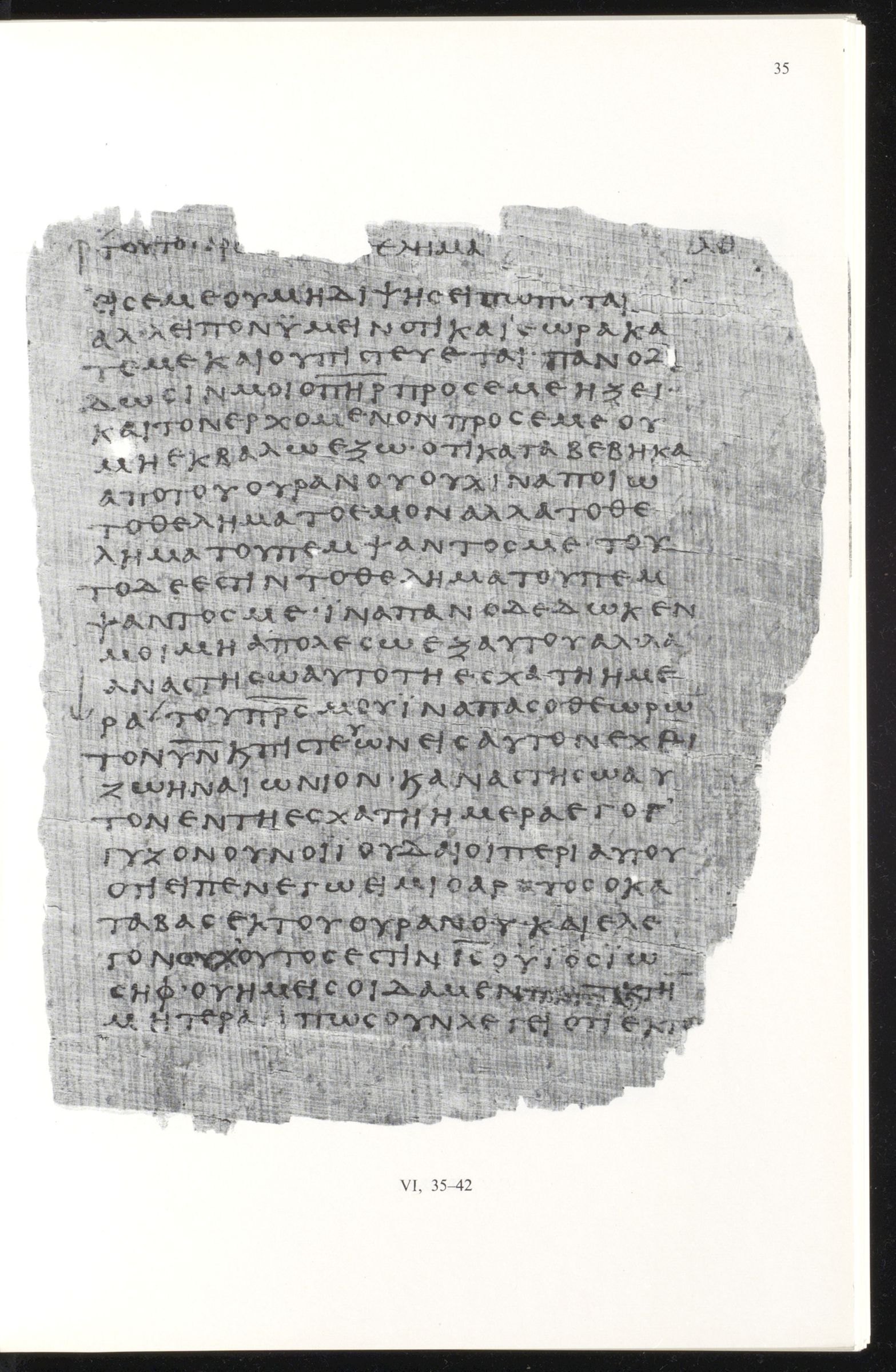
Fondation Martin Bodmer, Papyrus Bodmer II, Bodmer Lab image 1072205287_043 (https://bodmerlab.unige.ch/fr/constellations/papyri/mirador/1072205287), photographic plate of the 1962 Martin-Barns edition, shown whole. NTVMR page 350 (page 39) is linked to this image in NTVMR's page index. 6:35 begins on the previous page; 6:42 continues on the next page. Checked on the image: the printed caption reads ‹VI, 35-42›; the last line of writing, ‹μητεραν πως ουν λεγει οτι εκ το̣υ̣› (line 23 of the transcription), is legible at the foot of the page.
6:35 εις εμε ου μη διψησει πωποται
36 αλλ ειπον υμειν οτι και εωρακα
τε με και ου πιστευεται· 37 παν ο δι̣
δωσιν μοι ο π̅η̅ρ̅ προς εμε ηξει·
και τον ερχομενον προς εμε ου
μη εκβαλω εξω· 38 οτι καταβεβηκα
απο του ουρανου ουχ ινα ποιω
το θελημα το εμον αλλα το θε
λημα του πεμψαντος με· 39 του
το δε εστιν το θελημα του πεμ
ψαντος με· ινα παν ο δεδωκεν
μοι μη απολεσω εξ αυτου αλλα
αναστησω αυτο τη εσχατη ημε
ρα 40 του π̅ρ̅ς̅ μου ινα πας ο θεωρων
τον υ̅ν̅ και πιστεων εις αυτον εχη̣
ζωην αιωνιον· και αναστησω αυ
τον εν τη εσχατη ημερα 41 εγογ
γυζον ουν οι ιουδαιοι περι αυτου
οτι ειπεν εγω ειμι ο αρα̣τος ο κα
ταβας εκ του ουρανου· 42 και ελε
γον ο̣τι ουτος εστιν ι̅ς̅ ο υιος ιω
σηφ ου ημεις οιδαμεν πατερα και την
μητεραν πως ουν λεγει οτι εκ το̣υ̣
6:35And Jesus said unto them, I am the bread of life: he that cometh to me shall never hunger; and he that believeth on me shall never thirst. 36But I said unto you, That ye also have seen me, and believe not. 37All that the Father giveth me shall come to me; and him that cometh to me I will in no wise cast out. 38For I came down from heaven, not to do mine own will, but the will of him that sent me. 39And this is the Father’s will which hath sent me, that of all which he hath given me I should lose nothing, but should raise it up again at the last day. 40And this is the will of him that sent me, that every one which seeth the Son, and believeth on him, may have everlasting life: and I will raise him up at the last day. 41The Jews then murmured at him, because he said, I am the bread which came down from heaven. 42And they said, Is not this Jesus, the son of Joseph, whose father and mother we know? how is it then that he saith, I came down from heaven?
Where on the image
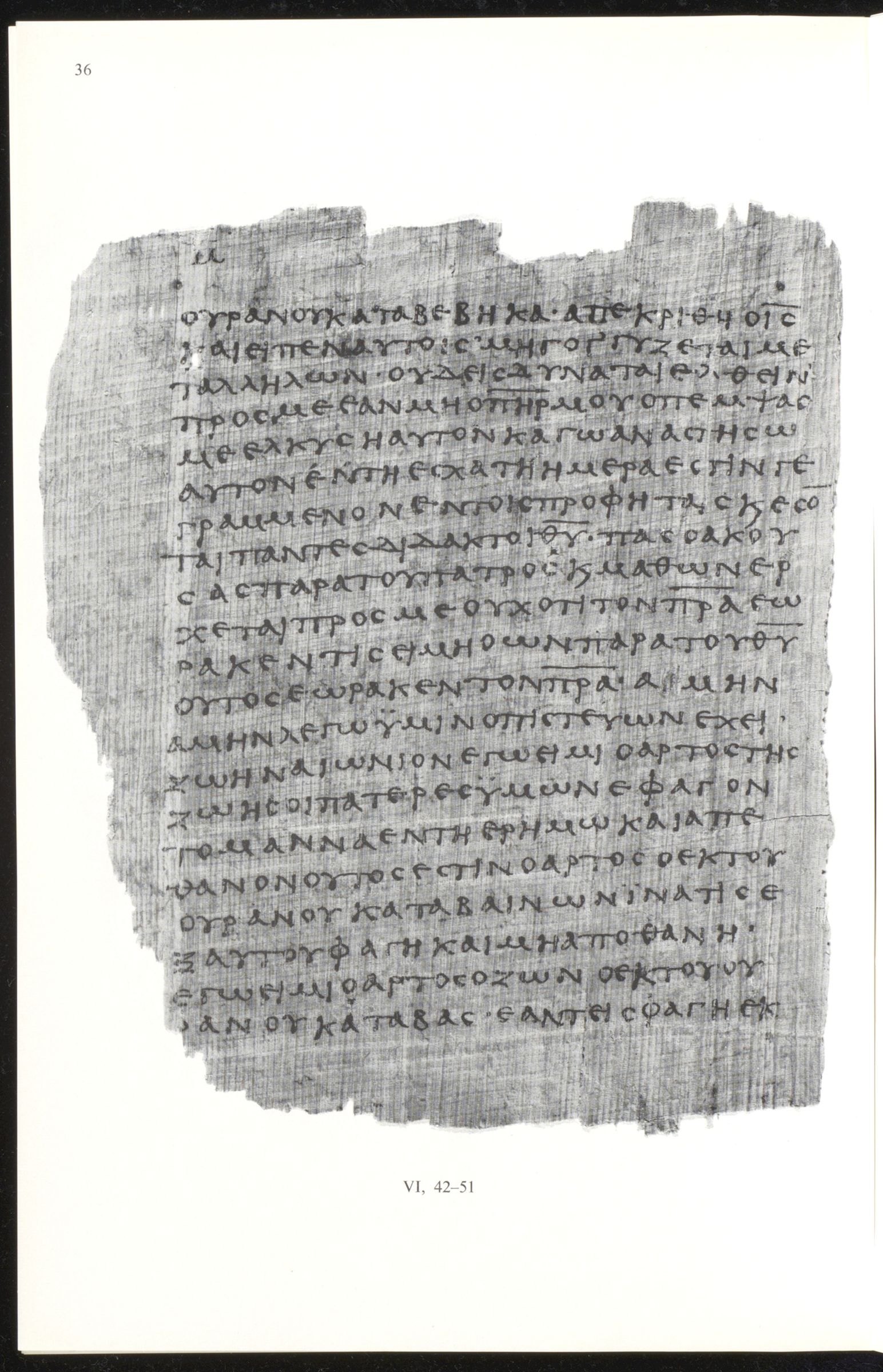
Fondation Martin Bodmer, Papyrus Bodmer II, Bodmer Lab image 1072205287_044 (https://bodmerlab.unige.ch/fr/constellations/papyri/mirador/1072205287), photographic plate of the 1962 Martin-Barns edition, shown whole. NTVMR page 360 (page 40) is linked to this image in NTVMR's page index. 6:42 begins on the previous page; 6:51 continues on the next page. Checked on the image: the printed caption reads ‹VI, 42-51›; the last line of writing, ‹ρ̣ανου καταβας· εαν τεις φαγη εκ› (line 21 of the transcription), is legible at the foot of the page.
6:42 ουρανου καταβεβηκα· 43 απεκριθη ο ι̅ς̅
και ειπεν αυτοις μη γογγυζεται με
τ αλληλων· 44 ουδεις δυναται ελθειν
προς με εαν μη ο π̅η̅ρ̅ μου ο πεμψας
με ελκυση αυτον καγω αναστησω
αυτον εν τη εσχατη ημερα 45 εστιν γε
γραμμενον εν τοις προφηται̣ς και εσον
ται παντες διδακτοι θ̅υ̅· πας ο ακου
σας παρα του πατρος και μαθων ερ
χεται προς με 46 ουχ οτι τον π̅ρ̅α̅ εω
ρακεν τις ει μη ο ων παρα του θ̅υ̅
ουτος εωρακεν τον π̅ρ̅α̅· 47 α[.]μην
αμην λεγω υμιν ο πιστευων εχει
ζωην αιωνιον 48 εγω ειμι ο αρτος της
ζωης 49 οι πατερες υμων εφαγον
το μαννα εν τη ερημω και απε
θανον 50 ουτος εστιν ο αρτος ο εκ του
ουρανου καταβαινων ινα τις ε
ξ αυτου φαγη και μη αποθανη·
51 εγω ειμι ο αρτος ο ζων ο εκ του ου
ρ̣ανου καταβας· εαν τεις φαγη εκ
6:42And they said, Is not this Jesus, the son of Joseph, whose father and mother we know? how is it then that he saith, I came down from heaven? 43Jesus therefore answered and said unto them, Murmur not among yourselves. 44No man can come to me, except the Father which hath sent me draw him: and I will raise him up at the last day. 45It is written in the prophets, And they shall be all taught of God. Every man therefore that hath heard, and hath learned of the Father, cometh unto me. 46Not that any man hath seen the Father, save he which is of God, he hath seen the Father. 47Verily, verily, I say unto you, He that believeth on me hath everlasting life. 48I am that bread of life. 49Your fathers did eat manna in the wilderness, and are dead. 50This is the bread which cometh down from heaven, that a man may eat thereof, and not die. 51I am the living bread which came down from heaven: if any man eat of this bread, he shall live for ever: and the bread that I will give is my flesh, which I will give for the life of the world.
Where on the image
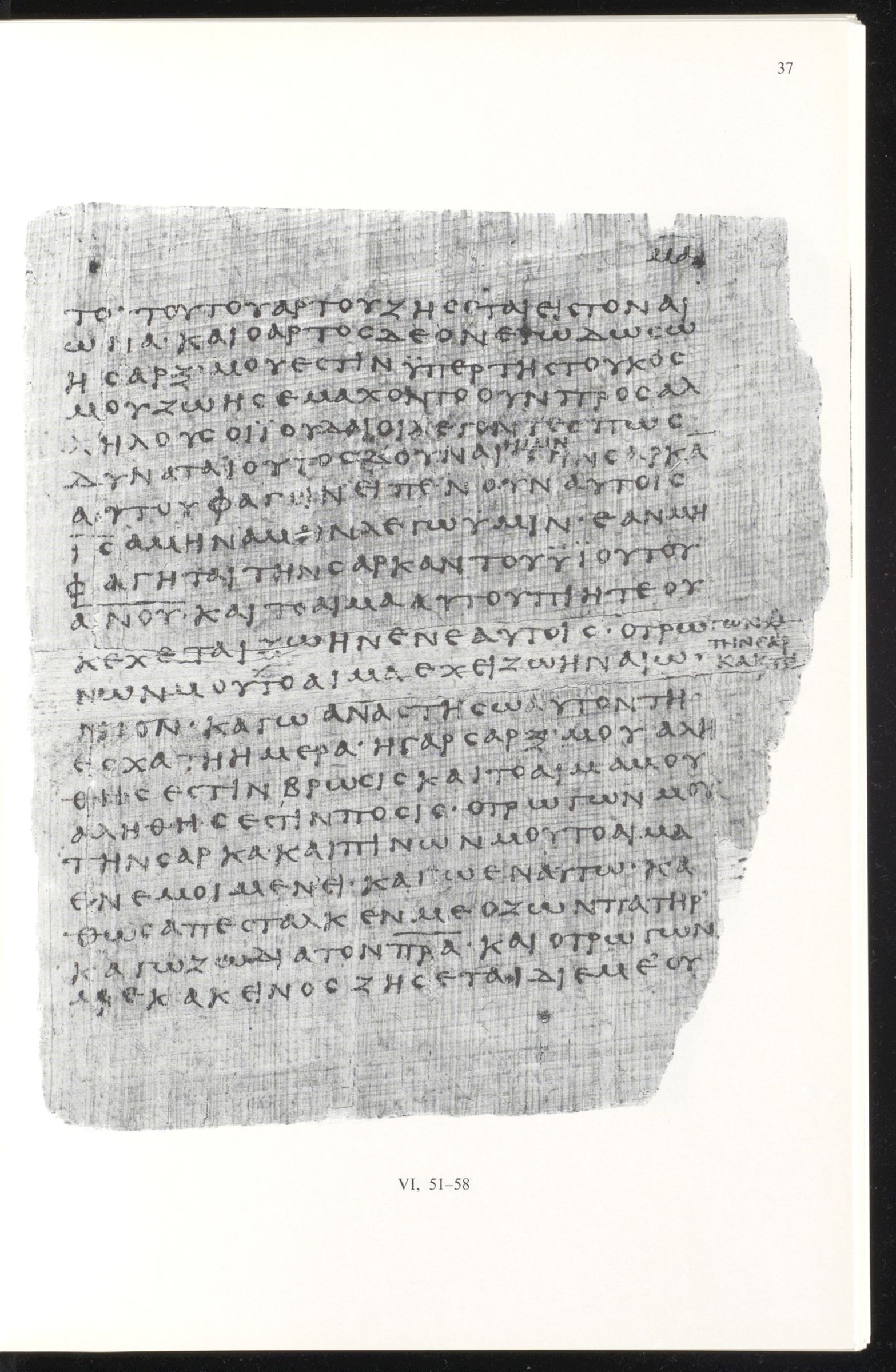
Fondation Martin Bodmer, Papyrus Bodmer II, Bodmer Lab image 1072205287_045 (https://bodmerlab.unige.ch/fr/constellations/papyri/mirador/1072205287), photographic plate of the 1962 Martin-Barns edition, shown whole. NTVMR page 370 (page 41) is linked to this image in NTVMR's page index. 6:51 begins on the previous page; 6:58 continues on the next page. Checked on the image: the printed caption reads ‹VI, 51-58›; the last line of writing, ‹με κακεινος ζησεται δι εμε ου› (line 21 of the transcription), is legible at the foot of the page.
6:51 του̣του του αρτου ζησεται εις τον αι
ωνα· και ο αρτος δε ον εγω δωσω
η σαρξ μου εστιν υπερ της του κοσ
μου ζωης 52 εμαχοντο ουν προς αλ
ληλους οι ιουδαιοι λεγοντες πως
δυναται ουτος δουναι την σαρκαν
αυτου φαγειν 53 ειπεν ουν αυτοις
ι̅ς̅ αμην αμην λεγω υμιν· εαν μη
φαγηται την σαρκαν του υιου του
α̅ν̅ο̅υ̅· και το αιμα αυτου πιητε ου
κ εχεται ζωην εν εαυτοις· 54 ο π̣ι̣
νων μου το αιμα εχει ζωην αιω
νιον· καγω αναστησω αυτον τη
εσχατη ημερα· 55 η γαρ σαρξ μου αλη
θως εστιν βρωσις και το αιμα μου
αληθως εστιν ποσις· 56 ο τρωγων μου
την σαρκα· και πινων μου το αιμα
εν εμοι μενει· καγω εν αυτω· 57 κα
θως απεσταλκεν με ο ζων πατηρ
καγω ζω δια τον π̅ρ̅α̅· και ο τρωγων
με κακεινος ζησεται δι εμε 58 ου
6:51I am the living bread which came down from heaven: if any man eat of this bread, he shall live for ever: and the bread that I will give is my flesh, which I will give for the life of the world. 52The Jews therefore strove among themselves, saying, How can this man give us his flesh to eat? 53Then Jesus said unto them, Verily, verily, I say unto you, Except ye eat the flesh of the Son of man, and drink his blood, ye have no life in you. 54Whoso eateth my flesh, and drinketh my blood, hath eternal life; and I will raise him up at the last day. 55For my flesh is meat indeed, and my blood is drink indeed. 56He that eateth my flesh, and drinketh my blood, dwelleth in me, and I in him. 57As the living Father hath sent me, and I live by the Father: so he that eateth me, even he shall live by me. 58This is that bread which came down from heaven: not as your fathers did eat manna, and are dead: he that eateth of this bread shall live for ever.
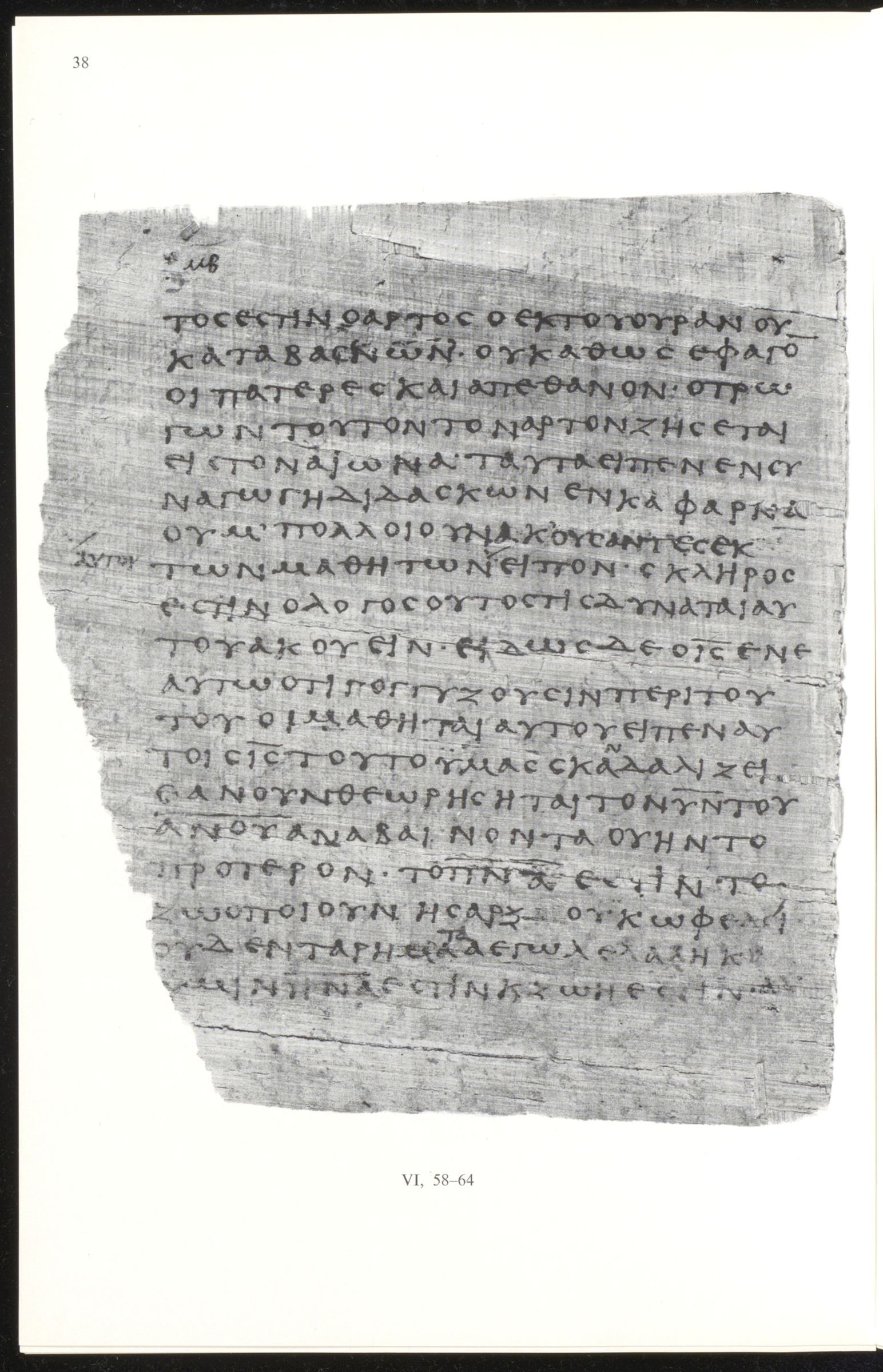
Where on the image
Fondation Martin Bodmer, Papyrus Bodmer II, Bodmer Lab image 1072205287_046 (https://bodmerlab.unige.ch/fr/constellations/papyri/mirador/1072205287), photographic plate of the 1962 Martin-Barns edition, shown whole. NTVMR page 380 (page 42) is linked to this image in NTVMR's page index. 6:58 begins on the previous page; 6:64 continues on the next page. Checked on the image: the printed caption reads ‹VI, 58-64›; the last line of writing, ‹υμιν π̅ν̅α̅ εστιν και ζωη εστιν· αλ› (line 19 of the transcription), is legible at the foot of the page.
6:58 τος εστιν ο αρτος ο εκ του ουρανου
καταβαινων· ου καθως εφαγον
οι πατερες και απεθανον· ο τρω
γων τουτον τον αρτον ζησεται
εις τον αιωνα· 59 ταυτα ειπεν εν συ
ναγωγη διδασκων εν καφαρνα
ουμ 60 πολλοι ουν [...]
των μαθητων ειπον· σκληρος
εστιν ο λογος ουτος τις δυναται αυ
του ακουειν· 61 ειδως δε ο ι̅ς̅ εν ε
αυτω οτι γογγυζουσιν περι του
του οι μαθηται αυτου ειπεν αυ
τοις ι̅ς̅ τουτο υμας σκαδαλιζει.
62 εαν ουν θεωρησηται τον υ̅ν̅ του
α̅ν̅ο̅υ̅ αναβαινοντα ου ην το
προτερον· 63 το π̅ν̅α̅ εστιν το
ζωοποιουν η σαρξ δε̣ ουκ ωφελει
ουδεν τα ρημα α εγω λελαληκα̣
υμιν π̅ν̅α̅ εστιν και ζωη εστιν· 64 αλ
6:58This is that bread which came down from heaven: not as your fathers did eat manna, and are dead: he that eateth of this bread shall live for ever. 59These things said he in the synagogue, as he taught in Capernaum. 60Many therefore of his disciples, when they had heard this, said, This is an hard saying; who can hear it? 61When Jesus knew in himself that his disciples murmured at it, he said unto them, Doth this offend you? 62What and if ye shall see the Son of man ascend up where he was before? 63It is the spirit that quickeneth; the flesh profiteth nothing: the words that I speak unto you, they are spirit, and they are life. 64But there are some of you that believe not. For Jesus knew from the beginning who they were that believed not, and who should betray him.
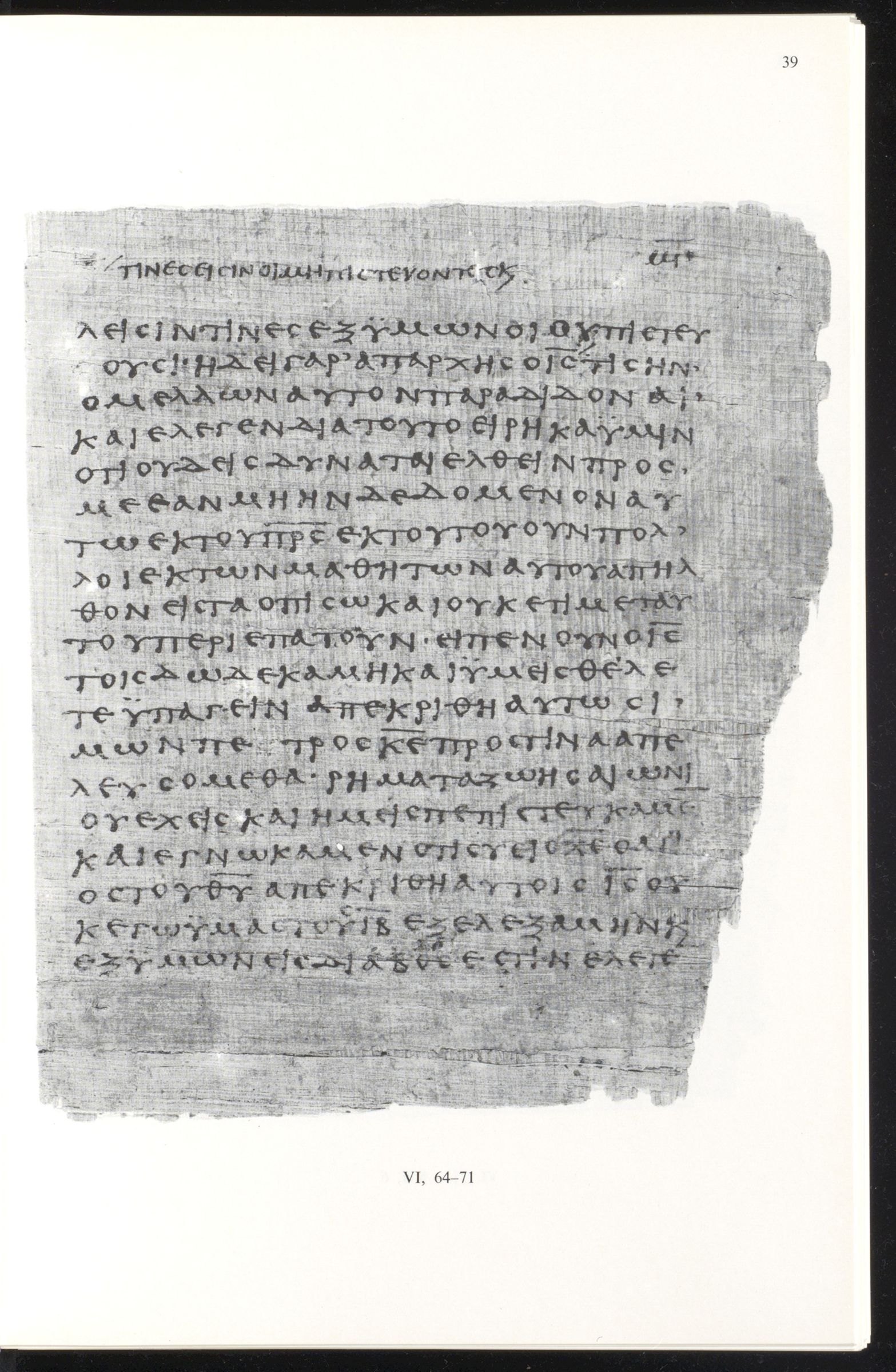
Where on the image
Fondation Martin Bodmer, Papyrus Bodmer II, Bodmer Lab image 1072205287_047 (https://bodmerlab.unige.ch/fr/constellations/papyri/mirador/1072205287), photographic plate of the 1962 Martin-Barns edition, shown whole. NTVMR page 390 (page 43) is linked to this image in NTVMR's page index. 6:64 begins on the previous page; 6:71 continues on the next page. Checked on the image: the printed caption reads ‹VI, 64-71›; the last line of writing, ‹εξ υμων εις διαβος εστιν ελεγεν› (line 19 of the transcription), is legible at the foot of the page.
6:64 λ εισιν τινες εξ υμων οι μη πιστευ
σουσι· ηδει γαρ απ αρχης ο ι̅ς̅ τις ην
ο μελλων αυτον παραδιδοναι
65 και ελεγεν δια τουτο ειρηκα υμιν
οτι ουδεις δυναται ελθειν προς
με εαν μη ην δεδομενον αυ
τω εκ του π̅ρ̅ς̅ 66 εκ τουτου ουν πολ
λοι εκ των μαθητων αυτου απηλ
θον εις τα οπισω και ουκετι μετ αυ
του περιεπατουν· 67 ειπεν ουν ο ι̅ς̅
τοις δωδεκα μη και υμεις θελε
τε υπαγειν 68 απεκριθη αυτω σι
μων πεπ̣τρος κ̅ε̅ προς τινα απε
λευσομεθα· ρηματα ζωης αιωνι
ου εχεις 69 και ημεις πεπιστευκαμεν
και εγνωκαμεν οτι συ ει ο χ̅ς̅ ο αγι
ος του θ̅υ̅ 70 απεκριθη αυτοις ι̅ς̅ ου
κ εγω υμας του ι̅β̅ εξελεξαμην και
εξ υμων εις διαβος εστιν 71 ελεγεν
6:64But there are some of you that believe not. For Jesus knew from the beginning who they were that believed not, and who should betray him. 65And he said, Therefore said I unto you, that no man can come unto me, except it were given unto him of my Father. 66¶ From that time many of his disciples went back, and walked no more with him. 67Then said Jesus unto the twelve, Will ye also go away? 68Then Simon Peter answered him, Lord, to whom shall we go? thou hast the words of eternal life. 69And we believe and are sure that thou art that Christ, the Son of the living God. 70Jesus answered them, Have not I chosen you twelve, and one of you is a devil? 71He spake of Judas Iscariot the son of Simon: for he it was that should betray him, being one of the twelve.
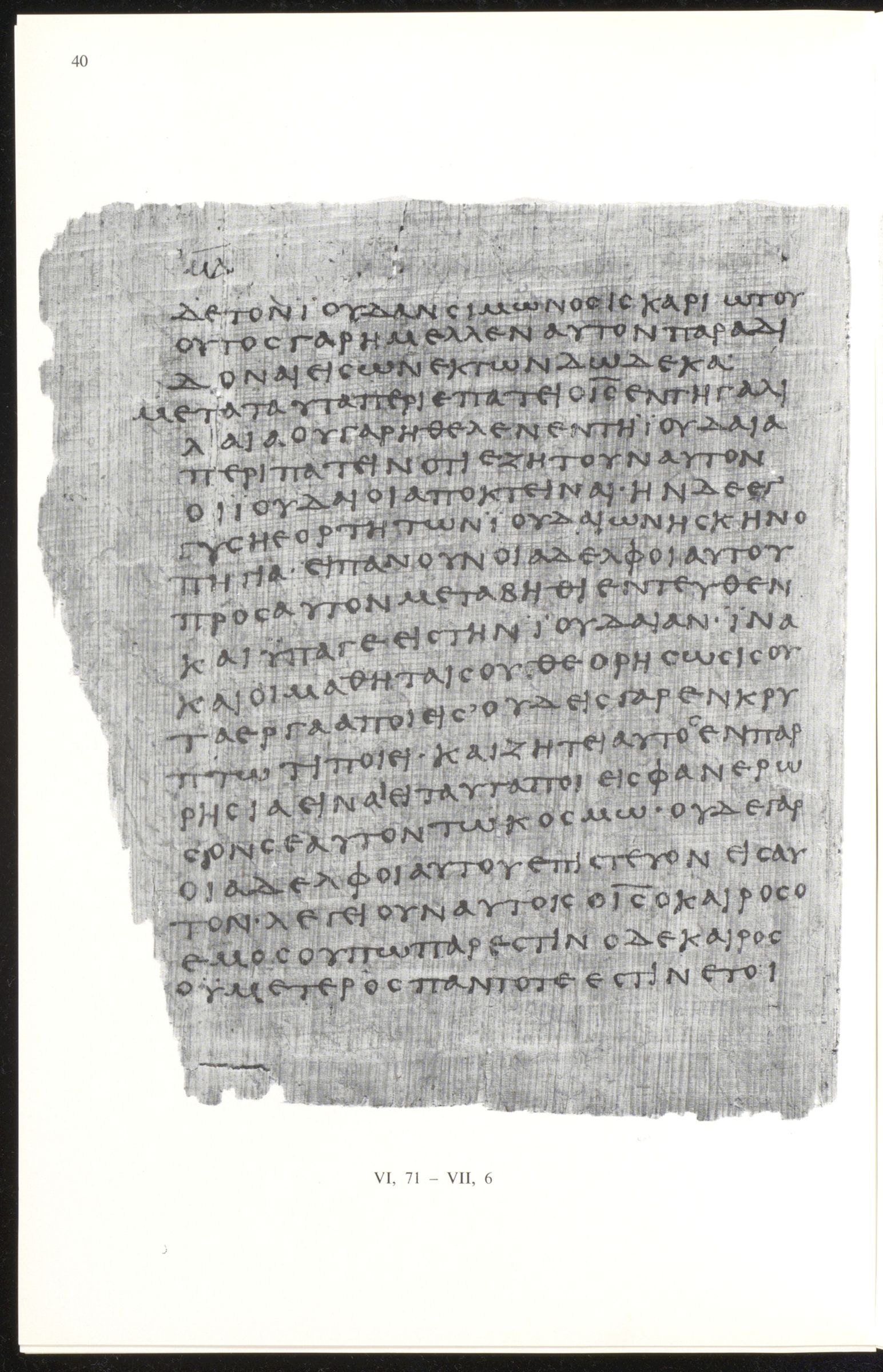
Where on the image
Fondation Martin Bodmer, Papyrus Bodmer II, Bodmer Lab image 1072205287_048 (https://bodmerlab.unige.ch/fr/constellations/papyri/mirador/1072205287), photographic plate of the 1962 Martin-Barns edition, shown whole. NTVMR page 400 (page 44) is linked to this image in NTVMR's page index. 6:71 begins on the previous page; 7:6 continues on the next page. Checked on the image: the printed caption reads ‹VI, 71 - VII, 6›; the last line of writing, ‹ο υμετερος παντοτε εστιν ετοι› (line 20 of the transcription), is legible at the foot of the page.
6:71 δε τον ιουδαν σιμωνος ισκαριωτου
ουτος γαρ ημελλεν αυτον παραδι
δοναι εις ων εκ των δωδεκα·
7:1 μετα ταυτα περιεπατει ο ι̅ς̅ εν τη γαλι
λαια ου γαρ ηθελεν εν τη ιουδαια
περιπατειν οτι εζητουν αυτον
οι ιουδαιοι αποκτειναι· 2 ην δε εγ
γυς η εορτη των ιουδαιων η σκηνο
πηγια· 3 ειπαν ουν οι αδελφοι αυτου
προς αυτον μεταβηθι εντευθεν
και υπαγε εις την ιουδαιαν· ινα
και οι μαθηται σου θεορησωσι σου
τα εργα α ποιεις 4 ουδεις γαρ εν κρυ
πτω τι ποιει· και ζητει αυτο εν παρ
ρησια εινα ει ταυτα ποιεις φανερω
σον σεαυτον τω κοσμω· 5 ουδε γαρ
οι αδελφοι αυτου επιστευον εις αυ
τον· 6 λεγει ουν αυτοις ο ι̅ς̅ ο καιρος ο
εμος ουπω παρεστιν ο δε καιρος
ο υμετερος παντοτε εστιν ετοι
6:71He spake of Judas Iscariot the son of Simon: for he it was that should betray him, being one of the twelve. 7:1After these things Jesus walked in Galilee: for he would not walk in Jewry, because the Jews sought to kill him. 2Now the Jews’ feast of tabernacles was at hand. 3His brethren therefore said unto him, Depart hence, and go into Judæa, that thy disciples also may see the works that thou doest. 4For there is no man that doeth any thing in secret, and he himself seeketh to be known openly. If thou do these things, shew thyself to the world. 5For neither did his brethren believe in him. 6Then Jesus said unto them, My time is not yet come: but your time is alway ready.
Notes
- Greek: the NTVMR diplomatic transcription, line by line as on the papyrus. Square brackets enclose letters that are lost or illegible and were supplied by the transcribers; a dot under a letter marks it as uncertain; [...] marks a gap. Nomina sacra and numerals keep the scribe's overline. Spelling is the scribe's (no accents or breathings). Words broken at a line end stay broken as on the papyrus. Corrections are not shown: the text is the first hand.
- English: the King James Version (1611), whole verses, for every verse that has text on the page. A verse that begins on one page and ends on the next is given in full on both. The KJV translates a later form of the Greek text, so its wording does not always match the papyrus; material differences (such as verses the papyrus does not have) are noted in the section.
Cite
Sources
- Source: Papyrus Bodmer II (P66), Fondation Martin Bodmer: images from the Bodmer Lab, University of Geneva; Greek from the INTF NTVMR transcription of P66; English from the King James Version (holding institution)
- Critical edition: INTF NTVMR diplomatic transcription (CC BY 4.0)
← previous · → next · v cycle view · l back to library